Reggie Miller Explains Why Michael Jordan Had No Weaknesses
Reggie Miller Explains Why Michael Jordan Had No Weaknesses
In the windowless film rooms of the 1990s, where the air smelled of stale coffee and the hum of VHS machines provided the soundtrack to obsession, Reggie Miller was a hunter. The Indiana Pacers legend didn’t just watch basketball; he dissected it with the cold, clinical precision of a forensic pathologist. He looked for the “tell”—that fractional hitch in a jump shot, the subtle tilt of a shoulder before a crossover, the momentary lapse in defensive focus that signaled a player was tired, frustrated, or vulnerable.
For eighteen years, Miller found a tell on everyone. He found the cracks in the armor of Hall of Famers and the hidden anxieties of All-Stars. But throughout a career defined by trash-talking bravado and clutch shooting, there was one ghost he could never catch, one equation he could never solve.
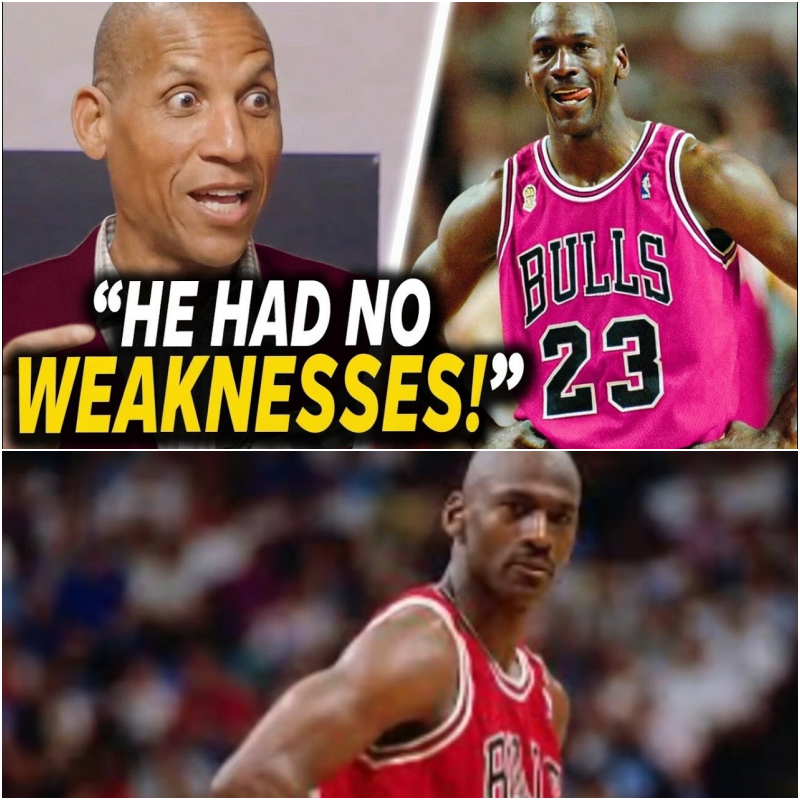
“I found a tell on everyone,” Miller recently admitted, his voice carrying a mix of lingering disbelief and hard-earned respect. “Not him. I could not find a tell. Not one. Damn. There was no weaknesses.”
“Him,” of course, is Michael Jordan.
To hear Miller describe it is to realize that the “Greatest of All Time” debate, which currently rages in barbershops and on social media between the camps of Jordan and LeBron James, often misses the visceral reality of what it was like to stand across from the Chicago Bulls’ number 23. For Miller, Jordan wasn’t just a superior athlete; he was a basketball anomaly—a player who seemed to have been engineered in a lab to eliminate every known human frailty.
The Shaq of Shooting Guards
In the lore of the NBA, Shaquille O’Neal is often cited as the most physically “broken” player in history—a force so massive and powerful that he rendered traditional defensive schemes obsolete. If you were a center in the 1990s, facing Shaq was less of a game and more of a natural disaster you hoped to survive.
Miller posits a terrifying comparison: Michael Jordan was the Shaq of shooting guards.
“I equate it to like this,” Miller said. “Maybe this is how centers feel when they were going against Shaq. He was the Shaq of shooting guards. I don’t care. There was no way you could get around him, in front of him. He was just too strong.”
This is a nuance of Jordan’s game that often gets lost in the grainy highlights of gravity-defying dunks and mid-air contortions. While his grace was poetic, his game was built on a foundation of brutal, unrelenting physical strength. Miller recalls trying every trick in the veteran’s handbook. He tried forcing Jordan left; Jordan scored. He tried forcing him right; Jordan scored. He tried “top-locking” him to deny him the ball; Jordan moved him off his spot. He tried holding, grabbing, and initiating physical warfare.
“You try to be physical with him,” Miller recounted, “and he matched your toughness. If you got physical, he beat you with skill. If you backed off, he scored effortlessly.”
The result was a psychological vacuum. For a player like Miller—a man who built a Hall of Fame career on finding an edge—realizing that your opponent had no edge to give was a form of mental torture. It was basketball’s version of the “Uncanny Valley”: Jordan looked like a man, he moved like a man, but he lacked the predictable failures that define the human experience on a basketball court.
The Myth of the Flaw
The modern NBA fan is accustomed to “flaws.” We live in an era of unprecedented data where every superstar’s kryptonite is charted on a heat map. We know LeBron James has occasionally struggled at the charity stripe. We know Kobe Bryant, for all his brilliance, could be baited into inefficient shot selection. We know Shaq could be sent to the free-throw line to neutralize his dominance.
But Miller’s scouting report on Jordan remains a blank page.
“Go left? Great. Go right? Great. Pull-up jumper? Great. Rebounding? Great. Passing? Great. Toughness? Untouchable,” Miller said.
Even the most difficult shot in the sport—the turnaround fadeaway—was, in Jordan’s hands, a statistical certainty. Miller describes the fadeaway as a “desperate” shot for most, a low-percentage heave born of being trapped. Yet Jordan mastered it to such a degree that defenders were left jumping at shadows. He would elevate to a point where his release was unreachable, hanging in the air as if the laws of physics were merely suggestions he chose to ignore.
The Black Eyes and the Chewing Gum
If the physical dominance wasn’t enough to break an opponent, Jordan’s psychological warfare usually finished the job. Miller, perhaps the greatest trash-talker in the history of the league, met his match in Jordan’s silence and his stare.
There is a specific image Miller conjures: Jordan palming the ball like a tennis ball, holding it inches from a defender’s nose. The tongue would be out, the gum would be moving casually, and those “black eyes”—cold, focused, and utterly devoid of empathy—would be staring right through you.
“He’s taunting you, holding the ball in your face, the tongue is all out… chewing the damn gum,” Miller said. “And then he comes down with those black eyes and looks at you. Most players would have broken under that kind of pressure.”
This was the “Jordan Atmosphere.” It wasn’t just about the points he was scoring; it was about the aura of inevitability he projected. He wanted you to know that he knew exactly how the next forty-eight minutes were going to go, and that your participation was merely a formality. It was a level of confidence that bordered on the sociopathic, designed to make elite athletes feel like children playing a game they didn’t fully understand.
The Survival of the Fittest
Miller’s admission is particularly striking because he was one of the few who didn’t fold. The battles between the Pacers and the Bulls in the late 90s—most notably the seven-game thriller in the 1998 Eastern Conference Finals—are legendary precisely because Miller refused to blink. When Jordan stared, Miller stared back. When Jordan talked, Miller chirped.
“I ain’t going anywhere,” Miller would tell him.
Yet, even with that legendary toughness, Miller admits he eventually had to abandon the idea of stopping Jordan one-on-one. The “hunter” had to become part of a “pack.” He describes the exhaustion of calling for help, looking toward teammates like Derek McKee to build a wall, to double-team, to do anything to just slow the storm.
“Get some help down here!” Miller would yell to his bench. “I’ve been calling you now!”
It is perhaps the ultimate testament to Jordan’s greatness that a player of Miller’s stature—a man who feared no one—is willing to admit, decades later, that he was essentially praying for a miracle every time Jordan touched the ball.
A Different Breed of Greatness
In today’s NBA, where “load management” is a standard business practice and stars are shielded from the grind of the 82-game season, the stories of Jordan’s preparation sound like urban legends. Miller notes the tales of Jordan staying out until the early hours of the morning, playing 36 holes of golf in the blistering sun, and then showing up to the arena to drop 45 points on the best defenders in the world.
It wasn’t that Jordan didn’t get tired; it was that he refused to let fatigue be a “tell.” He viewed any sign of weakness as a surrender, and Michael Jordan did not surrender.
As the game continues to evolve and new superstars emerge with freakish wingspans and three-point range from the logo, Reggie Miller’s testimony serves as a necessary anchor to the past. He reminds us that while talent can be measured in stats, “completeness” is something much rarer.
To Reggie Miller, Michael Jordan wasn’t just the best player he ever faced. He was the only one who left the film room empty-handed. In eighteen years of hunting, Miller found every “tell” in the league—except for the one that belonged to the ghost in the Chicago red jersey.
“There was no weaknesses,” Miller repeated, almost as a mantra. And for those who lived through the Jordan era, no other explanation is necessary.