“Hands Off the Lady ”—Retired SEAL Single Dad Stops a Boardroom Ambush
“Hands Off the Lady ”—Retired SEAL Single Dad Stops a Boardroom Ambush
The crystal chandeliers cast a cold, fractured light across the polished mahogany conference table, their reflections splintering in the dark wood like broken promises. Serena Whitmore stood at the head of the table, her hands flat against the grain, feeling the deep, structural vibration of a trap springing shut.
At thirty-four, Serena possessed a striking, classical beauty that often caused short-sighted men to underestimate her intellect. Her golden hair fell in precise, elegant waves past her shoulders, and today she wore a crimson sheath dress with a sharp V-neck—a deliberate choice that radiated boardroom confidence without an ounce of compromise. For six years, since inheriting Whitmore Holdings at twenty-eight after her father’s sudden passing, she had fought tooth and nail to transform the company from a traditional regional utility into a clean energy powerhouse. She had cultivated a transparent, intensely ethical corporate culture.
But transparency made enemies. Her refusal to play the old games had isolated her, and now, the vultures were no longer just circling. They were in the room.
“Sign the restructuring agreement, Serena,” Damian Cross said, his voice dripping with smooth, predatory patience. At forty, Cross was tall, gaunt, and meticulously tailored in a charcoal suit that perfectly matched the calculation in his gray eyes. As the company’s largest independent shareholder, he had spent eighteen months weaving a web of procedural manipulations, manufactured legal risks, and quiet betrayals. “You are entirely out of options. The board has voted. The transition to a crisis management committee is already underway.”
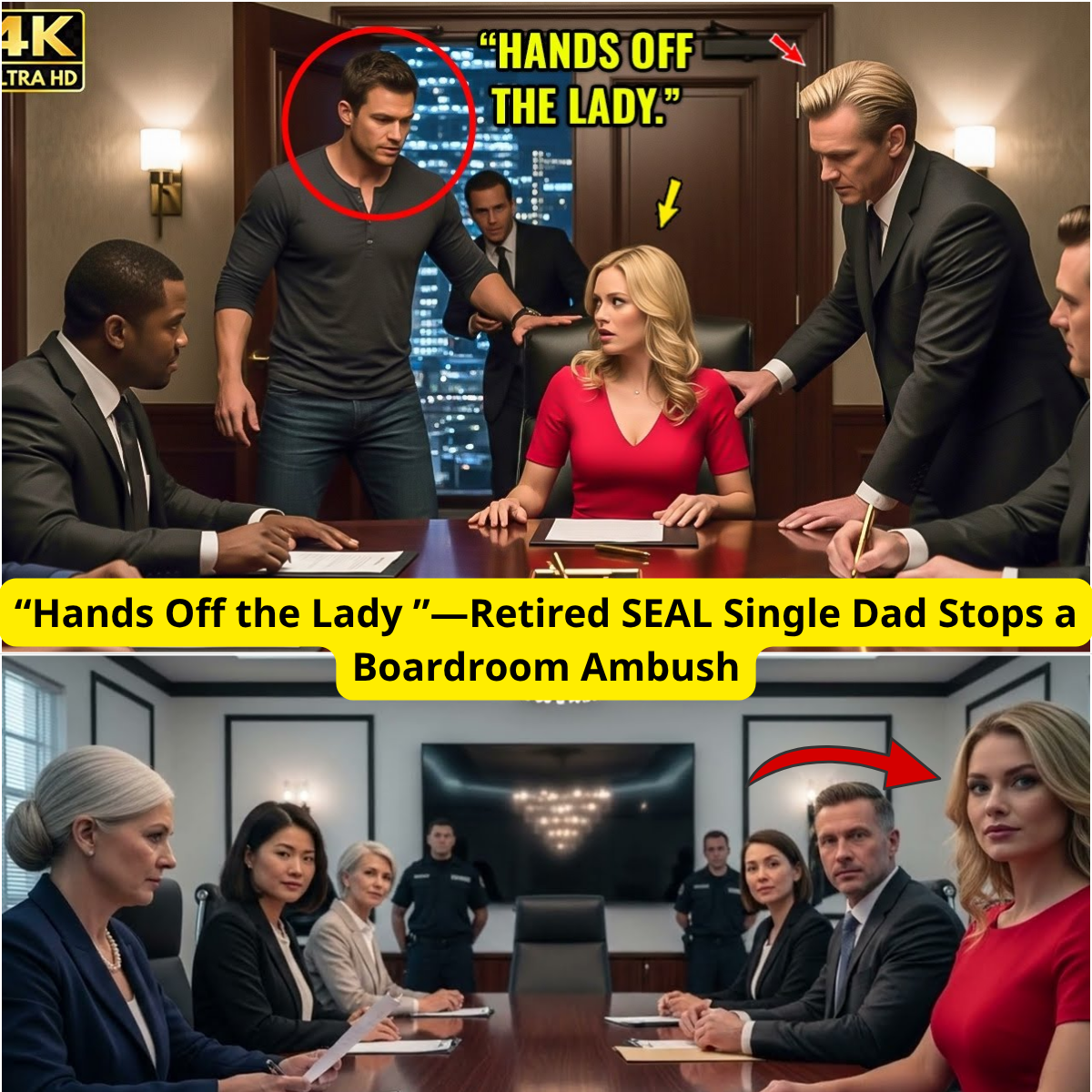
Serena looked around the room. To her left, Henry Caldwell, the internal legal counsel, nervously shuffled a stack of dense documents, his thin face pale but determined to see the coup through. To her right, Vivian Brooks, the CFO, stared blankly at her tablet, her calculated neutrality signaling exactly where the wind was blowing. Even the doors had been locked from the outside by unfamiliar security guards wearing unapproved tactical gear. One by one, the red indicator lights on the corner surveillance cameras had blinked off, systematically blinded by an internal override.
“This contract is an execution warrant for our green R&D sector,” Serena said, her voice remarkably steady despite the fury racing through her veins. “You’re going to strip our patents and sell them to foreign competitors.”
“What I do with the assets once you step down is no longer your concern,” Damian replied, sliding a heavy gold pen across the table. It came to a rest against the white paper like an executioner’s axe. “Sign. Before this becomes unnecessarily public.”
Then, the heavy oak double doors burst open with explosive force.
The sound echoed through the high-ceilinged room like a gunshot, splintering the tense silence. Every head snapped toward the threshold.
Carter Miller stepped through the shattered frame, his broad shoulders easily filling the entryway. At thirty-six, he wore a dark, unassuming security suit, but no civilian tailoring could conceal the lethal, coiled grace of his movements. He was a former Navy SEAL, a veteran of forty-three high-risk combat missions, and his face bore the rugged hardness of a man who had looked into the abyss and forced it to blink. His eyes, cold and sharp as tempered steel, swept the boardroom, instantly cataloging the threats, the sightlines, and the architecture of the room.
He took a single step forward, his boots striking the marble floor with absolute finality.
“Hands off the lady,” Carter said.
The words were spoken slowly, clearly, each syllable dropping with the heavy, undeniable resonance of a hammer striking an anvil. The room froze, suspended between heartbeats, as if the universe itself had paused to see what would happen next.
Two hours earlier, the morning had promised to be entirely routine.
Carter had adjusted his laminated security badge for the hundredth time in the mirrored wall of the ground-floor lobby. Whitmore Holdings towered forty-seven stories above the financial district, a monument of glass and steel reflecting the restless ambition of Manhattan. Carter’s contract here was supposed to be simple—a temporary, low-profile gig providing basic physical security for corporate events while he figured out his civilian life.
Single fatherhood hadn’t been part of the tactical plan when his wife was killed in a car accident two years ago. The tragedy had ripped him from active duty, forcing him to trade hostile territories and midnight extractions for second-grade homework and bedtime stories. His entire world now revolved around his seven-year-old daughter, Audrey.
At 8:30 AM, Carter had dropped Audrey off at the building’s premium childcare center on the third floor—a bright, secure facility filled with books and laughter. Audrey had hugged him tightly around the waist before running off to join a reading circle.
“I’ll be back to pick you up at noon, bug,” Carter had promised, kissing her dark curls.
“I’ll be waiting, Daddy,” she had smiled.
But as Carter began his morning rounds, a familiar, toxic unease started crawling up his spine. It was the exact internal radar he had relied on in the Helmand Province—the distinct sense that the air was thinning right before an ambush. His trained eyes began picking up anomalies that a civilian guard would never notice.
The new security guard stationed at the express elevator bank wore a badge with a font that was slightly off-spec. Another guard down the hall carried a communication earpiece from a different manufacturer than the building’s standard issue. These men didn’t possess the relaxed, watchful stance of professional building security; they moved with the rigid, aggressive confidence of hired muscle.
Following his instincts, Carter slipped into the executive floor’s primary utility and telecom closet. His breath hitched. The screws on the central access panel were freshly scratched. Inside, clean splice marks on the fiber-optic cables revealed that a sophisticated hardware signal jammer had been recently introduced into the building’s infrastructure. Someone was systematically cutting the top floor off from the outside world.
Carter’s mind flashed back to a disastrous mission four years ago in Kandahar. His team had been precisely sixty seconds late to an isolated extraction point—just one minute of hesitation that meant the difference between a successful rescue and finding a dead asset. The crushing weight of that failure had haunted his sleepless nights and ultimately driven him from the teams. He had sworn a solemn oath to himself: Never leave the weak undefended. Never be late again.
The mathematics of risk changed in an instant. He had an objective to secure.
Working with rapid, silent efficiency, Carter traced the spliced wires. He pulled out his rugged smartphone, capturing high-resolution photographs of the illegal hardware modifications. Then, with three precise strokes of his combat knife, he bypassed the jammer, forcing the building’s hardened backup systems to kick in. Deep within the server architecture, the security cameras began to cycle back online, silently routing their feeds to a secure, off-site legal archive.
As he closed the panel, the heavy-set guard with the fake badge appeared in the doorway, his hand reaching for a concealed weapon beneath his jacket.
The confrontation was brief, silent, and devastatingly violent. Carter closed the distance before the man could draw. He utilized a textbook close-quarters combat sequence—a brutal palm strike to the chin, followed by a swift transition into a blood choke. In exactly eight seconds, the mountain of a man went limp. Carter dragged him into the closet, securing his wrists and ankles with heavy-duty zip-ties from his tactical kit. A second guard, coming to investigate the lack of radio response, met an identical fate via a precise pressure-point takedown.
Commandeering the lead guard’s master electronic keycard, Carter bypassed the locked security protocols of the forty-seventh floor. He marched down the executive corridor, his focus locked onto the heavy oak doors of the boardroom.
Now, inside the boardroom, the silence shattered completely.
Damian Cross was the first to recover his composure, his lips curling into a sharp, condescending smile. “I believe you’ve lost your way, officer. This is a private, closed-door session of the board. Temporary security personnel are not permitted within this room. Leave. Now.”
Carter didn’t blink. He didn’t even look at Cross. Instead, he kept his eyes locked on Serena, maintaining a strict professional distance that carried an underlying current of absolute reassurance.
“Ma’am,” Carter said, his voice cutting through the corporate tension. “I have just documented multiple severe physical and digital security breaches within this facility, including active tampering with the primary surveillance network and the presence of unauthorized, hostile personnel on this floor. Under Section 4 of the Whitmore Holdings Corporate Safety Bylaws, any governance meeting conducted under active duress or compromised security parameters must be immediately suspended pending an independent federal investigation.”
Serena’s eyes flared with brilliant, instantaneous comprehension. She recognized the lifeline the moment it was thrown. Rising from her chair with a renewed, commanding authority that seemed to alter the gravity of the room, she slammed her hand onto the table.
“Mr. Caldwell,” Serena said, her gaze pinning the terrified legal counsel. “As our chief legal officer, I am certain you are fully aware that any contracts signed or resolutions passed under an active, documented security compromise are legally null and void from the moment of inception. I am officially motioning for an immediate emergency suspension of this meeting.”
Henry Caldwell’s hands shook, his carefully prepared legal arguments crumbling into dust. “That’s… that’s an unprecedented overreach, Serena! Simple technical glitches with the cameras do not constitute a structural security threat—”
“Technical difficulties don’t usually involve black-market hardware physically spliced into our main communication trunks, Henry,” Carter interrupted conversationally.
He pulled out his phone and tapped the screen. Because he had restored the building’s backup network, his phone seamlessly synced with the boardroom’s massive high-definition presentation display. The crisp, undeniable photographs of the tampered data lines filled the wall.
“Furthermore,” Carter continued, his voice hardening, “the restored system logs indicate that at exactly 2:17 AM this morning, an administrator account pulled a complete, unauthorized duplication of the entire clean energy R&D patent database.”
Liam Torres, the young data engineer who had been brought into the meeting under the guise of an IT adviser, sat up straight, his face filling with sudden courage. “2:17 AM? I’ve been tracking that exact data anomaly for three days! The MAC address of the device that authorized that specific midnight download… it matches the hardware signature of Mr. Caldwell’s corporate laptop.”
The boardroom erupted into absolute chaos. Accusations and frantic denials flew across the mahogany table like shrapnel. Henry Caldwell’s face drained of all color, his voice rising to a panicked squeak as he began babbling incoherently about routine security audits and pre-approved legal archiving.
Vivian Brooks, the calculating CFO who had spent the morning weighing her options, looked at the presentation screen, looked at the terrified lawyer, and immediately chose her side. “If our core intellectual property has been duplicated and compromised outside of encrypted channels, the fiduciary and criminal liability to this board is catastrophic. I am withdrawing my support for the restructuring effective immediately. I demand a full forensic audit.”
With the balance of power tilting decisively toward Serena, Carter stepped up to the table. He produced a encrypted USB drive he had confiscated from the unconscious guard in the closet and plugged it directly into the console.
“Let’s see what else they were planning,” Carter said.
The screen blinked, displaying a series of hidden directories. The files were damning beyond measure. It contained the complete, pre-written script for today’s forced meeting, including predetermined voting outcomes, and most devastatingly, a series of draft contracts with a front-company registered in the Cayman Islands, detailing the multi-billion-dollar sale of Whitmore’s clean energy patents to a hostile foreign conglomerate.
“The timestamps on these drafts match our internal leaks perfectly,” Liam Torres shouted, his fingers flying across his tablet. “This wasn’t a restructuring. This was a coordinated, international corporate espionage plot planned weeks in advance.”
Alexandra Pierce, the elder stateswoman of the board who had remained quiet throughout the morning, slammed her folder shut. Her sixty years of corporate governance lent immense weight to her words. “I have witnessed hostile takeovers in my time, Damian, but this is outright criminal conspiracy to commit wire fraud and grand larceny. The evidence is staggering.”
Seeing his grand architecture collapse into ruins, Damian Cross’s polished corporate mask slipped entirely. His face contorted into a snarl of cold, unadulterated fury. He slowly reached into his breast pocket, pulled out his personal phone, and swiped to a live surveillance feed.
He turned the screen toward Carter.
The blood in Carter’s veins turned to absolute ice. The screen showed a real-time, hidden camera angle of the third-floor childcare center. A man in a dark jacket was standing just outside the glass doors, his eyes fixed directly on seven-year-old Audrey as she colored at a small table.
“Accidents happen in high-rise buildings every single day, Mr. Miller,” Damian whispered, his voice dangerously low, vibrating with absolute malice. “Tragic, terrible accidents. Especially to small children who manage to wander into elevator shafts or secure construction zones because their fathers were too busy playing the hero.”
The temperature in the boardroom seemed to plunge below freezing. Carter’s hands clenched into white-knuckled fists, every lethal instinct honed by decades of black-ops training screaming at him to vault across the mahogany table and crush Damian’s throat. But his tactical mind wrestled the rage into submission. A physical assault right now would jeopardize everything, creating a legal gray area that Cross’s expensive lawyers could exploit. The parameters of the mission had instantly escalated: he had to secure the asset, neutralize the threat, and protect his child.
Before Carter could speak, Serena Whitmore stepped into the line of fire. She pulled out her encrypted personal cell phone and dialed a direct number from memory, placing it on speaker.
“Andrea,” Serena said, her voice cutting through the air like steel. “This is Serena. We have a Code 7 situation initiated in the executive boardroom. There is an active, credible threat against a minor currently inside your facility. Her name is Audrey Miller. Implement the immediate protective protocols.”
A sharp, authoritative female voice responded instantly over the speaker. “Copy that, CEO. Terminating public access to the third floor. Lockdown initiated.”
The name Andrea Collins instantly registered in Carter’s tactical memory. He looked at Serena in shock.
Serena met his gaze, explaining quickly in a quiet, fiercely protective tone, “Andrea Collins is our global director of corporate security. Her late husband was Chief Petty Officer Michael Collins, Navy SEAL Team 4. He was killed in action three years ago. Whitmore Holdings fully funds an independent educational trust for the children of fallen special operators. Andrea knows exactly what it means to protect a warrior’s family, Mr. Miller. Your daughter is entirely safe.”
The revelation completely reframed everything Carter thought he knew about the woman standing before him. Serena Whitmore wasn’t just a corporate executive protecting her profit margins; she was a woman of profound principle, someone who understood sacrifice, honor, and loyalty at a level that transcended the sterile politics of the financial district. Damian Cross’s desperate threat had completely backfired, forging an unbreakable alliance he could never have anticipated.
“Mr. Cross,” Serena said, turning her attention back to the gaunt conspirator, her voice ringing with absolute finality. “You have just openly committed criminal coercion, kidnapping threats, and conspiracy to harm a minor on a fully recorded line. Under our corporate bylaws, any board member placed under active criminal investigation is automatically and immediately recused from all voting privileges pending legal resolution.”
“There is also the matter of the federal ‘Stop the Clock’ provision,” Carter added, his composure entirely restored as he stepped up beside Serena. “When evidence of physical coercion or safety threats is introduced into a corporate governance meeting, any executive member can invoke an immediate emergency freeze pending a federal ethics review. The provision requires a quorum of two board members.”
“I officially second the motion,” Alexandra Pierce said instantly, her voice firm.
“Thirded,” Vivian Brooks added without hesitation.
The very legal machinery that Damian Cross had spent eighteen months trying to subvert had turned into the noose around his neck. Serena activated the emergency recording protocol, locking the minutes of the meeting into an un-tamperable legal ledger.
Carter’s phone buzzed with a secure, encrypted text message from Andrea Collins: Package secure. Two hostile intruders neutralized at the perimeter. NYPD Tactical and FBI field agents are on-site and entering the elevators.
A profound wave of relief washed over Carter, though his face remained an unreadable mask of stone. He looked across the table at Damian, whose phone was now ringing frantically.
“You know, Cross,” Carter said conversationally, his tone deliberately casual. “In my experience, white-collar criminals always forget one fundamental rule of the modern age: once you turn the network back on, everything is a matter of federal record. That shell company you registered in the Caymans? That automatically upgrades this from a state matter to an FBI wire fraud and corporate espionage investigation.”
Damian answered his trembling phone. His personal defense attorney’s voice was loud enough to be heard across the silent room, sounding entirely panicked. “Damian! Don’t say a word! Federal agents just executed simultaneous raid warrants on your home office, your private servers, and your secondary residences! They have everything—”
The heavy boardroom doors opened for the second time that morning.
This time, it wasn’t hired muscle. Six federal agents clad in tactical windbreakers with ‘FBI’ emblazoned in stark yellow letters marched into the room, flanked by armed NYPD officers. They moved with flawless, practiced professional efficiency. Within seconds, Damian Cross and Henry Caldwell were pulled from their executive chairs, their hands secured behind their backs in cold, gleaming steel handcuffs.
Damian Cross, who had walked into the room expecting to steal a clean energy empire, left it in federal custody, facing a litany of charges that would ensure he spent the rest of his natural life in a maximum-security penitentiary. Henry Caldwell wept openly as he was escorted out, his protests regarding attorney-client privilege falling on entirely deaf ears.
The remaining board members sat in stunned silence as the agents began methodically tagging the laptops, tablets, and corporate documents as federal evidence.
Alexandra Pierce stood up, looking at Serena with deep respect. “The emergency ethics committee will convene tomorrow morning to formally strip Cross of his shares under the corporate felony forfeiture clause. Serena, your position as CEO is entirely secure. Congratulations on surviving the wolves.”
Thirty minutes later, the chaotic storm of investigators and corporate advisors had shifted down to the lower floors. Carter slipped out of the boardroom unnoticed. His tactical objective was completed, his temporary contract was technically fulfilled, and he had absolutely no desire to be caught in the media circus that would inevitably descend upon the building.
He stood at the executive elevator bank, waiting for the car to arrive so he could finally collect his daughter.
“Mr. Miller,” a voice called out.
He turned to see Serena Whitmore walking down the corridor. The absolute poise she had maintained during the crisis was still there, but her eyes held a soft, genuine warmth that he hadn’t seen before.
They stood together in front of the mirrored elevator doors—the high-powered billionaire CEO and the scarred, single-father security guard.
“Thank you,” Serena said simply. The words were quiet, but they carried the immense, crushing weight of a life saved and a legacy preserved.
“Just doing my job, ma’am,” Carter replied automatically.
“We both know that’s a lie,” Serena smiled gently, stepping closer. “Your contract didn’t require you to dismantle a sophisticated wiretapping operation, neutralize armed mercenaries, or stand between me and a room full of killers. I read your full security dossier when your agency submitted your application. Former SEAL Team Six, a Silver Star, a Purple Heart. Widowed. Raising a daughter completely alone. Carter… you possess the skills to run global risk conglomerates anywhere in the world. Why take a temporary night-watch contract here?”
Carter looked at his own reflection in the polished steel of the elevator doors, thinking of the quiet promise he had made to Audrey. “Because when you’re running global operations, you’re always on a plane. You’re always tracking threats ten thousand miles away. Sometimes, the smallest perimeters are the ones that matter most. Protecting one person, being there to pick up your kid at noon… that makes more of a difference than commanding an army.”
The elevator arrived with a soft, melodic chime, the doors sliding open to reveal an empty car. Carter stepped inside, turning to face her.
Before the doors could close, Serena reached out, her hand resting firmly against the rubber edge to hold the frame open.
“I’m going to need a permanent Director of Global Security, Carter,” she said, her eyes locked onto his with absolute clarity. “Someone who understands that protecting a multi-billion-dollar clean energy empire means protecting the humanity of the people who build it, not just the physical assets. The position includes a permanent seat on the executive council, an independent educational trust fund for Audrey, and the explicit corporate understanding that your duties as a father always take tactical precedence over your duties to this board. What do you say?”
Carter looked at her, seeing the absolute sincerity, the fierce honor, and the unwavering strength that defined her. He thought of Audrey’s future, of a life where he didn’t have to bounce from contract to contract, and of a purpose that felt aligned with the warrior’s code he carried in his chest.
A small, genuine smile finally broke through his rugged features. “I’ll review the contract clauses, ma’am. But I think we can come to an agreement.”
Serena released the door, her smile mirroring his. “By the way, your daughter is currently down in the main conference room with Andrea Collins. She’s currently commanding a circle of the younger children, reading them an elaborate story about deep-sea extractions and brave ocean sailors. Andrea tells me she’s quite the tactical storyteller.”
As the heavy steel elevator doors began to close, cutting off the top-floor boardroom, Carter caught Serena’s final words echoing through the space.
“Like father, like daughter, Mr. Miller. I’ll see you both tomorrow morning.”