“SIR, CAN WE EAT THE LEFTOVERS?” A Poor Girl Asks — Not Knowing He’s a Millionaire
“SIR, CAN WE EAT THE LEFTOVERS?” A Poor Girl Asks — Not Knowing He’s a Millionaire
Chapter I: The Shadow on the Linoleum
The October afternoon sun had a deceptive warmth to it, the kind that cast long, honey-colored rectangles across the outdoor patio of the Bluebird Café. Located just far enough from downtown Chicago to escape the worst of the sirens, the small street café was alive with the mundane rhythm of a Tuesday lunch hour. Silverware clinked against heavy ceramic plates, espresso machines hissed violently in the background, and laughter floated easily between tables covered in canvas umbrellas.
At a quiet corner table, tucked away behind a large planter of fading geraniums, sat Daniel Carter.
To anyone walking past, Daniel looked like a man who simply had the luxury of time. He wore a well-tailored charcoal blazer, the sleeves casually pushed up his forearms, and a crisp white linen shirt without a tie. At forty-two, he possessed the calm, measured stillness of someone who had already climbed his mountain and didn’t feel the need to shout about the view. He was the founder and chief executive of Carter Vanguard Systems, a data security infrastructure firm valued somewhere north of three hundred million dollars.
Yet, on days like today, Daniel avoided the sleek executive dining rooms on the ninety-second floor of the tower. He preferred the unpolished reality of places like the Bluebird. Here, surrounded by strangers who didn’t want anything from him, he could eat a simple turkey club sandwich, read the financial pages, and watch the everyday architecture of humanity pass by. It kept him grounded; it reminded him of who he had been twenty years ago when his entire net worth was tied up in a secondhand laptop and a stack of overdue utility bills.
He was just lifting his coffee mug to his lips when a faint, sudden shadow fell across the white laminate of his table, blocking out the autumn sun.
Daniel paused, his hand hovering over the mug. He didn’t look up immediately, expecting a hurried waiter or perhaps a patron looking to borrow an empty chair from his table. But the shadow didn’t move. It remained perfectly still, a small, trembling silhouette against the white surface.
Daniel lowered his mug and looked up.
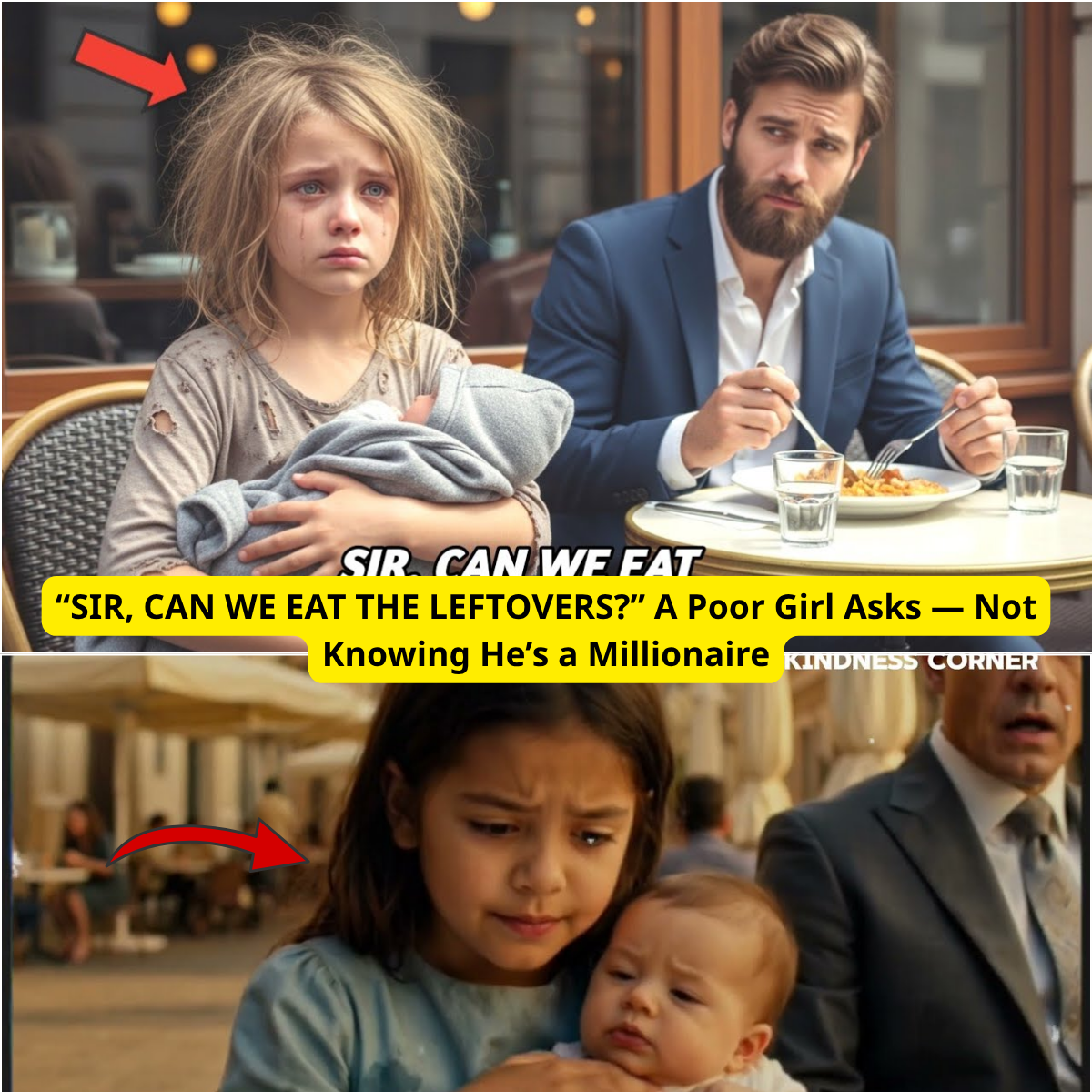
Standing three feet away, right at the edge of his table’s umbrella, was a little girl. She couldn’t have been older than eight. Her blonde hair was a chaotic tangle of knots, looking as though it hadn’t seen a brush in weeks, and her face was smudged with a dark streak of soot along the jawline. She wore a faded red sweatshirt that was three sizes too large for her, the cuffs rolled back into thick, clumsy bundles at her wrists, and a pair of worn canvas sneakers with holes worn straight through the canvas toes. Her eyes were wide, a pale, striking blue, but they were ringed with a heavy, raw redness that spoke of an entire day spent crying in secret.
But it wasn’t her appearance that made Daniel’s breath catch in his throat. It was what she was holding.
Cradled against her small chest, held with a terrifying, protective ferocity, was an infant. The baby was tiny—perhaps two or three months old—wrapped tightly in a thin, pilled cotton blanket that had long since lost its original color. Only a small patch of pink forehead and a tiny, sleeping fist were visible against the girl’s shoulder.
Daniel felt a familiar, defensive instinct click into place. In a city like Chicago, children on the streets were an unfortunate, frequent reality. Usually, they carried cardboard signs or approached tables with small, practiced speeches about bus fare or shelter vouchers. He reached instinctively toward his back pocket, his fingers finding the edge of his leather wallet, preparing to pull out a twenty-dollar bill to give her so she would move along.
But the girl didn’t ask for money.
She didn’t look at his wallet. Instead, her pale blue eyes dropped down to his plate, where the remaining half of his turkey club sandwich sat beside a small pile of potato chips. Her lower lip quivered, a tiny, involuntary movement that she tried desperately to stop by biting down on it.
She swallowed hard, her small chest heaving underneath the oversized red sweatshirt, and spoke in a voice that was barely louder than the hum of the nearby traffic.
“Sir,” she whispered, her hands tightening instinctively around the baby. “Can we eat the leftovers?”
Chapter II: The Desperation of Lily
The ambient noise of the café—the clinking of the forks, the laughter from the corporate group two tables over, the drone of the city bus pulling up to the curb—suddenly vanished from Daniel’s mind. It was as if a vacuum had sealed his table off from the rest of the world.
The girl’s request was simple, almost primitive, but the sheer, raw desperation in her cracked voice carried a structural weight that hit Daniel squarely in the chest. There was no performance here; there was no hustle. It was the absolute edge of human endurance, spoken through the mouth of a child who should have been sitting in a third-grade classroom learning fractions.
Daniel set his fork down slowly, his eyes never leaving her face. “What did you say, sweetheart?” he asked, his voice dropping into a low, gentle register he rarely used outside of his own home.
The girl took a half-step backward, her small shoulders tensing as if she expected him to raise his hand or call for the manager to have her thrown off the property. She looked down at her split sneakers, her voice cracking with an apology that made Daniel’s heart tighten like a fist.
“I’m sorry,” she said quickly, her words tumbling out in a panicked rush. “We haven’t eaten since yesterday morning. My mom is sick, and my baby brother… he’s just so hungry. He won’t stop crying unless he sleeps, and he’s been sleeping too much today. I just thought… if you were done with the bread…”
She didn’t finish the sentence. She just stood there, her small frame swaying slightly from what Daniel now realized was pure, unadulterated exhaustion.
Two tables away, a middle-aged woman in a bright yellow trench coat glanced over, her brow furrowing with a sharp, uncomfortable annoyance. She caught Daniel’s eye and gave a subtle, universal shake of her head—the kind of look that said, Don’t encourage them, they’ll never leave. Further back, a man in a business suit deliberately turned his back to the scene, focusing with intense, artificial interest on his laptop screen.
Daniel felt a cold, hard anger bloom beneath his ribs—not at the little girl, but at the comfortable, insulated world that could look at an eight-year-old holding a newborn infant and see nothing more than an inconvenience to their lunch hour.
He didn’t push the plate toward her. He knew that half a cold sandwich and a handful of stale potato chips wasn’t charity; it was an insult to her dignity. Instead, Daniel stood up.
Lily immediately flinched, her eyes widening in fear as she took another two steps back onto the public sidewalk. “I’m sorry,” she whispered again, her knuckles turning white against the baby’s blanket. “I’ll go.”
“Stay right there, Lily,” Daniel said, his voice firm but entirely devoid of anger. He didn’t know her name yet, but he used the tone of a man who was taking control of a chaotic room. “Don’t move an inch. I’ll be right back.”
Daniel walked briskly inside the café, bypassing the hostess stand and going straight to the main counter. He caught the eye of the head chef, a burly man named Marcus who was working the expo line, and pulled a hundred-dollar bill from his wallet, slapping it flat onto the stainless-steel counter.
“Marcus,” Daniel said, his eyes locked onto the chef’s. “That little girl outside on the patio. I want two orders of the roasted chicken breast, a double order of mashed potatoes, fresh green beans, a loaf of the warm sourdough bread, and a large thermos of warm milk. Right now. Drop whatever else you’re doing.”
Marcus looked at the bill, then out the window at the small, ragged figure standing by the planter. His expression softened. “Give me five minutes, Mr. Carter.”
Chapter III: The Banquet on Elm Street
When Daniel walked back out onto the patio, he carried a high chair from the vestibule in one hand and a tall glass of cold water in the other. Lily was still there, standing exactly where he had left her, looking like a small monument of doubt.
“Sit down,” Daniel said, gesturing to the wicker chair opposite his own.
She looked at the chair, then at her own dusty jeans, hesitating. “Sir, the waiter said I can’t be on the patio unless I buy something.”
“I bought the table, Lily,” Daniel said gently, pulling the chair out for her himself. “Which means for the next hour, this is your house. Sit down.”
Slowly, with a caution that broke Daniel’s heart, the girl slid into the chair. She didn’t let go of the baby; she kept him balanced precariously on her lap, her thin arms forming a protective cradle around him. The movement caused the infant to stir. His small, wrinkled face puckered, and a tiny, weak whimper escaped his lips—a reedy, exhausted sound that confirmed everything Lily had said about their hunger.
Within four minutes, the glass door of the café swung open, and Marcus himself came out, carrying a large oval tray. He didn’t send a busboy. He laid the dishes out with a quiet, professional reverence: two heavy white plates piled high with steaming chicken breast and gravy, a basket of sliced sourdough radiating heat, three small bowls of butter, and a small pitcher of warm milk alongside a sterile plastic cup.
Lily’s eyes grew so wide the pale blue seemed to dominate her entire face. She stared at the steam rising from the gravy as if it were a mirage that would vanish if she breathed too hard.
“Go ahead,” Daniel said, sliding a fork and a linen napkin toward her. “It’s all yours.”
She didn’t eat like a child who had been spoiled by options. She took a piece of the warm bread first, breaking it with her right hand while keeping her left arm locked around her brother. She dipped it into the gravy and put it into her mouth, her eyes closing instantly as she swallowed. A single, large tear broke free from her lower lash, tracking through the dust on her cheek and dropping onto her collar.
She didn’t wolf the food down; she ate with a slow, deliberate reverence, as if her body were absorbing the nutrients in real time. Between every two bites of chicken, she would look down at the baby on her lap, her lips moving in a silent, comforting murmur that only her brother could hear.
“Where is your mom, Lily?” Daniel asked quietly, leaning his elbows on the table, his own food completely forgotten.
“She’s at the apartment,” Lily said, her mouth full of potato. She swallowed quickly, looking guilty for speaking with her mouth full. “It’s not an apartment really. It’s the basement under my uncle’s old shop on 4th Street. It’s got two mattresses on the floor. Mom hasn’t been able to get out of bed since the leaves started turning brown. She used to clean the hotels downtown, but her lungs got real bad. She just coughs and sleeps all day.”
“And your dad?”
“He left before Leo was born,” Lily said simply, nodding down at the baby. “I don’t remember him much. Just that he had a big red truck.”
Daniel listened, his face a calm mask of executive control, but beneath the table, his hands were clenched into white-knuckled fists. He had spent the last ten years of his life analyzing market inefficiencies, structural risks, and system failures. But looking at Lily, he saw the ultimate system failure—an eight-year-old girl serving as the sole logistics manager, caregiver, and provider for a family of three in the middle of one of the wealthiest cities on earth.
Leo began to cry more urgently now, his tiny legs kicking out against the thin cotton blanket. Lily’s face instantly flooded with a deep, maternal panic. She reached for the plastic cup of warm milk, but her hands were shaking too badly to pour it without spilling.
“Let me,” Daniel said.
Chapter IV: The Master Script of the Millionaire
The patrons of the Bluebird Café—the lawyers, the real estate brokers, the local boutique owners—spent the next twenty minutes witnessing a scene that none of them knew how to categorize.
Daniel Carter, a man who regularly negotiated contract terminations with international tech consortiums, took the small plastic cup of warm milk and a small spoon from the waiter. He knelt down on the stone tile of the patio, his gray trousers pressing into the dust, and showed Lily how to tilt the spoon so the baby could take the milk without choking. He didn’t look at his watch once. He didn’t check his phone, which was currently vibrating themselves to death inside his blazer pocket with alerts from his board of directors.
He helped the little girl feed her brother, drop by drop, until the infant’s crying subsided into a long, milky sigh of absolute contentment.
“He likes you,” Lily whispered, her face relaxing into the first genuine smile Daniel had seen. It was a beautiful smile, one that revealed a missing lateral incisor and reminded him that beneath the grime and the terrifying responsibility, she was just a little girl who should have been playing with dolls.
Daniel stood up, wiping the dust from his knees, and looked down at her. The lunch crowd was beginning to thin out, the tables emptying as people headed back to their offices. But Daniel knew his day was entirely rewritten. The master script of his life had just been permanently altered by a single question about leftovers.
He knelt down again, bringing his eyes exactly level with hers.
“Lily,” Daniel said, his voice carrying that absolute, unshakeable certainty that had built his empire. “I want you to listen to me very carefully. You don’t have to look for bread anymore. You don’t have to carry Leo down Elm Street to see if someone leaves a sandwich on a table. Do you understand me?”
Lily blinked, her fork hovering over the remaining pieces of chicken. “Are you going to give me a job, sir? I can wash the dishes. I can clean the floor real good.”
“No,” Daniel said, a small, sad smile touching his lips. “Your job is to go to school. Your job is to learn how to read and play at recess. I am going to take care of the rest.”
She looked at him with a profound, beautiful skepticism—the kind of doubt that only comes from a child who has been lied to by every adult who had ever made a promise. “People don’t just do that,” she whispered.
“I do,” Daniel said.
Chapter V: The Architecture of a Miracle
Within three hours, Daniel’s executive assistant had cleared his entire schedule for the next two weeks.
By 4:00 p.m. that Tuesday, a private medical transport ambulance had arrived at the basement on 4th Street. Lily’s mother, a frail, thirty-two-year-old woman named Sarah who looked like she weighed less than eighty pounds, was gently lifted from her damp mattress and transferred to a private room at Northwestern Memorial Hospital, her admission cleared under Daniel’s personal corporate account. The diagnosis was severe, untreated pneumonia compounded by chronic malnutrition—a condition that would have been fatal within three weeks if Lily hadn’t walked onto the Bluebird patio.
By Thursday, Daniel’s real estate team had located a quiet, two-bedroom apartment in a brick building three blocks from a public park in Lincoln Square. The lease was signed for five years, paid in full in a single wire transfer from the Carter Foundation.
Six weeks later, the morning sun was once again hitting the pavement, but the air had the sharp, clean bite of late November.
Daniel stood by the front gate of the Lincoln Square apartment building, his hands shoved deep into the pockets of his wool overcoat. The door to the building opened, and Lily stepped out onto the concrete path.
She didn’t look like the shadow that had fallen across his table in October. Her blonde hair was clean, brushed into two neat braids that bounced against her shoulders. She wore a bright pink winter coat with a fleece hood, a new pair of blue jeans without holes, and a purple backpack that looked entirely filled with books. Behind her, standing in the doorway, was her mother, Sarah. Her face was still pale, but her eyes were clear, her posture straight, and she was holding little Leo, who had grown two chins and was currently wearing a knitted blue cap that made him look like a small ball.
Lily ran down the path, her new sneakers clicking crisply against the stone. She stopped in front of Daniel, her face bright with a hopeful, electric energy.
“Today is the library day,” she said, her voice clear and strong. “Miss honey said if I finish my spelling words before noon, I can choose three books about space.”
“Three?” Daniel asked, his eyes crinkling. “That sounds like a lot of reading, Lily.”
“I can do it,” she said proudly, squaring her shoulders exactly the way she had done when she was protecting her brother on the street. “I’m the fastest reader in the second row.”
Daniel smiled, reaching out to gently adjust the strap of her purple backpack. “I know you are, sweetheart. Now get going before the bus leaves.”
He watched her run down the sidewalk toward the yellow school bus idling at the corner, her braids flying behind her like pennants. He stood there until the bus had pulled away into the morning traffic, its exhaust forming small white clouds in the crisp November air.
Years later, when Daniel Carter was an old man, having retired from the technology sector and handed his company over to a new generation of engineers, journalists would often ask him about the turning point of his career. They wanted to hear about the venture capital rounds, the initial public offering, or the night his software code had first secured the national banking grid.
But Daniel would always shake his head, his eyes turning toward a small, framed photograph that sat on the center of his mahogany desk—a picture of a young woman with bright blue eyes, wearing a black cap and gown, holding a degree in pediatric medicine from Johns Hopkins University.
“The most important decision of my life didn’t happen in a boardroom,” Daniel would tell them, his voice dropping into that quiet, steady cadence that had always defined him. “It happened at a forty-dollar wicker table on Elm Street, when the world was looking the other way, and a hungry little girl asked me for her dignity. Sometimes, the greatest systems in the world are built by the smallest voices, and all you have to do is be quiet enough to hear them.”