Viral Livestream Clash Over “Judea vs Palestine” Ignites U.S. Firestorm on Identity, History, and October 7
Viral Livestream Clash Over “Judea vs Palestine” Ignites U.S. Firestorm on Identity, History, and October 7
New York City — A tense livestream exchange between an Israeli Jewish commentator and a Palestinian woman living in Jordan has exploded across American social media, turning a short argument about identity into a wider political battle over history, land, indigeneity, and the meaning of belonging.
The clip begins almost casually. A young woman says she lives in Jordan, was born there, and that her parents were also born there. But when asked where her grandparents were from, she says Palestine. The Israeli speaker immediately presses the issue: if generations can pass outside the land and a person still remains Palestinian by origin, why should Jews not also retain their ancestral claim after centuries of exile?
That question becomes the center of the entire exchange.
“There is a difference between nationality and originality,” the woman says.
The Israeli speaker seizes on the line. If originality matters for Palestinians, he argues, it must also matter for Jews. If a Palestinian family in Jordan can still claim emotional and historical origin in Palestine, then Jews, whose collective memory, language, religious tradition, archaeology, and national story are tied to Judea, can also claim origin in that land.
For American viewers, the clip has become more than another Israel–Palestine argument. It has become a test case in narrative consistency.
On campuses, in podcasts, in political debates, and across TikTok and YouTube, the word “indigenous” has become one of the most powerful weapons in the Israel–Palestine discourse. Pro-Palestinian activists often frame Palestinians as the indigenous people of the land and Zionism as a settler-colonial project. Pro-Israel voices respond by arguing that Jews are not foreign to the land but are themselves an ancient people rooted in Judea, expelled, scattered, and repeatedly attacked across history.
The livestream throws that argument into raw street-level language.
The Israeli speaker insists that Jewish identity is not merely a religion. He argues that Jews are a people, an ethnicity, a civilization, and a nation descended from the tribes of Israel. A Jew, he says, remains a Jew even without religious belief, just as a Palestinian may claim Palestinian origin even if born in Jordan.
The Palestinian woman challenges him. She questions the proof. She argues that many peoples have lived in the land and that names, borders, and populations have changed over time. She laughs at his certainty and resists the idea that ancient history alone settles modern political rights.
That is where the conversation becomes heated.
The Israeli speaker turns to the name Palestine, arguing that before the land was called Palestine, it was Judea, and that the Roman renaming was part of an imperial effort after Jewish revolts. He claims Palestinians pronounce the name as “Falastin” because Arabic lacks the “P” sound, using that as a rhetorical jab to suggest the name came from outside the Arabic language.
Historians would put this more carefully. The name Palestine has ancient roots, was used by Greeks and Romans, and later entered Arabic usage as Filastin. But the speaker’s broader point is clear: he is arguing that Palestinian identity, as a modern national identity, should not erase the older Jewish connection to Judea.
That claim has outraged pro-Palestinian viewers, who say it dismisses the lived reality of Palestinians, including families displaced in 1948 and refugees whose identity has persisted for generations across Jordan, Lebanon, Syria, Gaza, the West Bank, and the wider diaspora.
But it has energized pro-Israel viewers, especially in the United States, who argue that Palestinian advocates often demand permanent recognition of Palestinian refugee identity while denying Jews the same historical continuity.
The debate then shifts to October 7.
The Palestinian woman says Israel is not peaceful and argues that Israel’s response in Gaza has been worse than the Hamas attack. The Israeli speaker rejects what he sees as a false moral balance. He says war is not a competition of exact numbers. In his framing, after a massacre, a state does not respond by counting bodies proportionally. It responds by eliminating the threat.
That line has become one of the most clipped parts of the video.
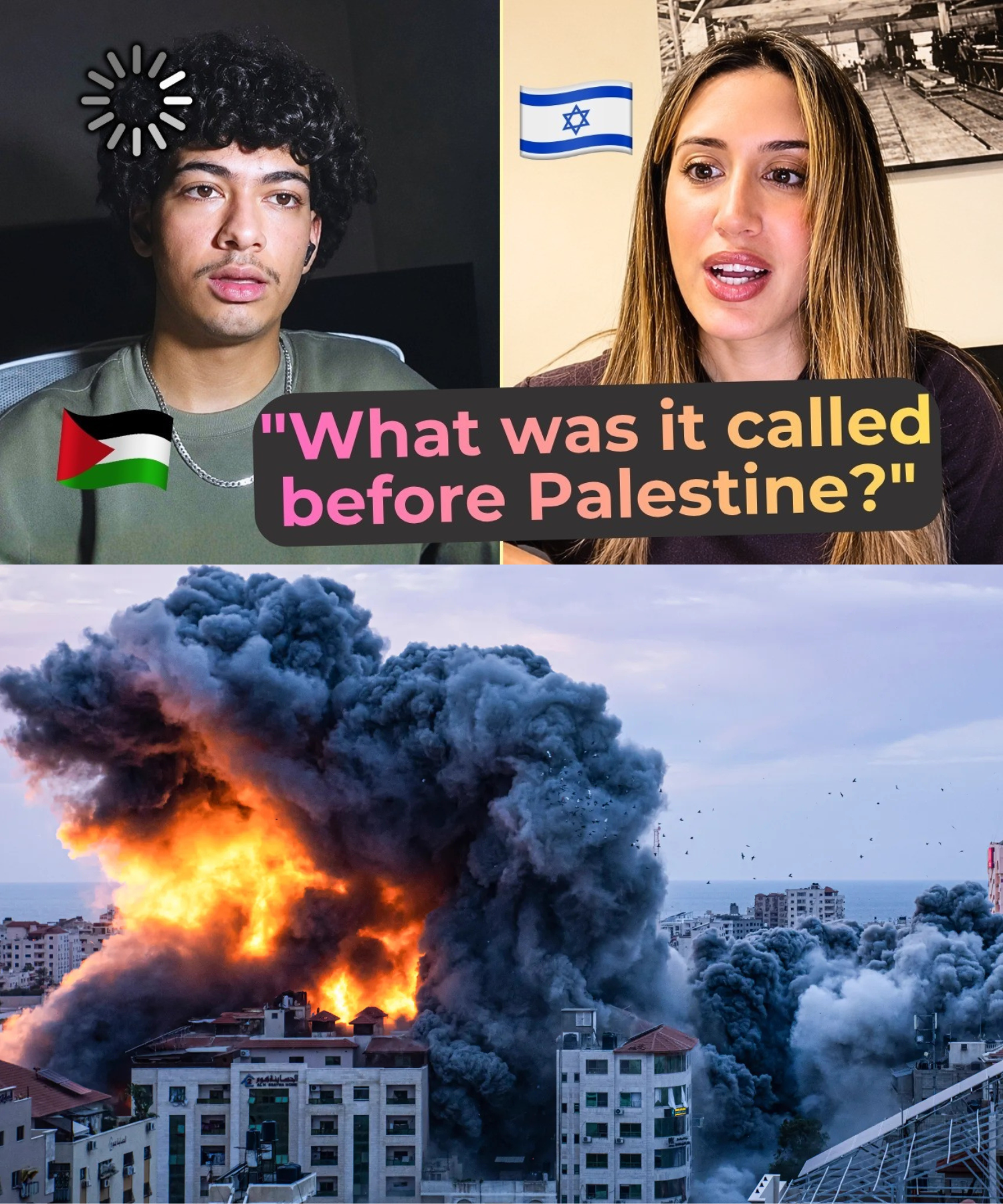
Supporters say it captures the reality of war: Israel’s objective after October 7 is not revenge by arithmetic, but the dismantling of Hamas’s capacity to repeat the attack. Critics say this logic risks justifying overwhelming force against civilians and ignores the humanitarian devastation in Gaza.
The clip therefore lands directly in the middle of America’s most bitter foreign-policy fight.
Jewish Americans watching it hear an argument about survival: if someone enters your home, kills your family, and takes hostages, you do not search for a “peaceful option” while the attacker remains armed. Palestinian Americans hear something different: a defense of a war that has devastated Gaza and displaced vast numbers of civilians.
Neither side sees the same clip.
That is the deeper crisis.
The video shows how the two national narratives are no longer merely competing. They are speaking different languages. For one side, the land is Judea, the place where Jews come from, where Hebrew was born, where Jewish kings ruled, where temples stood, and where exile never erased origin. For the other side, the land is Palestine, the place of grandparents, villages, olive trees, homes, maps, keys, memory, and loss.
Both stories are powerful.
Both are incomplete without the other.
But in the online arena, complexity rarely survives.
The Israeli speaker pushes hard, sometimes dismissively, arguing that Palestinians do not have a distinct identity separate from Arabs or Jordanians. That claim is politically explosive and deeply disputed. Palestinian national identity is real to millions of people and has been shaped by displacement, resistance, family memory, and political history. To deny it outright is to inflame the very conflict one claims to explain.
At the same time, the Jewish claim to peoplehood and indigeneity is also real and historically grounded. Jews are not merely adherents of a religion floating outside geography. Jewish memory is tied to land, language, calendar, pilgrimage, scripture, archaeology, and exile. To deny that connection is also to inflame the conflict.
That is why this clip matters in America.
The United States is now the global stage where these narratives battle for moral legitimacy. On university campuses, slogans like “from the river to the sea” collide with Jewish fears of erasure. In synagogues, families debate whether the world understands Jewish history at all. In Arab and Muslim communities, Palestinians ask why their dispossession is treated as secondary. In Congress, aid, ceasefire demands, recognition of statehood, and antisemitism hearings all orbit the same unresolved question:
Whose story counts?
The livestream offers no peace plan. It offers no diplomatic solution. It does not answer borders, sovereignty, refugees, settlements, Gaza’s future, or Jerusalem.
But it reveals the emotional engine beneath all of those issues.
Land is never just land.
It is origin. It is memory. It is grief. It is pride. It is proof of existence.
That is why a young woman in Jordan can say she remains Palestinian through her grandparents. That is why a Jew whose grandparents lived in Yemen after exile can say he comes from Judea. Both are reaching backward to explain who they are now.
The danger is when one side uses its own memory to cancel the memory of the other.
That is exactly what American observers are now confronting. If Palestinian origin matters, Jewish origin cannot be mocked as fantasy. If Jewish indigeneity matters, Palestinian identity cannot be dismissed as meaningless. Any future worth imagining must somehow hold both truths without letting either become a weapon of erasure.
The viral debate ends without agreement.
But it exposes the rawest question in the conflict:
Can two peoples rooted in the same land tell their stories without denying each other’s right to exist?
For now, online America is still fighting over the answer.