Why Did Jesus Fold The Burial Cloth After The Resurrection?
Why Did Jesus Fold The Burial Cloth After The Resurrection?
The heavy limestone door had already been rolled away, but the darkness inside the tomb still clung to the edges of the morning.
Thomas stepped through the narrow entrance, his sandals kicking up a fine layer of Judean dust. Outside, the early sun was just beginning to burn through the mist over Jerusalem, but inside, the air was cold and smelled faintly of vinegar and dried aloe.
He didn’t know what he was looking for. He hadn’t believed Mary Magdalene when she came bursting into the upper room, breathless and sobbing about a stolen body. He hadn’t entirely believed Peter or John either, even after they ran to the garden and came back with wild, wide-eyed expressions, muttering about linen wrappings. Thomas was a pragmatist. He lived in a world of physical weights, architectural lines, and undeniable facts. If a man died under the systematic brutality of a Roman crucifixion, that man stayed in the dirt.
Yet, here he was, drawn to the empty sepulchre by an itch he couldn’t scratch.
He stopped in the center of the chamber. His eyes adjusted to the gloom, tracking the rough-hewn contours of the stone shelf where they had laid the broken body of Jesus just two days prior.
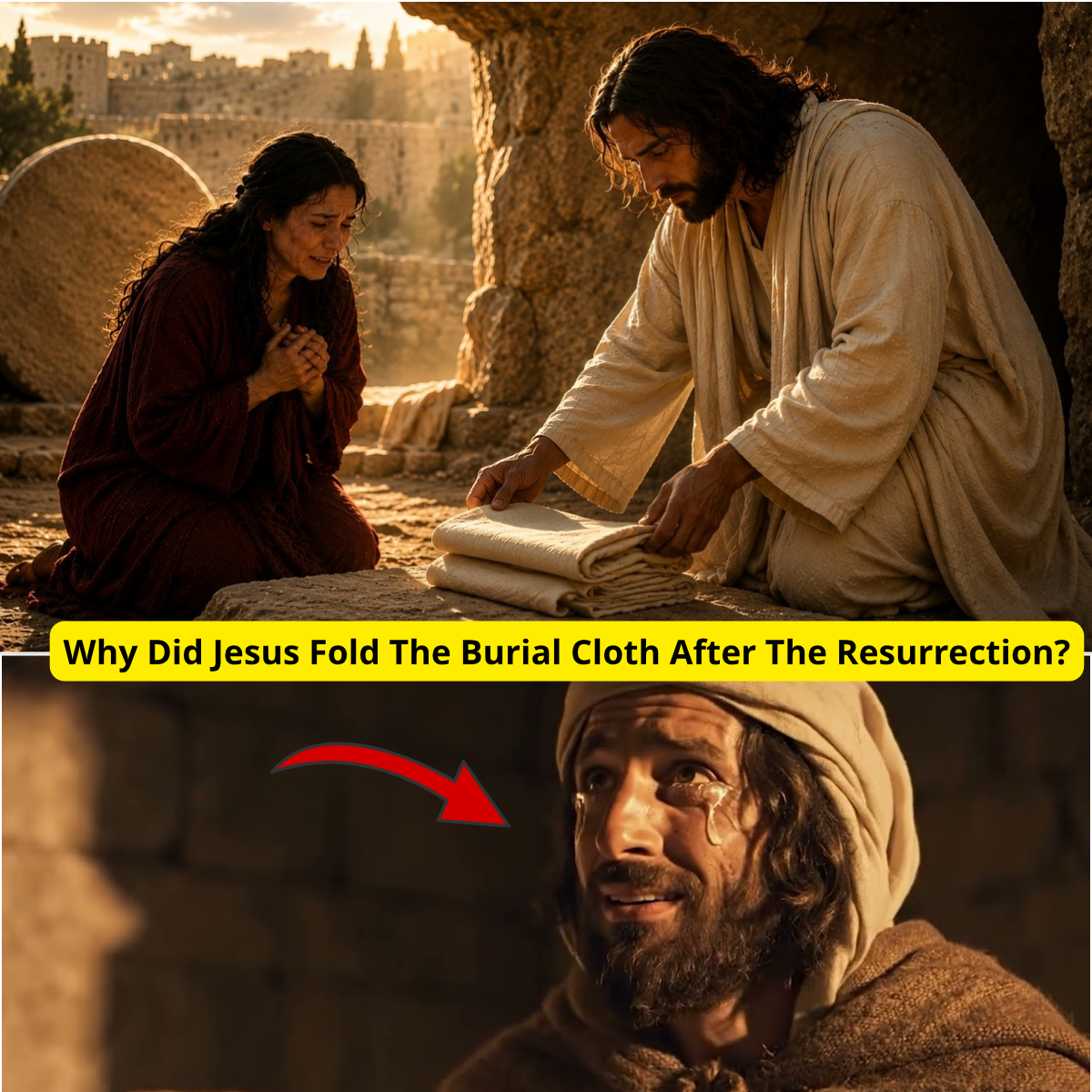
The shelf was empty. But it wasn’t bare.
Lying on the cold stone were the linen shroud and the binding strips—the othonia. Thomas walked closer, his breath catching in his throat. He reached out a hesitant, calloused hand, his fingers hovering just millimeters above the cloth. He expected to see a tangled mess, the frantic, discarded rags of grave robbers who had torn the burial garments away to steal the body or the expensive spices packed within them.
Instead, the linen strips were lying in an undisturbed, hollow shell. The heavy layers of fabric, stiffened and cemented together by seventy-five pounds of dried myrrh and aloes brought by Nicodemus, still retained the precise shape of a human torso. It looked exactly like a cocoon from which the living tenant had simply evaporated. The wrappings hadn’t been unrolled or slashed with a knife; they had merely collapsed inward under their own weight once the physical form inside vanished.
Grave robbers would have taken the clothes with the body, or at least hacked through the valuable linen to scrape out the costly spices. No thief, no matter how disciplined, would have spent hours carefully extracting a corpse from a hardened, aromatic cast without disrupting its external structure.
Thomas stared at the empty shell of linen, his mind racing through a dozen logical inconsistencies. But then his gaze shifted toward the head of the stone bench, into a small, separate niche cut into the limestone wall.
There, sitting entirely by itself, was the sudarium—the smaller linen cloth that had been wrapped around the face and head of the dead master.
It wasn’t collapsed. It wasn’t tossed into a corner. It had been folded neatly, with sharp, deliberate creases, and set carefully aside in a designated place.
Thomas stared at the folded cloth, and suddenly, the cold stone of the Roman tomb faded away. His mind was violently pulled back to a completely different room, a completely different table, and a tradition he had witnessed every single day of his life.
The Master’s Table
To understand why Thomas froze at the sight of a piece of folded linen, one had to understand the unspoken language of a first-century Jewish household.
In the villages of Galilee and the bustling quarters of Jerusalem, the relationship between a master and his servant was governed by strict social codes, but none was more intimate or expressive than the ritual of the dining table. Before a meal began, the servant would place a clean linen napkin beside the master’s plate. Throughout the dinner, the master would use the cloth, but its final placement at the end of the evening carried an absolute, undeniable message.
If the master finished his meal, stood up, and casually crumpled the napkin before tossing it onto the table, the message was clear to every servant watching from the shadows of the kitchen: The meal is finished. The table can be cleared. I am done here, and I am not coming back.
But if the master rose from the table, took the linen napkin, and took the time to fold it neatly, smoothing out the wrinkles with his fingers before setting it in a separate, clean spot beside his plate, the servant knew one thing with absolute certainty:
The master is not finished. He has merely stepped away. Do not clear the table. Do not close the house. Do not assume the evening is over. The master is coming back.
Thomas stood in the damp silence of the tomb, his heart hammering against his ribs like a trapped bird. The realization hit him with the force of a physical blow.
The resurrection morning could have been an event of pure, chaotic power—a shattering of stone, a blinding light, a frantic escape from the jaws of death. But the folded cloth told a completely different story. It spoke of an unbelievable, shocking serenity.
The one who had conquered the grave hadn’t burst out of his wrappings in a panic, gasping for air like a man who had barely survived a disaster. He hadn’t fled the tomb in terror of the Roman guards outside. The King of Kings, after tearing through the fabric of mortality and stepping out of the hardened shell of his burial clothes, had stood up in the dark, quiet sanctuary of the tomb. He was entirely in command of the cosmos, yet he had taken a brief, deliberate moment to reach down, take the cloth that had covered his bloodied face, and fold it with sharp, elegant precision.
He had left a message in the language of his people. He had left a love letter written in linen for the very first eyes that would dare to look into the darkness.
I am not finished, the cloth whispered from the stone shelf. The table is still set. I am coming back.
The Precision of Witnesses
Thomas stepped back from the shelf, his hands trembling. He remembered how John had described entering the tomb just an hour earlier. John had told them that he saw and believed, but at the time, Thomas had dismissed it as the emotional hysteria of a grieving young man. Now, looking at the exact arrangement of the othonia and the separate, folded sudarium, Thomas understood the precision of John’s account.
The Gospel writers didn’t invent these details. A fabricator attempting to create a myth of a risen god would have focused on the cosmic theater—the thunder, the lightning, the visible ascent into the clouds. No one inventing a religion would stop to write down a domestic detail about laundry. The only reason a writer would record the specific placement of a folded face-cloth is if he had physically stood in the room, smelled the mixture of aloe and damp stone, and seen it with his own bare eyes.
John had used three distinct Greek words in his recollection of that morning, a progression of human sight that Thomas was now experiencing firsthand.
First, there was blepo—the simple, superficial glance John had cast into the tomb from the outside entrance, seeing nothing but the outline of clothes. Then came theoreo—the careful, sustained scrutiny Peter used when he marched past John into the chamber, examining the collapsed shell of the wrappings and marveling at the impossibility of it. And finally, there was eidon—the sight that leads to internal comprehension, the moment where the external data connects with the soul.
Thomas was experiencing his own eidon now. He wasn’t looking at a crime scene; he was looking at an announcement.
He thought of the forensic reality of the cloth itself. Decades later, traditions would whisper of the Sudarium of Oviedo in northern Spain and the Shroud of Turin, ancient linens preserved through centuries of war and empire because of the mysterious, anatomical blood patterns scorched into their fibers. Experts would analyze the AB blood types, the rare pollens from the Jerusalem hills, and the three-dimensional reliefs captured on the top fractions of a millimeter of the fabric.
But Thomas didn’t need future science. He had the immediate, cultural testimony of the first-century table.
He leaned against the cold limestone wall, the weight of his own cynicism crumbling around him. For three years, he had watched Jesus feed thousands, heal the blind, and command the wind and the waves. Yet, when the darkness of Friday had fallen over Golgotha, Thomas had allowed the sheer horror of the cross to wipe out his memory of the promises. He had assumed the meal was over. He had assumed the Roman Empire had crumpled the napkin and thrown it across the table of history.
But the Master had folded it himself.
Between the Cloth and the Return
The sun was higher now, casting a bright, golden beam through the entrance of the tomb, illuminating the dust motes dancing in the air. Thomas looked from the empty linen shell to the neatly folded face-cloth one last time before turning toward the exit.
He walked out into the garden, the cool morning air sweeping over his face. He knew his journey wasn’t over. He knew he would still struggle, that his pragmatic mind would still demand to touch the wounds in the Master’s hands and side before his faith became absolute. The theology would take time to catch up with the reality.
But as he walked back toward the city walls to join the other disciples, the suffocating grief that had weighed him down for forty-eight hours had vanished.
He realized the precise moment in history where he—and every person who would follow the story for the next two thousand years—now existed. They were living in the grand, expectant space between the folded cloth and the Master’s return.
The ascension would eventually come, and the angels would echo the exact promise left on the stone shelf: “This same Jesus, who has been taken from you into heaven, will come back in the same way you have seen him go.” The church would face persecution, empires would rise and fall, and generations would wake up in the dark mornings of their lives wondering if the promise was real.
But the napkin was still folded. The table had not been cleared. The house was not closed.
Thomas picked up his pace, a sudden, urgent energy flooding his limbs. He didn’t look like a man mourning a dead teacher anymore; he looked like a servant who had seen the sign, a servant who knew that the evening wasn’t over, and that at any moment, the footsteps of the Master would echo in the garden once again.