How Christianity Is Different From Every Religion
How Christianity Is Different From Every Religion
In an era defined by a dizzying marketplace of ideas, philosophies, and spiritual paths, modern seekers face an unprecedented conundrum. Confronted with a vast array of religious traditions, the contemporary mind often defaults to a comfortable pluralism—the idea that all faiths are essentially distinct paths climbing the same spiritual mountain. From a distance, the major world religions do seem to share common terrain: they encourage ethical behavior, promote charity, and offer a framework for understanding the transcendent.
Yet, beneath this surface-level harmony lies a radical divergence. While most global faiths operate on a familiar architecture of human effort, Christianity flips the entire structure on its head. The ultimate distinction of the Christian faith does not lie in its moral codes, its rituals, or even its devotion. It lies in a fundamental asymmetry regarding how a human being relates to the Divine—an asymmetry beautifully illustrated by a simple story about an apple cake, and anchored not in abstract mythology, but in the gritty arena of ancient history.
The Merit Trap: The Architecture of World Religion
To understand what makes Christianity unique, one must first look at the structural blueprint that governs almost every other religious system. Whether examining ancient polytheism, Eastern philosophies, or the great monotheistic traditions of Judaism and Islam, a consistent, universal pattern emerges.
Imagine this pattern as a journey. A person begins at an initiation point—perhaps a ritual performed in infancy or a conscious decision made in adulthood. Once inside the door, they find themselves on a long, winding, and often tumultuous path. This path represents the lifespan of the believer, characterized by a series of peaks and valleys, moral triumphs, and spiritual failures.
At the very end of this long highway sits a massive gate, and above that gate hang the scales of justice. Beyond the gate lies the ultimate goal: Heaven, Paradise, Nirvana, or eternal enlightenment.
For the vast majority of the world’s religions, the principle that determines whether that gate opens is simple: merit.
[Entrance] ------> (The Wavy Path of Life: Deeds & Rituals) ------> [The Scales of Judgment]
Under this system, the spiritual life is a lifelong university enrollment. You pass the entrance exams, you attend the lectures, and you study the texts under the guidance of wise professors, gurus, or imams. But no matter how benevolent your teachers are, none of them can guarantee you a degree on your first day of class. Why? Because acceptance comes at the very end, based strictly on a final assessment. On that day of judgment, your good deeds must outweigh your bad deeds. You must hope that your adherence to the law, your charity, and your rituals have been sufficient to tip the scales in your favor.
The inevitable psychological byproduct of this structure is chronic uncertainty. Under a merit-based system, no adherent can ever truly say, with absolute certainty, that they are accepted by God today. The final verdict is perpetually deferred to the end of the road.
Flipping the Script: Acceptance at the Beginning
It is precisely against this universal backdrop of human effort that Christianity drops its most radical bomb. If the definition of religion is a system where acceptance comes at the end based on an assessment of merit, then Christianity, strictly speaking, is not a religion at all. It is a relationship.
In the Christian framework, the entire timeline of salvation is reversed: acceptance comes at the very beginning of the journey, not at the end.
This radical shift changes everything. The Christian message asserts that Jesus of Nazareth did not come into the world merely to give humanity a new set of rules, a better textbook, or a more rigorous ethical code. Instead, he came to announce that the final exam had already been taken—and aced—by someone else.
According to Christian theology, human beings are trapped in a state of moral insolvency, consistently falling short of the perfect holiness required to coexist with a perfect God. Because humanity cannot scale the mountain to reach the Divine, the Divine descended the mountain to reach humanity. Through his life, death, and resurrection, Jesus absorbed the moral debt of mankind, offering an absolute pardon as a free gift.
Therefore, when a person places their trust in Christ, they do not start a long climb to earn God’s favor. They receive God’s full favor at the starting line. They do not work for forgiveness; they work from forgiveness. The pressure of the final exam is entirely removed, replaced by the security of an unshakeable adoption.
The Analogy of the Cookbook
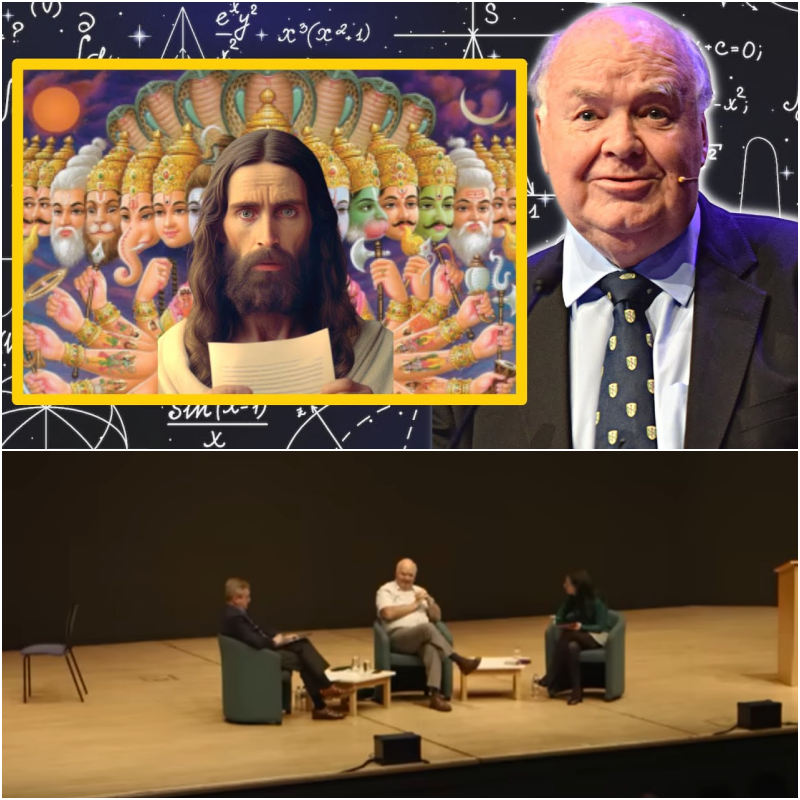
The profound difference between these two worldviews is often best understood through the lens of human relationships. Consider an analogy popularized by the eminent Oxford mathematician and Christian philosopher John Lennox.
Imagine a man who meets a woman in university and decides he wants to marry her. He approaches her with a beautifully wrapped package. Inside is a pristine, comprehensive cookbook. He opens it to page 147—a recipe for apple cake—and lays down the law:
“I would like to marry you,” he says. “But here are the conditions. This recipe requires exactly so much flour, so much sugar, and so many apples. If you closely follow these rules and bake this cake perfectly for the next forty years, I will think about accepting you as my wife. If you fail, you can go back to your mother.”
To any modern audience, this scenario is not only absurd; it is deeply insulting. No self-respecting human being would ever base a lifelong, intimate relationship on a continuous trial of domestic merit. We recognize instinctively that true love and intimacy cannot function under the looming threat of eviction or conditional acceptance.
Yet, this absurd cookbook scenario is exactly how millions of people view God. They imagine a deity standing over them with a cosmic recipe book, arms crossed, waiting to see if their performance over forty or fifty years will finally render them worthy of love.
In a healthy marriage, a spouse does not cook, clean, or show affection in order to gain acceptance. They do those things because they already have it. The security of the marriage covenant is the very engine that fuels the desire to please the other person. This is the heart of the Christian distinction. The good works, the moral living, and the charity of a Christian are not a frantic attempt to tip the scales of judgment; they are a joyful, spontaneous expression of gratitude for a relationship that is already secure.
A Faith Rooted in the Dirt of History
To the modern skeptic, this concept of unconditional grace may sound beautiful, even poetic. But beauty alone does not make something true. A comforting story remains a myth unless it is tethered to reality. This brings us to the second major differentiator of Christianity: its insistence on historical verification.
Many ancient religions and modern philosophies are built on a foundation of timeless, abstract ideas. If you were to prove that the figures in their foundational myths never actually existed, the core teachings of those philosophies would remain largely intact. The ethics would still be good; the meditations would still be peaceful.
Christianity enjoys no such luxury. It is a faith that intentionally paints a target on its own back by rooting its validity entirely in historical fact. As the Apostle Paul famously wrote in his first letter to the Corinthians:
$$\text{If Christ has not been raised, our preaching is useless and so is your faith.}$$
Christianity does not ask for blind faith—a phrase often popularized by secular critics to describe believing in something despite a total lack of evidence. Rather, it demands an evidence-based faith.
When the author of the Gospel of John concluded his account of Jesus’ life, he explicitly stated that he had recorded specific, physical “signs” so that his readers might believe based on testimony. John was not writing a theological fantasy or compiling a canonical book for a future global religion; he was an eyewitness recording historical events for a contemporary audience.
The central claim of Christianity—the resurrection of Jesus—is a forensic riddle that invites investigation. Unlike scientific evidence, which relies on repeatable experiments in a controlled laboratory, historical evidence relies on the evaluation of documents, eyewitness consistency, and the psychological transformation of historical figures.
Consider the raw historical data:
A Jewish teacher is publicly executed by the Roman Empire.
He is buried in a guarded, known tomb.
Three days later, that tomb is empty.
Within weeks, his demoralized, terrified disciples suddenly transform into courageous modern martyrs, proclaiming they have seen him alive.
Skeptics and fierce enemies of the movement, such as James the brother of Jesus and Saul of Tarsus, suddenly convert and gladly face execution for this claim.
To dismiss these accounts out of hand simply because they involve a supernatural event is not objective historical inquiry; it is a philosophical prejudice. If one approaches the New Testament texts with the same historiographical tools used to study the exploits of Alexander the Great or Tiberius Caesar, one finds a body of historical evidence that is staggeringly robust.
The Echo of the God-Shaped Hole
Ultimately, the unique architecture of Christianity addresses a fundamental human ache that no other system can satisfy. The French philosopher Blaise Pascal famously observed that there is a “God-shaped vacuum” in the heart of every human being—a deep, persistent longing for something more than this material world can offer. We catch glimpses of it when we experience breathtaking beauty, when we fall in love, or when we face the stark reality of our own mortality.
Other worldviews attempt to fill this void by giving humanity a shovel and telling them to dig their way to heaven through ritual, intellect, or moral rectitude. Christianity looks at our broken shovels, steps into the trench with us, and offers a hand to lift us out.
By combining rigorous historical evidence with a radical, upside-down message of unconditional grace, Christianity offers something entirely distinct from the religious status quo. It transforms the divine-human dynamic from a terrifying employment contract into a secure, lifelong adoption. It invites the skeptic to stop running on the treadmill of religious merit, to examine the historical ledger, and to step into a relationship where acceptance is not the prize at the end of the race, but the gift that empowers you to run.









