Unidentified Creatures Filmed Deep in Remote Forests
Unidentified Creatures Filmed Deep in Remote Forests
The human mind has an insatiable hunger for the unexplained, a deep-seated need to populate the dark, empty spaces of our world with monsters. Across every continent, isolated communities and vast wildernesses have given birth to legends that blur the thin line between biological mystery and psychological projection. These creatures—collectively known as cryptids—represent the ultimate intersection of local history, environmental anxiety, and our enduring fascination with what might be lurking just beyond the edge of our campfires.
1. The Jersey Devil: The Curse of the Pine Barrens
Deep within the densely forested coastal plain of southern New Jersey lies a million-acre expanse of pitch-black rivers, dense pitch pines, and heavy silence known as the Pine Barrens. For over three centuries, this isolated wilderness has been the undisputed domain of the Jersey Devil, a chimeric entity tightly woven into early American history.
The Legend of Mother Leeds
Unlike many monsters born from modern sightings, the Jersey Devil boasts an origin story deeply rooted in colonial folklore. Local history traces the creature back to 1735 and a woman known as Mother Leeds. Plagued by poverty and already burdened with twelve children, Leeds discovered she was pregnant for a thirteenth time. In a moment of sheer desperation and exhaustion, she cried out, “Let this child be the devil!”
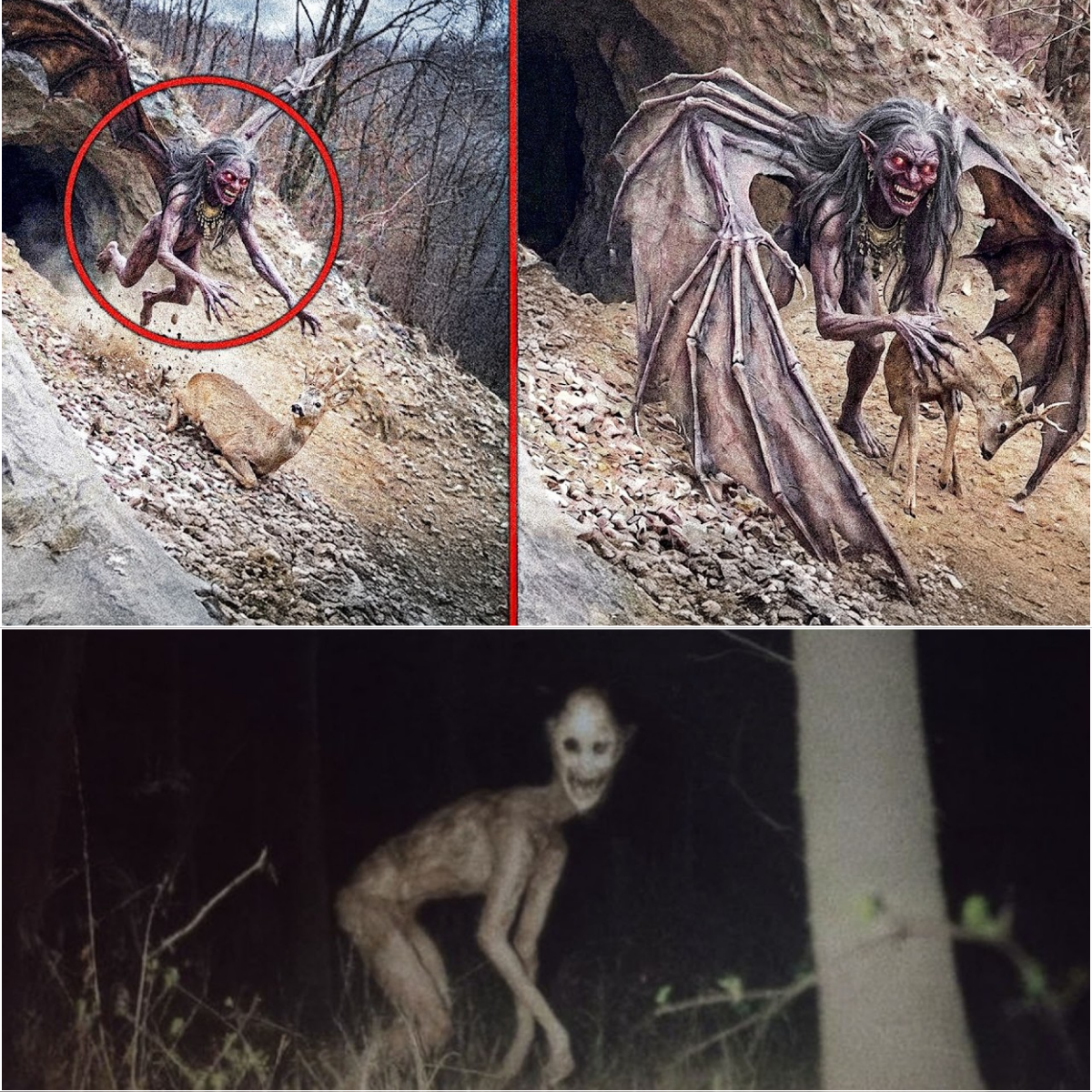
When the winter night of her labor arrived, the child initially appeared completely normal. However, within moments of entering the world, the infant began to transform. It rapidly sprouted hooves, a horse-like head, massive bat wings, and a thin, thrashing snake’s tail. The newly christened “Leeds Devil” viciously attacked the room’s occupants, let loose a piercing shriek, and flew directly up the chimney, escaping into the dark swamplands to terrorize generations to come.
Historical Sightings and Panic
The Jersey Devil is not just a bedtime story; it has repeatedly caused widespread civic panic. The most notable wave of sightings occurred during a single week in January 1909. Thousands of people across New Jersey and Pennsylvania claimed to encounter the beast.
Public Closures: Schools closed their doors, factories stood entirely empty as workers refused to leave their homes, and armed vigilante groups patrolled the edges of the woods.
Physical Evidence: Police officers reported shooting at the creature, claiming the bullets bounced off its hide, while streetcars in Bristol, Pennsylvania, were allegedly attacked by a flying, winged beast matching its exact description.
Decades later, newspaper reporters continued to document bizarre occurrences. On July 27, 1937, an unknown animal with glowing red eyes terrified residents in Downingtown, Pennsylvania, prompting immediate media comparisons to the Pine Barrens specter. Even today, sporadic reports of high-pitched screams echoing through the pines keep the legend alive.
2. The Yowie: Australia’s Aggressive Ape-Man
While North America has Bigfoot and the Pacific Northwest boasts Sasquatch, the Australian Outback hides its own terrifying counterpart: the Yowie (also known historically as the Yahoo or Yori). Deeply embedded in Aboriginal oral traditions long before European colonization, the Yowie represents a starkly violent branch of the global homnid mythos.
Characteristics and Behavior
Unlike the generally reclusive and peaceful depictions of Bigfoot, the Yowie is frequently described as an intensely volatile, aggressive apex predator. Standing anywhere from seven to nine feet tall, it is covered in thick, matted black or deep red hair. Witnesses emphasize its massive, prominent jaw, large red mouth, and two sharp, fang-like canine teeth—a distinct feature that sets it apart from other global ape-men.
Reports of Yowie encounters often focus on raw power and territorial violence. Indigenous lore and modern bushmen accounts detail instances of the creature tracking travelers, throwing massive boulders at campsites, and aggressively tearing the heads off large dogs and kangaroos that venture too deep into its territory.
The Biological Mystery of the Outback
The biological puzzle of the Yowie lies in Australia’s unique natural history. Australia is defined almost entirely by its marsupial population, containing very few native placental mammals. This lack of native primates leads cryptozoologists into two distinct schools of thought regarding what the Yowie actually is:
Theory
Proposed Origin
Supporting Arguments
The Relict Hominid Hypothesis
An undocumented species of great ape or ancient homnid (Homo erectus or Gigantopithecus)
Matches eyewitness descriptions of primate locomotion and physical skeletal structure.
The Bipedal Marsupial Hypothesis
A surviving descendant of extinct megafauna, such as the New Guinea Hulatherium
Aligns perfectly with Australia’s natural evolutionary isolation and marsupial lineage.
3. The Mongolian Death Worm: Terror of the Gobi
In the harsh, wind-swept expanses of the Gobi Desert, nomadic herders speak in hushed tones of the Olgoi-Khorkhoi, translated literally as the Mongolian Death Worm (“intestine worm”). The creature earned this gruesome title because of its smooth, sausage-like shape and deep, blood-red coloration, closely resembling a living human intestine.
       [ Gobi Desert Nomadic Lore ]
                    │
       ─────────────┴─────────────
      ▼                           ▼
[Acidic Attack]            [Electrical Blast]
Secretes yellow saliva     Discharges lethal energy
that corrodes prey         capable of killing from
on physical contact.       a distance.
Lethal Mechanisms
Measuring between two and seven feet long, the Death Worm is feared not for its physical jaws, but for its terrifying arsenal of long-range biological weapons. Nomads firmly believe the worm can secrete a highly corrosive, acidic yellow saliva that instantly turns any organic material it touches a decayed yellow color.
Furthermore, the creature can reportedly discharge massive bursts of electricity from its body. According to local hunters, when the worm prepares to strike, it raises the front half of its body directly out of the sand, inflating itself like a balloon until it violently expels its lethal toxins, dropping adult humans and livestock instantly from a distance.
Scientific Expeditions
Because Mongolia remained under strict Soviet control until 1990, Western researchers were barred from investigating the region for decades. In 2005, the Center for Fortean Zoology organized a dedicated expedition, traversing over a thousand miles of the unforgiving Gobi terrain.
Mainstream biologists argue that the Gobi Desert is far too hot and arid for any true annelid (worm) to survive, suggesting witnesses are likely misidentifying burrowing vipers or limbless amphisbaenians (reptiles). However, the expedition concluded that the highly specific, uniform descriptions given by isolated nomadic tribes point directly toward a completely unclassified, highly venomous desert animal.
4. The Kamaitachi: The Sickle Weasels of Japan
Emerging from the snowy mountainous regions of Chubu, Japan, the Kamaitachi represents a perfect blend of environmental reality and supernatural Yōkai folklore. Translated as the “sickle weasel,” this creature serves as a mythical explanation for a very real physical phenomenon: the sudden, painless lacerations people experience when struck by fast-moving, freezing mountain winds.
The Three-Weasel Method
The Kamaitachi does not hunt alone. Folklore dictates that these small, hedgehog-skinned weasels travel and attack in highly coordinated trios, riding the crests of powerful whirlwinds at speeds that render them completely invisible to the human eye.
The mechanics of their attack are remarkably precise:
The First Weasel: Pounces on the unsuspecting traveler, knocking them flat to the ground and leaving them disoriented.
The Second Weasel: Uses its razor-sharp, sickle-shaped claws to instantly slice open the victim’s legs.
The Third Weasel: Applies a mystical, numbing salve to the wound that immediately stops the bleeding and prevents pain.
Because of this incredibly swift sequence, a victim often only realizes they have been attacked when they look down later and notice a clean, deep, bloodless gash in their skin.
A Linguistic Twist: Modern historians note that the word Kamaitachi might have originated as a playful samurai pun. The traditional sword stance known as Kama-yachi (“sword stance”) sounds identical, seamlessly evolving over centuries into the beloved, wind-riding sickle weasel of Japanese myth.
5. The Yeti: The Spiritual Guardian of the Himalayas
Standing above all other winter cryptids is the Yeti, the legendary “Abominable Snowman” of the high Himalayas. While Western pop culture frequently simplifies the Yeti into a massive, aggressive white gorilla, ancient Sherpa and Tibetan traditions view the creature with deep reverence, describing it as a dark-furred, highly spiritual entity.
Ancient Encounters
Human fascination with the Yeti stretches back thousands of years. Historical texts record that in 326 BC, Alexander the Great halted his conquest of the Indus Valley explicitly to demand the capture of a Yeti. Local chieftains informed the emperor that the creature lived only at extreme altitudes and would perish from distress if brought down to the lowlands, leaving Alexander to famously weep.
The Etymology of the Monster
The Western moniker “Abominable Snowman” is entirely a product of 1920s British military translation errors. The actual indigenous names offer far more insight into the creature’s potential biological reality:
Yeti: Derived directly from the Tibetan words yeh-teh, meaning “little man-like animal.”
Meti: A regional dialect term translating explicitly to “bear.”
Modern genetic testing on alleged Yeti hair and bone relics kept in Himalayan monasteries consistently points toward the Ursus arctos isabellinus (the Himalayan brown bear) or ancient hybrid lineages of polar bears. To the local people, however, the Yeti is far more than a simple animal; it is a sentient guardian of the mountains that can actively choose to render itself invisible, revealing its physical form only to true believers.
6. The Dover Demon: A Modern Alien Cryptid
On the night of April 21, 1977, in the quiet, affluent town of Dover, Massachusetts, a brand-new legend was born. Over a brief 25-hour period, three independent groups of teenagers witnessed a bizarre, unclassifiable entity that sparked a massive debate: where do cryptids end and extraterrestrials begin?
      [ Eyewitness Sketch: The Dover Demon ]
                   _....._
                .-'       '-.
               /  o     o    \  <-- Huge, Glowing Red Eyes
              |               |
               \    _____    /  <-- No Visible Nose or Mouth
                '-._______.-'
                    /   \
                   /     \      <-- Elongated, Spindly Limbs
The Bartlett Encounter
The initial sighting occurred when 17-year-old Bill Bartlett was driving through the town with friends. His headlights suddenly illuminated a creature creeping along a stone wall. Bartlett described a grotesque, hairless entity with coarse, sandpaper-like tan skin.
It possessed a massive, bulbous head with zero facial features save for two large, glowing orange-red eyes. Its body was small, supported by long, thin, spindly fingers and toes that it used to mold itself around the rocks.
Skeptical Explanations
Skeptics and local law enforcement quickly tried to dismiss the ensuing teenage panic by claiming the witnesses had merely seen a newborn baby calf or a stray baby moose under unusual nighttime lighting.
However, local zoologists immediately pointed out that a baby moose lacks front-facing eyes and a bulbous, earless head. Because its physical description perfectly mirrors modern accounts of “Grey” aliens, the Dover Demon remains a fascinating, unique bridge between traditional woodland folklore and modern ufology.
7. The Goatman: The Legend of Lover’s Lane
The deep, rural woods of Prince George’s County, Maryland, house one of the United States’ most enduring and violent urban legends: the Goatman. Described as a terrifying, seven-foot-tall anthropomorphic hybrid, this creature combines the lower half and head of a horned goat with the torso and arms of a powerful human.
The Mad Scientist Hypothesis
Unlike ancient folklore, the Goatman’s origins are thoroughly modern, directly reflecting Cold War-era anxieties surrounding genetic engineering. Local lore places the blame squarely on a rogue scientist working at the nearby Beltsville Agricultural Research Center.
According to the story, an experiment involving goat DNA went horribly awry. The scientist mutated into a bloodthirsty, half-animal abomination, broke out of the laboratory facility, and fled into the surrounding forests carrying a heavy woodcutter’s axe.
[ Cold War Scientific Anxiety ] ──► [ DNA Experiment Fails ] ──► [ The Axe-Wielding Goatman ]
The Terror of the Suburbs
Throughout the 1970s and 1980s, the Goatman became a terrifying rite of passage for local teenagers. Urban legends frequently centered around “Lover’s Lanes”—isolated, wooded roads where young couples parked their cars after dark.
The creature was accused of stalking these clearings, viciously decapitating family pets, and using its axe to smash the windshields of parked cars. While mainstream skeptics view the Goatman as a classic urban campfire story designed to keep teenagers out of the dark woods, the legend remains a potent symbol of science gone wrong.
8. The Ahul: The Apex Predator of Java
Deep within the dense, unexplored rainforests of Mount Salak on the island of Java, Indonesia, lives a winged terror known to locals as the Ahul. Named after the deep, booming “A-hooool” cry it echoes across the canopy at night, this cryptid represents a massive, highly dangerous aerial predator.
Morphology and Sightings
First documented by Western naturalist Dr. Ernest Bartels in 1925, the Ahul is described as an enormous flying creature with a staggering wingspan of 18 to 28 feet. While its body is covered in thick, charcoal-grey fur like a giant megabat, its facial structure is remarkably distinct, showing a flat, human-like face with the prominent, dark eyes of a chimpanzee.
                      / \                 / \
                     /   \               /   \
                    /     \             /     \
                   /       \___________/       \
                  /         (  O   O  )         \
                 /           \   _   /           \
                /             '-...-'             \
               /  [ 18 to 28 Foot Wingspan ]      \
Advanced Physical Adaptations
The Ahul is structurally distinct from any bat species known to modern science:
Powerful Lower Limbs: It possesses long, heavily muscled legs and sharp, predatory talons.
Predatory Behavior: Unlike herbivorous fruit bats, the Ahul is an active carnivore, capable of sweeping down through the rainforest canopy to snatch up large fish, jungle mammals, and allegedly, adult humans.
Many cryptozoologists theorize that the Ahul—along with its close New Guinean cousin, the Ropen—may not be a mammal at all, but rather a tiny, highly isolated population of surviving pterosaurs that adapted seamlessly to life inside the dense, protective canopy of the Indonesian jungle.
9. The Black Shuck: The Spectral Hound of East Anglia
For well over a millennium, the coastal paths, graveyards, and foggy lanes of East Anglia, England, have been haunted by a terrifying omen of doom: the Black Shuck. Taking its name from the Old English word scucca (“demon”), this massive, ghostly black dog serves as a terrifying, definitive harbinger of death.
Physical Manifestations
Eyewitness accounts over centuries describe the Black Shuck as an immense hound, ranging in size from a large dog to a calf or a full-grown horse. It moves across the countryside in absolute silence, its heavy paws making no sound on the gravel lanes.
The dog is easily identified by its single, burning Cyclopean eye positioned squarely in the middle of its forehead, glowing with a malevolent red or green light. According to local lore, to look directly into this eye is a certain death sentence; the witness or a loved one will inevitably perish before the calendar year concludes.
The Bungay Church Disaster
The most famous, historically documented encounter with the Black Shuck occurred on August 4, 1577, at the churches of Bungay and Blythburgh in Suffolk.
During an incredibly violent, freak thunderstorm, the massive black hound reportedly burst through the closed doors of the church into the crowded sanctuary. It ran wildly down the center nave, instantly killing a man and a boy with its bare teeth before causing the massive stone church steeple to collapse down through the roof.
As the beast fled back out into the storm, it left deep, scorched claw marks seared directly into the oak church doors—burns that remain fully visible to tourists visiting the church today.
10. The Manananggal: The Severed Viscera of the Philippines
Of all the terrifying creatures born from global folklore, few can match the raw, visceral horror of the Manananggal. A prominent, deeply feared fixture of Philippine mythology, this creature is a highly specialized, predatory sub-species of vampire that targets the most vulnerable members of rural communities.
[ Upper Body: Torso & Wings ] ──► Flies into the night to hunt prey.
            │
            ▼ (Separates at the waist)
            │
[ Lower Body: Stationary Legs ] ──► Remains hidden, vulnerable to garlic/salt.
The Separation Anomaly
The name Manananggal comes directly from the Tagalog word tanggal, meaning “to separate.” By day, the creature appears as an ordinary, remarkably beautiful village woman. However, when night falls, it undergoes a horrific physical transformation.
The creature splits completely in half at the torso. Huge, leathery, bat-like wings sprout directly from its shoulder blades, allowing the upper torso to take flight into the night sky, leaving its helpless lower intestines and legs standing upright on the ground.
Hunting Methods and Defenses
The flying torso roams rural villages, searching for sleeping couples and pregnant women. Utilizing an incredibly long, thread-like proboscis tongue, it quietly pierces the roofs of thatched houses to feast on the blood of its victims.
To defeat a Manananggal, one must locate the stationary lower half it left behind in the brush. Smearing the open, severed waist with crushed garlic, salt, or ash prevents the flying torso from ever rejoining its body. If the upper half cannot fuse back with its legs before the very first ray of morning sunlight hits the horizon, the creature instantly combusts into ash.
11. The Jorōgumo: The Binding Arachnid
In the rich tapestry of Japan’s Edo period, spiders were viewed not as simple insects, but as long-lived creatures endowed with supernatural, alien capabilities. This cultural fear culminated in the legend of the Jorōgumo, a powerful, shape-shifting Yōkai whose name translates to “binding bride.”
                 [ The Two Faces of the Jorōgumo ]
                                 │
         ────────────────────────┴────────────────────────
        ▼                                                 ▼
[ The Human Facade ]                            [ The True Form ]
Appears as a beautiful, lonely                  Transforms into a massive,
young woman to seduce handsome,                 400-year-old predatory spider
isolated men.                                   to ensnare and consume them.
The Seduction Strategy
According to Japanese myth, when a golden silk orb-weaver spider successfully reaches its 400th birthday, it gains the ability to freely alter its form. The Jorōgumo uses this magic to transform into an incredibly beautiful, cultured young woman.
She purposefully targets lonely, handsome young men, enticing them with music or false affection, and inviting them back to her isolated estate. Once the victim is completely relaxed and entirely off his guard, she binds him tightly in razor-thin, steel-strong silk threads, slowly paralyzing him so she can consume him at her leisure.
The Waterfall of Jōren
A famous folktale from the Izu Peninsula details a lone woodcutter who encountered a beautiful woman resting near the Jōren Falls. Over several weeks, the man grew increasingly pale and physically weak.
An unannounced local priest accompanied the woodcutter on a subsequent visit and immediately noticed a near-invisible spider thread wrapped around the man’s ankle. The priest chanted a protective ward, forcing the Yōkai to reveal her true form as a giant spider. Though the woodcutter initially escaped, the deep spiritual enchantment held him captive; he eventually ran directly back into the waterfall’s pool, completely ensnared by the web, never to be seen again.
12. The Beast of Exmoor: Britain’s Alien Big Cat
Not all cryptids are ancient mythological demons; some represent modern, ongoing ecological mysteries. The rolling hills of Devon and Somerset, England, are home to the Beast of Exmoor, a classic example of an ABC (“Alien Big Cat”) stalking the modern British countryside.
The 1980s Slaughter
The legend gained massive public attention in the early 1980s, when a single farm manager on an Exmoor estate reported losing over a hundred healthy sheep in a matter of months. The injuries were shockingly violent and entirely uncharacteristic of native predators like foxes or stray dogs:
Crushed Skulls: Livestock skulls were completely shattered by immense jaw pressure.
Peeled Hides: The skin was cleanly peeled back from the carcasses.
Surgical Throat Cuts: Deep, singular punctures targeted the carotid arteries.
Concurrently, hundreds of residents began reporting sightings of a massive, sleek, black panther-like cat moving effortlessly through the local fields. The problem grew so severe that the British Ministry of Agriculture eventually deployed royal marine sharpshooters to patrol the moors, though the elusive feline easily evaded them.
Exotic Collectors and Concrete Evidence
The prevailing scientific explanation avoids the supernatural entirely. Following the passage of the UK’s strict Dangerous Wild Animals Act of 1976, many wealthy, eccentric collectors who kept exotic predators as pets suddenly found themselves facing massive licensing fees and jail time.
Rather than turn their animals over to authorities, many chose to quietly drive out to remote areas like Exmoor and release their panthers, cougars, and leopards directly into the wild. This theory gained major credibility in 2006, when a Devon farmer discovered the skull and bones of an authentic puma on his property, offering concrete proof that large, non-native predators have indeed carved out a quiet, lethal home in the British wilderness.
13. The Qalupalik: The Ice Demon of the North
Born from the harsh, freezing landscapes of Nunavut, Canada, and the icy coasts of Alaska, the Qalupalik is a terrifying aquatic boogeyman utilized by Inuit parents for centuries as both a dark piece of folklore and a vital, life-saving educational tool.
    [ The Child Approaches Thin Ice ]
                   │
                   ▼
     (Distinct knocking sounds heard from below)
                   │
                   ▼
 [ Qalupalik Strikes: Drags child into the freezing abyss ]
Physical Horrors
The Qalupalik is described as a grotesque, vaguely humanoid female creature that lives deep beneath the Arctic ice sheets. Her skin is bumpy, scaled, and tinted a decayed, sickly green, and she is accompanied by a foul, overwhelming odor of sulfur. She possesses long, matted, stringy black hair and long, claw-like fingers.
She wears an amauti—a traditional Inuit parka featuring a large, built-in baby-carrying pouch. Rather than carry her own young, she uses this leather sack to stuff children she snatches from the shoreline, dragging them down into the sub-zero water to keep them captive forever.
A Practical Myth
The true genius of the Qalupalik myth lies in its direct survival utility. Walking near the edge of unstable ocean ice is the single most dangerous activity an Inuit child can engage in.
By telling children that a hideous, child-stealing monster lives right beneath the ice—and that a distinct, rhythmic knocking sound against the frost is her final warning that she is about to strike—Inuit elders successfully used psychological terror to ensure their children stayed far away from treacherous, thin ice, proving that some monsters are invented solely to keep us alive.