Kevin Garnett Reveals Why Players Never Trash Talked Michael Jordan
Kevin Garnett Reveals Why Players Never Trash Talked Michael Jordan
In the tribal, hyper-masculine ecosystem of the 1990s NBA, words were often as lethal as a crossover dribble. Trash talking wasn’t merely a byproduct of competition; it was a calibrated tool of psychological demolition. And perhaps no one in the history of the hardwood wielded a sharper tongue than Kevin Garnett.
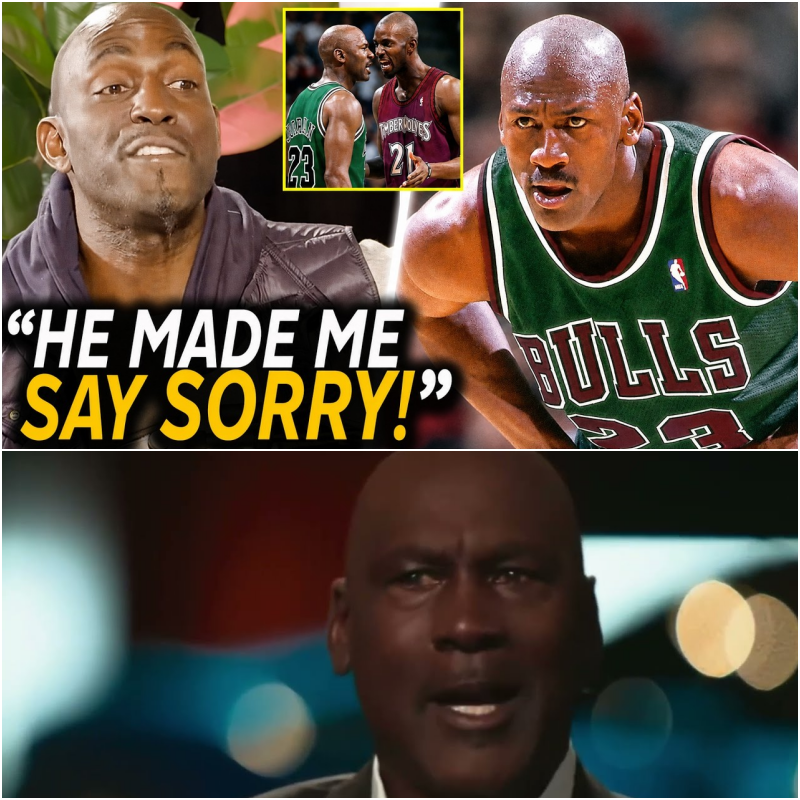
Known as “The Big Ticket,” Garnett was a seven-foot kinetic storm of intensity, a player who would bark at opponents, bang his head against padded stanchions, and unleash verbal volleys so vitriolic they became the stuff of league legend. Yet, buried within the bravado of a Hall of Fame career is a humbling confession that serves as a cautionary tale for any athlete who dares to poke the “Black Cat.”
Kevin Garnett, the man who never backed down from a fight, recently peeled back the curtain on the one time he realized that some players are better left undisturbed. It was the night he learned that Michael Jordan didn’t just play basketball—he conducted a masterclass in total annihilation.
The Confidence of a Rookie
The year was 1996. Kevin Garnett was a gangly, high-flying rookie for the Minnesota Timberwolves, a teenager who had bypassed college to prove that a kid from high school could handle the physical and mental rigors of the pros. By the second half of the season, Garnett was beginning to find his footing. The game was slowing down, his confidence was surging, and he felt like he belonged.
On a cold night in Chicago, the Timberwolves arrived at the United Center. For Garnett, it was a homecoming of sorts; nearly 70 people from his old neighborhood had made the trip to see the kid who had made it out. The energy was electric, and the adrenaline was flowing.
“I was feeling it,” Garnett recalled in a recent retrospective. “The neighborhood was there. My teammate, Junior Rider, was having a night. He was on fire. And when you’re young and you’re seeing your guy kill, you want to be the one to fuel that fire.”
As the game progressed, Rider was indeed giving the Bulls fits. Garnett, caught up in the fervor of the moment and emboldened by the presence of his friends and family, began to chirrup from the sidelines and on the court. He wasn’t just cheering; he was barking.
“Yo, keep killing that [expletive]!” Garnett yelled at Rider, gesturing toward the legendary Michael Jordan. “You having a good game, Joe! Keep it going! Straight up!”
At the time, the Timberwolves were holding their own. It was a tight, two-point game. Garnett, in his youthful exuberance, thought he was winning the psychological battle. He thought he was the hunter. He didn’t realize he was merely a loud noise in the path of a predator.
The Shift in the Atmosphere
Every veteran player from that era describes a specific “look” that Michael Jordan would give when a game shifted from a professional contest to a personal vendetta. Garnett was about to experience it firsthand.
“I said it again, loud enough for him to hear,” Garnett said. “And the second it left my mouth, I knew something had changed. You could feel the atmosphere shift. It went from a basketball game to a funeral.”
Jordan, according to Garnett, didn’t snap back with a witty insult. He didn’t argue. He simply stopped. He put his hands on his hips, locked his legs, and stared.
“That look stabbed me for about 15 seconds,” Garnett admitted. It was the silence of a man calculating exactly how much pain he was about to inflict.
Junior Rider, a veteran who knew better than to wake the sleeping giant, sensed the impending doom immediately. He tried to quiet his rookie teammate, motioning for Garnett to shut up before the ceiling caved in. But Garnett, fueled by the “neighborhood energy,” leaned in. He kept yelling. He doubled down.
It would be the last mistake he made that night.
Six Minutes of Absolute Ruin
What followed is a sequence that Garnett still struggles to describe with anything other than awe and a hint of residual trauma. Michael Jordan, who had a modest 18 points at the time of the “transgression,” transformed into a force of nature.
“He dropped into that back-leg stance,” Garnett noted, referring to Jordan’s iconic triple-threat posture. “When he does that, it’s over. He wasn’t just playing anymore. He was taking the game away from us.”
In a span of roughly six or seven minutes, Jordan exploded. The two-point lead evaporated as Jordan relentlessly attacked the basket, pulled up for mid-range jumpers, and suffocated the Timberwolves on the defensive end. He went from 18 points to 40 in a blink.
The psychological toll was even greater than the scoreboard. The Timberwolves, rattled by the sudden onslaught, began to crumble. They committed back-to-back 10-second violations—an embarrassing rarity in professional basketball—simply because they couldn’t handle the pressure Jordan was exerting on the ball.
“We were down 25 just like that,” Garnett laughed, though the memory clearly still carries weight. “I was on the bench with my head down. I wasn’t just tired; I was mentally broken. I had awakened a level of competitiveness I didn’t even know existed.”
As the Bulls starters were pulled from the game, the mission accomplished, Jordan walked past the Minnesota bench. He didn’t gloat with screams. He simply looked at the young rookie and offered a chilling, repetitive acknowledgement of the “lesson” he had just delivered.
“Okay, young fella. Okay. Y’all done? Damn, young fella.”
Garnett turned to Junior Rider to apologize for the mess he’d caused. Rider’s response was short: “I told you. Just shut your ass up.”
The Evolution of the Trash Talker
The encounter didn’t stop Kevin Garnett from talking trash—that would be like asking a wolf to stop howling at the moon. However, it fundamentally altered how he talked. That night in Chicago was the genesis of Garnett’s transition from a loud-mouthed rookie to a calculated psychological tactician.
He realized that trash talk was a weapon with a recoil. If used against the wrong target, or used without the ability to sustain the energy, it would destroy the user.
“The biggest mistake you can make in trash talk is stopping halfway,” Garnett explained. “The moment you try to fade out, or I see you’re tired, that’s when it flips. I can smell it when you’re fading. That’s when I step right on top of you.”
Garnett eventually became the master of this himself, using his voice to sense weakness in others. But he never again directed that energy toward Michael Jordan. He had learned that some mountains are not meant to be climbed; they are meant to be respected from a distance.
The Two Poles of Silence: Tim Duncan and Gary Payton
As Garnett’s career progressed, he encountered two other legends who challenged his verbal dominance in entirely different ways: Tim Duncan and Gary Payton.
If Michael Jordan was a wildfire that grew when fanned by trash talk, Tim Duncan was a vacuum. For years, Garnett tried everything in his verbal arsenal to get a rise out of the “Big Fundamental.” He insulted him, he barked in his ear, he tried to disrupt his zen-like focus.
“Timmy was the exact opposite,” Garnett said. “Every word, every jab… it just hit a wall. No reaction. No emotion. That was the part that really got to me. There was nothing to grab onto.”
Duncan’s response to Garnett’s fiercest insults was often a simple, polite phrase after a made basket: “Nice try,” or “Got you.” It was a “subtle” kind of psychological warfare that eventually forced Garnett to stop talking to him altogether. You can’t fight a ghost, and you can’t break a man who refuses to acknowledge the hammer.
Then there was Gary “The Glove” Payton. While Jordan punished you for talking and Duncan ignored you, Payton was the architect of the conversation. Garnett recalls Payton as the “Master,” a man who treated trash talk as a strategic tool rather than an emotional outburst.
Garnett tells a story of an All-Star practice where Payton pulled him and a young Kobe Bryant aside. For 30 minutes, the veteran didn’t talk trash; he gave a clinic. He broke down defensive concepts, positioning, and how to control an offensive player’s options. It was a moment of profound respect—two of the most competitive minds in history standing silent, listening to the man who knew how to control the game with his mind as much as his hands.
The Legacy of the Word
In today’s NBA, the art of the “trash talk” has changed. With high-definition cameras and social media, every word is scrutinized, and the raw, unfiltered warfare of the 90s has largely been replaced by “micro-aggressions” and Twitter beefs.
But for Kevin Garnett, the lesson from 1996 remains the gold standard for understanding the game’s mental geometry. Basketball is a game of skill, but it is also a game of will. Garnett’s career was defined by his ability to impose his will on others, but his greatness was cemented by his ability to recognize when he had met his match.
He learned that the loudest person in the room isn’t always the strongest, and that the deadliest players are the ones who can turn your own words into the fuel for your demise. Michael Jordan didn’t just beat the Minnesota Timberwolves that night; he reshaped Kevin Garnett’s DNA.
“Never talk [expletive] to Mike ever again in life,” Garnett concluded. It’s a rule he lived by for the rest of his legendary career—a silent tribute to the night the Big Ticket found out exactly what it costs to challenge a King.