The CEO Sold Him a “Junk” Garage for $1,000 — 6 Months Later, He Turned It Into an Empire
The CEO Sold Him a “Junk” Garage for $1,000 — 6 Months Later, He Turned It Into an Empire
The wind off Lake Michigan didn’t just blow through Cicero; it cut through the industrial flats like an iron blade. It carried the scent of wet soot, frozen road salt, and the stagnant, heavy air of abandoned industry.
Daniel Carter stood on a patch of fractured asphalt, his hands buried deep inside the pockets of a Carhartt jacket that had seen too many winters. The fabric was frayed at the cuffs, the insulation thinning, but it was the only shield he had left. Beneath his heavy work boots, the gray December snow crunched with a hollow, brittle sound.
Before him sat the carcass of Langley Auto Logistics’ oldest graveyard asset: a dilapidated, three-bay repair garage that had been gutted by an electrical fire two years prior. The structure was an eyesore of corrugated steel and water-logged brick. Its roof sagged in the center like a dying horse, its corrugated panels rusted into an ugly, deep orange. Half of the high-set windows were shattered, their jagged glass teeth catching the pale winter light. Above the primary bay, a heavy wooden sign hung by a single, rusted chain, tilting precariously in the wind. Inside, clearly visible through the open, broken door, sat the charred, hollow shell of a burned-out sedan—a monument to the building’s ruin.
Behind Daniel, the low, mechanical hum of a high-end engine broke the silence. A black Cadillac Escalade, its paint polished to a mirror finish, sat idling at the edge of the lot, its exhaust pluming into the freezing air like thick white smoke.
The rear door clicked open, and Victoria Langley stepped out onto the salted gravel.
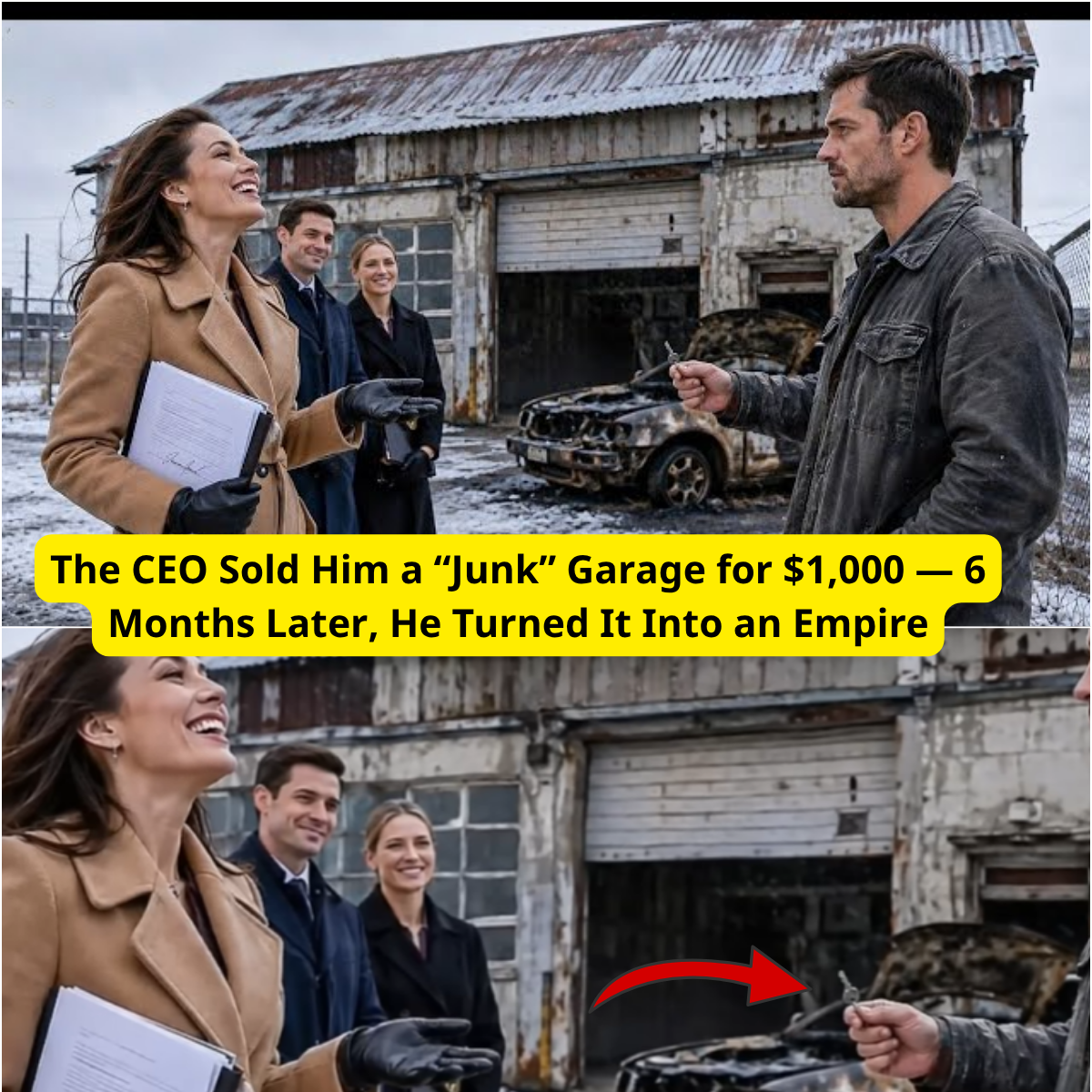
As the CEO of Langley Automotive, Victoria was a fixture in Chicago’s business journals—sharp-witted, fiercely competitive, and entirely unsentimental. Her tailored cashmere coat was immaculate, its cream-colored wool completely untouched by the gray slush of the industrial district. She didn’t walk so much as navigate the terrain, her leather boots picking a clean path toward the edge of the property. She stopped a few feet from Daniel, glanced up at the collapsing roof, and let out a short, incredulous laugh that vaporized instantly in the cold.
“You’re actually serious about this, Mr. Carter?” she asked, her voice laced with an amused, patronizing pity. “You genuinely want to take title to this parcel? The city has already flagged it for demolition twice. It’s an environmental liability.”
Daniel didn’t look at her immediately. He kept his eyes fixed on the rusted sign above the door. “It’s what I can afford,” he said quietly. His voice was raspy from the cold, but steady.
Victoria signaled to her assistant, who hurried forward with a leather-bound folio. She pulled a pen from her pocket and handed the transfer documents to Daniel with a smirk. “The municipality was going to charge us fifty grand just to clear the ground and remediate the soil. Honestly, you’re doing our balance sheet a favor. But I have to ask—what exactly do you see here?”
Her assistants, standing like sentinels near the idling SUV, chuckled softly on cue.
Daniel ignored them. He took the pen with stiff, cold fingers and signed his name at the bottom of the deed transfer. When he handed the folio back, he reached into his jacket and pulled out a thick envelope containing exactly ten one-hundred-dollar bills. It was a crisp, clean stack of currency.
One thousand dollars.
It was every single cent he had left in the world. It was the residue of a life that had been systematically dismantled over three years—liquidated after losing his senior technician position at a commercial fleet yard, after the eviction notice on their apartment in Berwyn, and after the predatory medical bills had swallowed his remaining savings.
Victoria took the envelope without counting it, handing it off to her assistant as if it were dirty laundry. She turned back toward her vehicle, her heels clicking against the frozen ground, but stopped just before reaching the open door. She looked over her shoulder, her eyes sweeping over Daniel’s worn boots and the ruined building behind him.
“You know, Daniel,” she said, her tone cool and clinical. “The market has a very natural way of sorting people out. Some people are born to build empires. Others are born to collect junk. Good luck with your scrap metal.”
The heavy door of the Escalade shut with a muffled, expensive thud, and the vehicle glided away into the gray afternoon, leaving a faint smell of premium gasoline and disturbed slush in its wake.
Daniel stood entirely still as the sound of the engine faded into the distance. The silence of the abandoned industrial park settled around him, heavy and suffocating. For a long moment, the sheer weight of his isolation threatened to crush him. He was a forty-two-year-old man with no home, a ruined career, a thousand-dollar piece of hazardous real estate, and a dead wife whose absence still felt like an physical ache in his chest.
Then, the small wooden side door of the garage creaked open.
“Dad? Is it really ours now?”
Daniel turned, the tightness in his chest loosening slightly. Standing in the doorway was his ten-year-old daughter, Lily. She was wrapped in an oversized winter coat that had belonged to her cousin, her small hands protected by bright pink knit mittens. In her grasp, she balanced two steaming paper cups of cheap gas-station coffee. Her bright blue eyes, so identical to her mother’s, scanned the blackened interior of the main bay.
Daniel forced a smile, the first real movement of his facial muscles in hours. He walked over, knelt down in the slush, and took one of the cups from her. “Yeah, Lil,” he whispered, his voice cracking slightly. “This is ours. Every square inch of it.”
Lily looked past his shoulder at the cracked masonry and the charred frame of the old car sitting in the shadows. “It’s really ugly, Dad,” she admitted honestly, her nose wrinkling at the smell of old charcoal and wet iron.
Daniel let out a soft laugh, pulling her into a brief, one-armed hug. “Maybe it is right now. But your mom used to say that ugly things are just things that haven’t been loved yet. They can still become beautiful if you put the work in.”
They didn’t wait for the morning. That very night, under the yellow glow of a battery-powered construction lamp Daniel had saved from his old toolbox, they began to clear the wreckage. They worked until midnight, their breath blooming in the freezing air. Together, they swept mounds of green shattered glass into plastic buckets. They dragged out water-logged lengths of rotten two-by-fours and piled up old, stiff tires that had melted against the concrete floor.
The air inside the garage was thick with the scent of old motor oil, stale smoke, and decades of professional neglect. But with every bucket of debris they carried out to the curb, the space seemed to expand. It began to feel less like a tomb and more like a room.
Before the grief had taken over, Daniel had been regarded as one of the finest diesel and automotive mechanics in the Cook County area. He was a master technician who could diagnose a spun bearing or a faulty timing solenoid simply by placing a screwdriver against the engine block and listening to the vibration. In his prime, he had spent his Thursday nights running free workshops in his backyard, teaching neighborhood kids how to change their brakes and read diagnostic codes so they wouldn’t get ripped off by the corporate chains. People trusted him because his hands were dirty but his ledger was clean.
But when Sarah, his wife, was diagnosed with aggressive small-cell carcinoma, the machinery of his life ground to a halt. The specialized treatments weren’t covered by his employer’s basic healthcare plan. He began missing shifts to sit beside her during chemotherapy infusions, his mind fractured between torque specifications and survival rates. The corporate management at the fleet yard, driven by quarterly efficiency targets, eventually replaced him with a younger, cheaper trade-school graduate.
After Sarah passed, the grief didn’t just break his heart; it paralyzed him. The bills piled up like winter drifts, the bank accounts drained to zero, and the friends who had once filled his backyard drifted away, uncomfortable with the sight of a strong man drowning in sorrow. This broken garage wasn’t just a business venture; it was the final beachhead in his war against total oblivion.
The winter broke slowly, turning into a wet, stubborn Midwestern spring. Every single morning, long before the sun cleared the low-rise factories to the east, Daniel rolled up the rusted garage door.
At first, the silence was deafening. Days passed into weeks with nothing but the sound of the wind rattling the metal roof. He had no advertising budget, no neon signs, and no digital presence. He simply sat at his old metal workbench, cleaning his vintage Snap-on tools over and over until the chrome shone like silver. He refused to give up the routine. He wore his clean blue work shirt every day, his name tag—Daniel—stitched over the left pocket.
One rainy Tuesday afternoon, the streak broke. A rusted 2008 Ford F-150 sputtered into the gravel lot, its engine clattering like a box of loose nails. Black smoke poured from beneath the warped hood.
An elderly woman, her face lined with age and anxiety, climbed out of the cab. She introduced herself as Martha Higgins, a retired schoolteacher who lived on a fixed social security income three miles away. “I can’t pay much, young man,” she said nervously, her eyes darting toward the interior of the garage. “The big shop on Cicero Avenue told me I needed a whole new engine block. They wanted four thousand dollars just to touch it.”
Daniel didn’t say a word. He grabbed his shop light, laid down on a piece of cardboard on the wet concrete, and slid beneath the truck’s chassis. He emerged ten minutes later, wiping a thick smear of black grease from his forearm.
“It’s not the block, Mrs. Higgins,” Daniel said gently. “Your radiator hose split right at the clamp, and the coolant loss caused the head gasket to overheat. The clattering is just a dry valve train. I can patch the line, flush the system, and replace the gasket for you.”
The woman looked down at her small, plastic coin purse, her fingers trembling. “I… I only have forty dollars until the first of the month. I need this truck to get my husband to his dialysis appointments.”
The actual retail value of the parts and the six hours of heavy labor required was easily three hundred and fifty dollars. Daniel glanced toward the corner of the shop, where Lily was sitting on an overturned milk crate, her schoolbooks spread across a makeshift plywood desk under a flickering LED bar. She was watching him quietly, waiting to see what her father would do.
Daniel looked back at Martha and smiled, his expression warm and completely devoid of transaction. “Forty dollars is exactly what the job costs today, ma’am. Leave me the keys. I’ll have it purring by five o’clock.”
The old woman’s eyes welled with tears. Two days later, she returned to the shop, not with more money, but with a large, heavy pot of homemade chicken dumpling soup and a small plate of cornbread. More importantly, she told her church group about the quiet, honest mechanic who hadn’t taken advantage of her.
Within a week, the church’s deacon brought in his van. Then came a young mother with a failing alternator, followed by an elderly veteran whose brake lines had rotted through. Daniel treated every single person who crossed his threshold with the same exact baseline of absolute dignity. He worked on delivery vans for local bakeries, rusted sedans belonging to night-shift warehouse workers, and old station wagons that had no business being on the road.
If a customer couldn’t afford the retail price of a critical safety repair, Daniel didn’t turn them away. He would barter for fresh eggs, for a box of old shop rags, or simply for a handshake and a promise to pay it forward. He spent nights sleeping on the cot in his small back office, waking up at 2:00 a.m. to finish a transmission rebuild just so a local roofing contractor wouldn’t lose a day of commercial wages.
Word of mouth travels slowly in a big city, but in the blue-collar neighborhoods of Chicago’s outer rim, it travels with the force of an unwritten law. People didn’t just bring their cars to Daniel because he was cheap; they brought them because his garage felt like a sanctuary in a world that usually tried to take everything you had left.
Six months after the deed was signed, the facility on the corner was unrecognizable.
The rusted corrugated panels had been replaced with deep charcoal siding. Bright, high-output LED shop lights glowed through clean, unbroken windows. The three repair bays were constantly occupied, the hydraulic lifts hissing as they raised vehicles from dawn until dusk. Daniel had been forced to clear out the old, burned-out car in the center bay to make room for a modern alignment machine.
Outside, a beautiful, hand-painted wooden sign hung straight and true above the entrance. It featured clean white lettering against a navy blue background: Carter & Daughter Auto Repair. Lily had designed the layout herself, and when Daniel first saw her raising it into place with the shop crane, he had been forced to turn his face toward the wall to hide his tears.
The defining moment of the business, however, occurred on a torrential Thursday in late October.
A battered Honda Civic rolled into the bay, its tires bald and its rear bumper held together by layers of gray duct tape. A young woman stepped out, holding a toddler wrapped in a thin fleece blanket. She was visibly shaking, her eyes wide with panic. She explained that she was driving from Ohio to Minnesota to escape an abusive domestic situation, but her water pump had failed on the interstate, leaving her stranded on the side of the highway with less than twenty dollars in her purse.
Daniel didn’t ask for a credit card. He didn’t ask for her identification. He immediately brought the mother and child into his heated back office, poured them cups of hot cocoa, and set to work. He stayed under that car for four straight hours, replacing the water pump, installing two safe, used tires from his own stock, and changing the oil out of his own pocket.
When he handed her the keys, the woman looked at him with an expression of profound dread. “How… how much do I owe you, sir? Please be honest.”
Daniel shook his head, wiping his hands on a clean grease rag. “You don’t owe me a thing, ma’am. The car is safe. The fluids are topped off. You’re good to get to Minnesota.”
The woman stared at him, her jaw dropping. “I can’t take this from you. This is your livelihood. I saw how busy you are.”
Daniel leaned against the service counter, his smile gentle but firm. “Then do me a favor instead. When life gives you the opportunity to help someone who’s backed into a corner, you take it. That’s how we pay the tab around here.”
The woman broke down, weeping openly as she thanked him and drove out into the rain.
What Daniel had no way of knowing was that the young mother, Elena Vance, was an investigative feature writer for a major national digital media outlet. Three days after her departure, an article appeared on the publication’s homepage. The headline was simple: The Mechanic Who Repairs Broken Lives.
The piece was an incredibly raw, beautifully written account of her encounter with Daniel. It detailed his history, his loss of his wife, his tiny garage, and the philosophy of radical kindness he practiced daily in an industrial corridor that the rest of the city had forgotten.
The article went viral within forty-eight hours. It was shared millions of times across social media platforms. By the following Monday, Daniel’s email inbox was flooded with thousands of messages from across the United States. Donations from everyday citizens poured into a crowdfunding campaign Elena had set up without his knowledge. Tool manufacturers offered to restock his inventory for free. Local vocational schools reached out to partner with him.
Within two months, Daniel used the capital influx to hire three out-of-work mechanics from the area, providing them with competitive wages and full health benefits. He expanded the physical footprint of the garage and launched an evening apprenticeship program specifically designed for at-risk youth and struggling young adults who wanted to learn a trade but couldn’t afford tuition. The little scrap-metal garage had transformed into one of the fastest-growing independent automotive groups in the state.
One crisp, clear morning in early May, the shadow of a familiar vehicle fell across the gravel lot.
The black Cadillac Escalade pulled up to the main bay, its polished finish catching the bright spring sun. Victoria Langley stepped out of the back seat. She was dressed in another expensive designer suit, but her movements were slower this time, her usual aura of absolute corporate certainty replaced by a quiet, cautious hesitation.
The garage behind Daniel was a hive of controlled, professional activity. The air was filled with the rhythmic zipping of pneumatic impact wrenches, the steady hum of engines, and the sound of classic rock music playing softly from a stereo near the roof. Five technicians in matching navy blue uniforms worked systematically across the expanded bays.
Victoria walked toward the service desk, her eyes scanning the clean floors, the state-of-the-art diagnostic machines, and the crowd of local customers reading newspapers in the waiting area. She looked stunned, as if she had walked into a mirage.
Daniel stepped out from beneath a lifted Jeep, wiping a light sheen of oil from his fingers with a clean red cloth. He didn’t look angry; he looked entirely at peace.
“I don’t understand, Daniel,” Victoria said, her voice unusually subdued as she stopped before him. “Our analysts flagged this location as a dead zone. We couldn’t make it profitable with a million-dollar corporate budget. How did you do this?”
Daniel tossed the rag onto his workbench and looked her dead in the eye. “You looked at this place and saw a broken building, Ms. Langley. You saw an environmental liability. I looked at it and saw a place where people who had been discarded by the world could finally start over.”
Victoria looked around the shop, her gaze lingering on the apprentices working together on a engine swap, their faces bright with focus and pride. “I read the articles,” she admitted quietly. “I heard you just signed the lease on two more locations in the West Side.”
“And we’re launching our free women’s automotive safety seminars next month,” Lily added, stepping out from behind the front counter with a clipboard in her hand. She was taller now, her demeanor radiating a quiet, administrative confidence that mirrored her father’s.
Victoria stared at the father and daughter for a long, silent moment. The cold, analytical armor she had worn for decades seemed to crack slightly at the edges. Her voice softened to a degree that her corporate board members would have found unrecognizable. “I was entirely wrong about you, Daniel. I apologize.”
Daniel smiled kindly, his expression completely free of malice. “We’re all wrong about people sometimes, Ms. Langley. The world teaches us to look at the exterior. It’s an easy mistake to make.”
Victoria looked down at her polished leather shoes, a faint hint of genuine embarrassment touching her features. “Can I ask you something? Why did you choose to help so many people—why did you give away so much labor—when you were down to your last thousand dollars? When you had nothing yourself?”
Daniel glanced around the bustling warmth of his garage. He looked at the young workers laughing as they shared a tool, at the elderly customers drinking coffee out of ceramic mugs, and at Lily, who was looking at him with absolute pride.
“Because kindness saved me when nothing else in this world could,” Daniel said softly. “When you’ve lost everything, you realize that the only things that actually matter are the things you give away.”
Victoria didn’t answer right away. She reached into her leather handbag, pulled out a heavy, platinum-embossed business card, and laid it gently on the service counter between them.
“Langley Automotive is launching a national community investment initiative,” she said, her tone professional but laced with a new, profound respect. “We’re funding thirty non-profit repair and vocational training centers across the rust belt over the next three years. We have the capital, but we don’t have the soul. I want Carter & Daughter to design the curriculum and lead the entire project as our national director. Name your terms.”
Daniel looked down at the gleaming card on the counter. The very woman who had dismissed him as a collector of junk six months ago was now standing in his shop, asking him to save her company’s legacy.
He didn’t gloat. He didn’t demand an apology for the past. He simply looked up, extended his grease-stained hand, and shook hers with a firm, warm grip. He didn’t do it because he wanted the satisfaction of revenge; he did it because the quiet empire he had built out of hope had already made him far richer than revenge ever could.
And that is the enduring truth about human kindness. The world often views it as a weakness, a small and inconsequential currency used by those who cannot compete in the margins of life. But every now and then, a single act of radical generosity becomes a seed. It takes root in the broken, rusted places of the world, growing into a second chance, a new beginning, and an unshakeable empire built entirely on grace.
If life ever presents you with the choice to extend your hand to someone who is drowning, you should always take it. You never truly know when you might be rebuilding the very foundation of someone else’s entire world.