Poor Single Dad Gave Blood to Dying Millionaire – Next Morning_His Life Changed””
Poor Single Dad Gave Blood to Dying Millionaire – Next Morning_His Life Changed””
Chapter I: The Call in the Rain
The rain hammered against the rusted, corrugated tin roof of the transit shed like a rhythmic volley of gunfire. Daniel Carter stood just inside the open bay doors of the logistics warehouse, watching the greasy pavement of the industrial district turn into a series of oil-slicked black mirrors.
His boots were completely soaked through, the cheap leather having split along the welt hours ago during his shift. His breath came in ragged, uneven plumes; he had just run three solid blocks from the metropolitan bus stop through a blinding downpour, holding his six-year-old daughter, Lily, tightly against his chest to shield her from the worst of the autumn gale.
Daniel hated hospitals. He hated the sterile, unyielding whiteness of the walls, the piercing smell of antiseptic that always failed to mask the scent of human decay, and the low, mechanical drone of life support equipment. To him, those buildings were not places of healing; they were cold monuments to every single thing life had ever stripped away from him.
“Papa, are we staying here long?” Lily asked softly. She was perched on a plastic chair in the emergency admissions waiting room, rubbing her sleepy eyes with the sleeve of her oversized, faded pink sweater.
“Just for a little while, sweetheart,” Daniel whispered. He forced a small, tight smile onto his lips—a fragile mask that didn’t reach his tired gray eyes—and reached down to gently tuck a damp strand of brown hair behind her ear. “I just have to do one quick thing, and then we’ll go home and get you some warm tea.”
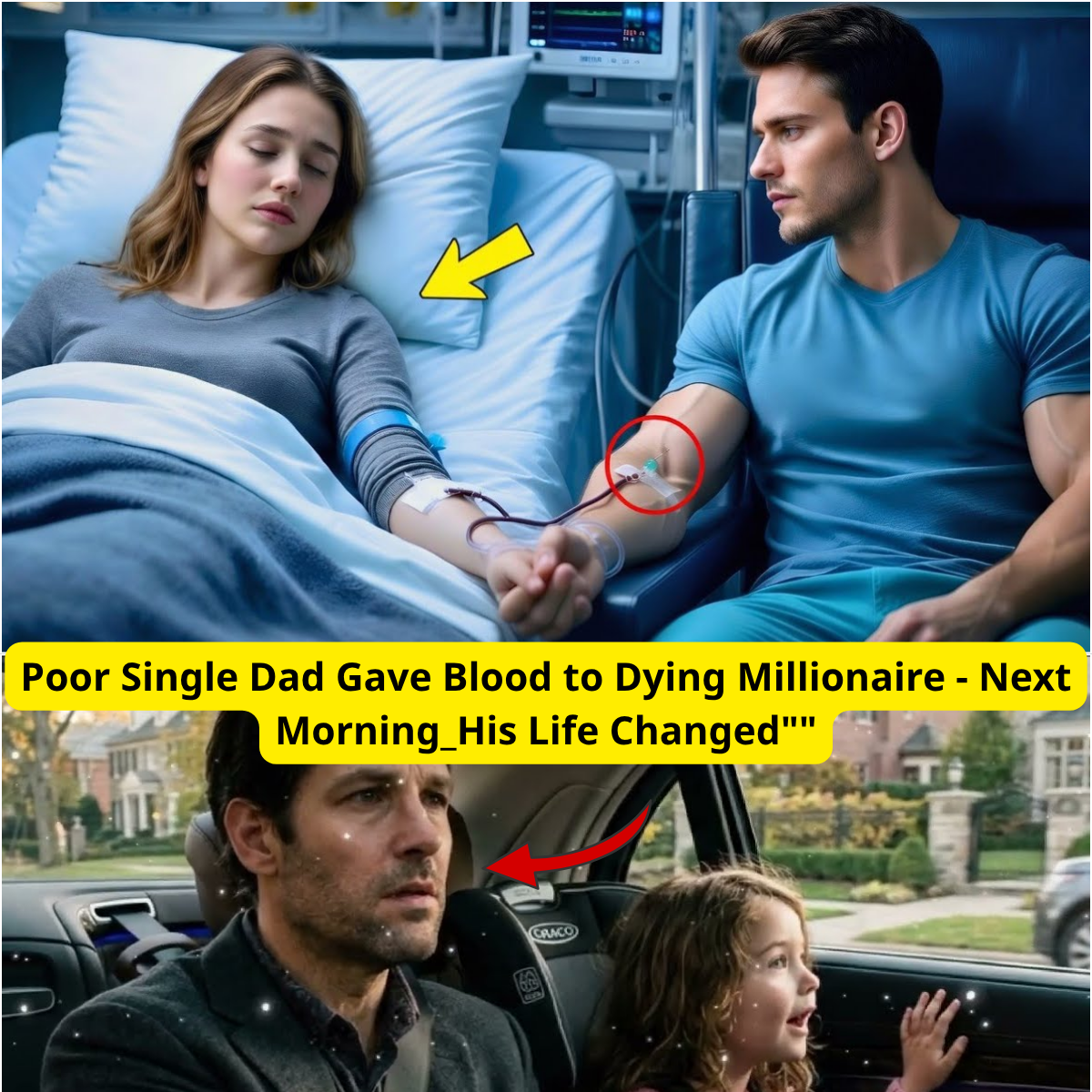
Daniel wasn’t at the municipal hospital for himself. Two hours ago, while he was finishing a grueling twelve-hour shift unloading heavy wooden pallets from a cross-country freight trailer, his ancient flip phone had rattled against his hip. The woman on the other end had been a frantic charge nurse from the county’s central blood registry. She was calling every rare-phenotype donor within a fifty-mile radius, her voice carrying a thin edge of panic that immediately caught Daniel’s attention.
A wealthy manufacturing executive named Victor Harrington—a man whose surname was emblazoned in chrome letters on three different high-rises downtown—had been rushed into emergency trauma surgery following a catastrophic multi-car collision on the interstate. His blood type was an extraordinarily rare subtype of $O\text{-negative}$, lacking common antigens to the point that standard bank reserves were completely useless. Without an immediate, direct transfusion from a matching donor, the surgeons couldn’t repair his ruptured hepatic artery. The billionaire would not survive until midnight.
Initially, Daniel had almost said no. Every muscle in his six-foot frame was screaming in protest from the warehouse labor. His lower back felt like a rusted iron hinge, he hadn’t eaten anything since a stale piece of white bread at 6:00 AM, and the last crumpled five-dollar bill resting in his pocket was strictly earmarked for Lily’s school lunch fees for the upcoming week. He had nothing left to give.
But then the nurse had paused over the static of the line and quietly added, “Please, Mr. Carter. He has young children, too. They’re waiting in the private lobby right now.”
Daniel had looked across the breakroom at Lily, who was quietly drawing stick figures on the back of a greasy receipt, and the refusal died in his throat. He knew exactly what it felt like to look at a child and wonder how they would survive the darkness alone.
Chapter II: The Price of Kindness
Inside the donation cubicle, the overhead fluorescent tubes buzzed with a sharp, blinding light that made Daniel’s eyes water. A young hematologist thanked him with a curt, efficient nod before prepping his left forearm with an iodine swab. The cold liquid sent a shiver straight up Daniel’s sleeve.
“You’re doing a remarkable thing tonight, sir,” the doctor murmured, his fingers deftly searching for a suitable vein amidst the heavy scar tissue left by years of manual labor. “You’re saving a man’s life.”
Daniel gave a single, exhausted nod, keeping his eyes fixed on the ceiling tiles. “I’m just doing what anyone should,” he replied quietly, his voice hollow. But deep down, in the cynical corners of his mind where poverty had taught him the harsh realities of the city, he knew better. He knew that if the roles were reversed, the men who owned the high-rises rarely stopped their luxury cars to look at the people unloading their trucks.
As the thick, dark red liquid began to drain through the plastic tubing, slowly filling the clear collecting bag suspended beside the cot, Daniel stared out the small glass portal window at the storm.
His thoughts drifted back to his late wife, Emma. Emma had been an idealist, a woman who looked at the broken asphalt of their neighborhood and saw flowers trying to grow through the cracks. She used to hold his rough hands between hers and tell him that kindness was an investment—that whatever light you put out into the world would eventually find its way back to your doorstep when the night got too dark.
Daniel had stopped believing in Emma’s light exactly two years ago, on the night the monitors in the oncology ward finally went flat. Cancer hadn’t cared about her kindness. It hadn’t cared that she volunteered at the community kitchen or that she sang Lily to sleep with a voice like spun sugar. It had simply consumed her, leaving Daniel with a mountain of unpayable medical debts, an eviction notice on their old apartment, and an endless succession of double shifts that left him too numb to weep.
Since her death, life had been a daily exercise in survival. He had learned the precise art of pretending he wasn’t hungry during dinner so Lily could have the larger portion of mac and cheese. He had learned how to ignore the red, bold print on the utility bills and how to sew the soles of his shoes back together with industrial nylon thread from the warehouse floor.
When the collection machine finally chimed, signaling the full unit had been drawn, a nurse removed the needle, taped a cotton ball over the puncture wound, and handed him a small, generic foil-top juice box.
“Thank you for your service, Mr. Carter,” she said, her mind already moving to the next emergency as she hurried the bag toward the elevator.
That was it. No grand fanfare, no sudden miracle, no monetary compensation—just another cold, exhausted night in the city. Daniel slowly pulled his sleeve down, took Lily’s small, warm hand in his, and stepped back out into the relentless rain. The yellow streetlights cast long, shivering reflections on the flooded blacktop as they began the long, silent walk back toward the tenement housing district, completely unaware that three floors above them, one of the most powerful financial titans in the state had just opened his eyes in the intensive care unit and demanded the name of the stranger who had kept him anchored to the earth.
Chapter III: The Unwelcome Visitors
Daniel barely slept that night. The radiator in their small, third-floor apartment maintained a continuous, metallic clanking that offered very little actual heat, and the sound of the rain dripping steadily into a plastic bucket through a structural crack in the kitchen ceiling kept pulling him out of a shallow, troubled slumber.
Around dawn, the storm finally subsided into a thick, gray fog that hung low over the city’s industrial smokestacks. Daniel dragged himself out of bed, his body feeling twice as heavy as it had the day before. He walked into the cramped kitchen and quietly prepared a mug of weak black tea, using the absolute last spoonful of granulated sugar left at the bottom of the glass jar.
Lily was still fast asleep on the sagging cushions of the old thrift-store sofa, her small form wrapped tightly within the borders of a faded quilt that Emma had hand-stitched during her final months. Daniel stood over her for a long moment, watching the steady rise and fall of her shoulders, a familiar, suffocating knot of anxiety tightening in his throat as he thought about the empty pantry cabinets behind him.
He was just reaching for his work jacket, preparing to slip out the door for his 7:00 AM shift, when an uncharacteristically loud, firm knock rattled the old wooden door frame.
Daniel frowned, his muscles instantly tensing. Nobody visited them at this hour unless it was the landlord looking for the three hundred dollars he was short on the October rent. He checked the deadbolt, took a breath, and pulled the door open.
Two men stood in the dim, narrow hallway. They were dressed in matching, tailored charcoal wool overcoats that fell perfectly over pristine silk ties. Their Italian leather shoes were immaculately polished, entirely free of the city mud that covered everything else in the building, and their presence made the peeling wallpaper and smell of boiled cabbage in the corridor look instantly more pathetic.
“Mr. Daniel Carter?” the older man asked. His voice was polite, perfectly measured, and possessed the smooth cadence of an expensive corporate attorney.
Daniel shifted his weight, his hand remaining firmly on the edge of the door, his eyes narrowing with deep suspicion. “Yeah. Who’s asking?”
“My name is Robert Hayes,” the man replied, extending a manicured hand that Daniel didn’t take. “I am the senior legal counsel for Mr. Victor Harrington and the Harrington Global Group. We’ve been looking for you since 4:00 AM, sir.”
Daniel’s mind raced, searching for some mistake he must have made. “The man from the hospital? Look, if this is about some medical liability or a problem with the blood—”
“No, sir, not at all,” Robert interrupted gently, dropping his hand with an understanding smile. “Mr. Harrington survived his surgery entirely due to your contribution. He has been discharged to his private estate under home medical care, and he has requested your presence immediately. He wishes to meet the man who saved his life.”
Daniel looked down at his faded flannel shirt, the frayed cuffs of his denim jeans, and the work boots held together by luck and glue. “I have a shift starting in twenty minutes at the logistics park. I can’t miss it. If I’m late, the foreman replaces me before the whistle blows.”
“Your supervisor at the warehouse has already been contacted by our corporate office, Mr. Carter,” Robert replied smoothly, stepping back to gesture toward the stairs. “Your position is entirely secure, and you will be fully compensated for your time today. Our transportation is waiting for you at the curb downstairs.”
Daniel felt an immediate, deep-seated discomfort wash over him. In his experience, wealthy people didn’t seek out men from his side of the river unless there was a problem to be solved or a liability to be erased. But as he looked back at Lily, who had been woken up by the voices and was now peeking out from beneath her quilt with wide, curious eyes, he realized he didn’t really have the luxury of choice.
Chapter IV: Two Different Worlds
After helping Lily pull on her cleanest pair of sneakers and her small winter coat, Daniel followed the two lawyers down the graffiti-lined stairwell and out into the crisp morning air.
A massive, midnight-black Mercedes-Benz limousine was idling quietly by the curb, its exhaust forming small white plumes in the cold air. The vehicle looked like a foreign spacecraft parked against the backdrop of broken brick facades and overflowing trash bins, drawing the immediate, intense curiosity of several neighbors who peeked out from behind yellowed lace curtains.
During the twenty-minute drive, Daniel remained completely silent, his arms crossed over his chest as he stared out the tinted glass windows. Lily, however, was absolutely transfixed. She pressed her nose against the glass, her eyes reflecting the massive, gleaming glass towers of the financial district, the pristine brick sidewalks of the historic district, and the rows of high-end boutiques where single dresses cost more than Daniel earned in a financial quarter.
“Papa,” she whispered, her voice full of a child’s reverence. “Are we in the rich part of the world now?”
Daniel let out a dry, humorless breath, his hand resting on her small shoulder. “Looks like it, bug. Just remember, it’s just stone and glass. Don’t let the shine fool you.”
The limousine eventually slowed, turning off the main thoroughfare and passing through a pair of massive, automated iron gates that bore a brass monogram. The car crawled up a long, winding driveway lined with ancient white oak trees before coming to a stop in front of a sprawling, limestone neo-classical estate that looked more like a European museum than a private residence.
Daniel hesitated before stepping out onto the cobblestone courtyard. He had spent the last three years of his life sacrificing his physical health just to secure thirty square feet of cracked drywall for his daughter. Seeing a place of this scale didn’t inspire awe in him; it inspired a profound, quiet anger at the sheer imbalance of the world.
Inside the grand foyer, the air was warm, smelling faintly of lemon wax and wood smoke. Every surface was too clean, the white marble floors polished to a mirror shine, the oil paintings on the walls framed in heavy gold leaf.
Robert Hayes led them through a set of double mahogany doors into a massive, sun-drenched library. Sitting in a leather armchair near a roaring limestone fireplace was Victor Harrington.
The billionaire looked nothing like the aggressive, iron-jawed titan Daniel had seen on the local business news segments. He was a man in his early fifties, but tonight he looked fragile. His face was a pale, translucent gray, his frame seemed shrunk inside a dark velvet robe, and a clear cannula line ran from a portable oxygen concentrator near his chair to his nose.
When Victor looked up, his eyes—sharp, calculating, and piercingly blue—locked directly onto Daniel’s face. He studied the warehouse worker’s posture, the protective way he held his daughter’s hand, and the complete lack of deference in his eyes.
“So,” Victor said, his voice raspy and low, his chest laboring slightly beneath the robe. “You’re the man who gave me my morning.”
Daniel shifted his weight, his hand remaining in his pockets. “I just donated a pint of blood, Mr. Harrington. The doctors did the actual work.”
Victor shook his head slowly, a faint, painful grimace passing over his features as he moved his torso. “No, Mr. Carter. Don’t diminish it. The chief of surgery told me that by the time they cross-matched your unit, my blood pressure had dropped to forty systolic. Without you, my children would be spending this morning finalizing my funeral arrangements. I know exactly what you did.”
Chapter V: The Value of a Life
Victor raised a thin, trembling hand and made a brief gesture toward Robert Hayes and the rest of the staff standing near the perimeter of the room. “Leave us,” he commanded softly. “Everyone. Give me ten minutes with Mr. Carter.”
The attorneys and assistants bowed their heads and quietly exited, the heavy mahogany doors clicking shut behind them. The massive library suddenly felt profoundly quiet, the only sound being the gentle crackle of the birch logs burning in the hearth.
Daniel remained standing near the door, his boots looking remarkably dirty against the Persian rug beneath them. Men of his economic standing were usually asked to use the service entrance of estates like this, not invited into the inner sanctum to sit among first-edition leather volumes.
Victor looked over at Lily, who was still clutching her small stuffed rabbit against her chest, her eyes wide as she examined the massive rows of books that reached all the way to the vaulted ceiling.
“What’s your name, little one?” Victor asked, his tone softening into something entirely human, completely devoid of his corporate authority.
“Lily,” she answered, stepping slightly behind her father’s leg for safety.
Victor smiled faintly, a genuine warmth flickering in his eyes. “You remind me of my daughter, Clara, when she was that age. Same serious look in your eye.” He turned his gaze back to Daniel. “I asked the hospital administration about you this morning, Daniel. I have a lot of influence in that network, so they were quite cooperative. They told me you didn’t leave an insurance account, you didn’t ask for a voucher, and you walked out into a torrential downpour before the unit had even reached the operating theater. Why?”
Daniel shrugged his shoulders, his expression remaining guarded. “Someone needed help, and the nurse said you had kids. That’s all the reason I needed. I didn’t do it for a reward.”
Victor leaned back against the leather cushions, his blue eyes staring intently at the ceiling. “Do you know how many people live in this city, Daniel? Four million. And do you know how many of them would look at a dying stranger on a digital registry and leave their family in the middle of a storm after a twelve-hour workday to give away a piece of their own body for nothing? Almost none.”
The billionaire paused, reaching for a leather folder resting on the mahogany desk beside his chair. “I’ve spent the last thirty years of my life building corporate infrastructure,” Victor continued, his voice dropping into a reflective, quiet whisper. “I’ve acquired manufacturing plants, bought real estate portfolios, accumulated capital, and tracked my net worth on spreadsheets every morning at 5:00 AM. But last night, lying on that cold gurney with a ruptured liver, listening to the alarm on the heart monitor speed up… none of that garbage mattered. Not a single cent of it.”
He looked directly at Daniel, his voice thick with an emotion he clearly wasn’t used to showing. “The only thing that mattered in that dark room was whether I would ever get to see my kids walk through a door again. My entire empire couldn’t buy me one extra cubic centimeter of oxygen. You bought it for me.”
Victor slid the leather folder across the polished surface of the desk until it rested at the edge, closest to Daniel.
“Open it,” Victor said.
Daniel hesitated, then walked forward and flipped the leather cover open. Inside was a certified deed of title and absolute ownership for a three-bedroom craftsman house located on a quiet, tree-lined street in the western suburb—not even four blocks away from Lily’s elementary school. The document bore a gold state seal, fully processed and completely paid in full.
“I can’t take this,” Daniel said immediately, his voice dropping as he tried to push the folder back. “I told you, I didn’t come to the hospital looking for a payout. I don’t need charity.”
“It isn’t charity, Daniel. It’s an exchange of assets,” Victor said firmly, his eyes flashing with a touch of his old executive iron. “You gave me my life back. This is me ensuring that your life is protected in return. And that’s only the first page.”
Victor pointed a finger at a secondary document inside the jacket. “One of my regional distribution hubs at the logistics park had a senior warehouse operations manager retire last month. The position requires someone who understands the floor mechanics, someone who knows how the freight moves, and someone who actually possesses a moral compass. The position comes with standard eight-to-four hours, full family medical coverage, and a salary that guarantees your daughter will never have to worry about a school lunch or an empty cupboard for the rest of her life. The contract is drafted. All it needs is your signature.”
Daniel’s throat tightened so violently he couldn’t breathe. For two long, agonizing years, he had carried every single bill, every late notice, every physical ache, and every memory of Emma completely alone, never asking for help, convinced that the world was nothing more than a cold machine designed to grind men like him into dust.
Now, sitting on a polished mahogany desk in front of him, was the first real doorway to a different life—a life where he could actually breathe, a life where he could be the father Emma had always wanted him to be.
Lily looked up at him, her small hand reaching out to touch the leather folder, her wide, hopeful eyes reflecting the warmth of the fireplace.
As Daniel looked down at his daughter, the old, heavy armor around his chest finally cracked completely open, and for the first time since his wife’s death, he felt a sensation he thought had vanished from the earth forever.
He felt relief.