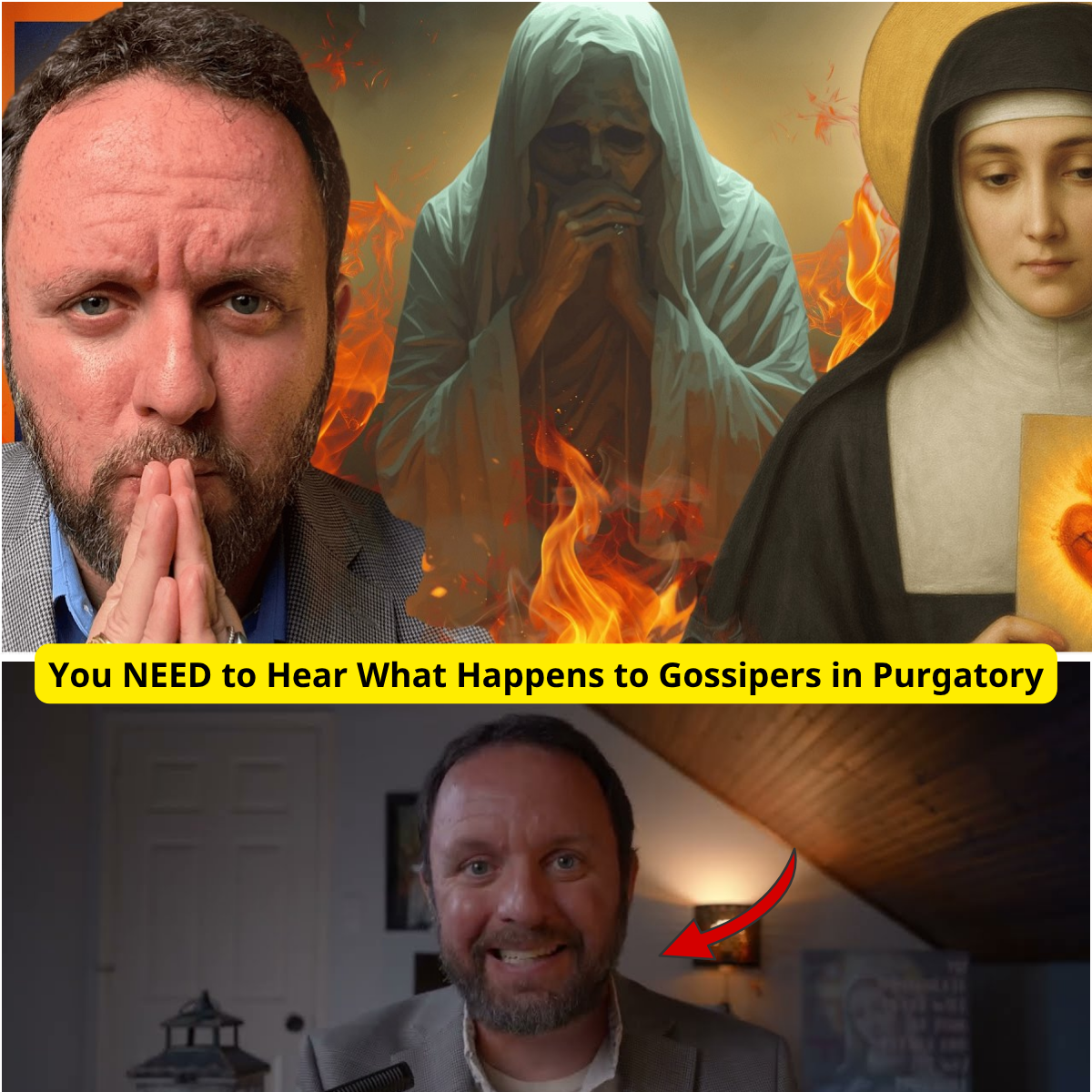
You NEED to Hear What Happens to Gossipers in Purgatory
You NEED to Hear What Happens to Gossipers in Purgatory
The crisp autumn air of Paray-le-Monial, a quiet commune nestled in the heart of eastern France, usually carried the comforting scent of damp earth and burning hearths. But inside the stone walls of the Visitation Convent, the atmosphere was thick with a heavy, suffocating silence. It was the evening of a day that had tested the community’s patience, a day where whispered words had cut sharper than any physical trial.
In the dim light of the convent chapel, Sister Margaret Mary Alacoque knelt before the Blessed Sacrament. Her hands, calloused from hard labor, were clasped tightly against her chest. Her eyes were fixed on the golden monstrance, but her mind was reeling from the heavy burden she carried. Margaret Mary was a soul caught between two worlds—the mundane reality of her convent life, where her fellow sisters often misunderstood and ridiculed her intense devotion, and the blinding, fiery reality of the divine revelations she received from the Sacred Heart of Jesus.
To the world, and even to many in her own community, she was just an eccentric, frail nun. But to the Lord, she was a chosen vessel, a mystic destined to reveal the boundless, burning ocean of His love and mercy. Yet, being a vessel of divine truth meant bearing the weight of immense spiritual warfare.
That evening, the heavy oak doors of the chapel seemed to groan as the wind howled outside. Margaret Mary closed her eyes, trying to drown out the lingering memory of the sharp comments she had overheard in the refectory earlier that afternoon. A couple of the senior sisters had been whispering in the shadows, their voices laced with judgment about a younger novice who had made a minor mistake during prayers. The whispers had traveled fast, like a slow-burning fire catching a dry field, morphing from simple criticism into a full-blown distortion of the young girl’s character.
Margaret Mary sighed deeply. “O Lord,” she prayed silently, “why is the human tongue so quick to destroy what Your grace has built?”
As she sank deeper into prayer, the familiar, supernatural weight of a vision began to press down upon her soul. The physical walls of the chapel seemed to dissolve, replaced by a vast, terrifying expanse of spiritual reality. She was being shown the mystery of Purgatory—the place of final purification, where souls are cleansed of the lingering stains of their earthly failures before entering the unblemished light of Heaven.
The spiritual landscape before her was a mixture of blinding, intense light and agonizing shadow. It was not a place of arbitrary punishment, but of profound, painful truth, where souls finally saw the full, cascading consequences of the choices they had made on earth.
In the center of this vision, Margaret Mary recognized two souls of high standing from the secular world who had recently passed away. They were noblewomen, ladies who had occupied the highest echelons of society in life. In the physical world, they had shared the same wealth, the same privileges, and the same glittering social circles. But here in the realm of purification, their conditions were starkly, dramatically different.
The first noblewoman was enveloped in a dense, dark fog of suffering. Her soul writhed under a unique, agonizing weight. Margaret Mary’s heart broken as she watched her. This woman, while on earth, had used her high social status and sharp wit to rule over her social circles, but her favorite weapon had been the casual destruction of reputations. She had been an avid gossiper, a master of elegant slander, turning a blind eye to the reality that her whispered rumors had systematically ruined the lives, livelihoods, and social standing of her subjects and peers.
Now, she was sentenced to many long, agonizing years in Purgatory. The sheer weight of her time was staggering. But what shocked Margaret Mary the most was not the duration of her punishment, but the law of divine justice operating upon her.
As Margaret Mary watched, a stream of golden light—the spiritual grace of Holy Masses, prayers, and indulgences being offered for the deceased noblewoman by her living relatives on earth—descended into Purgatory. But instead of enveloping the suffering noblewoman to ease her pain, the grace was forcefully diverted. The divine light bypassed her completely and flowed into the souls of the families and individuals whose reputations she had ruined during her life.
A gentle, yet authoritative voice echoed in Margaret Mary’s spirit, explaining the profound mystery: “Every Mass, every prayer, and every indulgence offered for this soul must first go to repair the damage she caused on earth. It must heal the spiritual and temporal wounds of those she slandered. Only after the debt of her gossip is fully satisfied in the lives of her victims will any spiritual credit be given to her, to finally reduce her own time of purging.”
It was a terrifying realization. The noblewoman was entirely helpless, completely dependent on the very people she had looked down upon and destroyed with her words. Her sin was like a shattered pillow thrown from a high bell tower; the feathers of her rumors had scattered across the world, and she could not gather them back.
Then, Margaret Mary’s gaze shifted to the second noblewoman. Her state was entirely different, radiant with a calm, hopeful light. Her sentence was shockingly brief: she was to spend only as many days in Purgatory as she had lived years on earth.
Margaret Mary marveled at this mercy, and the divine voice spoke again: “This soul understood the true virtue of charity. Throughout her life, she deliberately chose to put up with the shortcomings, defects, and annoying faults of her neighbors with a great, patient love. When others gossiped, she defended the absent. When others slandered, she offered a cloak of charity. She conquered her own inner animosity and became a shield for the weak. Because she covered the faults of others with love on earth, my mercy now covers her faults with a swift purification.”
The contrast was a lightning bolt to Margaret Mary’s soul. Sins against charity—specifically the casual, everyday venom of gossip—bound a soul to long, bitter purification, while the active practice of charity and the protection of a neighbor’s reputation acted as a powerful accelerant toward eternal bliss.
The vision shifted, pulling Margaret Mary deeper into the cloistered world she knew so well. The expansive noble estates faded, replaced by the familiar layout of religious life. She found herself looking at two deceased nuns who had lived in a neighboring community.
They were placed in separate spiritual cells of suffering, but the intensity of their purification was wildly disproportionate. One sister was in a state of profound, weeping grief, her soul burning with a deep fire of regret. Margaret Mary felt an overwhelming spiritual connection to her pain.
The suffering nun looked at Margaret Mary, her spiritual voice crying out in agony: “I see it all so clearly now! My eyes have been forced open in the light of truth. When I was on earth, living in community, I constantly lacked charity toward my sisters. I judged their actions, whispered about their flaws, and held onto bitter resentments. I withdrew my affection and friendship from them, creating factions and cold walls within the holy convent.”
The nun’s soul shook with a paroxysm of grief. “And now, my punishment matches my malice. Because I refused to offer love and fellowship to my sisters while on earth, I have spiritually cut myself off from them. I am now entirely unable to benefit from the very prayers and Holy Masses they are currently offering for me from the convent chapel. My coldness has locked me out of the stream of their charity.”
Margaret Mary wept bitterly for the sister. She saw how gossip and a lack of charity weren’t just simple, harmless defects of character that people could laugh about over tea or recreation. They were an infectious, spiritual disease that quietly eroded the Body of Christ. It was a common tragedy, even among the most devout believers—covering up the malice of gossip by framing it as a pious request: “We really need to pray for so-and-so, because did you hear what she did?” It was a deceptive poison, intended to make others esteem a person less, to strip them of love, and to diminish their reputation under the guise of holy concern.
The vision began to fade, leaving Margaret Mary trembling on the cold stone floor of the chapel. The silence of the room felt heavier now, charged with the immense responsibility of what she had just witnessed. She knew she couldn’t keep this truth to herself; she had to offer her own life as an act of reparation for these poor, suffering souls.
Not long after that profound night, during the solemn Feast of Corpus Christi, Margaret Mary was once again kneeling before the Blessed Sacrament, lost in adoration. Suddenly, the peaceful air around her grew incredibly dense, and a figure materialized before her eyes, completely enveloped in roaring, brilliant spiritual flames.
The heat radiating from the spirit was so intense, so physically tangible, that Margaret Mary felt as though her own clothes and skin were catching fire. Her breath caught in her throat, and an abundance of tears streamed down her face at the sheer, pitiable sight of the spirit’s agony.
The soul in the flames looked at her with a mixture of desperation and deep reverence. “Do you remember me, Sister?” the voice resonated within her mind.
Margaret Mary focused through her tears and recognized him. He was a Benedictine monk, a holy priest to whom she had once gone for the Sacrament of Confession. During that confession, he had exhibited a rare spiritual insight, recognizing the authenticity of her soul, and had firmly ordered her to receive Holy Communion despite her intense feelings of unworthiness.
“Because of that holy advice,” the priest’s soul explained, the flames flickering around him, “God has allowed me to have recourse to you in my hour of extreme purification, so that I might obtain some alleviation in my immense sufferings. I beg of you, Margaret Mary—apply everything you do, everything you pray, and everything you suffer for the next three months to my soul.”
Without a moment’s hesitation, and knowing she would need the strict consent of her Mother Superior, Margaret Mary made a solemn promise. “I will bear it for you, Father,” she whispered.
The priest’s soul then revealed the exact reasons for his intense purification in the fires of Purgatory. “My sins were three, hidden beneath a cloak of external holiness,” he confessed. “First, I preferred my own personal interests and comfort to the true glory of God, possessing a far too great attachment to my own reputation among men. Second, I suffered from a distinct want of charity toward my brother monks, harboring silent judgments. And finally, I allowed myself to hold too natural, too human an affection for creatures in my spiritual dealings with them, rather than directing their hearts purely to God. This deeply displeased the absolute sanctity of Divine Love.”
The three months that followed were a living martyrdom for Margaret Mary.
The spirit of the Benedictine monk never left her side. Wherever she walked within the convent—whether she was scrubbing the heavy wooden floors, standing in the choir for the Divine Office, or trying to rest in her small, freezing cell—the priest stood beside her. And on the exact side where he stood, Margaret Mary felt a continuous, burning physical heat, an agonizing sensation of being consumed by an invisible fire.
The suffering was so intense that her tears were continual, and involuntary groans escaped her lips during her duties. Her Mother Superior, observing her frail nun completely overwhelmed by an inexplicable, deeply physical agony, was moved with a profound compassion. Recognizing the spiritual nature of the trial, the Superior ordered Margaret Mary to perform severe external penances, including the traditional monastic discipline.
Remarkably, Margaret Mary found that the sharp, external physical pains imposed upon her by the authority of her superior through holy charity actually brought an immediate, miraculous relief to the intense, burning spiritual pains inflicted upon her by the presence of the purifying soul. It was a tangible demonstration of how acts of intentional, earthly penance could alleviate the immense debts of Purgatory.
At the exact conclusion of the three grueling months, the atmosphere in Margaret Mary’s cell suddenly transformed. The burning, suffocating heat vanished, replaced by a cool, heavenly breeze.
The Benedictine monk appeared before her once more, but he was no longer enveloped in terrifying flames. Instead, he was bathed in a radiant, blinding light of pure joy and celestial glory, standing on the very threshold of being admitted into eternal bliss. He looked at her with an expression of boundless gratitude.
“Thank you, my faithful sister,” he said, his voice like music. “Your charity has broken my chains. I promise you, from this moment forward, I will be your fierce protector and intercessor before the throne of Almighty God.”
As the vision dissolved, the physical illness that had plagued Margaret Mary during those three months instantly left her body. She stood up, fully recovered, her heart bursting with a profound understanding of the power of intercessory love.
As the years progressed, Margaret Mary was appointed as the Mistress of Novices, tasked with forming the young, fragile souls entering the convent. She modeled her instruction entirely on the lessons of the Sacred Heart—gentleness, humility, and an absolute, unyielding commitment to charity in speech.
One afternoon, the father of one of her young novices passed away rather suddenly. The young girl was entirely devastated, weeping in her cell, deeply worried about the eternal state of her father’s soul. Moved by her maternal affection and the virtue of holy charity, Margaret Mary promised the novice that she would dedicate her personal prayers to the deceased man.
A few days later, the novice approached Margaret Mary again, her eyes red from crying, gently repeating her request for prayers.
Margaret Mary looked at the young girl with a serene, radiant smile, gently taking her hands. “Be completely satisfied, my child,” Margaret Mary said with absolute certainty. “Your father is already in a state to benefit us by his prayers, instead of needing ours. His purification is complete.”
The novice blinked in shock, a look of disbelief crossing her face. “So soon, Mother?”
Margaret Mary nodded gently. “Go and ask your mother, when you next see her, what generous, selfless action your father performed right before his death. For it is that specific act of Christian virtue that made the judgment of God incredibly favorable to him.”
The novice had to wait many months until the solemn day of her religious profession to finally see her mother. The moment they were reunited in the convent parlor, the young nun eagerly asked about her father’s final hours.
The mother’s eyes welled with tears as she recalled the memory. “Ah, my child, it was a beautiful thing. When the priest arrived at our home to give your father the Holy Viaticum, a local butcher from the town—a man of very low social standing, with whom your father had been involved in a bitter, public argument weeks prior—joined the small procession to accompany the Blessed Sacrament. He stood quietly, hiding in the far corner of the sickroom, looking terribly ashamed.”
The mother smiled through her tears. “Your father, perceiving him there, stopped the prayers. With the last of his physical strength, he called the butcher by his name and told him to approach the bed. In front of everyone, your father cordially pressed the man’s hand, looked him in the eyes, and asked his pardon with a profound, deep humility that is very unusual for a man of his high rank and wealth. He wanted everyone in the town to witness his absolute satisfaction and desire for peace before he met his Maker.”
When the novice returned to the cloister, her heart was filled with a safe, profound awe. She realized that Margaret Mary had learned of this secret, hidden event through the promptings of God alone, confirming the absolute truth of her spiritual insight. That single, monumental act of humility and public reconciliation had completely disarmed the strict justice of God, unlocking a swift entry into eternal life.
Sitting in her cell that night, Margaret Mary felt a profound desire to capture the essence of everything the Sacred Heart had taught her through these encounters. She dipped her quill into ink, determined to compose a prayer that would act as a refuge for frail human hearts, a prayer that would root out the toxins of gossip, pride, and animosity, transforming human weakness into divine love.
She wrote the words slowly, her heart beating in unison with the rhythms of grace:
“O Sacred Heart of my Lord and Savior Jesus Christ, to Thee I consecrate and offer up my person and my life, my actions, trials, and sufferings, that my entire being may henceforth only be employed in loving, honoring, and glorifying Thee.
This is my irrevocable will: to belong entirely to Thee, and to do all for Thy love, renouncing with my whole heart all that can displease Thee. I take Thee, O Sacred Heart, for the sole object of my love, the protection of my life, the pledge of my salvation, the remedy of my frailty and inconstancy, the reparation for all the defects of my life, and the secure refuge at the hour of my death.
Be Thou, O most merciful Heart, my justification before God Thy Father, and screen me from His anger, which I have so justly merited. I fear all from my own weakness and malice, but placing my entire confidence in Thee, O Heart of love, I hope all from Thine infinite goodness.
Annihilate in me all that can displease or resist Thee. Imprint Thy pure love so deeply in my heart that I may never forget Thee or be separated from Thee. I beseech Thee, through Thine infinite goodness, grant that my name be engraved on Thee; for in this I place all my happiness and all my glory, to live and to die as one of Thy devoted servants. Amen.”
Margaret Mary laid down her pen, looking out her small window at the quiet French night. She knew the spiritual battle against the sins of the tongue and the coldness of the world would continue. But she also knew that within the burning furnace of the Sacred Heart, every broken, fragile human soul could find the strength to choose charity, to protect their neighbor, and to finally be transformed into the image of love itself.