Former Muslim’s Testimony Shakes America: Friendship, Bible Evidence, and the Dream That Changed Everything
Former Muslim’s Testimony Shakes America: Friendship, Bible Evidence, and the Dream That Changed Everything
Virginia Beach, Virginia — A resurfaced testimony from the late Christian apologist Nabil Qureshi is once again gripping American faith audiences, drawing millions into a story of friendship, evidence, family heartbreak, and one of the most painful decisions a devout Muslim can make: leaving Islam to follow Jesus Christ.
The account, now spreading through Christian media circles, is not framed as a quick conversion story or a viral debate victory. It is far more dramatic than that. It is a slow collision between two worlds — Islam and Christianity, family loyalty and personal conviction, inherited identity and historical investigation.
Qureshi begins with a memory familiar to many Muslim Americans who grew up after September 11. His identity was not casual. It was formed in a home where Islam was faith, family, honor, discipline, and belonging. As a young Muslim, he saw himself as someone who could defend Islam in the West, correct misconceptions, and show Americans that Muslims were not terrorists, but faithful, moral, loving people.
That mission mattered deeply.
Then came college.
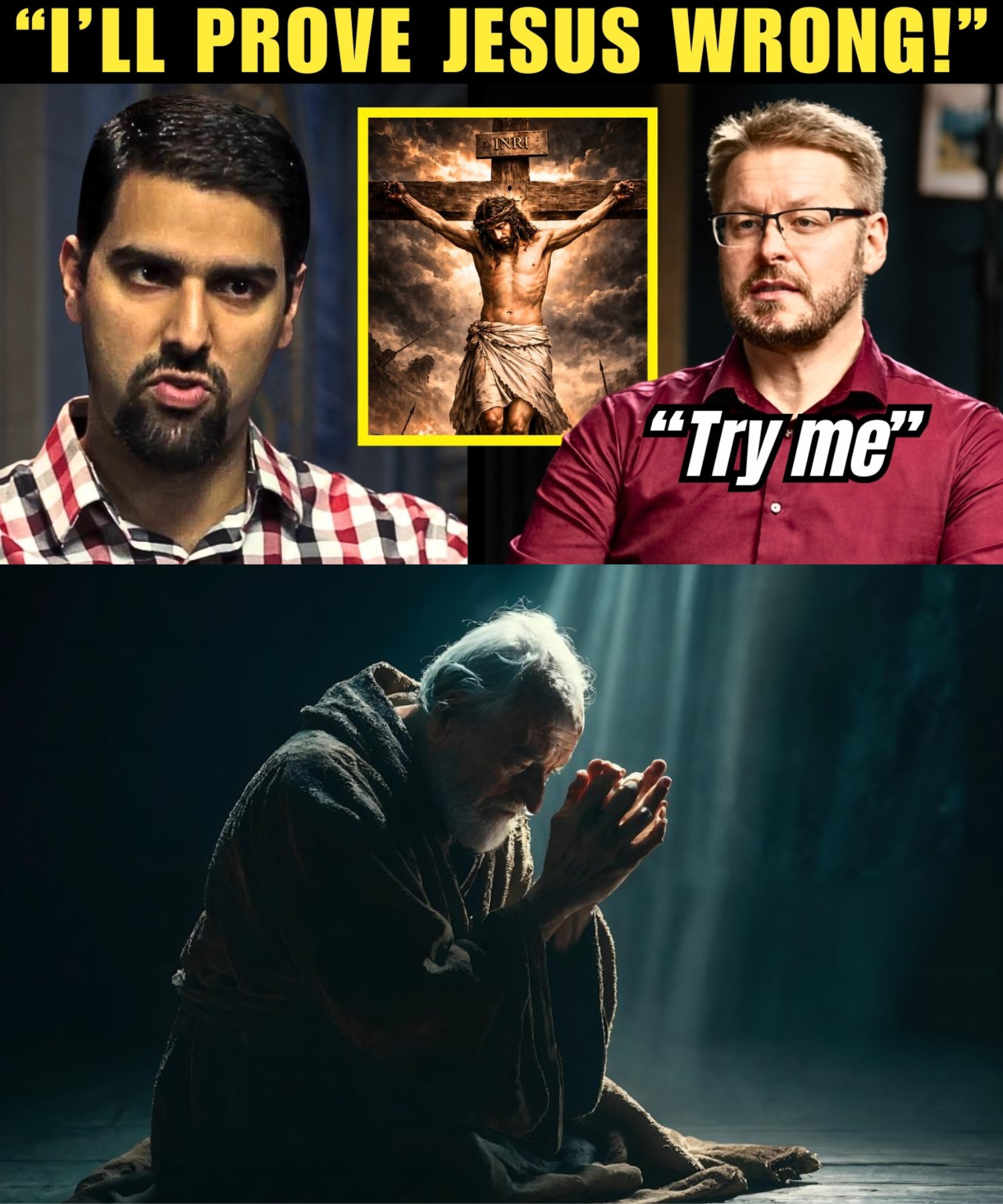
According to Qureshi’s testimony, the turning point began with a Christian friend named David. The two were sharing a room during a public speaking and debate tournament when Qureshi noticed David reading the Bible. Qureshi thought it would be an easy takedown. He had already challenged other Christians before. He knew the argument: the Bible had been translated too many times, copied too many times, altered too many times. Jesus spoke Aramaic, the New Testament was written in Greek, later preserved in Latin, then translated again into European languages. How could anyone know what the original message really said?
For many Christians, that argument had worked.
David did not collapse.
Instead, he asked Qureshi a question that stopped him cold. If Qureshi could speak to his mother in one language and accurately tell David in English what she had said, was that automatically a corrupted translation? Of course not. A multilingual person can preserve meaning across languages. David then argued that the New Testament was not dependent on one fragile translation chain. It had thousands of Greek manuscripts, thousands more early translations, and tens of thousands of quotations from early Christian writers.
Qureshi said he thought David was making it up.
But the challenge had begun.
The two men started arguing constantly — not as enemies, but as friends. They studied together. Took classes together. Went to each other’s homes. Over time, they became close enough that Qureshi would later say he knew David would take a bullet for him. That trust became crucial. Because when someone asks you to reconsider your entire worldview, evidence alone may not be enough. You also need to know that person loves you.
The first crack came after nearly a year of studying New Testament manuscripts.
Qureshi reached a conclusion he had not expected: the New Testament could not have been uniformly and undetectably changed. The manuscript tradition was too broad, too early, and too widely distributed for a central authority to alter everything without detection.
But that did not make him Christian.
It only raised the next question: did Jesus claim to be God?
For a Muslim, this was the most dangerous issue. Islam honors Jesus as Messiah and prophet, but it firmly rejects the idea that Jesus is God or the Son of God. Qureshi says that, from his childhood, he had been taught that calling Jesus divine was blasphemy.
Then he read John.
“In the beginning was the Word, and the Word was with God, and the Word was God.” Later, “the Word became flesh.” For Qureshi, this was shocking. He tried to dismiss it by arguing that John was speaking, not Jesus. Then he encountered Jesus’ own words in John 8:58: “Before Abraham was, I am.” David pointed him back to Exodus 3:14, where God reveals himself as “I Am.”
Then came John 20:28, where Thomas addresses Jesus as “My Lord and my God.”
Qureshi kept searching for escape routes.
When he moved from John to Mark, the earliest Gospel by many scholarly views, he found another crisis. In Mark 14:62, Jesus responds to the high priest with language that evokes Daniel’s “Son of Man” and divine authority. The high priest tears his robes and declares blasphemy. To Qureshi, the implication became unavoidable: the charge against Jesus made sense only if his words were understood as a divine claim.
The investigation now became personal.
Christianity, Qureshi realized, stood on two core claims: Jesus is Lord, and God raised him from the dead. If Jesus claimed divinity but remained dead, the claim failed. If he rose from the dead, the resurrection vindicated him.
Qureshi began studying the historical case for the resurrection. He said the evidence for Jesus’ death by crucifixion was especially difficult to avoid because even many non-Christian scholars accept it as one of the strongest historical facts about Jesus’ life. That placed him in direct tension with the Quranic denial, as traditionally understood, that Jesus was killed by crucifixion.
Then David challenged him again.
Qureshi had examined Christianity critically. But had he examined Islam with the same skepticism?
That question became devastating.
He began comparing the evidence for Muhammad, the Quran, Islamic history, and the claims he had accepted from childhood. He says that when he applied the same critical standard, the case for Islam began to crumble. He saw that the earliest biography of Muhammad came much later than the earliest sources for Jesus. He questioned claims of Quranic preservation, scientific miracles, and prophecy. He concluded that the Muhammad of historical sources looked different from the Muhammad of Muslim devotion.
But accepting Christianity was not simply an intellectual decision.
It meant devastating his family.
Qureshi describes the honor-shame world of many Muslim families, where leaving Islam can feel like destroying generations of family honor. He feared not only losing his parents’ approval, but humiliating them before the community. He also pointed to traditional Islamic teachings on apostasy, which in many classical schools could carry severe consequences. For him, conversion meant losing everything.
So he prayed.
As a Muslim, he had been taught that dreams could be a form of divine guidance. He asked God for dreams. He says he received one vision and three dreams, including one that became central to his conversion.
In that dream, he stood before a narrow door leading to a feast. He wanted to enter, but his friend David was in the way. Qureshi asked, “I thought we were going to eat together.” David replied, “You haven’t responded.”
When Qureshi called David, his friend told him to read Luke 13. There, Jesus speaks of making every effort to enter through the narrow door before it closes.
Qureshi said the dream placed him inside the parable.
Still, he asked for more.
Eventually, in deep emotional turmoil, he opened the Quran looking for comfort and found none that spoke to his pain. Then he opened the Bible. In Matthew 5, he read, “Blessed are those who mourn, for they shall be comforted.” The words felt personal, alive, addressed to him. Later, Matthew 10 confronted him with the cost: whoever loves father or mother more than Christ is not worthy of him; whoever does not take up the cross is not worthy.
That was the moment.
Qureshi prayed, submitting to Jesus and accepting his death and resurrection.
But the emotional earthquake came later, when his parents learned of his decision. He describes his father, a veteran of the U.S. Navy, breaking down and saying it felt as if his backbone had been ripped out. His mother, he said, looked as if the light had gone from her eyes.
Qureshi collapsed before God, asking why he had not been allowed to die before causing his family that pain.
Then, he says, the answer came: “This is not about you.”
That sentence changed his understanding of the Gospel. Christianity was not merely a doctrine to believe. It was a life to surrender. If God had entered the world, suffered, and died for sinners, then following Jesus meant loving others sacrificially, even when it cost everything.
That is why the testimony still shakes American audiences.
It is not a story about winning an argument.
It is a story about truth becoming costly.
And it leaves one question burning for every viewer, Muslim, Christian, skeptic, or seeker:
If the evidence leads somewhere painful, are you still willing to follow it?