She Helped an Old Man Every Day — Until His Grandson Walked In With Lawyers and Changed Everything…
She Helped an Old Man Every Day — Until His Grandson Walked In With Lawyers and Changed Everything…
The glass pot of regular decaf was always heavier than the high-octane blend, dense with the unglamorous weight of an late October morning in upstate New York. At 6:58 AM, the mist off the Mohawk River still clung to the bottom four inches of the diner’s plate-glass windows, turning the passing headlights on State Route 5 into soft, yellow blurs.
Mara Brennan moved between the vinyl booths with the flat, frictionless stride of someone who had spent six years calculating the exact distance between the toaster station and the pass-through window. She was twenty-eight, though her shoulders carried the specific, unyielding alignment of an older woman—a posture she’d inherited during the twenty-four months she spent lifting her mother from a specialized hospice bed before the final stack of medical invoices arrived to clear out her remaining savings account and her grandfather’s land lease.
“You know what I miss most?”
The voice was thin, carrying the dry, papery rattle of a radiator that hadn’t been bled since the winter of ninety-four. It came from the back corner booth—the one beneath the copper-colored mirror where the laminate table was slightly loose at the floor bolts.
Mara stopped, her right forearm balanced against the weight of the Pyrex rim.
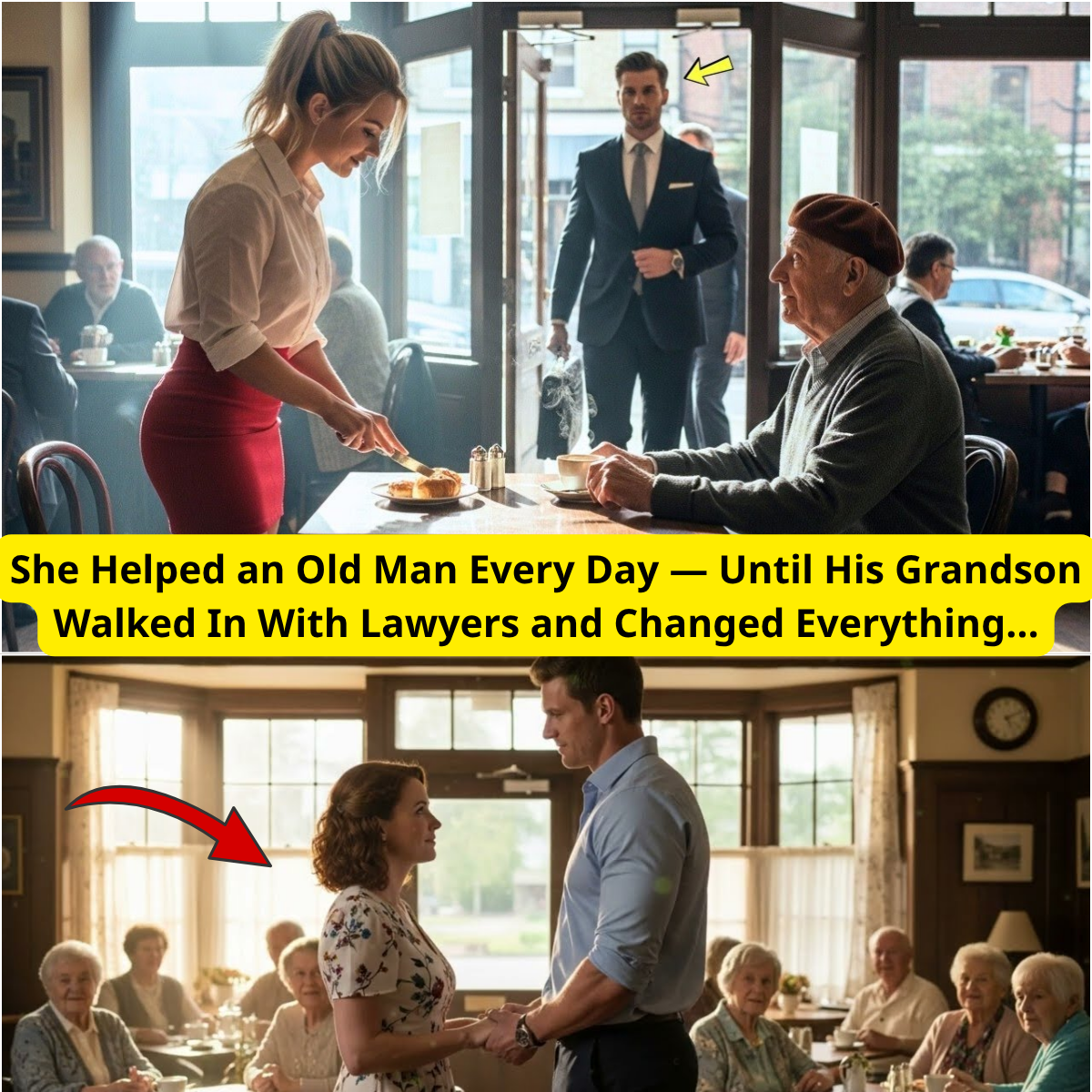
Walter Finch was eighty-one, though his cardigans always looked like they belonged to a ninety-year-old man who had shrunk during the wash cycle. His hands, marked by the thick, bluish ropes of senile purpura along the knuckles, were trembling with a small, rhythmic vibration as he tried to unfold the morning edition of the Daily Gazette. It was more of an administrative gesture than a literacy exercise; his eyes had been failing since the previous spring, the lenses of his bifocals thick enough to distort his pupils into large, pale marbles.
“What’s that, Mr. Finch?” Mara asked. She didn’t use her waitressing voice—that high, bright soprano that usually guaranteed a twenty percent return from the truckers at the counter. She spoke into the quiet pocket of the booth.
“Someone remembering how I take it,” Walter said, his eyes remaining fixed on the tiny print of the legal notices. “The girl at the drive-thru down by the bypass… she just hands the cup through the window in a cardboard sleeve. It’s got a plastic lid with a little tab. You have to pull the tab with your teeth if your fingers don’t work. Dorothy used to… well. It doesn’t matter.”
Mara looked down at the dark circle of the coffee in her pot. Six years ago, she was supposed to be finishing a degree in structural engineering at Syracuse. She knew about margins. She knew about the small, invisible points where a beam fails because the load wasn’t distributed properly across the bearing plate.
“Two sugars, Mr. Finch,” she said, her voice dropping into the gap between his newspaper and the Formica. “No cream. And you fold the sports section under the front page first, even though you always check the county obituaries before you look at the box scores.”
Walter’s hands stopped their small, rhythmic twitching. The newsprint gave a dry, soft crackle as he lowered it three inches. His eyes, a faded, washed-out blue that looked like denim that had spent too many summers on a clothesline, came up to hers. They were bright with that sudden, terrible moisture that old men spend their entire lives trying to swallow down.
“You… you notice that?” he asked.
“Everyone deserves to be noticed, Mr. Finch,” Mara said, tilting the pot until the dark amber liquid filled his heavy ceramic mug precisely to the quarter-inch margin below the rim. “It’s the only thing that doesn’t cost extra around here.”
The Fragments
By December, the 7:15 AM arrival had become the fixed point around which Mara’s entire Tuesday shift rotated.
Walter would appear through the glass vestibule exactly three minutes after the county bus cleared the intersection, his black oxford shoes polished to a high, military gloss that didn’t match the frayed cuffs of his trousers. He never ordered the large breakfast platters—the lumberjack specials or the three-egg omelets that the line cooks liked to throw together. He ordered two slices of white toast, dry, and a single scrambled egg that he broke apart with the side of his fork into small, identical squares.
His check was always eight dollars and forty-five cents. He always left a crisp, five-dollar bill folded into a small triangle under the base of the sugar caddy.
“People have lives, Mara,” he told her one morning when the snow was coming down in thick, wet flakes that turned the parking lot into a gray salt marsh. He was speaking about his son, a senior vice president for a logistics firm out in King County who hadn’t been east of the Mississippi since the funeral three years ago. “Marcus—my grandson—he sent a postcard from Cabo San Lucas for Christmas. It had a picture of a marlin on the front. He’s a smart boy. Very busy. He works forty-eight hours a week in an office with a view of the harbor. I don’t blame him for not calling. When you’re moving that fast, the scenery behind you just looks like a blur.”
“Scenery shouldn’t include your grandfather, Walter,” Mara said, wiping down the chrome border of the jukebox next to his booth.
“I’m just in between chapters now,” he said, his voice level, almost clinical, as if he were describing a piece of probate real estate that had stayed on the market too long. “Waiting for the epilogue. The house is very quiet. Sometimes I leave the television on in the guest room just so I can hear the sound of boots on a floorboard when I’m in the kitchen.”
Mara reached across the counter, her fingers, rough from the industrial sanitizer and the cold rinse water, catching the thin, dry ridge of his wrist. “Maybe it’s not an epilogue, Walter. Maybe the ink just needs a minute to dry before the next section starts.”
She began the small adjustments that don’t appear on a time card. She’d arrive ten minutes before her shift to intercept the delivery driver, ensuring the only unwrinkled copy of the local paper was set aside behind the pie case before the gravel haulers could grease it up with their thumbs. If the morning rush grew loud, she’d place her own plastic coat-check tag on the table of booth four, telling the manager it was reserved for an insurance adjuster who never arrived.
On the third Tuesday of January—a date Walter had let slip weeks before while complaining about the price of his prescription renewal—she brought out a wedge of Dutch apple from the back cooler. It wasn’t the diner’s stock; she’d baked it in her own apartment the night before using lard she’d rendered herself, the crust flaky enough to shatter under a plastic fork. She’d stuck a single, blue birthday candle into the center of the crumb topping.
Walter didn’t blow it out immediately. He sat looking at the little yellow flame until the wax began to pool on the cinnamon. When he finally looked up, his cheeks were wet, the tears running down into the white stubble of his jaw without any resistance from his muscles.
“You’re the only one who remembered, Mara,” he whispered, his voice cracking on the consonants. “The only one in three years.”
The Absence
The breakdown of an old machine doesn’t happen all at once; it happens in the tiny clearances where the oil runs thin.
By March, Mara noticed that the five-dollar triangles under the sugar caddy were folded less precisely, the edges uneven. Walter’s shoes had lost their high gloss, showing the salt-stains from the town sidewalks along the welts. Then came the aluminum cane—the cheap kind with the four-pronged gray rubber base that made a rhythmic, clack-thud sound against the linoleum every time he cleared the door.
One Tuesday morning, the clock above the counter hit 7:30. Then 7:45.
The county bus had gone by twice, its exhaust leaving two black plumes in the slush, but booth four remained empty, the unwrinkled copy of the Gazette sitting face-down on the counter next to the butter tubs.
Mara worked the rest of her shift with a tight, cold knot sitting just behind her apron string. At 2:15 PM, she didn’t punch out; she walked past the manager’s station without looking at him, her coat still half-zipped as she hit the gravel lot.
She found the address in the old yellowed directory that Rosy kept under the kitchen ledger. The house was a small, green-shingled cape on Elm Street, sitting behind a row of overgrown privet hedges that hadn’t seen a pair of shears since Dorothy’s knees had given out in the nineties. The porch steps were covered in a thin skin of clear ice, and the morning mail was still sticking out of the tin box by the door like a row of white tongues.
She knocked three times, her knuckles stinging against the cold oak.
When the lock finally turned, it was a slow, agonizing process of latch and deadbolt. Walter stood in the hallway, wearing a pair of faded flannel pajamas that hung off his collarbones like a drop-cloth over a sawhorse. His face was gray, the skin beneath his eyes dark and bruised from a lack of circulation.
“I fell, Mara,” he said before she could ask. He looked down at his own bare feet, his toes curled against the cold linoleum of the entry. “No fractures. Just… the floor was very far down today. I couldn’t quite get the leverage to get back up until noon. I’m just tired. So very tired.”
Mara didn’t go back to her apartment that afternoon. She went to the grocery store on Third Avenue, bought three quarts of whole milk, a bag of potatoes, and a box of those generic saltine crackers that dissolve easily in broth.
Over the next three weeks, her schedule ceased to belong to the diner. She cut her hours back to the early morning shift, leaving by eleven to spend her afternoons in the small, overheated kitchen on Elm Street. She organized the orange plastic prescription bottles that sat on his nightstand like a tiny, confusing city; she read him the obituaries from the Gazette, her voice steady as she parsed through the names of men who had served in the same guard unit or worked at the old locomotive plant before the furnaces went dark.
The diner manager, a man named Henderson whose entire philosophy of human relations was based on the kitchen labor percentage, cornered her behind the ice machine one Friday morning.
“You’re missing the noon turn, Brennan,” he said, his red face slick with grease from the grill vent. “I can’t keep your station open for a girl who’s running an unsanctioned home care service on company time. You want to be a nurse, go to school. You want to work here, you stay till two.”
“He doesn’t have anyone else, Henderson,” Mara said, her hands continuing to count out the silver spoons for the setup trays.
“That’s not my line on the ledger,” he said.
That evening, as the light through Walter’s bedroom window turned the color of an old bruise, the old man called her over from the doorway. His breathing had become shallow, a dry, clicking sound that came from the top of his throat.
“Why do you do this, Mara?” he asked, his voice barely lifting above the hum of the small space heater in the corner. “You don’t owe an old surveyor anything. You have your own rent. Your own life.”
Mara reached down and adjusted the heavy wool quilt—the one Dorothy had quilted from old flannel shirts forty years ago—pulling it up until it covered his thin shoulders. She didn’t wipe the tears that had started to slide down her nose; she let them hit the wool.
“Because someone should, Walter,” she said. “Because you’re here. Because kindness isn’t an account you settle when you have an extra five dollars in your pocket. It’s the only thing that keeps the frost from getting through the walls.”
The Grandson
Walter Finch died on a Thursday morning, three weeks before the river ice broke.
The notification didn’t come from a doctor or a lawyer; it came from the hospice nurse who had been assigned to the case after Mara had spent four hours on the phone with the county social services office. Walter had listed the diner’s number and “Mara (Booth 4)” on his intake form under the section marked Primary Kin or Responsible Representative.
She stood in the back storeroom among the boxes of paper napkins and gallon jugs of pancake syrup, her apron over her face, crying for twenty minutes until her lungs felt like they had been scraped with steel wool. She had known him for four months, but in the specific geography of her life, he had become the only person who didn’t look at her as a machine that delivered eggs and collected change.
The funeral at the cemetery on the ridge was a sparse, cold affair. The wind off the river was high, flapping the corners of the green artificial grass that the undertakers had laid down over the frozen mud. There was Mara, the hospice nurse, and three neighbors from Elm Street who had come mostly to see if the house was going to be listed for sale before the spring thaw.
As the pastor began the final committal service, the gravel driveway behind the oak trees rattled with the sound of a high-end European sedan.
A man in his early thirties stepped out, his coat a heavy, dark gray cashmere that looked entirely too clean for the county line. He was holding a late-model smartphone in his right hand, his thumb working the screen until he reached the edge of the tent. His hair was cut into that sharp, expensive style that requires an appointment three weeks in advance.
“I’m Marcus,” he said, his voice breathless, carrying the thin, nasal clip of the West Coast. He didn’t look at the casket; he looked at the five people standing under the canvas canopy. “Marcus Finch. Walter’s grandson. I got the flight from Seattle last night, but the connection in Chicago was delayed two hours. Where is everyone? Did the rest of the family go to the church?”
Mara turned her face toward him. Her eyes were red, her nose swollen from the cold wind, but her mouth was a flat, hard line that made Marcus stop three feet short of the grass border.
“You’re looking at them, Mr. Finch,” Mara said. Her voice didn’t carry across the ridge; it stayed right between them, cold and heavy as a wet shingle. “This is everyone. We’re all he had left.”
Marcus’s face flushed a sudden, mottled purple that ran from his silk tie up into his ears. He looked at his phone, then down at his own leather shoes, which were already caked with the yellow clay of the ridge. “I had the quarterly reviews… I couldn’t get the authorization for the leave before Wednesday. He… he always told me he was doing fine in his letters.”
“He died alone, Marcus,” Mara said quietly, her voice finally breaking on his name. “He spent three years waiting for someone to remember that he still used two sugars. Now please step back. The pastor isn’t finished.”
The Yellow Envelope
Mara assumed that was the conclusion of the ledger. She went back to the diner, took her extra shifts back from the relief girl, and spent her evenings staring at the wall of her apartment, the silence there feeling slightly heavier now that the telephone didn’t ring at four o’clock.
Two weeks later, the glass door of Rosy’s Diner clicked open at 2:30 PM—the dead hour between the lunch rush and the dinner setups. Marcus Finch entered, flanked by two men in dark blue suits who carried matching leather briefcases with combination locks on the brass latches.
Mara’s heart dropped into her shoes. She’d spent enough time around the county courthouse during her mother’s illness to know what those briefcases meant. It was the estate fight—the long, ugly process where distant relatives appear out of the woodwork to claim the pewter spoons and the old furniture, looking for anyone who had been near the old man’s checkbook during his final months.
“Miss Brennan,” the older of the two lawyers said, his voice formal as he took his coat off and laid it over the back of booth four. “We’re here on behalf of the estate of Walter Finch. We need to review the codicil to his will.”
Mara wiped her hands on her apron, her knuckles turning white against the cotton. “I don’t want his money,” she said, her voice shaking with a sudden, hot anger. “I didn’t take a dime from him. The five-dollar tips are in the jar by the register if you want to count them. I just wanted him to have someone in the room when his breathing changed.”
Marcus stepped forward, his gray cashmere coat open, revealing a wrinkled shirt underneath. The expensive, executive clip was gone from his posture; his shoulders were hunched, and his eyes had that raw, hollow look that Mara recognized from her own reflection after the hospice van had left her mother’s house.
“Miss Brennan,” Marcus said, his voice very low. “My grandfather left you the deed to the Elm Street property. The house is yours. The probate is already clear.”
Mara blinked, the chrome edge of the pie case behind her feeling suddenly cold against her shoulder blades. “What?”
“But that’s not why we came down here from the office,” Marcus continued, his hand reaching into his coat pocket to pull out a long, legal-sized envelope that had turned yellow around the adhesive flap. “He left a letter for me. He gave it to the hospice attorney four days before he passed. The instructions said I had to read it here. In this booth. With you sitting across from me.”
They sat down. The two lawyers remained standing by the counter, looking at the daily special board with that professional detachment that costs four hundred dollars an hour.
Marcus’s fingers trembled as he broke the wax seal on the back of the yellow paper. His voice was thin as he began to read, his eyes staying fixed on his grandfather’s ragged, uneven script.
“Marcus,” the letter read. “If you’re holding this, the surveyor has finished his lines. I don’t blame you for the time you spent in Seattle. I know how the world works now—everything is based on speed, everything is based on the volume of the return. I was an old man with a broken cane, and old men don’t show up on a quarterly spreadsheet.
But I want you to know about Mara Brennan. She’s a girl who works sixty hours a week for eight dollars and forty-five cents an hour plus whatever the truck drivers leave on the counter. She has no stock portfolio. She doesn’t own a car that works when the temperature drops below zero. And yet, every Tuesday morning at 7:15, she gave me the only thing that had any value left in this county.
She gave me her attention, Marcus. She remembered my coffee. She remembered the day I was born when my own son was in Cabo San Lucas. She saw me when I had become completely transparent to every other person in this township, including the boy I taught to fish down by the creek.
I’m leaving her the house because the walls need someone who knows how to stay in a room. She gave me my dignity back for the final section of the book, and you can’t buy that with a vice president’s bonus.
Learn from her, Marcus. Success is nothing but a cold room if you’re too busy to see the people who are sitting in the corner. Wealth is a statistical error if you can’t remember how someone takes their coffee. Be better than the system taught you to be. Be more like the girl in the apron.”
Marcus stopped reading. The paper gave a sharp, dry rattle as his fingers lost their grip, the yellow sheet sliding across the Formica until it touched Mara’s sugar dispenser. He didn’t cover his face; he just sat there in the orange neon light, the tears running down into his expensive collar, his chest shaking with a silent, devastating grief that had arrived four months too late.
“I was trying to make him proud,” Marcus whispered, his fingers curling into his palms until his knuckles went gray. “I thought… I thought if I made partner by thirty, he’d see that the family had made it out of the valley. I forgot to just sit with him. I forgot the house had a porch.”
Mara reached across the table. She didn’t take his hand—not yet—but she laid her palm flat on the newsprint that still sat between them.
“He knew you loved him, Marcus,” she said softly, her own tears leaving two clear circles on the laminate. “He just needed to feel the weight of it while he could still lift the cup.”
Walter’s Corner
The transition of the Elm Street house didn’t happen during the spring thaw; it happened during the heat of August.
Marcus didn’t go back to Seattle, except to sign the lease termination on his apartment overlooking the harbor. He took a position with a small municipal consulting firm in Albany, forty-five minutes down the river road, cutting his hours back until his calendar had actual gaps in the afternoon.
They didn’t sell the cape. They didn’t put a “For Sale” sign behind the privet hedges.
Instead, over the course of six months, they gutted the interior of the first floor, removing the high, dark paneling and replacing it with wide, low tables made from the old cedar beams of the barn down by the creek. They called it Walter’s Corner. It wasn’t a clinic, and it wasn’t a senior center with a sign-in sheet and a state budget; it was just a house where the door was unlocked at six in the morning, and where the coffee was always brewed in heavy ceramic mugs that didn’t have plastic lids.
One year after the funeral, Mara stood by the new bay window, looking out at the crowded front room.
There were twelve people sitting under the copper-rimmed mirrors they’d salvaged from the diner—three retired railroad workers who had spent the last five years sitting on park benches, an older woman named Mrs. Gable whose husband had died in the VA hospital back in May, and two men from the municipal yard who had stopped in just to see if the rumors about the free Dutch apple pie were true.
Marcus walked up behind her, his sleeves rolled up to his elbows, a fresh pot of regular decaf held in his right hand. He didn’t wear the cashmere coat anymore; he wore a faded denim shirt that showed the grease stains from the new commercial toaster they’d installed in the pantry.
“Do you think he sees them?” Marcus asked, his voice dropping below the sound of the spoons against the saucers. “Do you think he knows he changed the whole block?”
Mara turned, her hand sliding into his—not with the sudden heat of a new romance, but with the heavy, durable partnership of two people who had spent a winter clearing out the same house.
“I think he always knew, Marcus,” she said, her smile small and steady against the window glass. “He just needed someone to prove the math worked before he turned the page.”
An elderly woman with a faded blue cardigan—the kind with the pearl buttons that are always slightly loose—approached the window station, her empty cup held between two shaking hands.
“Excuse me, dear,” she said, looking at Mara’s apron. “How do you take yours? I’re going to bring the next round from the kitchen.”
Mara’s breath caught for a fraction of a second, her fingers tightening around Marcus’s hand.
“Two sugars, ma’am,” she said. “No cream. And fold the paper first.”
“Two sugars,” the woman muttered, her head nodding as she turned back toward the stove. “I’ll keep that on the register. Everyone deserves to be remembered.”
And as the sun finally cleared the ridge behind the river, turning the fog on Elm Street into a long, golden ribbon, Mara understood that the ledger was finally balanced. We don’t leave monuments behind us in the valley; we leave the small, daily rituals of our survival—the names we check, the birthdays we mark with a single blue candle, and the quiet, unblinking certainty that someone in the room knows exactly how much sweetness you need to get through the morning.