Muslim Doctor HID Christians for 47 Days… Then God Showed Up | Christian Testimonies
My name is Dr.
Ysef Al- Masri.
I am 48 years old.
And what I am about to tell you today changed everything I thought I understood about God, about faith, and about what one ordinary man can do when heaven asks him to risk his life.
Three years ago, in the basement of my small medical clinic in Gaza City, I hid 12 Christians for 47 days while armed men searched the streets above us.
I fed them with what little I had.
I treated their wounds.
I held their children when they cried in the dark.
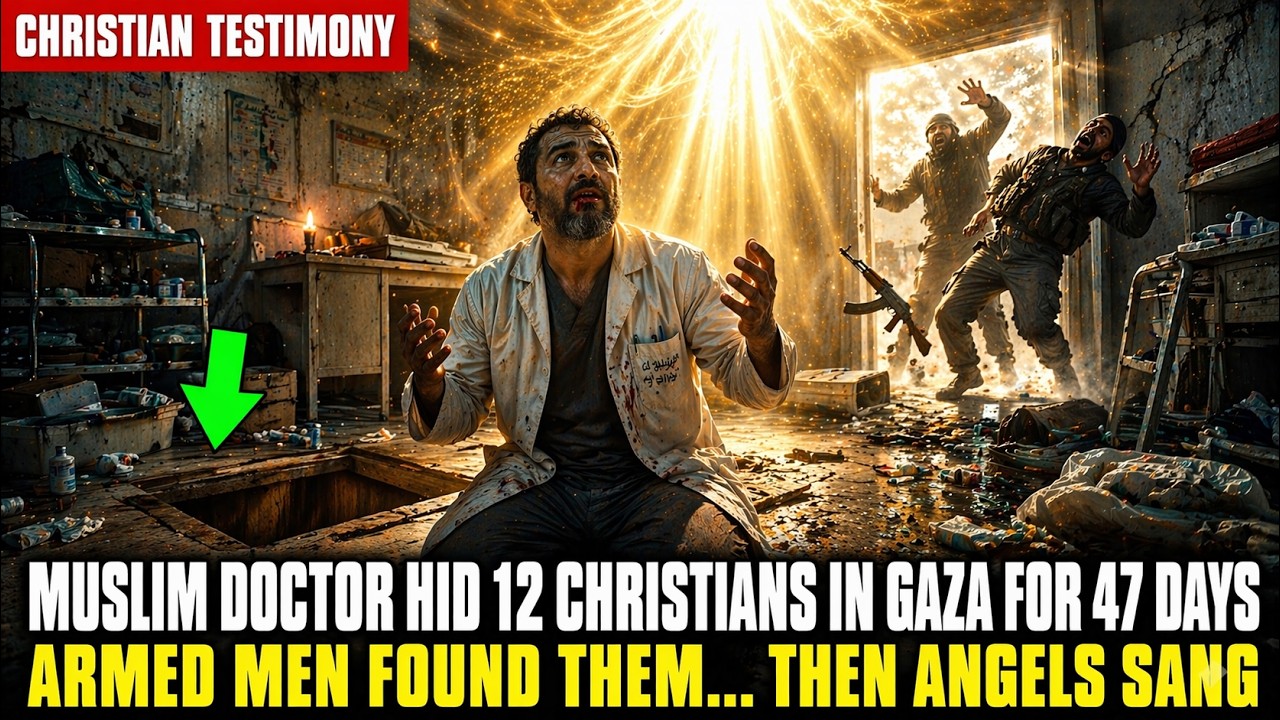
And on the 47th night, when the men with rifles finally found us, when they dragged me out by my collar, and pressed a gun to my head, and demanded I hand over the believers hiding beneath my examination room, what happened at that moment defies all human explanation.
What those armed men witnessed, what we all heard and saw in the flood lit alley behind my clinic, is something that no military training, no political ideology, and no earthly logic can account for.
I swear by everything I now hold sacred, that every word you are about to hear is completely true.
Every detail is burned into my memory as though it happened last night.
Are you ready to hear how the God of heaven protected his children in one of the most dangerous places on earth and transformed the heart of a man who never believed in miracles? Like this video if you want me to continue sharing these testimonies of faith in the midst of persecution.
I was born in 1977 in the Riml neighborhood of Gaza City.
My father Ibrahim al- Mazri was a respected pharmacist who ran a small shop near the Alshifa hospital complex.
My mother Fatima was a school teacher who taught Arabic and mathematics to primary school children.
We were a comfortable family by Gazan standards, not wealthy but stable.
My father owned our apartment outright.
We had enough to eat.
I attended a good school.
My parents were devout, observant Muslims who prayed five times daily and fasted during Ramadan with a discipline that shaped my entire childhood.
I was the middle child of five.
My older brother, Khaled, became an engineer.
My younger brother, Omar, studied law.
My two sisters married young, as was the custom, and raised their families within a few streets of our parents’ home.
The family remained close.
Every Friday after prayers, we gathered at my parents’ apartment for a meal.
My mother cooked makluba, the upside down rice and meat dish that is the pride of Palestinian kitchens, and we argued about football, politics, and the future, the three subjects that fuel every Gazan conversation.
I decided to become a doctor at the age of 11, the year my grandmother suffered a stroke, and there was no neurologist available in the entire Gaza Strip to treat her.
She lay in a bed at Alshifa for 9 days, unable to speak, unable to move the left side of her body, while the doctors around her did what they could with the limited resources they had.
She survived, but she never fully recovered.
She spent the last four years of her life in a wheelchair, communicating through gestures and the few words she could still manage.
That experience planted something in me.
A determination to become the kind of doctor my grandmother needed and did not have.
I studied relentlessly.
I won a scholarship to study medicine at Cairo University in Egypt.
One of only three students from Gaza accepted that year.
I spent six years in Cairo, graduating in 2001 with a specialization in general surgery.
I had offers to remain in Egypt, to take positions in Jordan and the Gulf States, where the pay was 10 times what I could earn at home.
But Gaza pulled me back.
My people needed doctors.
My family needed me close.
And I felt a duty, a word my father used often, to serve the community that had raised me.
I returned to Gaza in 2002 and began working at Alshifa Hospital.
For the next 15 years, I operated on everything from apppendecttomies to shrapnel wounds, from complicated births to trauma injuries from the periodic escalations that defined life in the strip.
I saw things in those operating theaters that no human should see.
Children with burns covering 80% of their bodies.
Young men with amputations that no surgery could reverse.
pregnant women brought in from collapsed buildings with dust still in their hair and fear still in their eyes.
By 2015, I had saved enough to open my own clinic, a small two- room facility in the Zaiton neighborhood south of the city center.
It was modest, an examination room, a small operating area for minor procedures, a reception space, and a storage room.
The building was old, built in the 1960s with thick concrete walls that had survived multiple conflicts.
Beneath the storage room was a basement, a damp, low ceiling space that I used for keeping medical supplies away from the heat.
I had no idea that this basement would one day become a sanctuary.
You need to understand something about the Christian community in Gaza to grasp the weight of what I am about to tell you.
When I was growing up, there were roughly 3,000 Christians living in the strip.
By 2023, that number had dropped to barely 1,000.
Most had left over the decades, migrating to the West Bank, to Jordan, to South America, to anywhere that offered stability and freedom of worship.
Those who remained were the ones who could not leave or the ones who chose not to.
The Christians of Gaza were primarily concentrated around the Holy Family Catholic Church and the St.
Pfurious Greek Orthodox Church in the Old City.
They were shopkeepers, teachers, pharmacists, nurses.
They lived quietly, practiced their faith without drawing attention, and maintained relationships with their Muslim neighbors that were for the most part cordial and respectful.
I had treated Christian patients throughout my career.
They came to Alshifa like everyone else.
They bled the same.
They healed the same.
Their mothers wept the same when a child was injured.
I did not think of them as fundamentally different from my Muslim patients.
They were gazans.
They were my people.
But I did not understand their faith.
I did not understand why they stayed in a place where their numbers were shrinking, where their churches were occasionally damaged, where they lived under the constant pressure of being a tiny minority in a land consumed by conflict.
I asked a Christian nurse named Hannah about it once during a long night shift at Alshifa in 2009.
Why do you stay? I asked her as we drank tea in the breakroom.
Your family could get visas.
You could live in Bethlehem in Ammon anywhere.
She looked at me with dark steady eyes because this is where God planted us, Dr.
Yousef.
And you do not abandon the garden God gives you even when the soil is hard.
I remembered those words for years.
I did not understand them at the time.
I thought it was sentiment, nostalgia, perhaps even stubbornness, but I remembered them.
If this testimony is touching your heart, if you feel that God is speaking to you through these words, please share it with someone who needs to hear it.
Your simple action can change a life.
In October 2023, when the escalation began, Gaza became a place of horror that exceeded anything I had witnessed in my 20 years of medical practice.
The bombardments were relentless.
Buildings that had stood for generations collapsed in seconds.
Families were wiped out.
The hospitals overflowed.
Al-shifa, the place where I had trained and operated for 15 years, became the center of international attention for all the wrong reasons.
My clinic in Zetun was still standing, though the building next door had been partially destroyed.
I was treating wounded civilians daily, sometimes 30 or 40 patients in a single shift, working with dwindling supplies and no electricity except from a small generator that ran on whatever fuel I could find.
My wife Nadia and our two children had been evacuated south to Kunis, staying with her parents.
I remained behind to keep the clinic open.
It was on the 23rd day of the conflict that Hannah, the Christian nurse from Alshifa, appeared at my clinic door.
She was carrying a child in her arms, a boy of about four years old with bandages on his head and dust covering every inch of his clothing.
Behind her stood 11 other people, three families, I would later learn, men, women, children.
Their eyes were the eyes of people who had seen the end of the world and were still somehow breathing.
Dr.
Yousef, Hannah said.
Her voice was steady, but her hands were trembling.
We have nowhere to go.
The church was hit.
Our homes are gone.
We have been walking for two days.
No one will take us in.
They are afraid of what will happen if they are found sheltering Christians.
I looked at the 12 faces behind her.
An elderly man with a white beard and a wound on his forehead.
A young mother clutching a baby to her chest with the desperation of someone who expects the child to be taken from her at any moment.
Two teenage boys who stood close to their father.
A thin, tall man with glasses held together by medical tape.
A grandmother who could barely stand, supported by a girl of about 12 who had the quiet intensity of someone far older than her years.
I should have said no.
The rational part of my mind understood exactly what sheltering Christians in my clinic would mean.
If they were found there, if anyone reported me, the consequences would be severe.
Not just for me, but for Nadia and our children, for my parents, for my brothers and sisters.
In a time of war, accusations of collaboration, of betrayal, of aiding the enemy, such accusations did not require evidence.
They required only a rumor and a loaded weapon.
But something happened in that moment that I cannot fully explain even now.
I looked at Hannah, at the child in her arms, at the 12 terrified people standing in the street outside my clinic, and I heard a voice inside me that was not my own.
It said simply, “Let them in.
” I opened the door wider.
“Come,” I said, “quickly, all of you.
” The basement beneath my storage room was approximately 6 m by 4 m.
The ceiling was so low that a tall man had to duck to avoid hitting his head on the exposed pipes.
The floor was bare concrete.
The walls were damp.
A single ventilation shaft, no wider than my forearm, connected the space to the outside air.
There was no toilet, no running water, no natural light.
This would be home for 12 people for the next 47 days.
I will not pretend it was anything other than what it was.
It was miserable.
It was cramped, dark, suffocating, and terrifying.
The children cried at night.
The elderly woman, whose name was Miriam, developed a cough that we could not allow her to express freely for fear of the sound carrying to the street above.
The young mother, Samar, ran out of milk for her baby within the first week, and we had to improvise with diluted formula I had in my medical supplies.
But within the misery, something remarkable began to happen.
Something I had never encountered in all my years as a doctor, in all my years as a Muslim, in all my years as a Gazan who thought he understood suffering.
These 12 people prayed.
Not occasionally, not desperately, the way I prayed when a surgery was going badly.
They prayed constantly, systematically with a discipline that matched anything I had seen in the most devout Muslims I knew.
Every morning before dawn, the elderly man, whose name was Elias, would gather the group in a circle on the cold concrete floor and lead them in whispered prayers.
They recited psalms from memory.
They sang hymns so quietly that the sound was more vibration than melody.
They read from a small Bible that Hannah carried in a plastic bag inside her clothing, the pages worn thin from years of handling.
I watched them through the trap door during those first days, bringing food and water when I could, checking on Miriam’s cough, examining the baby’s breathing.
And what I saw confused me deeply.
They were not broken.
They should have been.
They had lost their homes, their church, their neighbors.
Some of them had lost family members in the bombardments.
They were hiding in a hole in the ground dependent on the mercy of a Muslim stranger with no guarantee they would survive another day.
And yet there was something in that basement that I could not name.
A quality in the air, a steadiness in their voices, a light in their eyes that did not correspond to their circumstances.
Subscribe to this channel and activate the notification bell so you never miss another testimony of God’s miraculous power.
Every week we share real stories that will strengthen your faith.
Elias was the spiritual anchor of the group.
He was 71 years old, a retired school teacher who had spent his entire life in Gaza.
His wife had died two years earlier.
His only son had immigrated to Chile in 2018.
He had every reason to have left with him.
But Elias had stayed.
On the fifth night, I came down to the basement to check on Miriam, and found Aaliyah sitting alone in the corner, his Bible open on his lap, his lips moving silently.
I sat beside him with the small torch I used to navigate the space.
“How can you pray at a time like this?” I asked him quietly.
He looked at me with eyes that seemed to hold decades of accumulated peace.
“Dr.
Yousef, he said, this is exactly the time to pray.
When everything is stripped away, when there are no walls, no comforts, no guarantees.
That is when you discover whether your faith is real or just a habit.
Your God allows this, I said, gesturing at the damp walls, the sleeping children, the darkness.
He allows his people to suffer like this.
How do you worship a God who permits this? Elias smiled gently.
A question I have wrestled with for 71 years, he replied.
And the answer I have found is this.
He does not cause the suffering, but he enters it with us.
He is here in this basement right now, as close to us as our own breathing.
I did not believe him, but I could not dismiss what I saw in his face.
By the second week, we had developed a routine.
I ran the clinic above during the day, treating the steady stream of wounded who came to my door.
At night, I prepared food for the 12 using whatever I could obtain from the market or from donations meant for the clinic.
Rice, tinned beans, bread when it was available, water that I filtered through a basic system I had assembled from medical supplies.
I carried the food down after midnight when the streets were quiet.
I emptied the bucket they used as a toilet.
I changed Miriam’s dressings.
I checked the baby’s temperature.
Nadia called me every 2 or 3 days when the phone networks allowed it.
I did not tell her what I was doing.
She would have been terrified.
She would have begged me to stop and she would have been right to do so.
What I was doing was reckless by any rational measure.
one suspicious neighbor, one informant, one careless sound from the basement, and it would all be over.
Hannah helped me manage the group.
She was extraordinary, a woman of perhaps 40, small in stature, but immense in composure.
She organized the sleeping arrangements, managed the food distribution, kept the children calm, mediated the small conflicts that inevitably arise when 12 frightened people share a space smaller than a living room.
She also served as a bridge between me and the group’s faith, translating their prayers for me, explaining their rituals, answering my increasingly frequent questions.
The three families had their own characters, their own rhythms.
Alias was alone, the patriarch of no one and everyone simultaneously.
He became the grandfather the children ran to when the darkness frightened them.
The counselor the adults turned to when the confinement became unbearable.
He had a gift for telling stories.
Biblical accounts retold in the Gazan dialect with details and humor that made even the most terrifying passages feel intimate and warm.
The children would cluster around him in the dim light, their faces upturned, their fear momentarily suspended by the sound of his voice.
describing David facing Goliath or Daniel in the den of lions.
The first family was Samar and her husband George, a mechanic who had run a small workshop near the port.
George was a quiet, broad-shouldered man who spoke little, but watched everything.
He spent hours each day doing press ups and stretches in the cramped space, burning off the anxiety that would have consumed a lesser man.
Their baby Issa slept between them on a folded blanket, and George would lie awake at night with his hand on the child’s chest, feeling each breath, counting them as if each one might be the last.
The second family was headed by Hannah, not to be confused with nurse Hannah, a tall, thin man with the medical tape glasses.
He was an accountant who had worked for an international aid organization before the escalation closed their offices.
His wife Ree was a woman of fierce quiet strength who organized the other women into a washing rotation, a cooking preparation schedule, and a system for keeping the children occupied during the endless hours.
Their two teenage sons, Sammy and Bros, aged 15 and 13, were old enough to understand the danger and young enough to be permanently marked by it.
Sammy developed a habit of pressing his ear to the ceiling, listening for footsteps above, his body tense as a wire.
But the younger retreated into drawing, scratching images on scraps of cardboard with a pencil stub, pictures of houses, of churches, of birds in flight, images of a world that existed only in his memory.
The third member of the group was Miriam, the elderly grandmother, and her granddaughter Nure, the 12-year-old girl with the ancient eyes.
Nure had been caring for Miriam for 2 years since her parents had immigrated to Chile and left the old woman behind because she refused to leave Gaza.
Dr.
Yousef Nor told me one night as I checked Miriam’s temperature, “My grandmother says the stones of this land know her name.
She says if she dies, she wants to die where she was baptized.
The girl spoke with a matter-of-fact gravity that made me want to weep.
The days blurred together, dawn prayers, whispered conversations, the sound of the baby fussing, the smell of rice cooking on a small gas burner I had smuggled down, the distant thuds of bombardment, sometimes close enough to shake dust from the ceiling, sometimes far enough to be mistaken for thunder.
The children developed a game where they named the explosions, calling the faraway ones the grumpy neighbor and the close ones the angry uncle.
It was the kind of dark humor that only people living under bombardment can produce, and it broke my heart every time I heard them laugh at it.
On the 19th night, something happened that began to crack the foundations of my unbelief.
Miriam’s cough had worsened dramatically.
I examined her with the limited equipment I had and diagnosed what I believed was pneumonia.
In normal circumstances, she would need intravenous antibiotics, oxygen, and hospital monitoring.
In a basement with no electricity, no running water, and no medical equipment beyond my basic surgical kit, she was going to die.
I told Elias privately.
He nodded slowly.
Then we will pray, he said.
I wanted to shout at him.
I wanted to say that prayer would not clear fluid from an old woman’s lungs, that faith would not replace the antibiotics I did not have, that this was a medical reality and not a spiritual problem.
But I said nothing because I had nothing else to offer.
That night, the group gathered around Miriam.
Ilas placed his weathered hands on her forehead.
The others placed their hands on her shoulders, her arms wherever they could reach, and they prayed.
not loudly, barely above a breath, but with an intensity I had never witnessed in any religious observance in my life.
They prayed for over 2 hours.
I sat in the corner watching my medical training telling me this was futile.
Something else inside me, something I did not yet have a name for telling me to pay attention.
When they finished, Miriam was asleep.
Her breathing was still labored.
Nothing had changed clinically, but the next morning when I came down at dawn to check on her, her temperature had dropped.
Her breathing was clearer.
The rattling sound in her lungs had diminished.
By the third day, she was sitting up drinking water and asking for bread.
I am a doctor.
I have spent my professional life in operating theaters where outcomes are determined by skill, medicine, and physiology.
I do not have a medical explanation for what happened to Miriam.
Pneumonia does not resolve in 72 hours without antibiotics in a 71-year-old woman in a damp basement with no medical intervention.
I did not say this out loud, but Aaliyah saw it in my face.
He squeezed my hand and said, “He sees you too, Dr.
Yousef.
He knows your name.
” By the fourth week, the situation above ground had deteriorated beyond anything I had imagined possible.
The clinic was overwhelmed.
I was operating on kitchen tables using veterinary sutures when my surgical supplies ran out, amputating limbs with inadequate anesthesia because there was simply nothing else to be done.
The generator failed twice, and I performed one surgery by the light of mobile phone torches held by volunteers who could barely keep their hands steady, and below the 12 waited.
The food was running dangerously low.
I had been rationing from the beginning, but by day 28 we were down to rice and water.
The children were losing weight visibly.
The baby, whose name was Issa, a name meaning Jesus in Arabic, cried with a thin, weak sound that tore at my heart.
Samar, his mother, would hold him against her chest and rock him silently, her own body depleted, her milk long since dried up.
I remember standing in my examination room one evening, staring at the trap door beneath the supply shelf, and feeling the full weight of what I had taken on.
12 lives depending on me, my own family depending on my survival, patients above who needed me, a city disintegrating around all of us, and a growing certainty that someone was becoming suspicious.
It was my assistant, a young man named Tariq, who first raised the alarm.
Dr.
Yousef, he said one afternoon as we cleaned instruments after a long surgery.
People are talking.
They say you are using too many supplies, that food is disappearing, that you stay in the clinic at strange hours.
They are asking questions.
I looked at him carefully.
And what do you think? He held my gaze.
I think you are a good man, doctor, and I think good men sometimes do things that put them in danger.
I did not confirm or deny anything, but I knew that the window was closing.
On day 35, a more direct threat arrived.
Three armed men came to the clinic during the afternoon.
They were not from any official force.
They were neighborhood militia, young men with kalashnikovs and the restless aggression of people who had been given authority without accountability.
Their leader, a man of about 25 with a scar across his chin, walked through my clinic as if he owned it.
He opened cabinets, looked in the supply room, kicked at the door to the operating area.
“Doctor,” he said, leaning against the examination table.
“We have reports that you are hiding people in this building, people who should not be here.
” My mouth went dry.
“This clinic is open to all patients,” I said as steadily as I could.
“I treat anyone who comes through that door, regardless of who they are.
” He stared at me for a long moment.
We will be watching, he said, and then they left.
That night, I went down to the basement and told the group what had happened.
The fear in the room was palpable.
The children pressed against their parents.
Hannah closed her eyes and began to pray silently.
Elas looked at me with those steady, ancient eyes and said, “God brought us here, Dr.
Yousef, and God will bring us out.
Do not be afraid.
” I wanted to believe him.
With everything in me, I wanted to believe that there was a force beyond bullets and bombs that could protect these people.
But I was a man of science, a man of medicine, a man who had built his life on evidence and observation.
And the evidence told me that we were running out of time.
Over the next 12 days, I worked to find an evacuation route.
Through contacts at Alshifa, I learned of a humanitarian corridor that was being negotiated for the movement of medical personnel and civilians to the south.
If I could get the 12 Christians documented as medical patients, as displaced civilians requiring treatment, I might be able to move them through the corridor to relative safety.
Hannah worked with me on the documentation.
We fabricated medical records showing each of the 12 as patients under my care, suffering from conditions that required ongoing treatment.
It was fraud.
I knew it.
It went against every professional oath I had taken.
But the alternative was leaving them in a basement until they starved or were discovered.
On day 43, the corridor was confirmed.
It would open in 5 days.
Five more days.
I told the group.
Five more days.
and we will get you out.
If your faith is being tested right now, if you feel as though the walls are closing in, tell us in the comments so we know you are not giving up.
Share your prayer request and we will stand with you.
” They came on the 47th night.
It was approximately 2:00 in the morning.
I was in the clinic above preparing the documents for the evacuation that was supposed to happen the following day.
The generator was off.
I was working by the light of a single candle and the glow of my mobile phone.
The streets outside were silent, the kind of silence that falls over a city that has exhausted itself with grief.
I heard the vehicles first, two, maybe three, stopping in the alley behind the clinic, then the boots on the ground, then the pounding on the back door that was so violent the entire frame shook.
Open this door now.
I had rehearsed this moment in my mind a thousand times over 47 days.
I had planned what I would say, how I would deflect, how I would buy time.
But when the door burst open and six armed men poured into my clinic, every rehearsal evaporated.
They were not the young neighborhood militia who had come before.
These were older, harder, more disciplined.
They moved through the clinic with military precision, overturning shelves, tearing open cabinets, sweeping the beams of their torches across every surface.
Their leader was a broad-shouldered man with a close-cropped beard and eyes that showed no emotion.
He walked directly to me, grabbed the front of my shirt, and pulled me close enough that I could smell the cigarette smoke on his breath.
“Where are they?” he said.
I do not know what you are talking about, I replied.
He hit me across the face with the back of his hand.
The impact sent me stumbling against the examination table.
My lips split open and I tasted blood.
We know they are here, doctor.
We have been watching this building for 2 weeks.
We know about the food, the water, the supplies going downstairs.
Where are the Christians? One of his men had already found the supply room.
I heard the scraping sound of the shelf being moved.
Then the heavy thud of the trap door being pulled open.
Down here, the man shouted.
There is a space below.
The leader dragged me by the collar to the trap door.
He pushed me to my knees and pressed the barrel of his rifle against the back of my head.
The metal was warm.
It had been recently fired.
“Call them up,” he said.
“Call them up or I will go down there myself and it will be much worse.
” I looked down into the darkness of the basement.
I could not see the twel, but I knew they could hear everything.
I knew the children were awake.
I knew Samar was clutching Isa to her chest.
I knew Elias was praying.
I opened my mouth to speak, though I had no idea what I was going to say.
And that is when it happened.
A sound filled the clinic.
It did not come from the basement.
It did not come from the street.
It did not come from any direction I could identify.
It was a sound that seemed to emanate from the walls themselves, from the concrete, from the air, from a place beyond the physical structure of the building.
It was singing, a single voice at first, then many, a chorus of voices singing in a language I did not recognize, not Arabic, not Hebrew, not English, not any tongue I had heard in my 45 years of life.
The melody was unlike any music I had ever encountered.
It was not a hymn as I understood hymns.
It was something older, deeper, as if the sound had existed before the world began, and was only now being made audible.
The volume increased until it filled every corner of the clinic, resonating in my chest, vibrating in my bones.
The candle on my desk flickered and then burned brighter than any candle should burn, casting a golden light that made the entire room glow as if it were lit by a dozen lamps.
The armed men froze.
The leader released my collar and stepped backwards.
His rifle, which had been pressed against my skull, dropped to his side.
His face, which had been hard and empty, was now transformed by something I can only describe as absolute terror.
What is that? One of the men shouted.
His voice cracked like a boy’s.
Where is that coming from? The singing continued, growing in intensity, but not in volume.
It was as if the music was pressing inward, filling the spaces between our thoughts, occupying the silence within each of us.
And with the singing came a presence.
I felt it.
The armed men felt it.
Everyone in that building felt it.
A weight, a density, a fullness that was not oppressive but overwhelming, like standing at the base of a mountain that stretched beyond sight.
Like looking into an ocean that had no far shore.
The leader turned in a circle, his rifle raised, searching for the source of the sound, aiming at shadows, at walls, at nothing.
His men were pressed against the walls of the clinic, some crouching, some with their hands over their ears, their weapons forgotten on the floor.
And then the voice came, clear, distinct, spoken in Arabic that every man in that room understood.
These are my children.
You will not harm them.
Go and do not return.
” The leader looked at me.
His eyes were wide, the whites visible all around the iris.
His mouth was open.
His hands were shaking so violently that the rifle rattled against his body armor.
He did not speak.
He did not give an order.
He simply turned and ran.
His men followed.
They scrambled over each other to reach the door, leaving weapons, torches, and equipment scattered across my clinic floor.
I heard their boots pounding the alley.
I heard the vehicles start.
I heard the tires screaming on the broken asphalt as they drove away into the night.
The singing faded slowly like the last light of a sunset that lingers on the horizon long after the sun has gone.
The golden light dimmed.
The candle returned to its normal flame.
I was on my knees on the floor of my clinic alone bleeding from my lip, trembling from head to foot.
And for the first time in my life, I knew with absolute unshakable certainty that God was real, that he was present, that he had spoken.
I heard movement from the basement.
Hannah’s face appeared in the trap door, tears streaming down her cheeks.
Dr.
Yousef, she whispered.
Did you hear it? Yes, I said.
I heard it.
She climbed out and took my hands.
They were singing.
The angels were singing over us.
I could not argue with her.
I could not offer a scientific explanation.
I could not retreat to the safety of rational skepticism because I had heard it.
I had felt it.
And the men with rifles had heard and felt it too, and they had fled in terror from something they could not see and could not fight.
Elas was the last to come up from the basement.
He walked slowly, his old knees stiff from the cold concrete.
He looked at me, standing in the wreckage of my clinic, blood on my face, wonder in my eyes, and he said with a quiet smile, “Now you know, doctor, now you know who he is.
” The next morning, the humanitarian corridor opened as scheduled.
I loaded the 12 Christians into a medical transport vehicle documented as patients requiring treatment in the south.
Hannah carried Isa on her hip.
Alias walked with his Bible in his hand, not hidden, not wrapped in plastic, held openly for the first time in 47 days.
At the checkpoint, an officer examined my papers.
He looked at the names, at the medical records I had fabricated, at the faces staring back at him from the vehicle.
He paused.
He looked at me.
These are your patients, doctor? Yes, I said.
They require ongoing treatment.
I am transferring them to a facility in Khan Ununice.
He studied my face.
He saw the split lip, the bruise from the night before.
He looked back at the vehicle.
Then he stamped the papers and waved us through.
I drove that vehicle through streets I did not recognize.
Gaza City, the place where I was born, where I had lived and worked for 45 years, had been transformed into something from a nightmare.
Entire blocks reduced to rubble.
The smell of dust and worse hanging in the air.
Families picking through the wreckage of their homes looking for belongings for memories for the bodies of those they had lost.
When we reached the dropoff point in Khan Ununice, a contact from an international aid organization was waiting.
He would take the 12 from there, moving them through Egypt and eventually to safety in Jordan, where a Christian relief network would receive them.
Elias was the last to leave the vehicle.
He turned to me and took both my hands in his.
Dr.
Yousef, he said, you saved our lives, but God saved your soul.
Do not waste what he has given you.
Hannah hugged me.
Samar kissed my hand through her tears.
The children waved from the back of the aid vehicle, and then they were gone.
I stood in the road for a long time after they disappeared.
The sun was high and hot.
The sounds of the city, the ordinary sounds of people surviving filled the air around me, and I felt the emptiness of their absence like a wound.
For 47 days, those 12 people had been my purpose.
Every decision I made from the moment I opened the clinic door to the moment I drove them through the checkpoint had been oriented around their survival.
Now they were gone.
And the question that settled over me in the silence of that dusty road was one I had never faced before.
What happens to a man whose life has been rearranged by God? I drove back toward Gaza City that afternoon.
The return journey was slower.
The roads choked with debris and military vehicles.
I passed through two more checkpoints.
At the second, a young soldier looked at my empty vehicle and asked me where my patients were.
I told him they had been transferred.
He waved me through without further questions.
When I reached my clinic, I stood in the doorway and looked at the destruction the armed men had left behind.
overturned shelves, scattered supplies, broken glass on the floor.
The trapoor to the basement was still open, and I could see the dim space below, the blankets still spread on the concrete, the empty water containers, the small pile of cardboard where Bros had done his drawings.
I walked down the steps and sat on the floor where Elias had sat every morning for 47 days.
The space still smelled of bodies, of rice, of the cheap soap Hannah had used to wash the children.
I closed my eyes, and I could hear them.
the whispered psalms, the quiet hymns, Miriam’s cough, Isa’s thin cry, the rustling of Elias turning the pages of his Bible, and I could hear the singing, not audibly, not in the air around me, but deep within me, in a place I had not known existed before that night, a place where something new had taken root, something that was growing, and that would not stop growing no matter what I did.
I knelt on that cold concrete floor and I wept.
Not from grief, not from fear, from something I did not yet have the vocabulary to express.
The nearest word I had was gratitude, but it was bigger than gratitude.
It was the recognition that my entire life, my training, my skills, my decision to return to Gaza, my decision to open the clinic in Zetun, the basement beneath the storage room, all of it, every seemingly random choice and circumstance, had been arranged by a hand I could not see, pointing toward 47 days that would change everything.
I stayed in that basement for a long time.
When I finally climbed the stairs and stepped back into the clinic, the sun was setting.
The golden light came through the shattered windows and painted the broken room in colors that made it look for a moment like a cathedral.
I did not become a Christian immediately.
The experience in the clinic had shattered my existing framework, but building a new one took time.
I carried Elias’s words with me for weeks, turning them over in my mind the way a surgeon examines an X-ray, looking for the truth hidden beneath the surface.
I reunited with Nadia and the children in Kan Ununice.
When I told her what had happened, she wept.
She wept for the danger I had been in.
She wept for the 12 people I had sheltered.
And she wept because she could see that her husband had changed in a way she did not yet understand.
You are different, Yousef.
She told me one night as we lay in the dark listening to the distant sounds of the conflict.
Something happened to you in that clinic.
Something more than what you are telling me.
I told her about the singing, about the voice, about the light.
I told her about Elias and Hannah and Miriam’s inexplicable recovery.
I told her about the armed men who had fled from something they could not see.
She was silent for a long time.
Then she said, “My grandmother used to tell me that God speaks to those who are willing to listen.
Maybe you were willing, Yousef.
Maybe for the first time you were willing.
” In the weeks that followed, I could not escape what I had experienced.
I tried.
I returned to my medical routine, treating patients, managing emergencies, doing the work I had trained for.
But every quiet moment, every pause between patients, every hour of the night when sleep would not come, I was back in that clinic.
I was hearing the singing.
I was feeling the presence.
I was looking into the terrified eyes of armed men who had been undone by a voice that came from beyond the walls.
I began reading, not the Quran, which I knew well.
I began reading the Bible.
I found one in an aid package at a distribution center in Khan Ununice, a small Arabic New Testament tucked between blankets and tinned food.
I did not take it openly.
I slipped it into my medical bag, the way I might conceal a contraband medication, old habits of secrecy that I had learned from watching the Christians hide their faith.
I read the Gospels first, Matthew, Mark, Luke, John.
I read about Jesus healing the sick, and I recognized a physician’s compassion taken to a degree I had never imagined possible.
I read about him feeding the thousands, and I remembered the dwindling rice in the basement, the way it’s always seemed to stretch just far enough.
I read about him calming the storm, and I heard again the singing that had silenced armed men.
I read about him on the cross, dying for people who hated him, forgiving those who drove in the nails.
And I thought of Elias kneeling on a concrete floor, praying for the men who were dropping bombs on his city.
Every page drew me deeper.
Every parable felt like it had been written with my name on it.
The good Samaritan who stopped for a stranger on the road.
The shepherd who left 99 sheep to find the one that was lost.
The father who ran to embrace the son who had squandered everything.
I was that stranger on the road.
I was that lost sheep.
I was that prodigal son.
and someone had been running toward me my entire life.
It was 3 months later in a small apartment in Aman, Jordan, where we had relocated through a medical professional evacuation program that I gave my life to Jesus Christ.
I found a church, a small Arabic-speaking congregation of Palestinian, Iraqi, and Syrian believers who had all in their own ways been driven from their homelands by conflict and persecution.
The pastor was a former Muslim from Iraq named Doud who had lost his wife and two children in an attack on their church in Mosul.
He was a man acquainted with grief and yet his face carried the same impossible peace I had seen in Elias.
I told Doud my story.
He listened without interrupting.
When I finished, he said, “Dr.
Yousef, God did not just save those 12 people.
He used those 47 days to perform surgery on your heart.
He opened you up, removed what was dead, and placed something living inside you.
It was in that church on a Sunday morning, surrounded by believers who had paid the highest prices for their faith that I prayed the prayer of surrender.
I knelt on the floor of a rented hall above a grocery shop and said, “Lord Jesus, I have seen your power.
I have heard your voice.
I have witnessed your protection over your children.
I was your enemy and you showed me mercy.
I was blind and you gave me sight.
Take my life.
It belongs to you now.
Every skill, every year of training, every breath remaining in my body, it is yours.
The peace that filled me in that moment was the same piece I had seen in Elias’s eyes in the basement.
The same peace old Philip had spoken about on the hospital steps.
Had that been another life? The peace that passes all understanding.
The peace that no circumstance can steal.
Nadia watched from the back of the room.
2 weeks later she joined me at the front.
Our children followed within the month.
Today, 3 years after those 47 days, I work at a medical clinic in Aman that serves refugee families from across the Middle East.
I treat Muslims, Christians, Yazidis, people of no faith at all.
Every patient who sits on my examination table is made in the image of God.
Every life that passes through my hands is precious beyond measure.
I learned that truth in a basement in Gaza, and I will never forget it.
My family has struggled with my conversion.
My father, now in his 70s and still living in Gaza, has not spoken to me since he learned the truth.
My brother Khaled sent me a message saying I had shamed the family name.
My brother Omar, the lawyer, told me I had committed a form of cultural suicide.
Only my sister Huda, the youngest, maintains contact.
She calls me every week.
She does not agree with my decision, but she says she can hear something different in my voice, something she wants to understand.
I do not know if my family will ever accept what I have become.
But I pray for them every day by name, the way Elias taught me, the way Byron prayed for the doctor who harmed him in that other testimony I once heard.
the way the persecuted church has always prayed, not with resentment, but with the stubborn, irrational hope that God can reach any heart, no matter how closed.
I am in contact with Hannah, who now lives in Sweden with her family.
She works as a nurse in a hospital in Malma and leads a Bible study for Arabic-speaking women every Thursday evening.
She told me recently that she has started training Swedish churches in how to welcome Middle Eastern refugees.
She says the skills she learned managing 12 people in a basement have proven remarkably transferable.
Elias passed away 6 months after reaching Jordan.
He died peacefully in his sleep in a warm bed in a safe country with his Bible on the table beside him.
His son flew from Chile for the funeral.
I spoke at the service.
I told the congregation that Elias had taught me what faith looks like when it is tested beyond any reasonable limit and does not break.
I told them about the fifth night, about his steady eyes, about his answer to my angry question.
He is here in this basement right now, as close to us as our own breathing.
Those words will be carved on my heart until the day I stand before the God who spoke them through an old man’s mouth.
Miriam, the woman whose pneumonia vanished in a basement without antibiotics, lives with her granddaughter, Nure in Aman.
She is 74 now, not 84 as I sometimes misremember the years in the basement aged us all beyond our actual years.
She walks to church every Sunday morning, her arm linked through Nurses, who is now 15 and studying to become a nurse.
Miriam told me recently that she prays for me by name every day.
A Muslim doctor who fed her in the dark, she says, and God turned him into a brother.
Samar and baby Isa are in Canada.
Issa is three years old now.
He runs, he laughs, he has no memory of the basement where he spent the first weeks of his life.
George, his father, works as a mechanic in Toronto.
He told me on a video call last month that he has found a Gazan restaurant that makes Makluba almost as good as his mother’s.
He laughed when he said it and then he cried and then he laughed again.
That is what survival sounds like.
But the 13-year-old who drew pictures on cardboard in the dark, is now 16 and studying art at a school in Aman.
His teacher told Hannah that his work has a quality she has never seen in a student so young.
A depth, she said, as if he has seen things that most adults never see.
She is right.
He has.
Brothers and sisters listening to me today, I want to speak to you directly.
Perhaps you are in your own basement right now.
The walls are closing in.
The food is running low.
The enemy knows where you are.
You can hear the boots on the floor above, and you do not know if the next moment will bring rescue or destruction.
I want to tell you what Elias told me on the fifth night in that basement.
He is here in this place right now, as close to you as your own breathing.
The same God who sent the singing, who spoke in Arabic to armed men and made them flee, who healed an old woman’s lungs without medicine, who guided 12 people through a war zone to safety.
That same God is with you in your darkest hour.
He has not forgotten you.
He has not abandoned you.
He knows your name, just as he knew mine.
Perhaps you are not facing physical danger.
Perhaps your basement is a marriage that has become a prison.
Perhaps your armed men are the creditors who call at all hours.
The diagnosis the doctor delivered last week.
The addiction that has held you for years.
The grief that settled over your life and will not lift.
Whatever your 47 days look like.
The God who brought us out can bring you out.
If you have never given your life to Christ, today can be your day.
You do not need a church.
You do not need a pastor.
You do not need perfect words.
You need a willing heart and an honest mouth.
Repeat this prayer with me.
Say it out loud, Lord Jesus.
I have heard what you did in a basement in Gaza.
I have heard the testimony of a man who was changed by your presence.
I believe you are real.
I believe you have the power to save.
I ask you to come into my life to forgive my sins, to make me new.
I give you everything I am and everything I have.
Be my Lord.
Be my God.
Be the voice that speaks in my darkness in your holy name.
Amen.
If you have prayed that prayer with a sincere heart, the angels in heaven are celebrating your decision right now.
You have just taken the most important step of your life.
Share this video with someone who is hiding in their own basement tonight.
Someone who needs to know that God sees them, that he is singing over them, that rescue is coming.
Comment below and tell us where you are watching from.
Write your prayer request and we will lift it before the God who protects his children in the most dangerous places on earth.
And remember what Elias said to me on the last morning standing in a ruined street in Gaza with his Bible held openly in his hands for the first time in 47 days.
God did not just save those 12 people.
He used those 47 days to perform surgery on your heart.
He opened you up, removed what was dead, and placed something living inside you.
That is what God does.
He takes the dead places in us and fills them with life.
He takes the silent places and fills them with singing.
He takes the darkest basement and fills them with his glory.
As it is written in the book of Zephaniah 3:1 17, “The Lord your God is in your midst, a mighty one who will save.
He will rejoice over you with gladness.
He will quiet you by his love.
He will rejoice over you with loud singing.
He sang over us in Gaza.
He is singing over you right now.
May the God who hides his children in the storm and brings them out into the light pour his protection and peace upon every person who has heard this testimony.
May he give you courage to open your door when he asks you to let someone in.
May he give you faith to trust him when the boots are on the floor above you.
To him be glory and praise now and forever more.