Something INSANE is Happening in The UK…
Something INSANE is Happening in The UK…
The smoke rising over North Belfast does not just signify a neighborhood in distress; it marks a profound and dangerous fracture in the political landscape of Northern Ireland. Following a horrific knife attack on a vulnerable local resident, a wave of anti-immigration protests rapidly dissolved into targeted rioting, arson, and street battles with law enforcement. The crisis reveals an escalating friction between local working-class communities and a rapidly changing demographic landscape, exposing a deep undercurrent of rage that political leaders are struggling to contain.
The Catalyst on the Doorstep
The flashpoint occurred in a residential pocket of North Belfast, an area already weathered by decades of historical tension and economic stagnation. The peace of a quiet evening was shattered by what eyewitnesses and authorities describe as an exceptionally brutal knife attack. The victim, a 47-year-old local man described by neighbors as hard of hearing and living with special needs, was allegedly assaulted outside a flat complex. According to neighborhood accounts, the man had spent the previous days actively helping a group of newly arrived foreign nationals move their belongings into a nearby apartment.
The attack left the victim with severe, life-altering injuries to his face and eyes. Emergency services rushed the man to a nearby hospital, where surgeons labored to stabilize his condition. The Police Service of Northern Ireland (PSNI) moved swiftly, arresting a male suspect of Sudanese descent who was subsequently remanded in custody and formally charged in connection with the assault.
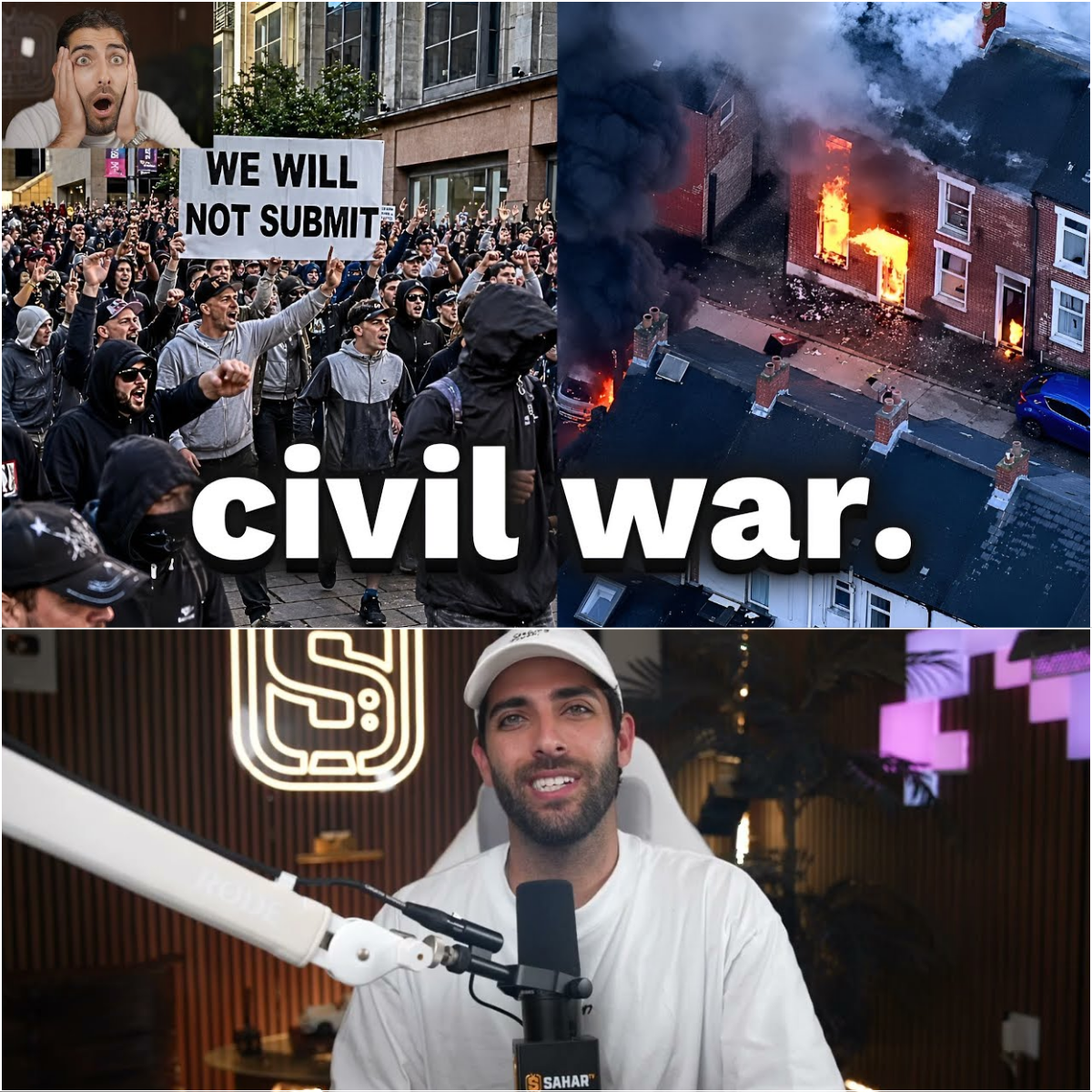
Almost immediately, a parallel narrative began to circulate through the community. Local residents claimed that the violence was not a random altercation but a coordinated assault involving a second individual whose presence had not yet been formally acknowledged in early official press briefings. Word spread rapidly through neighborhood networks, particularly in areas like Rathcoole, where the victim had deep family ties. For a community already distrustful of institutional narratives, the perception of a horrific act of violence committed against a vulnerable, helpful neighbor by a newly arrived asylum seeker acted as an immediate emotional trigger.
The response on the ground was instantaneous. Within forty-eight hours of the stabbing, digital mobilization networks flamed to life, calling for immediate public assemblies to protest against the region’s current asylum and border policies. What began as an expression of community grief and shock quickly transformed into a volatile, politically charged mobilization.
Arson and Escalation at the Roundabout
By dusk the following evening, several hundred people had converged on the Cloughfern roundabout on the outskirts of North Belfast. The crowd was a mixture of concerned local residents, political activists, and a substantial contingent of masked young men. Early speeches delivered via megaphones focused heavily on the themes of national identity, border security, and a perceived systemic failure by the government to protect its own citizens.
However, the veneer of a peaceful demonstration dissolved rapidly as the formal speeches concluded. A breakaway group of approximately two hundred masked individuals, many wearing heavy face coverings and dark clothing, split from the main assembly and marched deliberately toward the nearby Whiteabbey estate. The atmosphere shifted from political protest to active civil unrest within minutes.
Targeted violence soon focused on properties known to house asylum seekers and migrants—specifically Houses in Multiple Occupation (HMOs), which are multi-tenant residences often utilizing public funding to accommodate individuals awaiting asylum decisions. Using accelerants and improvised incendiary devices, rioters broke windows and set multiple properties ablaze.
"The sight of residential streets illuminated by burning cars and torched structures signaled a dangerous shift from generalized political anger to direct, localized retribution."
As the fires spread, emergency dispatchers flooded the area with fire crews and riot police. The PSNI deployed armored Land Rovers and tactical units to contain the crowd, but they were met with a barrage of bricks, fireworks, and petrol bombs. In several instances, residents reported seeing families and migrant workers being hastily evacuated from targeted buildings under police escort, loaded into transport vehicles to escape the approaching violence.
The rioting quickly blocked major thoroughfares, paralyzing public transport and local commerce. A public transit bus was hijacked and set on fire in the middle of a residential intersection, creating a massive barricade of twisted metal and thick black smoke. The sound of explosions from burning car tires and the sirens of emergency vehicles echoed across North Belfast well past midnight, forcing terrified families to barricade themselves inside their homes as the streets outside burned.
The Political Backlash and the Populist Echo
The response from official government corridors was swift, characterized by absolute condemnation of the street violence. UK Prime Minister Keir Starmer, addressing the Parliament, thanked first responders for their bravery and expressed solidarity with the stabbing victim, while firmly stating that the subsequent acts of violence and arson were entirely unjustified. Northern Ireland’s First Minister, Deputy First Minister, and the PSNI Chief Constable issued joint statements calling for immediate calm, labeling the rioters as “far-right hooligans” exploiting a human tragedy to advance a xenophobic agenda.
Yet, outside the halls of government, a much more polarizing rhetorical battle was taking place. Populist political figures and right-wing commentators used the Belfast riots to launch an aggressive critique of Western immigration policies. Prominent figures like Katie Hopkins directly attacked the media and government’s framing of the event, arguing that the public’s focus should be directed at the severity of the initial crime rather than the chaos of the aftermath.
"The government wants to talk about hooliganism on the streets because it prevents them from having to talk about the reality of unveted individuals committing acts of extreme violence on our doorsteps."
This populist rhetoric resonates deeply with a segment of the working-class population that feels entirely abandoned by mainstream political parties. The complaints raised on the streets of Belfast and Dublin reflect a growing belief that working-class communities are bearing the social and infrastructure costs of mass migration, while public resources—such as taxpayer-funded housing—are prioritized for foreign nationals over citizens struggling with housing shortages and economic inflation.
In public demonstrations following the Belfast riots, speakers in both Northern Ireland and the Republic of Ireland began articulating a shared anxiety regarding demographic shifts. Activists openly warned that the native population risks becoming a minority within their own historic territories if border policies are not immediately reversed. This sentiment is frequently coupled with broader cultural anxieties, including protests against modern school curriculums and a perceived institutional effort to dilute traditional Christian values across the island.
Demographic Shifts and Cultural Friction
The violence in Belfast cannot be viewed in isolation; it is part of a broader, systemic friction occurring across European urban centers as immigration rates outpace local integration frameworks. For decades, Northern Ireland’s political discourse was dominated almost exclusively by the green-and-orange binary of unionist and nationalist politics. However, the rapid influx of asylum seekers and global migrants has introduced a completely new axis of tension that cuts across old sectarian divides.
In many working-class estates, the rapid introduction of HMOs to house asylum seekers has altered the social fabric of neighborhoods overnight. Local residents often report feeling cut off from the decision-making processes governing their own communities. When public authorities convert residential properties into high-density migrant housing without local consultation, it breeds an environment of intense resentment and suspicion.
This institutional disconnect creates a fertile ground for rumors and radicalization. When a high-profile crime occurs—such as the stabbing in North Belfast—it is immediately interpreted not as an isolated criminal act, but as the inevitable consequence of a failed state policy. The perception that the authorities are attempting to “blanket” or minimize the details of immigrant-involved crimes to prevent unrest only worsens the community’s distrust, driving individuals away from legal avenues of grievance and toward vigilante action on the streets.
Furthermore, the integration crisis is compounded by global geopolitical tensions. In the digital aftermath of the Belfast riots, arguments erupted online between immigrant advocates and nationalist groups, with discussions rapidly deflecting toward global conflicts in the Middle East and historical colonialism. For many local residents, the arrival of individuals who openly express non-Western political or religious alignments—such as desires for the implementation of traditional religious laws over secular frameworks—is viewed as a direct, existential threat to the secular and legal foundations of Western society.
The Road Ahead for a Fractured Community
As the smoke clears over North Belfast and municipal crews clear the charred remains of buses and cars from the asphalt, the region is left to confront an incredibly volatile future. The deployment of heavy police forces may temporarily restore physical order to the streets, but it cannot repair the underlying social fabric that has been thoroughly torn by these events.
The strategy of simply labeling all protestors as “far-right agitators” fails to address the legitimate socio-economic anxieties felt by ordinary citizens who watch their neighborhoods change rapidly without their consent. Until political leaders engage in open, transparent dialogues regarding border management, housing allocation, and community safety, the cycle of crime, institutional silence, and subsequent street violence is highly likely to repeat.
For the people of Belfast, the memory of the vulnerable man attacked on his own doorstep and the subsequent nights of fire will remain a stark reminder of a changing world. The challenge moving forward is not merely a matter of policing, but a fundamental question of how a society preserves its internal security and social cohesion when the state’s immigration policies diverge drastically from the national mood. Until that gap is closed, the streets of Northern Ireland will remain a tinderbox, waiting for the next spark to ignite the dark.