The Sumerian Tablet the Bible Couldn’t Hide – It Describes What Noah’s Ark Really Was
The Sumerian Tablet the Bible Couldn’t Hide – It Describes What Noah’s Ark Really Was
The gas lamps in the basement of the British Museum did not burn with a steady light; they hissed, casting long, erratic shadows across the limestone floor that smelled of coal smoke and old clay.
It was November 1872. George Smith, a former banknote engraver who had spent his youth breathing in the fumes of acid baths and copper dust, sat with his elbows buried in fragments of Assyrian rubble. His fingernails were permanently stained with ink, his eyes bloodshot from tracking the microscopic wedges of cuneiform script through a heavy magnifying glass. He was thirty-two years old, entirely self-taught, and regarded by the university-trained orientalists of London as little more than a highly disciplined mechanic.
Beside him lay a broken fragment of dark clay, pulled from the royal library of Ashurbanipal at Nineveh. It was cataloged simply as K3375.
“Smith,” murmured the assistant curator, passing by with a tray of fossilized bone. “You’ve been staring at that ledger for three hours. The trustees are asking for the inventory on the Syrian copper weights.”
Smith didn’t answer. His hand was shaking so violently that the magnifying lens clattered against the edge of the oak table. The characters on the clay weren’t financial tallies or regional boundary deeds. He had just parsed an line that left him cold: a description of a mountain peak, a vessel coming to rest, and a dove released into an empty sky to find dry land.
“It’s the text from Genesis,” Smith whispered, his chest heaving as if the air in the room had suddenly dropped to zero pressure. “But the ink… the clay was baked before the kingdom of Judah had a name.”
Before the assistant could speak, Smith stood up. His stool flew backward, clattering against the stone floor. He didn’t scream; he let out a choked, liquid gasp, his fingers tearing at the collar of his linen shirt. He ripped the buttons from his waistcoat, his chest pulling in the damp basement air as if he were drowning in three inches of water. To the horrified onlookers from the classical department, it looked like a standard epileptic fit. But it wasn’t. It was the absolute, crushing vertigo of a man who had just realized that the foundational story of his civilization was a second-hand copy.
“He’s lost his mind,” a clerk muttered, backing away toward the corridor.
“No,” Smith gasped, dropping to his knees, his hands flat against the cold flagstones. “The broken part… the middle of the tablet is gone. It’s missing. We have the birds, we have the mountain, but the instruction… the reason for the water… it’s broken away.”
The Daily Telegraph would later put up the staggering sum of one thousand guineas to send Smith into the Iraqi desert to find the missing shards—a fool’s errand across thousands of square miles of shifting silt and ruined brick. Yet, against odds that standard history still cannot explain, Smith walked into the mound at Nimrud and, within a few days of turning over the debris, pulled the matching fragment from the dirt.
The modern world had its story: the flood was older than the Bible. The Mesopotamians told it first. For the next hundred and forty years, that was the baseline. It was treated as a historical curiosity, a comforting proof that human memory preserved the same great storm across different cultures.
But they were reading the wrong translation.
The Cylinder in the Drawer
In 2009, the narrative shifted from a grand epic to a technical manual.
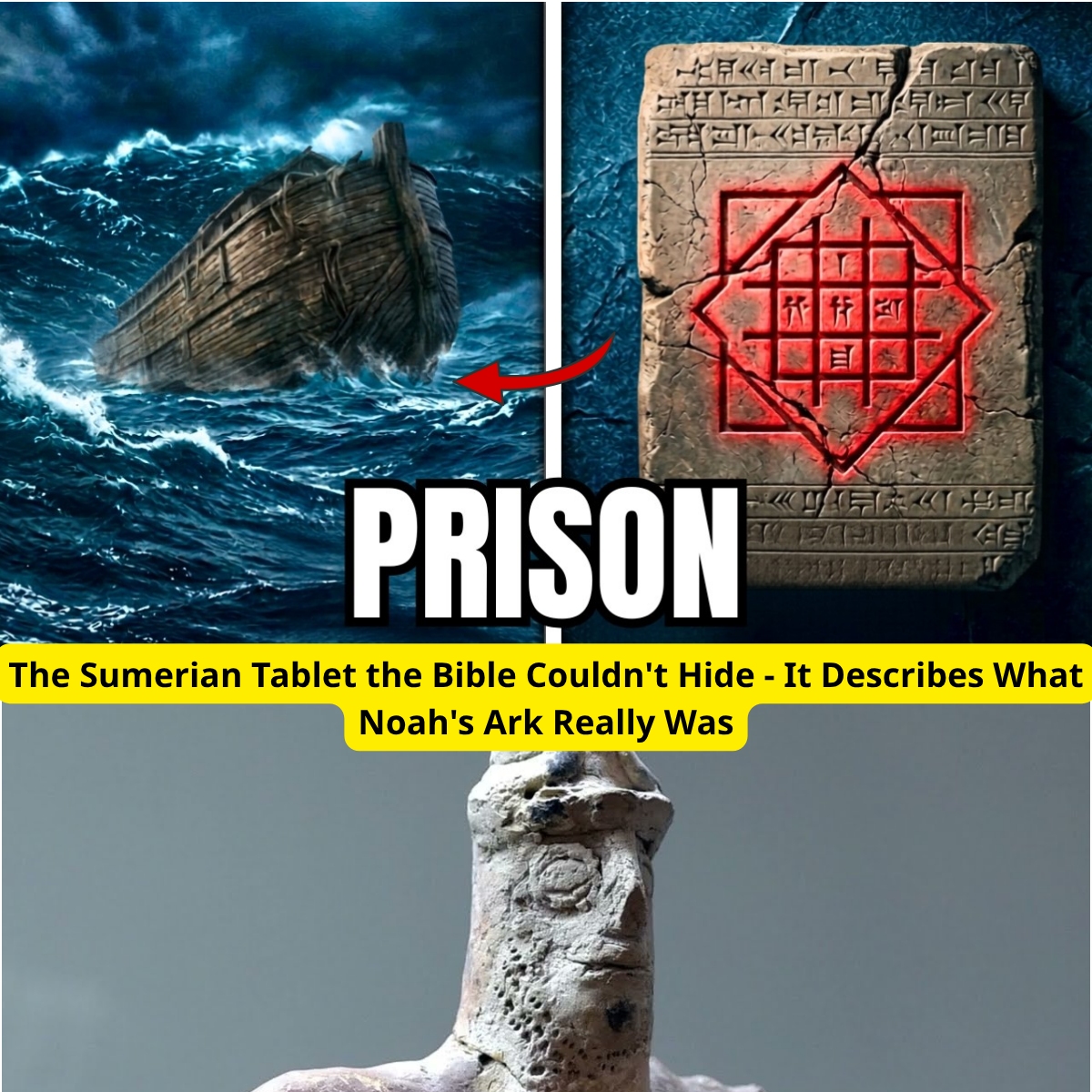
Dr. Irving Finkel, a man with a beard like a Victorian coal fire and an office at the British Museum that looked like a warehouse for forgotten languages, received a visitor named Douglas Simmons. Simmons brought a small, undistinguished lump of clay that his father had acquired in the Middle East after the Second World War. It was roughly the size of a modern smartphone, light brown, and packed with sixty lines of tiny, crowded cuneiform text.
Finkel didn’t take off his coat. He sat under a single halogen desk lamp, his fingers moving over the clay with the practiced ease of an expert who had spent forty years reading the business receipts of Babylon.
“This isn’t an epic, Douglas,” Finkel said, his voice dropping into a dry, precise rasp. “The tablets George Smith found were poetry—the Epic of Gilgamesh, written for kings to chant in palaces. This thing… this is a builder’s contract. It’s an invoice from a dockyard.”
The text was old Babylonian, dating to roughly 1750 BC—eleven centuries before a single Hebrew scribe set ink to the parchment of Genesis. Finkel tracked the lines with a bone stylus. The vocabulary wasn’t spiritual. It didn’t mention sin, righteousness, or the moral failings of an ancient world. It listed quantities: fourteen thousand cubits of palm-fiber rope, thirty ribs of pomegranate wood, three hundred barrels of hot bitumen for waterproofing the interior and exterior walls.
“It’s a guide,” Finkel muttered, his eyes wide behind his spectacles. “But look at the dimensions. Read what the scribe actually set down. He didn’t write boat. He wrote kippatu.”
“What does that mean?” Simmons asked.
“A coracle,” Finkel said, leaning back, the light reflecting off his bald head. “A kufar. A round, woven basket boat. The kind the marsh Arabs used to ferry melons down the Euphrates until the twentieth century. Except this one is scaled to the size of a fortress. The base area is three thousand six hundred square meters. Two-thirds of a football field, with walls six meters high. It’s a basket, Douglas. A massive, circular floating cage.”
Finkel stood up, walking to his bookshelf to pull down a copy of the Atrahasis, the older Akkadian flood account. He flipped through his own notes, his eyes darting between the 3,700-year-old tablet and the canonical translations.
“The drawings we give children show a ship with a bow and a stern,” Finkel said, his finger tapping the clay. “A vessel built to travel from point A to point B. But a circular basket has no keel. It has no rudder. It has no prow. If you put a boat like this into an inland sea, oars do nothing but spin it in a slow, sickening circle. It cannot be steered. It cannot be pointed toward a shore. It has no destination because it doesn’t need to go anywhere. It only has to float.”
He looked at Simmons, his expression turning cold. “A lifeboat is built to take you somewhere safe. A vehicle that cannot be steered, that has no rudder, is something else entirely. It’s a holding cell that happens to have buoyancy.”
The Noise in the Garden
To understand the architecture of the box, Finkel knew one had to understand the motive of the architect.
In the Western tradition—the version that passed through the filter of Genesis—the flood was a moral response to human wickedness. God looked at the earth, saw that man’s heart was continually set on evil, and regretted His creation. The water was a purge, a righteous punishment designed to clean the slate before starting fresh with a good man.
But the original Babylonian texts—the Atrahasis and the Eridu Genesis—did not speak of sin. They spoke of labor.
“In the beginning,” Finkel explained to his students during a private seminar in the museum’s upper library, “the universe was split. The high gods—Anu, Enlil, Enki—sat in council, while the lesser gods, the Igigi, did the backbreaking work. They dug the Tigris. They cleared the silt from the irrigation canals that kept Mesopotamia from turning back into a salt marsh. For ten thousand years, they carried the baskets of clay.”
He turned a page of his transcription. “And then, the Igigi revolted. They burned their tools. They surrounded the house of Enlil, the chief administrator of the gods, at night, their torches held high. They went on strike.”
The solution the gods arrived at was not to do the work themselves. It was to create a surrogate workforce. They slaughtered a rebellious god named We-ilu, mixed his blood with clay from the riverbed, and fashioned seven men and seven women. Humanity was created for a single, industrial purpose: to carry the baskets and keep the gods fed through sacrifice.
“For a time, the system worked perfectly,” Finkel said, his voice dropping an octave as he read from the Akkadian lines. “But humans do what humans do when they are given resource access. They multiplied. The text says the land became crowded like a bellowing bull. The noise… the sheer, collective racket of millions of people living, working, and breathing reached the upper chamber where Enlil slept. He couldn’t rest. The noise of his own machinery had become intolerable.”
“So he ordered the flood,” a student suggested.
“No,” Finkel corrected sharply. “That’s the mistake everyone makes because they only know the biblical ending. The flood wasn’t his first choice. It was his last. First, Enlil sent a plague to thin out the workforce. But Enki, the god of wisdom and fresh water, quietly instructed his favorite human, Atrahasis, on how to divert the offerings to the god of pestilence, and the plague stopped. So Enlil sent a drought. The crops failed. Humanity began to starve. Enki stepped in again, opening the underground aquifers.”
Finkel pointed to a line near the break in the text. “Then came the great famine. A famine so complete that the tablets describe mothers eating their own children to survive. Three separate times, Enlil tried to manage the population through systemic culling. Three times, the human workforce managed to adapt and recover. The flood wasn’t a righteous outburst of divine anger. It was the fourth iteration of a population-control protocol that kept failing until the gods went big enough to ensure total clearance.”
The Loophole and the Seal
The Ark Tablet added one more detail to the manual—the manner of the warning itself.
The gods had taken a sacred oath in council: none of them would reveal the coming storm to a single human soul. They were going to catch the workforce asleep in their beds. Enki, the craftsman god who had designed human biology from clay and blood, found himself caught between his loyalty to the council and his attachment to his creation.
“He didn’t speak to Atrahasis,” Finkel said, his fingers tracing the sixty lines of the Simmons tablet. “The tablet is explicit. Enki walked to the reed wall of Atrahasis’s house. He stood outside in the mud, turned his face to the wicker and the mortar, and spoke to the building itself.”
He read the translation aloud: ‘Wall, listen to me! Reed wall, pay attention to my words! Tear down your house, build a boat! Leave behind your possessions, save your life!’
Atrahasis was sitting on the other side of that wicker partition, listening to the wall mumble the dimensions of a giant basket. When the chief god Enlil later discovered that a remnant had survived, Enki could stand before the divine council with his hands clean, declaring that he had never broken his oath—he had never spoken to a human being. He had merely had a conversation with a piece of property.
“The only act of mercy in the entire narrative,” Finkel remarked with a dry, humorless smile, “is dressed up to look like a legal loophole in a contract. And once the basket was built, once the breeding pairs were loaded, came the door.”
Every version of the myth—Babylonian, Assyrian, Hebrew—lingered on the detail of the door. In the Atrahasis, the hero seals the entry point with thick bitumen while the first raindrops strike the leather hide of the deck. In the Gilgamesh fragment, Utnapishtim gives his palace to the shipwright before locking himself in.
But in Genesis 7:16, the detail remains, though the agent changes: And the Lord shut him in.
“Think about what that seal means,” Finkel said, leaning over the table, his eyes drilling into his students. “The water is rising from the deep. The canals are breaking. Outside that wall of palm rope and bitumen, every person these survivors have ever known is screaming in the rising mud. Their neighbors, their extended families, the children of their cities—they are all hitting the sides of the basket as it lifts off the ground.”
He struck the table with his knuckles. “And the people inside cannot open it. They cannot extend a hand. They cannot look out to see who is left. Why? Because the door locks from the outside. The hand that closed the container belongs to the entity that ordered the destruction. A door you cannot open from within is not a protective barrier, my friends. It’s a lock. The survivors weren’t being saved from a tragedy; they were being preserved in a safe-deposit box until the management decided the noise levels had fallen back to an acceptable baseline.”
The Bottleneck at the End
The final lines of the Mesopotamian records do not describe a rainbow or a promise of eternal love between the divine and the human. They describe a business meeting.
When the waters finally receded from the red mud of Mesopotamia, the basket settled on the side of a ridge. Atrahasis opened the seal, stepped out into the stench of a drowned world, and immediately built an altar. He lit a fire of cedar wood and sweet reeds, sending a column of aromatic smoke into the sky.
“And here is the most devastating line in the entire corpus,” Finkel said, turning back to the original text George Smith had wept over a century before. “The gods had been starving. For seven days and seven nights, there had been no humans on earth to dig the canals, till the fields, or make the burnt offerings. The gods were parched; their throats were dry. When the smoke from Atrahasis’s altar rose, the text says the gods swarmed to the sacrifice like flies over a piece of meat. They realized, too late, that in destroying their workforce, they had destroyed their own kitchen.”
Enlil was furious that any humans had survived the wipeout. But Enki stepped into the center of the assembly, his hands raised to quiet the starving deities.
“Don’t destroy them,” Enki argued to the council. “We need them to carry the baskets. But we must ensure they never grow loud enough to disturb your sleep again.”
The Atrahasis epic lists the “reforms” the gods enacted that afternoon on the mud-slick ridge. It wasn’t a covenant of grace. It was a genetic restructuring. The gods created a new category of human beings: women who were barren from birth, priestesses who were forbidden from childbearing by religious law, and a demon named Pasittu who would snatch babies from the cradle before they could reach adulthood.
“They built population control into the baseline of human biology,” Finkel said, his voice dropping to a whisper in the silent library. “Infertility, childhood disease, stillbirth—the Mesopotamians didn’t see these things as mistakes or curses from a devil. They saw them as the infrastructure of the post-flood world. They were the valves Enki installed so the engine would never again overheat and force Enlil to drown the planet just to get some rest.”
Modern population genetics has a term for what the Ark Tablet describes: a founder effect, or a genetic bottleneck. When a population is squeezed through a narrow opening—reduced down to a single family and a handful of selected livestock—every trait the survivors carry becomes a permanent, exaggerated law for every generation that follows. Every trait they lack is deleted from the history of the species for good.
The gods didn’t just save Noah, or Atrahasis, or Utnapishtim because they were good. They saved them because they were the exact dimensions of a seed population. They kept the minimum number of workers required to reboot the system under stricter guidelines, with their lifespans shortened and their reproductive cycles broken by design.
George Smith had run through the halls of the British Museum in 1872, tearing off his clothes because he thought he had found the cradle of his faith. He had no idea he had actually found the blueprint for the cage. The sixty lines of the Ark Tablet didn’t describe a miraculous rescue from a cruel world; they described a flat, calm, businesslike process—written in the same style as a grain invoice or a land survey—documenting the day the owners of the earth decided how many of us would be allowed to live, sealed the survivors into a box, and waited for the water to do the work.