500,000 People Saw the Virgin Mary in Ukraine: The Images No One Was Supposed to See
500,000 People Saw the Virgin Mary in Ukraine: The Images No One Was Supposed to See
The spring air of western Ukraine in 1987 did not carry the scent of blossoming fields; instead, it bore the invisible, metallic tang of residual anxiety. Exactly one year prior, on April 26, 1986, Reactor Number Four at the Chernobyl nuclear power plant had ruptured, unleashing a silent, radioactive shroud across the continent. For twelve months, the Soviet apparatus had operated at peak efficiency to suppress the truth, burying details, falsifying medical charts, and enforcing a desperate, suffocating silence. Anguish was a ghost that haunted every Ukrainian household, an unspoken terror that the air they breathed and the ground they tilled were quietly turning against them.
Six hundred kilometers away from the exclusion zone, nestled in the rolling countryside of the Lviv region, lay Hrushiv. It was an unassuming farming village, the kind of place where time seemed to have paused under the weight of Soviet collectivization. In the center of the village stood an old, wooden church dedicated to the Most Holy Trinity. It was a dead building. Decades earlier, communist authorities had padlocked the heavy timbers, stripped its altar, and desecrated its sanctuary, converting the sacred space into a silent monument to state-enforced atheism. For forty years, the Kremlin had labored under a singular, titanic objective: to systematically excise the name of God from human consciousness, treating religious faith not merely as a relic of the past, but as a dangerous psychological delusion to be cured with Siberian labor or a political prison sentence.
Yet, on the morning of April 26, 1987—precisely one year to the second after the first alarm wailed at Chernobyl—twelve-year-old Marina Kizyn stepped out of her cottage into the pale morning light. As she walked past the perimeter of the abandoned church, a sudden fluctuation in the atmosphere caught her eye.
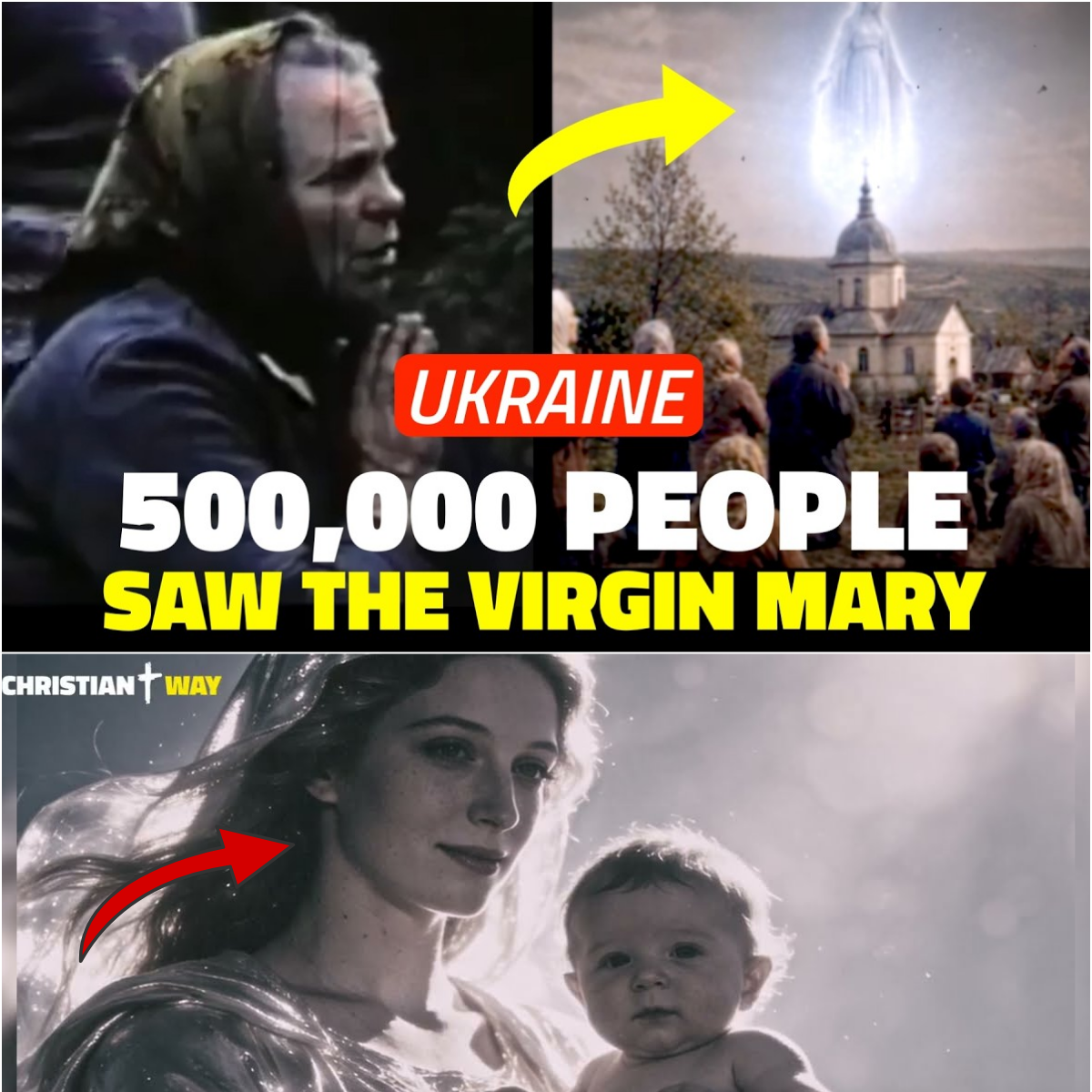
Hovering directly above the central dome of the wooden structure was a light unlike anything she had ever seen. It was not the harsh glare of an electric spotlight, nor was it a trick of the morning sun cutting through the mist. It was a dense, metallic silver luminescence, radiating an intense, silent energy that commanded the space around it without burning the eyes. Marina stepped closer, her breath catching in her throat. Within the center of the silver glow, the distinct silhouette of a young woman materialized. She was clad in deep, dark garments that contrasted sharply with the celestial light, and cradled gently in her arms was a small child. The entity did not speak, but the sheer aura radiating from the dome was one of absolute, unconditional peace—a balm for a land poisoned by invisible fire.
Terrified and breathless, Marina sprinted back to her home, her boots pounding against the hard-packed dirt. “Mama! Come quickly! You must see the church!”
Her mother, Myroslava, hurried outside, expecting a fire or a structural collapse. Instead, she stopped dead in her tracks, her hands flying to her mouth. There was no mistaking it. It was not a child’s overactive imagination, nor was it a mirage. Within hours, whispers traveled through the village like an electrical current. By nightfall, hundreds of Hrushiv residents stood shoulder-to-shoulder in the mud, their upturned faces bathed in a persistent, heavenly glow. The figure of the Virgin Mary remained perfectly visible, majestic and unmoving, a brilliant beacon breaking through the Soviet night.
In the late 1980s, the Soviet Union was a closed ecosystem. There were no smartphones, no internet, and the state controlled every printing press, television station, and telephone wire. Under the watchful eye of Mikhail Gorbachev, the empire was attempting a delicate dance of modernization through glasnost, but traditional religious defiance was still considered a severe threat to the state. Yet, what occurred over the next seventy-two hours completely defied the laws of totalitarian control.
Without a single newspaper report or radio broadcast, an inexplicable sociological phenomenon unfolded. Word of the light at Hrushiv slipped past the KGB’s wiretaps and traveled from mouth to mouth, kitchen to kitchen, crossing vast republics in a matter of hours. Within three days, the rural roads leading into the Lviv region were paralyzed. They came by the thousands, then by the tens of thousands. When the local authorities blocked the primary thoroughfares, the people abandoned their vehicles and marched through the dark, traversing miles of treacherous plowed fields and dense forests to bypass the state patrols. Pilgrims arrived from the furthest corners of Belarus, from the occupied Baltic states, and from the deep heart of Russia itself. Over the ensuing weeks, internal metrics would estimate that over 500,000 human beings descended upon the tiny village of Hrushiv, with as many as 70,000 people a day packed into the mud surrounding the locked wooden church.
The response from the Kremlin was immediate and aggressive. A gathering of half a million citizens openly defying state ideology was an ideological emergency. The order handed down to the regional commanders was uncompromising: crush the mass hysteria by any means necessary.
The skies above Hrushiv soon filled with the deafening roar of military helicopters. Soviet pilots flew at dangerously low altitudes, skimming just above the treetops, utilizing the violent downwash of their rotors and the terrifying thunder of their engines to scatter the crowds. The people below did not run. Instead, they linked arms, knelt deeper into the mud, and raised their voices in a unified, swelling chorus of traditional hymns.
When psychological warfare failed, the state deployed the armed militia and specialized KGB units. Heavy machinery dug massive, deep trenches across the access roads, turning the surrounding landscape into a fortress. Barbed wire fences were strung across fields, and armed checkpoints were established at every intersection. Anyone caught carrying a rosary or moving toward Hrushiv was threatened with immediate arrest, heavy fines, or physical violence.
Yet, the state was fighting an adversary that refused to conform to their tactical manuals. The apparition was not a fleeting glimpse; it was a continuous, undeniable manifestation. The figure of Mary appeared suspended directly in the air above the roof, her luminous form casting a brilliant light that illuminated the faces of the crowd even during the darkest hours of midnight. Many witnesses looking through binoculars noticed a heartbreaking detail: the Virgin was weeping, her celestial face stained with silent, glowing tears for the suffering of her children.
Desperate to break the spell, the KGB brought in massive, military-grade anti-aircraft searchlights. They positioned the heavy generators around the churchyard and struck the dome with millions of lumens of artificial, blinding light, attempting to wash out the heavenly image. But the laws of optics seemed to invert. Instead of erasing the phenomenon, the harsh glare of the Soviet searchlights only served to make the silhouette of the Madonna stand out with greater, crystalline clarity, transforming the state’s own equipment into a frame for the miracle.
It was during the third week of the siege that the Soviet propaganda machine began to suffer a fatal internal short circuit. The state newspaper, Pravda, desperately attempted to regain control of the narrative, publishing a series of pseudoscientific explanations. They claimed the light was merely an anomalous atmospheric refraction caused by the unique layout of the valley, or worse, that the psychological trauma and radiation from the Chernobyl disaster had triggered a localized epidemic of mass hallucination.
But the party’s lies disintegrated when confronted with the physical reality on the ground. There was no psychological model in existence that could explain a identical collective hallucination lasting for weeks, witnessed simultaneously by half a million people across every age bracket, social status, and educational background—including lifelong, card-carrying party members.
Then came the moment that made the regional commanders freeze. KGB officers, trained in the strictest tenets of scientific atheism and hardened by years of ideological enforcement, were sent into the thick of the crowd to identify ringleaders, confiscate religious items, and disperse the peasants with their batons. But as these men stepped into the perimeter of the churchyard, under the warm, pervasive glow of the silver light, something cracked within their resolve.
One by one, young officers stopped in their tracks. Their eyes drifted up toward the wooden dome, locking onto the serene, weeping face of the Madonna. The batons in their hands lowered. In full view of the crowd and their fellow soldiers, tears began to stream down the cheeks of men wearing the uniform of the state. Several officers dropped their weapons entirely, sinking to their knees in the cold mud alongside the very peasants they had been ordered to brutalize. The secret internal reports that were supposed to expose a religious hoax ended up doing the exact opposite; they became an official, administrative record of a genuine, supernatural intervention.
For the underground church, this was the moment of resurrection. In 1946, Joseph Stalin had officially outlawed the Ukrainian Greek Catholic Church, banning its liturgy, seizing its properties, and executing or exiling its entire hierarchy to the frozen wastes of Siberia. For over forty years, it had existed purely as a church of the catacombs. Priests celebrated the Eucharist in dark basements, risking decades in the gulag for a single blessing.
But under the light of Hrushiv, the spirit of fear evaporated. Sensing the shifting tide, underground priests stepped out from the shadows into the open air. They donned their hidden vestments right in front of the checkpoints, hearing confessions in the fields and celebrating the Divine Liturgy before tens of thousands of weeping believers. The Soviet police and KGB agents stood by, entirely paralyzed, unable to muster the political will to arrest a resurrection happening before the eyes of the entire world.
To those who knew the hidden spiritual geography of the region, the choice of Hrushiv was far from accidental. Exactly seventy-three years earlier, in May 1914—just months before the outbreak of the First World War and the bloody collapse of the old European order—the Virgin Mary had appeared to a group of peasants in that exact same village.
On that distant afternoon, she had left a prophetic warning that had seemed impossible to the ears of the pre-revolutionary world. She had told the villagers: “There will be a great war. Russia will turn its back on God, and Ukraine will suffer terribly for eighty years. Your churches will be leveled, your priests will be hunted, and your soil will be soaked in blood. But take heart, for at the end of this time of trial, Ukraine will be free.”
Three years later, in 1917, the Bolshevik Revolution tore through the empire. The Soviet Union rose from the ashes, launching the most systematic, ruthless anti-Christian purge in modern history, validating the prophecy with terrifying, mathematical precision. For over seven decades, the land had known nothing but famine, war, and ideological terror.
And now, in 1987, the eighty-year window of the prophecy was drawing to a close.
During the long nights of the 1987 apparition, several visionaries received profound internal locutions from the entity above the dome. The messages she delivered were not warnings of fire or geopolitical condemnation, but declarations of absolute, unconditional hope for a exhausted nation.
“I have come to thank the Ukrainian people,” the interior voice conveyed to the hearts of the faithful. “For you have suffered more for the Church of Christ than almost any other nation in these dark decades. You are a land that has shed oceans of blood for the preservation of the faith. Your long winter is finally coming to an end.”
But the Lady also left a serious, universal warning for the generation that would inherit the future—a message aimed directly at the heart of the modern world. “The world remains in grave peril,” she cautioned. “Humanity has placed its ultimate trust in science, in technology, and in the power of its own intellect, while completely forgetting the author of life. True peace will never be found in treaties or weapons, but only through a return to repentance and the power of prayer.”
It was an undeniable echo of her warnings at Fatima in 1917, where she had requested the conversion of Russia to avert global catastrophe. At Hrushiv, she was announcing to a weary continent that the grand atheist experiment—an empire that possessed thousands of nuclear warheads and commanded half the globe—was structurally hollow and marked for imminent destruction.
The collapse happened with dizzying speed. Only two years after the silver light faded from the wooden church in Hrushiv, the Berlin Wall was torn down by civilian hands in 1989. And just four years after the apparition, in December 1991, the Soviet Union fractured along its geopolitical fault lines and collapsed entirely from within, vanished from the political map without a single shot being fired from an external enemy. The regime that had proudly sworn to erase the memory of Christ from the earth was dismantled, while the illegal, underground church of Ukraine walked out into the sunlight, completely intact.
For generations of Americans who watched the Cold War through the lens of military strategy, satellite imagery, and nuclear deterrence, the story of Hrushiv stands as a staggering reminder of a different kind of power. It is a testament to a truth that no totalitarian regime has ever been able to fully comprehend: that the most fortified borders and the most brutal security apparatuses can be entirely undone by a community of ordinary people who refuse to yield their souls, kneeling in the mud under a light that no darkness can overcome.