Over 1500 WATCH LIVE as North Korean Pastor is Publicly Executed for Sharing the Message of Jesus
My name is Jin Ho. I’m a North Korean defector. I’m a Christian. I’m the brother of a martyr.
I live in a country now where I can say these things out loud. Where I can own a Bible and leave it on my table without fear.
Where I can go to church on Sunday and sing hymns with my eyes open.
With my voice loud, with my hands raised. But I cannot go home. I will never go home.
Home is a place where my brother’s blood soaks into the ground on a June morning in 2009.
Home is a place where his children, my niece and nephews, grew up behind barbed wire in a prison camp, if they are still alive.
Home is a place I carry in my chest like a stone, heavy and cold every single day.
I am here today to tell you what happened to my brother. To tell you what happened to our family, to tell you what is still happening right now at this very moment, to Christians in North Korea.
This is not an easy story to tell. There are nights when I wake up and I can still hear the sound of the gunshots.
There are days when I see my brother’s face in crowds and I have to remember all over again that he is gone.
But I must tell it. I promised him I would tell it even though he never knew I made that promise.
Even though by the time I made it, he was already dead. So let me take you back back to before the darkness came.
Back to when we were just two brothers growing up in a small town near the Chinese border trying to survive in a country that was slowly starving to death.
Ryong Chan is not a place you would have heard of before 2004 when a train explosion killed hundreds of people there.
Even after that, the world forgot about it quickly. It is a small town in North Pyongan province close to the border with China.
Close enough that on clear days if you climbed the hills outside town you could see across the Yaloo River into another country into a different world.
We grew up there, my brother Sunung Min and I. He was four years older than me.
Our father died when I was 9 years old during the worst years of the famine in the 1990s.
We called those years the arduous march, though that name makes it sound noble, like something to be proud of.
There was nothing noble about watching your father waste away because there was no food.
Nothing noble about eating bak soup and wondering if you would wake up the next morning.
My brother was 13 when our father died. I watched him change almost overnight. He became serious, protective.
He took on work that a boy should not have to do. Carrying loads at the train station, helping farmers in the fields, anything to bring home a bit of food or money.
Our mother worked at a textile factory when there was work to be had. But often the factory closed for weeks at a time because there was no electricity or no materials.
So Sunung Min became the pillar of our family. I remember his hands. Even as a young man, his hands were rough and scarred from work, but they were gentle, too.
When I was sick, he would lay his hand on my forehead to check for fever.
When I was afraid, and we were afraid often in those days, he would put his hand on my shoulder and I would feel safer.
He was not perfect. He had a temper sometimes, especially with a neighborhood bully who used to steal from smaller children.
He got into trouble once for talking back to a teacher who had accused him of something he did not do.
But he was good. Though even in a place where goodness could get you killed, where kindness was seen as weakness, sung was good.
We grew up like all North Korean children grow up. We worshiped Kim Ilang and Kim Jong-il because we had two.
We learned that they were gods, that they created the sun and the moon, that they loved us more than our own parents loved us.
We attended the self-criticism sessions where we had to confess our failings and denounce anyone who had failed.
We marched in the parades. We sang the songs. We wore the pins with their faces on our chests over our hearts.
But even as a child, I remember wondering. I remember looking at the pin on my chest and thinking, “If they love us so much, why are we hungry?
If they are gods, why did my father die? I never said these thoughts out loud.
You learn very young in North Korea that some thoughts must stay inside your head, locked away where no one can hear them.
Swang men wonder too. I could see it in his face sometimes when we stood in the cold for hours at the rally.
Our stomachs empty, our feet numb, praising the dear leader. He would get this look in his eyes, distant and questioning.
But he never spoke about it either. Not then. The years passed. The famine eased a little, though there was never enough.
We survived. That was what life was. Surviving. We were not living. We were just trying to make it through one more day, one more week, one more winter.
In 2005, when Sunung Min was 22 years old, he started making trips across the border into China.
Many people in Ryong Chan did this. The border was heavily guarded. But there were ways across if you knew the right people and had a little money to bribe the guards.
People went to trade, to find food, to find work. It was illegal. But the authorities looked the other way sometimes because they knew people were desperate.
Sung Min told our mother he was going to buy goods to sell in the market.
Medicine, soap, things we could not get in North Korea. He would be gone for two or three days, sometimes a week.
Our mother worried every time he left. If he was caught, he could be sent to a labor camp.
But we needed the money. We needed what he could bring back. So she let him go.
I noticed something different about him when he came back from his third or fourth trip.
It was late 2006, November or December. The winter was already bitter cold. He came home late at night and I woke up when I heard him come in.
We shared a small room sleeping on mats on the floor. I heard him moving around in the darkness and I whispered his name.
He came and sat next to me. I could barely see his face in the dark, but I could feel something had changed.
There was a stillness in him, a quietness that was different from his usual silence.
He did not say much that night. He just asked me if I ever wondered if there was something more than this, more than the life we were living, more than just surviving until we died.
I did not know what to say. I was only 18 years old and I had never heard anyone talk like that before.
Over the next few months, Sunungin made more trips. Each time he came back, I saw the change growing in him.
He became thoughtful. He stopped complaining about things that used to bother him. He started treating our mother with even more tenderness than before.
He would sit for long hours at night just thinking, staring at nothing. I asked him once what was happening to him, what he had found in China that was changing him.
He looked at me for a long moment and I saw something in his eyes I had never seen before.
It was fear, yes, but it was also joy. A kind of joy I did not understand.
Then one night in early 2007, he told me. We waited until our mother was asleep.
We went outside and walked to the edge of town where there was an old storage building that had been abandoned.
No one went there at night. It was safe or as safe as anywhere could be.
Inside that building in the darkness, my brother told me he had found God. I did not understand what he meant at first.
We had been taught there was no God. That religion was the opiate of the masses, a tool used by Americans and South Koreans to poison people’s minds.
I had never met anyone who believed in God. I had never even thought about whether God might exist.
Sun told me that on his second trip to China, he had met a Korean Chinese man who helped people cross the border.
This man had given him food and a place to sleep. And in this man’s house, Sunung Min had seen a book, a Bible.
He asked the man about it. The man was afraid at first. He knew North Koreans were taught to report anything like this.
But something made him trust sung. He began to tell him about Jesus Christ, about a God who loved people so much that he sent his son to die for them, about forgiveness, about eternal life, about hope.
Sun said he argued with the man at first. It sounded like foolishness. It sounded like propaganda, just a different kind than what we had been fed our whole lives.
But the man gave him the Bible and told him to read it. Just read it and see for himself.
So, Sung Min read. He hid the Bible in his bag and read it on the journey home.
He read it by candle light in our room while I was asleep. He read it and something broke open inside him.
When he told me all this, I was terrified. I knew what happened to people who were caught with Bibles.
I had heard stories of public executions, of entire families sent to prison camps. I begged him to throw the Bible away, to forget everything he had read, to save himself, to save our family.
But he could not. He told me he had tried. He had tried to forget to go back to how things were before.
But he could not unknow what he now knew. He could not unfill what he had felt when he read about Jesus calling people to come to him all who were weary and burdened and he would give them rest.
He said those words to me there in the darkness. He had memorized them. All who are weary and burdened and we were so weary.
We carried burdens so heavy. Come to me and I will give you rest. I started to cry.
I do not know why. Maybe because I heard something in those words that my soul recognized even though my mind did not understand.
Maybe because I saw in my brother’s face a peace that I had never seen in anyone’s face in my entire life.
Maybe because I was afraid. Maybe because I was hopeful. Maybe both. That night, Sunung Min showed me where he had hidden the Bible.
He had buried it in our small courtyard inside a clay jar wrapped in plastic to keep it dry.
He would dig it up late at night when everyone was asleep and read by the faintest candle light.
He asked me not to tell anyone, not even our mother. Not yet. It was too dangerous.
If I knew I was already in danger. If I told anyone else, the danger would spread.
I promised him I would keep his secret. But over the next months, the secret became mine, too.
Sun started reading to me from the Bible. Late at night, in whispers so quiet I had to lean close to hear him.
He will tell me what he had learned about creation, about the fall, about the flood and the tower and the patriarchs, about Moses and the Exodus and the promised land, about King David and the prophets, and then about Jesus born in a manger, teaching in parables, healing the sick, raising the dead, dying on a cross, rising on the third day.
It sounded impossible one. It sounded like a fairy tale. But something in me wanted it to be true.
Something in me needed it to be true. By late 2007, I had become a believer myself.
Though I am not sure I could have told you exactly what I believed. I just knew that when Sunungin talked about Jesus, something in me said yes.
When he read the words of scripture, something in me recognized them as truth. We were not alone for long.
Sang Minet a man at the market, someone who had also been to China. They recognized something in each other, some sign that I still do not fully understand.
A way of speaking, a gentleness, a light in the eyes. They talked carefully at first, testing each other, and then the man admitted he too had found Christ in China.
His name was Mr. Choi. He was older, maybe 40, with a wife and two daughters.
He had been reading the Bible for almost a year, alone, afraid, hungry for fellowship.
The three of them, Sang Min, Mr. Choi, and Mr. Choi’s wife, started meeting in secret.
Once a week late at night in different places, an abandoned shed, a storage room at the back of the market, the hills outside town when the weather was warm enough.
I joined them on the fourth or fifth meeting. There were five of us then.
We sat in a circle in the darkness and sang min read from the Bible by flashlight.
We did not know any hymns yet. We did not know how to pray out loud.
We just listened to the words and let them sing into us like rain into dry ground.
More people came slowly, carefully. A woman whose husband had died. A young man who worked at the train station.
An elderly woman who reminded me of my grandmother. When each person came carrying the same desperate hope that maybe, just maybe, there was something more than the life we had been given.
That maybe there was a God who saw us, who loved us, who had not forgotten us.
By early 2008, there were 12 of us. We called ourselves a church, though we did not really know what a church was supposed to be.
We had no building, no pastor. Though we started calling Sunung Min our pastor because he was the one who read the scripture and tried to explain it to us.
He had only known Christ for two years himself, but he was all we had.
We shared one Bible among 12 people. We tore pages out carefully and each person took a few pages to memorize before we passed them on.
We could not risk everyone having pages at the same time. If one of us was searched and caught, at least the others would be safe.
We learned hymns from Mr. Choi, who had learned them from Christians in China. We sang them so quietly, barely breathing the words, “Amazing grace, how great thou art.
Nothing but the blood of Jesus.” We did not know the tunes were supposed to be loud and joyful.
We sang them like laabis, like secrets, like prayers whispered in the dark. I remember the first time we took communion.
Sung Min had read about it in the Bible and wanted us to do it, but we did not have wine or bread.
We used water and a few grains of rice. Sungmin held them up and said the words he had memorized.
This is my body broken for you. This is my blood shed for you. Do this in remembrance of me.
We passed the cup. It was really just an old thin container. And we each took a tiny sip of water.
We each took a single grain of rice and let it melt on our tongues and we wept.
I do not think there was a single person there who did not weep because we understood maybe for the first time what it meant that Jesus had died for us that his body was broken that his blood was shed in a country where people disappeared every day where bodies were broken in prison camps where blood was shed for the smallest crimes.
We understood what it cost. The meetings became the center of my life. I lived for those nights when we gathered, when we could be honest about our doubts and fears, when we could pray for each other, when we could hear the words of scripture and remember that we were not alone, that God was with us.
Sunung min grew into his role as our pastor. He studied the Bible constantly. He asked questions of the Korean Chinese Christians he met on his trips across the border.
He brought back small bits of information, fragments of theology, pieces of wisdom. He shared everything he learned with us.
I watched him become more confident, more peaceful, more certain of what he believed. But I also saw the weight he carried.
He knew what we were risking. He knew that every meeting could be our last.
He knew that if we were caught, it would not just be us who suffered.
Our families would suffer, too. That was the law in North Korea. Three generations. If you committed a crime, your parents and your children would be punished with you.
Your guilt became their guilt. Sunung Min had married in 2006 before his first trip to China.
His wife Hijin was a quiet woman with a soft voice and kind eyes. She joined our gatherings after a few months.
She was afraid at first, more afraid than anyone, but she could not deny what she saw in Sunung Min.
She could not deny the change in him. And slowly she came to believe too.
They had their first child in 2007, a son, their second in early 2009, a daughter.
And Hijin was pregnant again by the spring of 2009. I remember Sang Min holding his son, looking down at that tiny face, and the expression on his face was so tender it hurt to look at.
He loved his children more than his own life. And he knew that by being a Christian, by being a pastor, he was putting them in danger.
We talked about it once, just the two of us. It was late at night, and we had just come from a meeting.
We were walking home through the empty streets, and I asked him if he ever thought about stopping, about giving it up to keep his family safe.
He was quiet for a long time. Then he said that he had thought about it every single day.
That he woke up thinking about it and went to sleep thinking about it. That he looked at his children and his heart broke at the thought of what might happen to them.
But then he said something I will never forget. He said that if he stopped now, if he denied Christ to keep his family safe, what would he be teaching his children?
That it was okay to abandon the truth when things got hard. That God could be trusted only when there was no cause.
He said he would rather his children grew up knowing their father had died for something true than grow up watching their father live for a lie.
I did not understand it then, not fully. I was young. I was afraid. I wanted to tell him to stop, to be smart, to protect himself and his family, but I said nothing because I could see in his eyes that his mind was made up, that he had countered the cost and was willing to pay it.
By the spring of 2009, our group had grown to almost 20 people. We had to split into smaller groups for safety, meeting on different nights in different places.
But once a month, we tried to gather everyone together. Those meetings were the most dangerous, but also the most beautiful.
20 people crowded into a tiny room, singing hymns in whispers, praying for each other, sharing what little we had.
I remember one meeting in May of 2009. It was raining outside, a heavy spring rain, and we met in an old storage building at the edge of town.
Someone had brought a bit of bread, real bread, not the corn cakes we usually ate, and we shared it among all of us.
Each person got a piece no bigger than my thumb. Song mean stood in the center and talked about Jesus feeding the 5,000.
How Jesus took a little boy’s lunch and multiplied it to feed a whole crowd.
How there were basketfuls left over. He said that was what God did with our faith.
We brought him so little, just our broken hearts and empty hands, and he multiplied it.
He took our small faith and made it enough. I looked around that room at the faces of my brothers and sisters, old Mrs.
Park, who had lived through the Japanese occupation and the Korean War and the famine, and had thought she would die without hope.
Young Mi, barely 16, who had found Christ and now had a reason to live.
Mr. Choi and his wife holding hands like teenagers. Hay Jin, her hand on her swollen belly, her face peaceful.
And I thought, “This is enough. This moment, this room, these people, this is enough.”
I did not know then that we only had a few weeks left. That someone in that room had already decided to betray us, that the end was coming fast and terrible and inevitable.
But in that moment, we were happy. We were a family. We were the church.
One of the last times I saw my brother before everything fell apart. We were sitting outside our house late at night.
It was early June, warm and clear. The stars were out, brighter than you can see them in the cities.
We could hear dogs barking in the distance and the sound of the river. Sung Min was holding his baby daughter.
She was asleep in his arms, her tiny hand curled against his chest. He was looking down at her with such love that I felt my throat tightened.
He said something to me then. He said that he used to think the hardest thing about being a Christian in North Korea would be the fear of death.
But he had realized that was not it. The hardest thing was knowing that the people you love most might suffer because of your faith.
He said he prayed every night that if the time came, God would take only him, that he would spare Hijin and the children, that he would spare our mother and me.
I told him nothing was going to happen, that we had been careful, that we would be okay.
He smiled at me, a sad smile, and said he hoped I was right. Then he looked back down at his daughter and whispered something to her.
A blessing, a prayer. I could not hear all the words, but I heard him say, “May you know the law and may he keep you.”
That was the last normal conversation we ever had. Two weeks later, they came for him.
The first sign that something was wrong came on a Tuesday morning in mid June.
I remember the day because it was just after the rice planting season and everyone was exhausted from working in the fields.
The air was thick and humid, the kind of weather that makes your clothes stick to your skin.
I was walking to the market when I saw Mrs. Park, the elderly woman from our church.
She was walking fast, her head down, and when I called out to her, she did not stop.
She walked right past me like she had not heard, but I saw her eyes.
Just for a second, they flicked toward me, and in them I saw pure terror.
My stomach dropped. I stood there in the middle of the street, people flowing around me, and I knew something had happened.
I went straight to find Sang Min. He was at home, sitting at the small table in our main room.
Hijin was feeding the children breakfast. Everything looked normal, but I could see the tension in my brother’s shoulders.
I asked him if something was wrong. He looked at Hijin, then at the children, then back at me.
He said we would talk later. That night, after our mother and Hay Jin had gone to sleep, Sunung min told me what he suspected.
One of our group, he would not tell me who, had been acting strangely for the past few weeks, missing meetings, asking odd questions about who else was involved, how many people we were, where we kept the Bibles.
Sunung Min had started to worry that this person might be compromised, that they might be working with the Boue, the Boue, the State Security Department, the secret police.
They were everywhere and nowhere. They had informants in every neighborhood, every workplace, every family.
They listened to conversations. They watched who met with who. They knew things before you knew them yourself.
If someone in our group was informing, we were already finished. It was just a matter of time.
I asked Sang Min what we were going to do. He said he had already stopped holding meetings.
He had won the core group. Mr. Choy, Hin, a few others he trusted completely.
He told them to stay away, to act normal, to pray and wait. But he would not run.
I begged him to cross into China to take Hijin and the children and go.
We could all go. We could escape. He shook his head. He said if he ran, it would confirm their suspicions.
They would arrest everyone connected to him. Our mother, Hijin’s parents, everyone in our church, everyone he had ever spoken to.
Dozens of people would suffer. But if he stay, if he acted normal, maybe they would decide they were wrong.
Maybe whoever was informing did not have enough evidence. Maybe we would be safe. I see now that he was trying to protect us, that he thought if he stayed calm, if he did not panic, he could somehow keep the rest of us safe.
But he was wrong. The next few days were agony. Every knock on the door made my heart stop.
Every stranger in the street looked like a secret police agent. I could not sleep.
I could barely eat. I watched Sunung Min go about his daily work, going to his job at the warehouse, coming home, playing with his children.
And I wanted to scream at him to run, but he would not. On the morning of June 23rd, they came.
I was not there when it happened. I had stayed at a friend’s house the night before.
We had been drinking a little homemade alcohol that tasted like poison, and I had fallen asleep on his floor.
It was the only reason I was not arrested with the rest of my family.
Later, I learned what happened. I heard it from neighbors who saw. I pieced it together from whispers and fragments.
They came at dawn when people were just waking up. Four vehicles, maybe 20 agents from the buoyu and the police.
They surrounded our house and three other houses in our neighborhood. They pounded on the doors.
They did not wait for people to answer. They broke the doors down. They dragged Sunung Min out into the street in his sleeping clothes.
They dragged H Jin out holding the baby. The two older children were crying, screaming for their father.
Our mother was crying too, begging them to tell her what was happening. The neighbors who saw it said, “Sung Min did not resist.
He did not fight. He let them bind his hands behind his back. He let them push him into the vehicle, but he kept his eyes on Hijin and the children the whole time.
He kept saying something to them over and over. The neighbors could not hear what it was.
I think he was saying he loved them. I think he was telling them to be strong.
I think he was praying. They searched our house. They tore it apart. They ripped up the floorboards.
They smashed the walls. They dug up the courtyard. And they found the jar, the clay jar with the Bible inside it.
I heard they held it up like a trophy, like they had f evidence of a great crime.
One of the agents was shouting, reading the charges out loud so all the neighbors could hear.
Possession of illegal religious materials. Distribution of South Korean propaganda, conspiracy against the state. They arrested Hin too.
They took her even though she was 8 months pregnant. They took the children, all three of them, including the baby who was not even a year old.
They took our mother, three generations. By the time I got home, it was midm morning.
I walked into our neighborhood and saw the crowd of people standing around our house.
The door was broken. The inside was destroyed. Everything we own was scattered in the street.
I asked what happened. A woman I had known my whole life looked at me with pity and fear and told me to run.
She said the boy had been asking about me. They had my name. They would be back.
But I could not run. Not yet. I had to know what happened. I had to find out where they had taken Sang Min.
I spent the next two days hiding and gathering information. I slept in an abandoned building at the edge of town.
I begged for food. I talked to people who might know something. I learned that they had arrested 17 people that morning.
All members of our church. They had been planning it for weeks, watching us, gathering evidence.
Someone had given them everything, names, locations, meeting times. Someone had betrayed us completely. I never found out who it was.
There were rumors it was a cousin of Mr. Choy who had recently joined our group.
Others said it was someone’s coworker who had been blackmailed into informing. It does not matter now.
Whoever it was, they destroyed us. I learned that Sung Min and the others were being held at the local Boe facility.
I learned they were being interrogated. I did not learn until much later what that word really meant.
The beatings, the sleep deprivation, the torture. I learned that Hin and the children had been taken to a different place.
That our mother was with them, that they were going to be sent to a quaniso, a political prison camp.
Camp 18, someone said, or maybe camp 22. No one knew for sure. Three generations.
That was the law. Sunung means crime became his children’s crime, became his wife’s crime, became his mother’s crime.
His son was 6 years old. His daughter was four. His baby was 8 months old.
They would grow up in a prison camp if they survived at all. I cannot describe what I felt when I learned this.
There are no words for it. It was like someone had reached into my chest and torn out everything inside.
I wanted to scream, but no sound would come. I wanted to cry, but I had no tears.
I just felt hollow, empty, dead inside. I thought about turning myself in. I thought that if I confessed, if I told them everything, maybe they would show mercy to the children.
But I knew that was foolish. There was no mercy. Turning myself in would not save anyone.
It would just add one more person to the count. Over the next week, more arrests happened.
People who had been to our meetings months ago. People who had spoken to Sunung once or twice.
The boy was thorough. They were casting a wide net. I stayed hidden. I moved from place to place.
A few people helped me. People who were not Christians, people who just hated the government, people who thought what was happening was wrong.
They gave me food. They let me sleep in the storage sheds. They risk their lives for me.
One man told me I should run to China while I still could. That there were people who helped defectors cross the border.
That if I stayed, I would eventually be caught. But I could not leave. Not yet.
Because on June 28, posters went up all over Rong Chon. Public execution notices. There were six names on the posters.
Sunung min’s name was at the top. The execution was scheduled for June 30th, two days away.
The charges were listed under each name. Enemy of the state. Antisocialist religious activities. Espionage for foreign powers.
Distribution of illegal propaganda materials. There were photographs. I do not know where they got the photos.
Sunung Min’s picture showed his face swollen and bruised. His left eye was nearly shut.
There was dried blood on his lip, but his eyes were still clear, still steady, still unafraid.
I stared at that poster for a long time. People walked past me looking at it, whispering to each other.
Some looked shocked, some looked satisfied, some looked afraid. Everyone knew that if you showed too much sympathy for the condemned, you might be next.
I read the notice over and over. The execution would be public. It would be held in the Ryong Chon Stadium.
Attendance was mandatory for all citizens. Anyone who did not attend would be questioned. They were going to kill my brother in front of the whole town and they were going to make everyone watch.
I do not remember walking away from that poster. I do not remember how I got back to the building where I was hiding.
I just remember sitting on the floor in the darkness, shaking, unable to think. Part of me wanted to run right then to go to China to escape to save myself.
But a louder part of me said I had to stay. I had to witness.
I had to see what happened to my brother. I owed him that much. I spent the next two days preparing.
I found old clothes that made me look different. I borrowed a hat from someone.
I covered my face with dirt to change my appearance. I planned where I would stand in the crowd, far enough from the front that I would not be easily seen, but close enough that I could see everything.
I prayed. I did not know if God was listening. I did not know if God cared, but I prayed anyway.
I prayed that Sang Min would be strong, that he would not suffer too much, that somehow, impossibly, God would save him.
But I also prayed for the strength to watch because I knew I had to.
I knew that someday someone would need to tell this story. Someone would need to bear witness to what happened.
I did not know then that I would be that someone that I would end up here years later telling you all of this.
But maybe God knew. Maybe that is why he kept me alive when he took everyone else.
The night before the execution, I barely slept. I lay on the floor of an abandoned warehouse, staring at the ceiling, watching the shadows move.
I thought about all the times Sung Min and I had stayed up late talking.
About how he used to tell me stories when I was small and could not sleep.
About how he taught me to fish in the river. How he showed me how to tie my shoes.
How he protected me from bullies. I thought about the last time we sat together under the stars, about how he helped his baby daughter, about the blessing he whispered over her.
I thought about the words he had memorized from the Bible and shared with me.
Words about not being afraid. Words about God being with us even in the darkest valley.
Words about the resurrection and the life. And I thought about Jesus dying on a cross between two criminals.
Forgiving the people who killed him, promising paradise to the thief who believe. I did not know if Sung Min thought about those things too in his cell waiting for morning.
I hope he did. I hope they gave him comfort. When dawn came, I got up and prepared myself.
I put on the old clothes. I pulled a hat low over my face. I rubbed dirt on my cheeks and forehead.
I looked at myself in a broken piece of mirror and barely recognized my own face.
Then I walked toward the stadium. The streets were full of people, all moving in the same direction.
Some walked quickly, eager to get it over with. Some walked slowly, dragging their feet.
Some had children with them. The government wanted even children to see this, to learn what happened to enemies of the state.
No one talked much. There was just the sound of feet on pavement. Thousands of people walking to witness six deaths.
I joined the crowd. I kept my head down. I did not make eye contact with anyone.
And I walked toward the place where my brother would die. The stadium was not really a stadium.
It was just a large open area with concrete rises on three sides used for political rallies and public gatherings.
There was a stage at one end. That is where they would bring the condemned.
I found a spot about halfway up the risers off to the sides. There were already more than a thousand people there and more kept coming.
The buoyu agents were everywhere watching the crowd. Care makingaking sure everyone who was supposed to be there was there in the front rows.
I could see families. I recognized some of them. The families of the condemned forced to watch their loved ones die.
I saw Sung Min’s wife, Hijin. She was holding the baby. The two older children sat on either side of her.
Even from a distance, I could see she had been crying. Her face was swollen.
Her eyes were red. Next to her was our mother. She looked like she had aged 20 years in one week.
Her face was gray. Her hands were shaking. I wanted to go to them. I wanted to hold them.
I wanted to tell them I was here that they were not alone. But I could not.
If I revealed myself, I would be arrested too. And then there would be no one left to tell the story.
So I stayed where I was, hidden in the crowd. And I watched more people came.
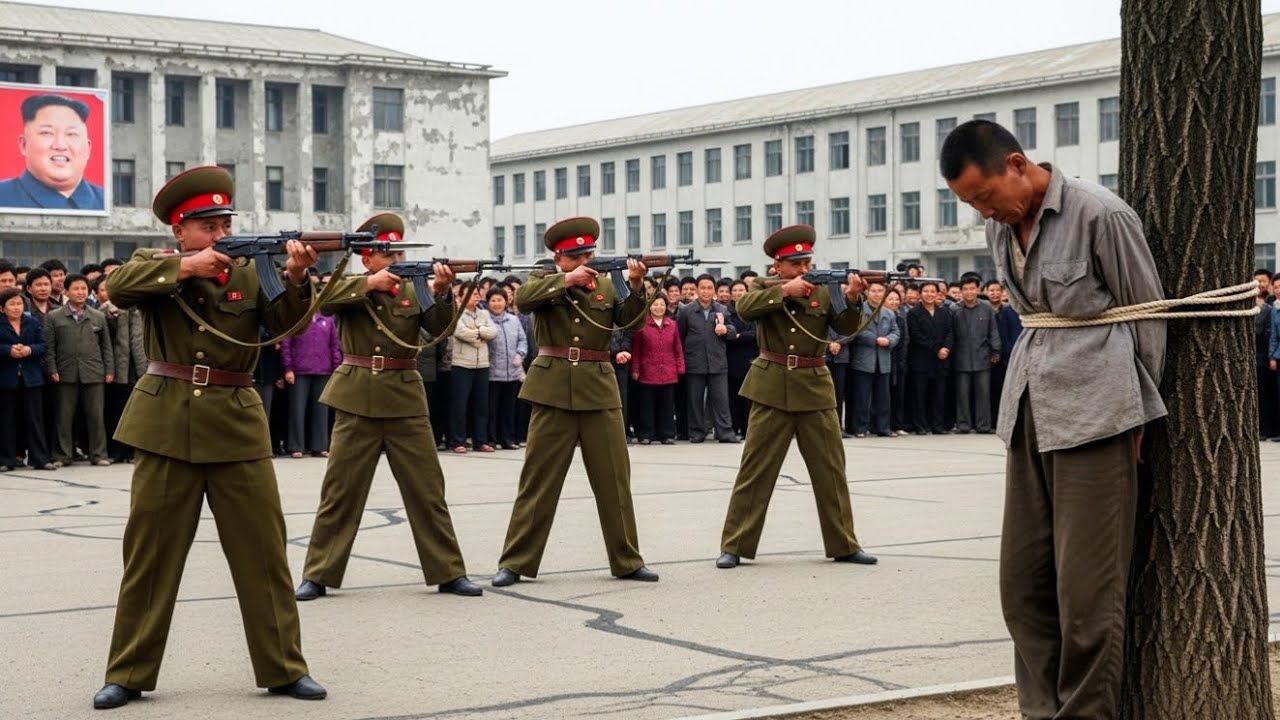
The stadium filled 1,500 people, maybe more. All of us forced to be there. All of us about to witness murder called justice.
At exactly 9:00 in the morning, soldiers marched onto the stage. Then the officials came, local party members, Bowie Buu officers, the people who had ordered this.
And then they brought out the condemned. Six people, their hands tied behind their backs, walking slowly, guards on either sides of them.
I saw Sunung min immediately. He was third in line. He was thin. He had lost weight in just one week.
His face was bruised and swollen. He walked with a limp, but he held his head up.
Next to him was Mrs. Park, the elderly woman from our church. Then Mr. Choy.
Then Mr. Chroy’s wife. Then two other men I recognized from our meetings. They lined them up on the stage facing the crowd.
Behind them, they erected six wooden posts. An official stepped forward with a loudspeaker. He began to read the charges.
His voice echoed across the stadium, harsh and mechanical. He called each person by name and listed their crimes.
When he got to Sunung Min, he said his name and then said, “Leader of an illegal religious group.
Distribution of 147 Bibles and Christian propaganda materials. Espionage activities in coordination with South Korean and American hostile forces.
Corruption of the people with superstitious nonsense. 147 Bibles. I had not known there were that many.
Sung Min must have been smuggling them for longer than I knew. Must have been distributing them to people I never met.
The official went on. He talked about how these criminals had betrayed the fatherland. How they had sold their souls to foreign powers.
How they deserve death. The crowd was silent. We had learned to be silent at moments like this.
Then the official asked the question. He asked each of the condemned if they would renounce their crimes, if they would confess and beg for mercy.
He started with Mrs. Park. She was so small and frail, standing there in her thin prison clothes.
The official asked her if she renounced her anti-state religion. Her voice was weak. I could barely hear it, but I heard what she said.
She said, “Justice is Lord.” The official moved to the next person and the next.
Each one said the same thing in one way or another. They would not renounce.
They would not confess. They would not beg. When he got to Sunung, I held my breath.
The official asked him, “Do you renounce your anti-state religious activities?” Sunung looked out at the crowd.
I do not know if he could see Hijgin and the children. I do not know if he was looking for them, but he looked out at all of us.
And his voice was clear and strong. He said, “Forgive them, father, for they know not what they do.”
Jesus words from the cross. Sunung min was praying for the people who were about to kill him.
The crowd murmured. The officials looked angry. One of them stepped forward and hit Sunung Min across the face.
He staggered but did not fall. Then they tied all six of them to the post.
The firing squad marched forward, 10 soldiers with rifles, and someone in that line of condemned believers began to sing.
It was Mrs. Park. Her voice was thin and wavering, but I knew the song immediately.
Amazing Grace. The hymn we had sung together in whisper so many times. One by one, the others joined her.
Sunung min’s voice rose above the rest, strong and clear. Amazing grace, how sweet the sound that saved a ratch like me.
I once was lost, but now I’m found. Was blind, but now I see. They sang in Korean, but I knew the English words, too, because Sunung min had taught them to me.
He said they were beautiful words. Words about being safe, about being found, about seeing clearly for the first time.
The officials were shouting, trying to drown out the singing, but the condemned kept singing.
The officer in charge of the firing squad gave the order. The soldiers raised their rifles.
The singing did not stop. The officer gave the second order and the rifles fired.
The sound was deafening. It echoed off the concrete walls of the stadium. It seemed to go on forever, though it was really only a few seconds.
I saw my brother’s body jerk back against the ropes. I saw his head drop forward.
I saw the blood. I saw all six of them fall silent. The singing stopped for a moment.
Everything was quiet. The whole stadium, 1,500 people completely silent. Then I heard crying. Hijin had broken down completely, sobbing, clutching the baby.
The children were crying too. Our mother had collapsed. Someone was trying to hold her up.
The officer walked to each body and fired one more shot to make sure they were dead.
I stood there in the crowd, my hand pressed against my mouth, biting down hard to keep from screaming.
I was shaking so badly I thought I would fall, but I could not look away.
They left the bodies there on the stage. The official announced they would remain there for 3 days as a warning to anyone else who thought about betraying the fatherland.
Then he dismissed the crowd. People started to foul out slowly. No one spoke. What was there to say?
I stayed until almost everyone had gone. I could not leave my brother there alone.
Finally, a boy agent started walking toward my section, checking faces. I had to go.
If I was caught, everything Sunung min died for would mean nothing. I walked out of the stadium with my head down.
I walked through the streets of Riong Chon. I walked until I reached the abandoned building where I had been hiding and then finally I collapsed.
I do not know how long I lay there on that floor. Hours maybe. I could not move.
I could not think. I just lay there shaking, seeing the moment over and over again.
The rifles firing. Sung Min’s body jerking. The blood When it started to get dark, I forced myself to sit up.
I had to think. I had to decide what to do. I could not stay in Ryong Chon.
They would find me eventually. I had to run. But first, I had to know what happened to Hijin and the children, to our mother, to the others who had been arrested.
Over the next few days, I gathered information. I learned that all the families of the executed had been sent to the camps the day after the execution.
Camp 18, just like I had heard. It was one of the worst camps, a place people did not come back from.
Here, Jyn was there with the three children. Our mother was there. Mr. Cho’s daughters were there, even though they were only teenagers.
I learned that in those camps most people died within a few years from starvation, from disease, from the brutal work, from the beatings.
Children did not usually survive. I learned that I could do nothing for them. Nothing at all.
That was when I decided to escape. Not because I wanted to save myself, but because someone had to tell the world what happened.
Someone had to witness. Someone had to make sure Sun means death meant something. So I started making plans.
I contacted people who knew how to get across the border. I gathered what little money I had.
I prepared to leave my country, my family, everything I had ever known. I stayed one more week in Ryong Chon.
I do not know why. Maybe I was not ready to let go. Maybe I was hoping for a miracle.
On the third day after the execution, I went back to the stadium at night.
The bodies had been taken down, but there was still blood on the stage. I stood there in the darkness and said goodbye to my brother.
I told him I would tell his story. I promised him I would make sure the world knew what he died for.
Then I turned and walked away from that place. I never went back. I need to tell you about June 30th, 2009.
I need to tell you everything even though there are parts I wish I could forget.
Even though I still wake up some nights with the sound of gunfire in my ears.
Even though 15 years have passed and the images are still as clear as if they happened yesterday.
This is the hardest part of the story to tell, but it is the most important part because this is the part the world needs to see.
The morning was hot and humid, the kind of day where the air feels thick, hard to breathe.
I woke up before dawn in the abandoned warehouse where I had been hiding. I had barely slept.
Every time I closed my eyes, I saw Sungmin’s face on that poster. Bruised and swollen.
I put on the old clothes I had gathered, a worn work shirt that was too big for me, pants with holes in the knees, the head pulled low.
I looked at myself in the broken mirror again and thought, “This is what I have become.
A ghost, a shadow, someone who does not exist.” I left the warehouse while it was still dark.
The streets were empty except for a few people hurrying to early shifts at factories.
No one paid attention to me. I walked slowly toward the stadium. I did not want to get there too early and stand out, but I did not want to be late either.
The boy would be watching for people who tried to avoid the execution. Absence would be noticed, recorded, punished later.
As I got closer, I saw more people emerging from their homes, families walking together, old people moving slowly, even small children holding their parents’ hands.
We were all walking to the same place, all walking to witness death. No one spoke.
There was just the sound of footsteps. Hundreds of footsteps, then thousands, all moving in the same direction like a funeral procession.
The stadium came into view. It was really just a large open space with concrete rises built up on three sides.
We used it for political rallies, for celebrations on Kim Ilang’s birthday, for public meetings.
I had been there many times before, but I had never been there for an execution.
I had heard about public executions. Everyone in North Korea had heard about them. They happened in every province, every city, every town.
The government used them to teach lessons, to show what happened to people who broke the rules, to keep everyone afraid.
But I had never seen one. And I had never imagined I would see my own brother executed.
The crowd was already large when I arrived. I would guess more than a thousand people, maybe 1,500.
The boy agents were everywhere, standing at intervals around the stadium watching. They had clipboards.
They were checking names, making sure everyone who was supposed to be there was there.
I kept my head down and moved into the crowd. I found a spot about halfway up the risers on the left side, not too close to the front where I might be seen clearly, not too far back where I might look like I was trying to hide.
Around me, people settled into their places. Some sat down on the concrete, some stood.
A few talked in low whispers, but most were silent. I looked around and saw faces I recognized.
People from our neighborhood. People who had known Sunung mean his whole life. People who had eaten meals at our house, who had borrowed tools from us, who had been our friends.
They would not look at me if they recognized me. Looking at the family of a condemned person was dangerous.
It suggested sympathy. It suggested doubt about the state’s judgment. So I stood there alone in the crowd of 1500 and I waited.
The front rows were filling up with families. I could see them being escorted in by guards.
They were not there by choice. The government forced the families of condemned prisoners to watch the executions.
It was part of the punishment. I saw Hijin before she saw me. She was carrying the baby and the two older children walked beside her, holding onto her skirt.
A guard was pushing them forward, telling them where to sit. She looked broken. Her face was pale and swollen from crying.
Her hair was messy. Her clothes were dirty. She moved like someone in a dream, like she was not fully present.
The children looked confused and afraid. The oldest Sang Minan was crying quietly. The little girl was clutching her mother’s skirt and whimpering.
The baby was fussing, probably hungry. They sat down in the second row, right in front of the stage, right where they would have a perfect view of their father’s execution.
Next to them, I saw our mother. Two guards were holding her up. She looked like she might collapse at any moment.
Her face was gray. Her eyes were empty. I wanted to run to them. I wanted to hold them and tell them I was there, but I could not move.
I was frozen in place, watching, helpless. Other families were brought in. Mrs. Park’s daughter and grandchildren.
Mr. Choice teenage daughters crying and holding each other. The families of the other condemned believers.
All of them forced to watch. All of them about to see their loved ones killed.
The stadium continued to fill. By the time the clock struck 9, there must have been close to 2,000 people there.
The largest gathering I had ever seen in Ryong Chon. At exactly 9:00, we heard the sound of military vehicles approaching.
The crowd went completely silent. Soldiers marched in first, maybe 30 of them in full uniform with rifles.
They formed lines on either side of the stage. Then came the officials, party members in their neat suits.
Bovibu officers, the people who had organized this spectacle. They took their places on the side of the stage, sitting in chairs like they were there to watch a performance.
Then the prisoners were brought in. They came from a covered truck that had pulled up behind the stage.
Guards led them out one by one, hands tight behind their backs, moving slowly. Mrs.
Park came first. She was so small and frail. She looked like a strong wind might blow her over.
But she walked with her head up. Then came one of the other men from our church.
Then Mr. Choy’s wife, then Mr. Choy himself, then another believer whose name I am not sure of.
And then Smin. My breath caught in my throat when I saw him. He had lost so much weight in just one week.
His face was bruised and swollen, worse than in the photograph on the poster. His left eye was nearly swollen shut.
There was a cut on his lip that had scapped over. He walked with a limb like maybe his leg or his ribs were broken, but his head was up.
His eyes were clear, and there was something in his expression. Not defiance exactly, but peace, a calmness that did not make sense.
They lined all six of them up on the stage facing the crowd. The soldiers brought out six wooden poles and planted them in holes that had already been dug.
The post were about as tall as a man, rough wood. Behind each post, I could see a dark stain on the stage floor.
All blood from previous executions. They did not bother to clean it. One of the officials stepped forward.
He had a loudspeaker and his voice boomed across the stadium harsh and metallic. He began with the standard speech about the greatness of our dear leader, about the perfection of our socialist system, about the enemies who tried to corrupt and destroy us from within.
Then he started reading the charges. He called each prisoner by name and listed their crimes.
When he called Mrs. Park. He said she had been distributing Bibles and holding secret prayer meetings for two years, that she had corrupted the minds of the young, that she was a spy for South Korean and American imperialism.
Mrs. Park stood there silently, her head bowed while he spoke. He moved down the line.
Each person had similar charges. Anti-state religious activities, distribution of illegal materials, espionage, corruption of socialist ideology.
When he got to Sunmin, his voice got louder, angrier. He called Sunmin the ring leader, the pastor of the illegal church.
He said Sunungin had smuggled 147 Bibles into North Korea from China. That he had held dozens of illegal meetings.
That he had recruited and corrupted 23 citizens. 23. That was more than I knew.
Sung Min had been reaching more people than he told me. The official said Sun Min was the worst kind of traitor, that he had sold his soul to foreign powers, that he deserved the severest punishment.
The crowd was absolutely silent. We knew we were supposed to shout in agreement to condemn the prisoners, but something held us back.
Maybe it was the heat. Maybe it was shock. Maybe it was that some people in that crowd knew these were good people, not criminals.
The official seemed angry at our silence. He shouted louder, demanding that we recognize the justice of what was about to happen.
A few people in the crowd started clapping mechanically. Others join. Soon there was scattered applause, not enthusiastic, just the sound of people doing what they were told.
Then the official turned to the prisoners. He walked down the line, stopping in front of each one.
He asked them if they were ready to confess their crimes, if they were ready to renounce their anti-state activities and begged for the mercy of the dear leader.
He started with Mrs. Park. He stood in front of her, the loudspeaker in his hand, and asked if she renounced her religion.
Mrs. Park was silent for a moment. I do not think anyone in that stadium was breathing.
Then she lifted her head. Her voice was weak and shaky. But I heard every word.
She said, “Jesus is Lord.” The official’s face turned red. He shouted at her, “Call her a fool.
Asked her again.” She said it again, louder this time, “Jesus is Lord.” He moved to the next prisoner, one of the men from our church.
Same question, same answer. Mr. Choice’s wife was next. She was crying, her whole body shaking.
But when the official asked if she renounced, she shook her head and whispered that Jesus was her savior.
One by one, they all refused. Every single one of them. When the official got to Sunung Min, I could see the rage in his face.
He stood right in front of my brother, shouting into the loudspeaker. Do you renounce your anti-state religious activities?
Do you confess your crimes? Do you beg for mercy? Sunung Min looked at him.
Then he looked out at the crowd. I do not know if he could see Hijin and the children.
I do not know if he was looking for them or looking past them, but he looked out at all of us gathered there.
And when he spoke, his voice was clear and strong. He said, “Forgive them, father, for they know not what they do.”
Jesus words from the cross. My brother was praying for the people who were about to kill him.
The crowd gasped. I heard murmurss all around me. The official looked like he might explode.
He stepped forward and struck Sunung Min across the face with the back of his hand.
Sunung Min’s head snapped to the side. He staggered but did not fall. Blood ran from his nose and mouth.
But he straightened up and looked at the official again and he smiled. I will never forget that smile.
It was not mockery. It was not defiance. It was peace. It was joy. It was the smile of someone who knew something the rest of us did not.
The official turned away in disgust. He bucked orders to the guards. They moved the prisoners to the post and began tying them.
They used rough rope, wrapping it around their chest and arms, binding them tight so they could not move.
Mrs. Spark was first, then the others, then Sung Min. I watched as they tied my brother to that wooden post.
I watched them pull the ropes tight. I watched him wence as the rope pressed against his ribs.
When all six were secured, the official stepped back. He raised his hand and the firing squad marched forward.
10 soldiers, young men, maybe 18 or 20 years old. They formed a line about 10 m from the prisoners.
They carried rifles, old models, but they would do the job. The soldiers stood at attention.
The officer in charge buck and order and they raised the rifles aiming at the prisoners.
And that is when the sinking started. It was Mrs. Park. Her voice was thin and trembling, but I recognized the melody immediately.
Amazing Grace. She sang in Korean. The words we had learned from the Chinese Christians.
The words we had sung together in our secret meetings in whispers, always afraid of being heard.
Now she sang them out loud in front of 2,000 people in her last moments of life.
One by one, the other prisoners joined her. Mr. Choyy’s voice strong and deep. His wife’s voice high and clear even through her tears.
The other believers adding their voices. And Sunung min’s voice rose above all arrest, strong and beautiful.
I had heard him sing this hymn a 100 times in the darkness. Now he sang it in the light, unafraid, unashamed.
Amazing grace, how sweet the sound that saved the wretch like me. The officials were shouting, trying to drown out the singing.
The officer in charge was yelling at the prisoners to be silent, but they kept singing.
I once was lost, but now I’m found. Was blind, but now I see. The officer in charge of the firing squad gave the first order.
The soldiers adjusted the aim, fingers on triggers. The singing did not stop. Was grace that taught my heart to fear and grace my fierce relief.
The officer gave the second order. How precious did that grace appear the hour I first believed.
The rifles fight. The sound was like thunder. It shook the stadium. It seemed to split the sky open.
I saw my brother’s body jug backward against the ropes. I saw his head snap back.
I saw the blood bloom across his chest, dark red against his gray prison clothes.
I saw all six of them fall silent at once. The singing stopped. The echo of the gunfire faded, and everything was quiet.
I stood there, my hand pressed against my mouth so hard I tasted blood. I had bitten through my own lip without realizing it.
My whole body was shaking. My knees felt weak around me. People were crying. Quiet crying, careful crying.
The kind of crying you do when you are afraid of being noticed. In the front row, Hajjin had collapsed forward, clutching the baby, sobbing so hard her whole body shook.
The two older children were screaming, calling for their father. Our mother had fainted. Someone was trying to revive her.
On the stage, the six bodies hung limp against the ropes. The officer in charge walked to each one with his pistol drawn.
He fired a single shot into each head to make sure. When he got to Sunung mean, I had to look away.
I could not watch that. I had seen enough. The official with the loudspeaker spoke again.
He announced that the bodies would remain on display for 3 days as a warning.
That anyone who showed sympathy for these criminals would be investigated, that this was the fate of all enemies of the state.
Then he dismissed the crowd. People began to stand and file out slowly. No one spoke.
What could anyone say? The families of the executed were not allowed to leave yet.
I saw guards holding them in place, making them sit there and look at the bodies, making them understand completely what had happened.
I wanted to stay. I wanted to go to Hijin and the children. I wanted to hold our mother, but a Bibu agent was walking through the crowd looking at faces, checking a list.
If I was recognized, if I was caught, everything would be for nothing. So I turned and walked away with the crowd.
I kept my head down. I did not look back. I walked through the streets of Ryong Chon in a days.
People dispersed to their homes. Some went to work. Life did not stop for an execution.
I walked without knowing where I was going. Eventually, I found myself back at the abandoned warehouse.
I went inside and sat down on the floor in the corner where I had been sleeping.
And then I broke. I do not know how to describe what happened next. It was like something inside me shattered into a million pieces.
I started to cry, but it was not normal crying. It was a sound I had never made before.
Like an animal in pain, I could not control it. I could not stop it.
I cried until I could not breathe. Until my throat was raw, until my chest hurt.
I cried for my brother. For the sound of the rifles, for the blood, for the way his body jerked when the bullets hit.
I cried for Hijin and the children who had watched their father die. For our mother who had lost her son.
I cried for Mrs. Park and Miss Choy and all the others who had died for nothing more than believing in Jesus.
I cried for the world that allowed this to happen. For a government that could kill people for owning a book.
For a system so evil it made children watch their parents executed. And I cried because I was alive and they were dead.
Because I was free and they were gone. Because I would go on living and they would not.
When the crying finally stopped, I lay on the floor in the darkness. I was empty, hollowed out.
I felt like I had died too, like my soul had been tied to that post with Sunung min and been shot through with bullets.
Night fell. I did not move. I just lay there staring at nothing. I do not remember falling asleep.
But at some point, I must have because I woke up to gray morning light coming through the broken windows.
For a moment, I did not remember where I was or what had happened. Then it all came crashing back.
My brother was dead. I got up slowly. My body achd. My head dropped. My eyes were swollen from crying.
I needed water, but I had none. I needed food, but I had none. I just stood there in that empty warehouse and tried to figure out what to do next.
I knew I could not stay in Riong Chon much longer. Every day I stayed was another day I might be caught, but I could not leave yet either.
I had to know what would happen to the bodies, to the families. Over the next three days, I stayed hidden but gathered information.
I learned that the bodies were left on the stage exactly as the official had said.
People walked past the stadium and could see them there rotting in the summer heat.
I learned that on the second day birds came crows. They landed on the bodies and the guards did nothing to stop them.
I learned that Hijin and the children and our mother were still being held. That they would be sent to Campin within a week.
I learned that the bodies would not be given to the families for burial. They would be burned and the ashes scattered.
There will be no grave to visit, no place to mourn. On the third night after the execution, I went back to the stadium.
It was past midnight. There were guards there, but they were tired and not paying attention.
I climbed to the top of the risers and looked down at the stage. The bodies were still there.
I could see Song Min’s body slump against the ropes. His head was hanging forward.
His clothes were soaked with dried blood. I sat there for a long time just looking at him, just saying goodbye.
I told him I was sorry I could not save him. I told him I was sorry I survived when he did not.
I told him I would never forget him. I told him I would tell his story and I told him I loved him.
Then I left that place. I walked away from the stadium and I never went back.
The next day, they took the bodies down and burned them. The smoke rose up over Riong Chon all afternoon.
I saw it from my hiding place and I knew it was them. That was the last of my brother.
Smoke rising into the sky. Two days later, I heard that the families had been taken to the camp.
Hay Jin and the three children, our mother, all of them loaded onto trucks and driven away.
I tried to find out more information. I asked people who might know. I heard that camp 18 was in the mountains near the Chinese border.
That it was one of the worst camps, a place where political prisoners were sent to die.
I heard that children rarely survive more than a few years there. That pregnant women and babies were the first to die.
Hijin was 8 months pregnant when she was arrested. I do not know if she gave birth in the camp.
I do not know if the baby survived. I will probably never know. That knowledge that I will never know what happened to them, that I cannot help them, that they are suffering and I am free.
That knowledge is a weight I carry every single day. After the families were taken away, I knew it was time to leave.
There was nothing left for me in Ring Chon. Everyone I love was either dead or in prison.
I started making plans to escape to China. I contacted people who knew the roots.
I gathered what little money I had. But before I left, I made a promise.
I promised God and I promised my brother that I would tell this story, that I would make sure the world knew what happened, that Sun’s death would not be meaningless.
I did not know then how I would keep that promise. I did not know I would end up here years later telling you all of this, but I knew I had to try.
So I prepared to leave my country to become a defector, to spend the rest of my life in exile.
And I carry with me the images of that day, the sound of the rifles, the sight of my brother’s blood, the sound of their singing, amazing grace, how sweet the sound.
Those words sustain them as they died. Those words would sustain me as I tried to leave.
The days after the execution blur together in my memory. I know I stayed in Ryon for another week, maybe two.
I know I hid in different places, abandoned buildings, storage sheds, once in a pigsty where the smell was so bad I could barely breathe.
I know I begged for food from people who pied me or hated the government enough to help, but I do not remember the details clearly.
It was like I was moving through water, everything slow and heavy and distant. Part of me had died on that stage with Sunung Min.
The part that was still alive was just going through the motions. I remember lying in the dark one night and praying.
It was the first time I had really prayed since the execution. I asked God why he had let this happen.
Why he had not saved Sunung min. Why he had not stopped the soldiers or struck down the officials or opened the prison doors like he did for Peter in the Bible.
I did not get an answer, just silence. But in that silence, I heard Sunung Min’s voice in my memory.
Words he had said to me once when we were reading the Bible together. Words about how Jesus himself asked God to take away the cup of suffering, but then said, “Not my will, but yours be done.
I did not understand it. I still do not fully understand it.” But lying there in the darkness, I made a decision.
I would leave. I would escape. I would tell the story. Not because I wanted to, but because someone had to.
I contacted a man I knew who helped people cross into China. His name was Mr.
An. He was not a Christian. He was just a businessman who saw an opportunity to make money from desperate people.
But he was reliable. People who paid him usually made it across. I met him in a back alley one evening.
I told him I needed a leave as soon as possible. He looked at me and I could tell he knew who I was.
News traveled fast in a small town. Everyone knew about the execution. Everyone knew the brother of one of the condemned was missing.
He asked if I had money. I gave him everything I had. Savings I had hidden.
Money our mother had kept buried in the courtyard. Money I had backed and borrowed.
It was not much, but it was enough. He told me to be ready in three days.
He would send someone to get me. Those three days were the longest of my life.
I was terrified that every sound was the boy coming for me. That someone had seen me meeting with Mr.
Anne and reported it. That I would be caught just before escaping. But no one came.
On the third night, a young man appeared at my hiding place just after dark.
He did not give his name. He just told me to follow him and stay quiet.
We walked through Ryong Chon, avoiding the main streets, staying in the shadows. We passed my old house.
The door was still broken from when the boy raided it. The windows were dark.
No one lived there now. I wanted to stop to go inside one last time to see the room I had shared with Sunung Min to find something to remember him by.
But the young man pulled my arm and whispered that we had to keep moving.
So I walked past my home for the last time and did not look back.
We walked for hours heading north toward the borders. There were two other people with us, a woman maybe in her 30s and a teenage girl.
We did not talk. We just walked in silence through the darkness. Just before dawn, we stopped at a farm on the outskirts of a small village.
The young man led us to a shed and told us to hide there. He said we would cross tomorrow night.
We had to wait for the right time when the guards change shifts. We spent the whole next day in that shed.
It was hot and cramped and it smelled like manure. The woman had brought some food, rice balls and dried fish.
We shared it among the four of us. It was the first real meal I had eaten in days.
The teenage girl was crying quietly. I asked her what was wrong, but she would not answer.
The woman told me the girl’s father had been executed the month before for trying to defect.
Now the girl was defecting anyway. She had nowhere else to go. I told her I understood that my brother had been executed too.
She looked at me then and I saw recognition in her eyes. She whispered the pastor.
I nodded. She said she had heard about it, that people were talking about how they sang at their execution, how they refused to deny their faith even at the end.
She said they were brave. I wanted to tell her that bravery had nothing to do with it, that it was faith, that it was love, that it was something bigger than any of us.
But I just nodded and we sat in silence. When night came, the young man returned.
He had another man with him, older, who looked like he had done this many times before.
They gave us dark clothes and told us to change. They told us to leave everything behind except what we could carry in our pockets.
I had nothing to carry. Everything I own in the world was already gone. We left the shed and walked north through fields and along the edges of forest.
We moved fast, almost running. The moon was half full and gave just enough light to see by.
After maybe 2 hours, we reached the river. The Tuman River, the border between North Korea and China.
It was narrower than I expected, maybe 30 or 40 m across. The water was stuck and moving fast.
I could hear it rushing over rocks. The older man pointed to a spot downstream where the current was slower.
He said that was where we would cross, but first we had to wait for the guards to pass.
We crouched in the bushes along the bank and waited. It was cold. The woman was shivering.
The teenage girl was breathing too loud and the older man told her to be quiet.
After what felt like forever, we heard footsteps. Two North Korean border guards walking along the bank, talking quietly to each other.
They passed within 10 m of where we were hiding. We held our breath until they were gone.
Then the older man whispered that it was time. We moved down to the water’s edge.
The older man went first, stepping into the river. The water came up to his waist immediately.
He turned and motioned for us to follow. The young man went next, then the woman, then the teenage girl, then me.
The water was shockingly cold. It took my breath away. The current was stronger than it looked.
I had to fight to keep my footing on the slippery rocks. The older man led us across slowly.
The water got deeper. At the deepest point, it was up to my chest. I am not a strong swimmer.
I panicked for a moment, thinking I was going to be swept away. But the woman grabbed my arm and helped me keep my balance.
We kept moving forward, step by step, fighting the current. And then finally, the water got shallower.
We climbed up the far bank and collapsed on the ground. We were in China.
I lay there on the wet ground, breathing hard, and I felt nothing. No relief, no joy, just emptiness.
I had escaped North Korea. But I had left everything I loved there. My brother’s grave or the place where his ashes had been scattered, my family in the prison camp, my home.
The older man told us to get up. We were not safe yet. The Chinese border guards were not far away.
And if they caught us, they would send us back. We had to get to a safe house before dawn.
We walked for another hour through Chinese farmland. Finally, we reached a small house on the edge of a village.
The older man knocked on the door in a pattern. Three knocks, pause, two knocks.
A Korean Chinese man opened the door. He looked at us and quickly ushered us inside.
The house was small and crowded. There were already five or six other North Korean defectors there hiding.
All of us crammed into one room. The Korean Chinese man gave us blankets and told us to sleep.
He said we would stay here for a few days until it was safe to move on.
I found a spot in the corner and lay down. I was exhausted, but I could not sleep.
I just lay there staring at the ceiling, listening to other people breathing and snoring around me.
I thought about Sunung Min. I wondered what he would think if he knew I had made it across.
I wonder if he would be proud of me or disappointed that I had run.
I thought about the last time I saw him, his body hanging limp against the ropes, the blood, the silence after the gunfire.
I thought about his children in the prison camp. Were they still alive? Were they cold?
Were they hungry? Were they crying for their father? I thought about our mother. Was she still alive?
Had the camp killed her yet? I thought about all these things and I wished I had died with them.
I stayed in that safe house for 5 days. Other defectors came and went. Some were moving on to the next stage of their journey.
Some were just arriving, still wet from crossing the river. Everyone had a story. The woman who had crossed with me had left because her husband had been executed for stealing food.
The teenage girl had left because her whole family was going to be sent to a camp.
An old man had left because he was starving and there was no food left in his village.
No one talked much. We were all too tired, too traumatized, too afraid. On the sixth day, the Korean Chinese man told me it was time to move.
He had arranged for me to go to another safe house deeper in China, away from the border.
He put me in the back of a truck with three other defectors. We hid under blankets and boxes.
We could barely breathe, but we stayed quiet. The truck drove for hours. Every time it stopped, I thought we had been caught.
But each time it started moving again. Finally, we arrived at another house in a small Chinese town.
The man who owned it was a Christian. He was part of an underground network that helped North Korean defectors.
This house was different. It was cleaner, safer, and there was food, real food, rice and vegetables, and even some meat.
The Christian man told us we could stay there for a few weeks while we decided what to do next.
He said, “Some people stayed in China and tried to build lives there, working illegally.
Others tried to make it to South Korea through Southeast Asia.” He asked if any of us were Christians.
I raised my hand. He smiled. He asked me to tell him my story. So I told him.
I told him about Sang Min, about the underground church, about the execution, about the singing.
When I finished, he was crying. He said he had heard stories like mine before, but it never got easier to hear them.
He said that there were people who wanted to help, organizations that documented these stories that tried to bring attention to what was happening in North Korea.
He asked if I would be willing to share my story more publicly someday. I did not know how to answer.
Part of me wanted to hide forever to forget everything that happened. But another part of me remembered the promise I had made.
I told him yes. Someday when I was ready I would tell the story. I stayed in that house for two months.
During that time I met other North Korean Christians who had defected. We started having small Bible studies together.
It was strange to pray out loud without whispering to sing hymns at normal volume to not be afraid.
But I was afraid anyway. Afraid that the Chinese police would raid the house and send us all back.
It happens sometimes. The Chinese government had an agreement with North Korea to return defectors.
So even in China, we were not truly free. The Christian men helped me find work, illegal work, under the table in a factory.
I worked 12 hours a day for very little money. But it was something. It let me save up for the next part of the journey because I had decided I could not stay in China.
I needed to go somewhere truly safe. South Korea maybe or beyond. The Christian men put me in contact with people who could help.
They were part of what some called the New Underground Railroad, a network of Christians and activists who helped North Korean defectors escaped through China to Southeast Asia.
The journey was dangerous and expensive, but it was the only way to real freedom.
In early 2010, almost a year after Sang Min’s execution, I left China. I travel with a group of five other defectors and a guide.
We took buses and trains through southern China. Always nervous, always ready to run if police ask for papers.
We crossed into Laos through the jungle. We walked for two days through thick forest, sleeping on the ground, eating very little.
I got sick with a fever, but had to keep walking anyway. When we finally made it to Thailand, we thought we were safe, but we were arrested almost immediately by Thai police.
They put us in a detention center for illegal immigrants. It was overcrowded and dirty, and we were kept behind bars, but it was better than North Korea, and the Thai government did not send defectors back.
We stayed in that detention center for 3 months while our cases were processed. During that time, I was interviewed by representatives from the South Korean government and from international organizations.
They asked me about my life in North Korea, about why I left, about what I had seen.
I told them about Sunung min, about the church, about the execution. They recorded everything.
They said my testimony was important, that it would help document the human rights abuses in North Korea.
I did not care about documentation or politics. I just wanted Sunung means death to mean something.
Finally, in late 2010, I was released from the detention center. I was given a choice.
I could go to South Korea where I would automatically be granted citizenship as a North Korean defector or I could apply for resettlement in a third country through the UN refugee agency.
I chose to go to South Korea. It seemed like the logical choice. They spoke my language.
They had programs to help defectors adjust. But when I arrived in Soul, I felt more lost than ever.
The city was overwhelming. The buildings were so tall. The streets were so crowded. There were more people in one subway station than in all of Riong Chon.
Everyone moved so fast. They were always looking at their phones, always rushing somewhere. No one looked at each other.
No one smiled. And everyone had so much so much food, so much clothing, so many things.
I walked through a supermarket once and almost cried at the sight of all the food.
Isisles and aisles of food. More food than I had seen in my entire life in North Korea.
But I did not fit in. I could not fit in. People called us defectors.
They called us refugees. They looked at us with pity or suspicion. We talked differently.
We dressed differently. We did not understand their jokes or their culture. I was given an apartment and some money to live on while I adjusted.
I was enrolled in classes to learn about South Korean society. I was supposed to find a job and start a new life, but I could not.
I was paralyzed. Every night I dream about Sunin, about the execution, about the sound of the rifles.
I woke up screaming. I could not eat. Food turned to dust in my mouth.
I lost weight until I looked like a skeleton. I could not work. I tried a few job but I could not focus.
I kept thinking about my family in the camp. I was depressed, traumatized, broken. One day a woman from a church contacted me.
She said she had heard about my story. She asked if I would like to come to their church.
I did not want to go. I did not want to see anyone. But she kept calling, kept inviting, kept reaching out.
Finally, I went. The church was full of South Korean Christians who welcomed me like family.
They fed me. They prayed with me. They listened to my story and slowly, very slowly, I started to heal.
I started sharing my testimony at that church. Just small groups at first, then larger gatherings.
People would cry when I told them about Sunung Min, about the singing at the execution, about the faith that sustained him even unto death.
They asked me what they could do to help, how they could pray. I told them to pray for North Korea, for the 50,000 Christians in prison camps, for the underground church that was still meeting in secret, still risking everything.
I told them to pray for Sun Min’s children, for our mother, for all the families torn apart.
And I told them not to forget. That was the most important thing. Do not forget.
Over the next few years, I continued sharing my testimony. I spoke at churches and conferences.
I was interviewed by human rights organizations and journalists. I told Sang Min story over and over until the words became almost automatic, but they never stopped hurting.
In 2013, I received news through unofficial channels. Someone who had escaped from camp 18 and made it to South Korea told me that Hijin had died in the camp.
She died shortly after giving birth to her fourth child. The baby died too. When I heard this news, I locked myself in my apartment for a week.
I did not eat. I did not sleep. I just sat in the dark and griefed.
Son means wife, dad. His baby dead. What about the other three children? What about our mother?
Were they still alive? I would probably never know. This is what I carry. This is the weight I wake up with every day.
The knowledge that I am free and they are not. That I am alive and sin is not.
That I sleep in a warm bed and eat good food while his children, if they are still alive, are starving in a prison camp.
People tell me it is not my fault, that there was nothing I could do, that I should not feel guilty, but I do.
I will always feel guilty. The only thing that makes it bearable is the hope that telling this story might make a difference.
That somehow it might help bring attention to North Korea, might help bring pressure to close the camps, might help save even one person from the fate that befell my family.
In 2015, I moved to a western country. I will not say which one for security reasons, but it is a place where I can speak freely, where I can share my faith without fur.
I still have nightmares. I still wake up some nights and think I am back in Riong Chon hiding from the Bowie Buu.
I still see Sung Min’s face bruised and bloody on that execution stage. But I also see his smile, his peace, his unshakable faith.
And I try to live in a way that honors his memory. I work with organizations that help North Korean defectors.
I advocate for human rights. I speak at churches and schools and anywhere people will listen.
And I tell Song’s story because he cannot tell it himself because his voice was silenced by bullets on a June morning in 2009.
But through me, he can still speak. From me, the world can know what happened to him.
What happened to Mrs. Park and Mister Choy and all the others who died for their faith.
Through me, people can know that there is a church in North Korea, that it is alive, that it is growing, that it refuses to die, no matter how much the government tries to stamp it out.
This is my mission now. This is why I am still alive. Not for myself, for them.
I sit here today in a country where I can speak freely and I try to find the words to tell you what it means to be the one who survived.
To be the brother who lived while Sunn died. To be free while his children remain in prison.
To have plenty while they have nothing. There’s no word in Korean or in English that fully captures this feeling.
Guilt is too small. Responsibility is too clean. It is something deeper, something that lives in my bones.
Every morning when I wake up in my warm bed, I think of them. When I eat breakfast, I think of them.
When I walk down the street in safety, I think of them. They are with me every moment of every day.
But I am getting ahead of myself. Let me tell you how I got here.
How I went from being a traumatized defector hiding in an apartment in soul to someone who stands before crowds and tells this story.
It was not a smooth journey. It was not a quick healing. There were many dark days.
Many times when I thought about giving up after I received the news about Hayene’s death in 2013, I fell into a deep darkness.
For months, I could barely function. I stopped going to church. I stopped answering calls from people who wanted to help.
I just sat alone in my apartment and sat at the walls. I was angry at God.
I did not understand how he could let Hijin die like that. How he could let a baby be born just to die in a prison camp.
How he could allow such suffering to continue. I stopped praying. What was the point?
God did not seem to be listening anyway. One night, I decided I could not go on.
The weight was too heavy. The guilt was too much. I thought about ending my life.
I even wrote a note. I wrote that I was sorry, that I had tried but I could not carry this burden anymore.
But before I could do anything, my phone rang. It was pastor Kim from the church in Soul.
He was calling to check on me because he had not seen me in weeks.
I did not answer but he left a message. He said, “Jinho, I do not know what you are going through right now, but I know you are suffering.
I want you to remember something your brother said in his final moments. He said, “Forgive them, Father, for they know not what they do.”
He was able to forgive even the people who killed him. Can you forgive yourself for surviving?
I listened to that message over and over. And something broke open inside me. Sunung min had forgiven his executioners.
He had looked at the people who were about to shoot him and he prayed for them.
He did not hate them. He did not curse them. He forgave them. And here I was unable to forgive myself for not dying with him.
I realized that by giving up by ending my life, I would be throwing away the very thing Sunung min had died to preserve his story, his witness, his faith.
If I died, who would tell what happened to him? Who would speak for the voiceless Christians still in North Korea?
That night I fell on my knees and I prayed for the first time in months.
I asked God to forgive me, to give me strength, to show me how to carry this burden without being crushed by it.
I did not hear a voice. I did not see a vision, but I felt something shift inside me, a small measure of peace, a tiny bit of hope.
I tore up the note I had written, and I decided to live. Not just to survive, but to truly live.
To live with purpose, to live for those who could not. I went back to church the next Sunday.
Pastor Kim hugged me and cried. He said he had been praying for me every day.
I started sharing my testimony again, but with a new understanding. I was not just telling a story about the past.
I was calling people to action in the present because the persecution did not end with Sunung means execution.
It is still happening right now today as I speak to you. Let me tell you what is happening in North Korea at this very moment.
There are an estimated 200,000 people in political prison camps right now. Of those between 50,000 and 70,000 are Christians or people in prison because of their connection to Christians.
These are not criminals. They are people who own a Bible. People who prayed, people who dare to believe in something other than the Kim regime.
They are in camps like camp 14, camp 15, camp 18, places where people work 16 hours a day in coal mines and fields, where they are given just enough food to keep them alive, but not enough to keep them from starving slowly.
Where they are beaten for the smallest infractions. Where they watch their children die from malnutrition and disease.
And there is nothing they can do. Three generation punishment is still the law. If you are caught as a Christian, your parents and your children go to the camps with you.
Babies are born in those camps and will die in those camps without ever knowing freedom.
Public executions still happen. Just a few years ago, in 2016, a woman was executed for owning a Bible.
In 2019, several people were executed for watching South Korean Christian videos. The underground church still exists.
It is estimated that there are between 50,000 and 400,000 Christians in North Korea. They still meet in secret.
They still risk everything to worship. And they still need our prayers. I have met other defectors who were part of the underground church.
I have heard their stories. One woman told me about a church that met in a basement.
20 people squeezing into a tiny space, taking turns reading from pages of the Bible they had memorized because they did not dare keep written copies.
She said they met every week for three years before someone betrayed them. 15 people were arrested.
She only escaped because she was sick that week and stayed home. A man told me about a pastor who was tortured for weeks to get him to give up the names of his church members.
They broke his fingers one by one. They put out his teeth. They beat him until he could barely stand.
But he never gave a single name. He died under torture without betraying anyone. These are not stories from the distant past.
These are things that happened in the last 10 years. This is the reality that Sunung Min died for.
This is the reality that his children are living in right now and the world does not know or if they know they do not care enough to do anything about it.
That is why I tell this story. That is why I stand before you today and ask you to listen, to care, to act.
I want to tell you about the last information I received about my family in 2016, 7 years after the execution.
I met a man who had escaped from camp 18. He had been there for 12 years before he managed to escape.
I asked him if he knew anything about my family, if he had ever heard of them.
He thought for a moment and then his face changed. He said he remembered hearing about a woman who had come to the camp in 2009 with three small children and an elderly mother.
He said people talked about them because the woman died in childbirth shortly after arriving.
He said he thought two of the children survived for a few years. Dubichia, but he could not be sure.
The camp was large. People died all the time. Children especially did not last long.
He said he did not know what happened to the elderly mother. That was the last information I ever received.
I do not know if Sung means children are still alive. If they are, they would be in their 20ies now.
They have spent their entire lives in that camp. I do not know if they remember their father.
The oldest was six when he was executed. Maybe he has some memories. Maybe he remembers being held, being loved, being told about Jesus.
Or maybe the camp has taken even that from him. I think about them every single day.
I pray for them every single day. I beg God to protect them, to sustain them, to somehow bring them out of that place.
But I do not know if I will ever see them again. I do not know if they are even alive.
This uncertainty is its own kind of torture. Not knowing is sometimes worse than knowing.
But I have had to make peace with it. I have had to accept that I may never have answers.
What I do have is this story and the responsibility to tell it. Over the past 15 years, I have shared Sang Min story in dozens of countries.
I have spoken at churches and universities and human rights conferences. I have met with politicians and activists and journalists.
I have done everything I can to make people aware of what is happening in North Korea.
Some people listen with tears in their eyes. Some people are moved to action. They donate to organizations.
They advocate for policy changes. They pray. But many people hear and then forget. They go back to their comfortable lives.
And North Korea becomes just another news story, another problem that seems too big to solve.
I understand. I do not judge them. The world is full of suffering and it is easy to become numb to it.
But I cannot become numb. I cannot forget because these are not statistics to me.
This is my brother. This is my family. So I keep telling the story. I will keep telling it until the day I die or until North Korea is free, whichever comes first.
Let me tell you what I want you to take away from this story. First, I want you to know that the underground church in North Korea is real and it is alive.
Despite 75 years of brutal persecution, despite public executions and prison camps and torture, Christians in North Korea continue to worship.
They continue to share their faith. They continue to believe this is a miracle. In any human terms.
Christianity should have been completely wiped out in North Korea by now. But it has not been.
It is growing quietly, secretly, but growing. This is the work of the Holy Spirit.
This is God moving in the darkest place on earth. Second, I want you to understand the cost of faith.
In the West, being a Christian is easy. You can go to church without fear.
You can own a Bible without risking death. You can pray out loud. You can sing hymns.
But in North Korea, believing in Jesus can cost you everything. Your life, your family, your freedom.
And yet, people still choose to believe. They count the cost. And they decide Jesus is worth it.
When I see Christians in free countries who treat their faith casually, who skip church because they are tired, who let their Bibles gather dust, I want to tell them about Sunung Min, about how he buried his Bible in a jar because it was so precious, about how he died rather than deny Christ.
I am not saying this to shame anyone. I am saying it to inspire. If Sun Min could have that kind of faith in the face of death, what kind of faith should we have in freedom?
Third, I want you to pray. This is the most important thing you can do.
Pray for the underground church in North Korea. Pray for their safety, their courage, their faith.
Pray for the Christians in the prison camps. Pray that God would sustain them, give them hope, bring them comfort in their suffering.
Pray for the North Korean government. Pray that their hearts would be changed, that they would see the evil of what they are doing and repent.
Pray for change. Pray for freedom. Pray for the day when North Koreans can worship openly without fear.
I believe in the power of prayer. I have seen God work miracles. The fact that I am alive, that I escaped, that I am able to tell this story, that is a miracle.
So pray, please pray. Fourth, I want you to support organizations that are working to help North Korea.
There are groups that send information into the country through balloons and radio broadcasts. Groups that help defectors escape.
Groups that advocate for policy changes and sanctions. Support them. Give to them. Help them in whatever way you can.
Every dollar makes a difference. Every voice raised in advocacy matters. And finally, I want you to remember.
Remember Sunung Min. Remember Mrs. Park and Mr. Choi and all the others who died for the FA.
Remember their courage, their joy, their peace in the face of death. Remember that they sang Amazing Grace as they faced the firing squad.
That they forgave the executioners. That they died with the name of Jesus on their lips.
Remember that there are 50,000 Christians in prison camps right now who need you to speak for them because they cannot speak for themselves.
Do not let their suffering be meaningless. Do not let the world forget about them.
I want to close by telling you what I have learned through all of this.
I have learned that faith is not about having an easy life. It is not about prosperity or comfort or success.
It is about trusting God even when nothing makes sense. Even when he allows suffering, even when he seems silent.
I have learned that God is present in the darkest places. That he was with Sang Min on that execution stage.
That he is with believers in the prison camps right now. That he does not abandon his children even when it seems like he has.
I have learned that the gospel is true. It must be true because nothing else could sustain people through what North Korean Christians have endured.
Nothing but the hope of resurrection. Nothing but the promise of eternal life. Nothing but the love of Jesus.
I have learned that I am stronger than I thought. Not in my own strength, but in God’s strength.
On my own, I would have given up years ago, but God has carried me.
He has given me the strength to keep going, to keep telling the story, to keep hoping.
And I have learned that my brother’s death was not in vain. Every time I tell his story, every time someone hears it and is moved to pray or act or simply remember, Sunung means death takes on meaning.
He did not die for nothing. He died for Christ and that is everything. I think about what Sunung mean said to me once, that he would rather his children grow up knowing their father died for something true than grow up watching their father live for a lie.
He made that choice and it cost him everything. But I believe I have to believe that he is in paradise now.
That he is with Jesus. That he is free from pain and suffering. That he is worshiping with a loud voice instead of a whisper.
I believe I will see him again. That we will stand together before the throne of God.
That he will introduce me to Mrs. Park and Mr. Choy and all the others that we will sing Amazing Grace together with our full voices with joy with no more fear until that day comes.
I will keep telling his story. I will speak for him because he cannot speak.
I will remember for him because the world has forgotten. I will live for him because he died.
This is my calling. This is my burden. This is my joy. My name is Jinho.
I am a North Korean defector. I am a Christian. I am the brother of a martr.
On June 30th, 2009, my brother Sang Min was executed by firing squad in Riong Chon, North Korea for the crime of believing in Jesus Christ.
He was 32 years old. He left behind a wife and three small children who were sent to a political prison camp where they have spent the last 15 years if they are still alive.
Sunung min died singing amazing grace. He died praying for his executioners. He died with faith and courage and peace.
He died so that you could know the truth about what is happening in North Korea.
Please do not let his death be forgotten. Please pray for North Korea. Pray for the underground church.
Pray for the Christians in the camps. Pray for Sun’s children. And please, if you believe in Jesus, live like he is worth dying for.
Because in many places in the world, he is. Sun knew that. He proved it with his life and his death.
May his faith inspire us all to live with that same courage, that same conviction, that same hope.
To God alone be the glory now and forever. Amen. I want to close by reading you the words that sustain sin in his final days.
The words he memorized from the Bible, the words he taught to me and to our small church from the book of Revelation chapter 7 13-17.
Then one of the elders asked me this in white robes, who are they and where did they come from?
I answered, sir, you know. And he said, these are they who have come out of the great tribulation.
They have washed their robes and made them white in the blood of the lamb.
Therefore, they are before the throne of God and serve him day and night in his temple.
And he who sits on the throne will shelter them with his presence. Never again will they hunger.
Never again will they thirst. The son will not beat down on them, nor any scorching heat.
For the lamb at the center of the throne will be their shepherd. He will lead them to springs of living water.
And God will wipe away every tear from their eyes. This is the promise that Sunung min believed.
This is the hope that kept him faithful even unto death. He has come out of the great tribulation.
He is before the throne. He will never hunger or thirst again. God has wiped away his tears.
And one day, one glorious day, I will see him there. Until then, I will tell his story.
Please do not forget him. Please do not forget them. Please pray for North Korea.
Thank you for listening. Thank you for caring. Thank you for remembering. May God bless you and keep you.
May his face shine upon you and be gracious to you. May he lift up his countenance upon you and give you peace.
Amen