Ancient DNA Reveals Tutankhamun’s Shocking Family Secret
Ancient DNA Reveals Tutankhamun’s Shocking Family Secret
The heavy scent of cedarwood, hot bitumen, and ancient dust hung thick in the air of the Valley of the Kings. It was November 1922, and the flickering light of a candle held by Howard Carter danced across a cracked plaster wall. Beside him, Lord Carnarvon stood in the suffocating heat, his breath catching in his throat.
“Can you see anything?” Carnarvon whispered, the tension agonizing.
Carter leaned closer to the small hole he had chiseled into the sealed doorway. For three millennia, darkness had ruled this hidden pocket of the earth. Now, as the warm air of the modern world rushed inside, the candle flame flickered, casting long, erratic shadows over shapes that gradually sharpened into focus. Glinting gold, stacked chariots, carved ebony couches, and monumental statues emerged from the gloom.
“Yes,” Carter breathed, his voice barely a rasp. “Wonderful things.”
When the world finally saw what lay within that tomb, it didn’t just discover an archaeological treasure; it encountered an instant legend. At the heart of it all was a face: a flawless, polished mask of gold and lapis lazuli, staring into eternity with serene, absolute power. This calm portrait of a handsome, divine young king became burned into the collective human consciousness. For decades, the global public looked at that golden mask and imagined a vibrant, robust warrior prince cut down in his prime by a shadowy assassin.
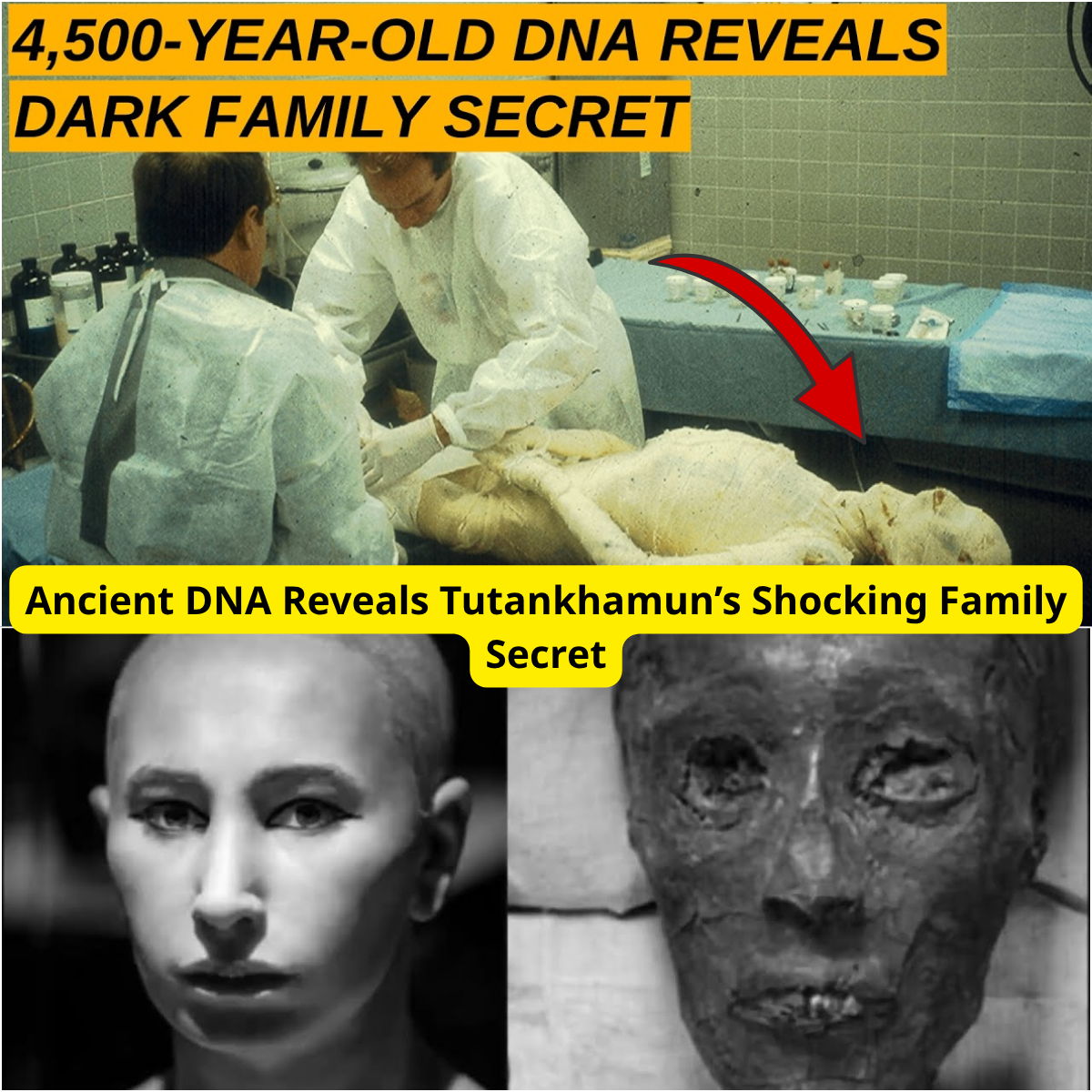
But the real face behind the gold mask was nothing like what we imagined.
For nearly a century, historians and scientists wrestled with a single, haunting question: Why did a pharaoh, surrounded by the greatest wealth and medicine of the ancient world, die at just nineteen years old? When early X-rays revealed a mysterious bone fragment and a dark spot at the back of his skull, a horrifying theory took root. It was the perfect historical murder mystery—a teenage king, cutthroat palace intrigue, a ambitious vizier, and a fatal blow to the back of the head.
Yet, as the twenty-first century dawned, advanced medical technology stepped into the dark tomb to rewrite the story. When a team of world-class scientists set legends aside and turned the cold, unyielding light of molecular science onto the royal mummies, the narrative of murder dissolved. What emerged in its place was a reality far more tragic, infinitely more complex, and deeply human. This is not just a story about the death of a king. It is an epic of a fracturing empire, a radical religious revolution, and the quiet, biological collapse of a dynasty that broke the laws of nature to keep its bloodline pure.
To understand the tragedy of Tutankhamun, the clock must be turned back long before his birth, to the high noon of the Egyptian Empire. Around 1390 BCE, Pharaoh Amenhotep III ruled over a land overflowing with unimaginable wealth. Egypt’s domain stretched from the banks of the Euphrates River in the north deep into the golden, mineral-rich territories of the Fourth Cataract of the Nile in the south. Gold was said to be “as common as dust” in the streets of Thebes. It was an golden age built on unwavering tradition, where the powerful priests of the state god Amun managed vast estates and kept the cosmic balance stable.
But this grand stability was a fragile illusion. When Amenhotep III died, his son, Amenhotep IV, ascended the throne and promptly launched the most radical, disruptive cultural earthquake in Egyptian history.
He looked at the immense wealth and political power of the Amun priesthood and chose to systematically dismantle it. He declared that the old gods were dead. In their place, he elevated a single, supreme deity: the Aten, the literal physical disk of the sun. This wasn’t a minor theological shift; it was a total monotheistic revolution. The king stripped the ancient temples of their funding, hacked the names of the traditional gods off public monuments, and changed his own name to Akhenaten—meaning “The Living Spirit of Aten.”
To completely sever ties with the past, Akhenaten abandoned the magnificent capital of Thebes. He forced thousands of his subjects into the scorching, desolate desert to build a brand-new holy city from scratch: Amarna. It was a surreal, glittering metropolis of white limestone and open-air temples, isolated from the rest of the world.
It was into this swirling vortex of religious fanaticism and political isolation that Tutankhamun was born. At birth, his name was not Tutankhamun, but Tutankhaten—”The Living Image of Aten.” He spent his earliest years running through the sun-drenched courtyards of Amarna, shielded from a kingdom that was quietly boiling with resentment. The traditional military was neglected, the economy was fracturing, and the people secretly prayed to their old, forbidden gods in the dark.
When Akhenaten died, he left behind a kingdom on the brink of civil war and economic ruin. The crown was placed upon the head of a child. At just nine years old, little Tutankhaten became the Pharaoh of Egypt.
The child-king was instantly trapped between the legacy of his father and the immense, vengeful pressure of the restored old guard. Under the guidance of older advisers like the vizier Ay and the military commander Horemheb, the boy king was forced to systematically undo everything his father had built. He officially abandoned the desert city of Amarna, letting the sands slowly swallow its palaces. He ordered the restoration of the defaced traditional temples. To seal this total surrender to the old ways, he changed his name to Tutankhamun: “The Living Image of Amun.”
For a few brief years, the young king worked to heal his fractured land. But just as he was stepping into his own manhood, the curtain fell abruptly. At nineteen, Tutankhamun died, leaving behind a chaotic vacuum and no living heir to inherit the Earth.
For decades, the physical remains of the young king lay in his tomb, largely undisturbed after Carter’s initial examination, while speculation ran rampant. In the early 2000s, mainstream researchers were deeply wary of conducting genetic studies on ancient royal mummies. The delicate molecules of DNA break down over thousands of years, and the risk of a scientist accidentally contaminating an ancient sample with their own modern skin cells or sweat was astronomically high.
However, by 2008, medical technology had advanced to a point where the invisible could finally be mapped. A state-of-the-art, sterile DNA laboratory was established deep in the secure basement of the Egyptian Museum in Cairo. Led by Egypt’s chief archaeologist, Dr. Zahi Hawass, an international team of geneticists set out to map Tutankhamun’s family tree and finally extract the true cause of his death from his very bones.
The team gathered tissue samples from eleven royal mummies of the New Kingdom, including the enigmatic remains found in forgotten side-chambers across the Valley of the Kings. The laboratory process was excruciatingly slow and nerve-wracking. The dark resins, sacred oils, and aromatic spices used by ancient embalmers had soaked into the royal bones over three thousand years, creating a thick, black chemical soup that actively blocked or degraded the genetic material. For months on end, scientists worked in pristine white hazmat suits, carefully washing away the chemical stains to isolate clean, ancient strands of DNA.
The first burning question the computers needed to answer was simple: Who exactly was Tutankhamun’s father?
Historical texts were frustratingly ambiguous, pointing alternatively to the grandfather Amenhotep III, the heretic Akhenaten, or a shadowy, short-lived co-regent named Smenkhkare. The definitive answer lay locked inside an anonymous, heavily damaged mummy found in a small, enigmatic tomb known as KV55. The names and royal cartouches on KV55’s coffin had been viciously scraped and chiseled away in antiquity, as if the occupant had been deliberately cursed to wander eternity without an identity.
When the computer screens finished processing the microsatellite DNA markers, the genetic data revealed an absolute, undeniable father-son relationship between the anonymous KV55 mummy and Tutankhamun via the Y-chromosome. Furthermore, the data proved that this individual was indisputably the biological son of Amenhotep III and his Great Royal Wife, Queen Tiye. When the genetic proof was cross-referenced with archaeological age estimates, the mystery was solved: the nameless, cursed occupant of KV55 was indeed the heretic king, Akhenaten. Tutankhamun’s paternal lineage was established.
But as the geneticists expanded their search to identify the boy king’s biological mother, the numbers dancing across the monitors threw the laboratory into a state of shock.
To locate the mother, the team analyzed a beautiful, nameless female mummy known simply to archaeologists as “The Younger Lady,” discovered decades earlier in a hidden side-chamber of Tomb KV35. Her face had been brutally smashed by ancient tomb robbers, her body left carelessly on the floor. When the DNA profiles were fully mapped and compared, the maternal match was perfect. “The Younger Lady” was undeniably Tutankhamun’s mother.
However, when the team ran a kinship analysis to see how the mother and father were related to each other, the data revealed a disturbing, dark truth. The genetic markers showed that Tutankhamun’s father (Akhenaten) and his mother (The Younger Lady) shared identical DNA variants across their entire genomes. They were not cousins. They were not distant relatives. They were full biological siblings, sharing the exact same mother and father.
Tutankhamun was the product of an extreme, multi-generational first-degree incestuous union.
In the glittering courts of ancient Egypt, sibling marriage was a deeply entrenched, sacred tradition. The pharaohs did not view this through the lens of modern morality; they viewed themselves as living gods on earth. According to Egyptian creation myths, the primordial gods Osiris and Isis were siblings who married to keep their divine lineage absolute. By marrying their sisters, pharaohs believed they were consolidating immense political power, preventing rival noble families from claiming the throne, and preserving the literal “pure blood” of the gods.
But biology does not bend its laws for anyone—not even the absolute rulers of the ancient world.
When full siblings reproduce, the natural genetic diversity that protects a child from illness is completely stripped away. Recessive, harmful genetic mutations that would normally remain hidden are suddenly paired together, duplicating themselves and manifesting as severe, agonizing physical disorders. Tutankhamun did not possess the pristine, god-like health depicted by his court artists. He carried the heavy, devastating tax of his family’s incestuous traditions locked within his very bones.
The pristine, powerful young warrior king immortalized in the global imagination was an absolute illusion. When the scientists subjected Tutankhamun’s mummy to high-resolution CT scans, the cold, brutal clarity of the medical imagery dismantled the myth piece by piece.
The scans revealed that Tutankhamun lived his entire life with a severe, congenital deformity of his left foot, a condition known as a club foot. His foot was turned sharply inward, forcing him to walk painfully on the outer edge of his ankle. Furthermore, the delicate metatarsal bones in his foot were suffering from a progressive, degenerative bone disease known as avascular necrosis. The blood supply to the bone tissue was failing, causing the bones to slowly die, crumble, and decay inside his flesh. Every single step the young king took across his marble palaces would have been an exercise in sharp, agonizing physical pain.
This medical discovery instantly solved another long-standing mystery of the tomb. When Howard Carter first cataloged the burial chamber in 1922, he found an astonishing collection of 130 meticulously carved walking sticks and canes. Some were tipped with exquisite ivory, others wrapped in rich ebony or gold leaf. For nearly a century, traditional historians had confidently written these off as mere regal scepter—symbolic staffs of pharaonic power.
But science exposed the poignant reality. Those canes weren’t symbols of majestic authority; they were medical necessities. Tutankhamun was a severely disabled young man who quite literally could not traverse his own palace corridors without leaning heavily on a wooden support.
Once this physical reality was understood, historians went back to the spectacular artwork found inside the tomb with fresh eyes. In traditional Egyptian art, pharaohs were legally required to be depicted as supreme, flawless specimens of physical perfection. They were always shown standing tall, muscles taut, confidently driving war chariots or pulling powerful bows during royal hunts. But on Tutankhamun’s painted treasure chests and ivory fans, a strange anomaly stood out. Even when he was depicted engaged in aggressive activities like hunting wild ducks or shooting arrows at targets, Tutankhamun was depicted sitting down in a chair, while his courtiers stood around him. It hadn’t been an eccentric artistic preference at all. It was a mandatory adaptation to a physical reality: the king’s legs simply could not support his weight under stress.
So, what finally pushed this frail, chronically ill young king into an early grave?
In 2005, high-resolution cranial scans conclusively proved that the mysterious hole at the base of his skull had not been caused by an assassin’s blunt object. Instead, the hole had been carefully drilled by embalmers after death to pour preservation resins into the brain cavity. The long-standing, glamorous murder theory was definitively dead.
To find the true killer, the scientific team shifted their focus to the microscopic level, searching for traces of ancient infectious diseases preserved within the marrow of the king’s bones. When the laboratory computers flagged a specific, highly distinctive sequence of ancient alien DNA, the final, devastating piece of the puzzle locked into place.
The tests revealed the unmistakable genetic footprint of Plasmodium falciparum—the deadliest, most lethal strain of the malaria parasite known to medicine. Tutankhamun’s body was riddled with it. The genetic markers indicated that he had contracted severe, chronic malaria multiple times throughout his short life.
In an otherwise healthy, modern individual with a robust immune system, malaria can be survived. But Tutankhamun was anything but healthy. His immune system was already fundamentally compromised by generations of severe inbreeding. His body was already exhausted from fighting a chronic, painful bone infection caused by the necrosis in his lower limb.
Then, fate dealt a final, catastrophic blow. The CT scans revealed that just days or weeks before his breath stopped, Tutankhamun had suffered a severe, traumatic fracture of his left leg, splitting the bone open just above the knee. In an era long before antibiotics, this wasn’t just a broken leg; it was an open, jagged wound that almost certainly became rapidly infected with deadly bacteria, poisoning his bloodstream.
The tragic sequence of his final days now stood bare before modern science. It wasn’t a stealthy assassin in the night, but a sudden, compounding cascade of physical misfortune.
Picture the teenage king, his body already fragile from genetic inheritance, suffering a sudden, violent fall—perhaps from a royal chariot or a palace platform. He lies in his bed, his fractured leg screaming in pain, an open wound festering with rapid infection. And then, at that exact moment of absolute physical vulnerability, a massive, roaring flare-up of the malaria parasite hits his bloodstream, bringing on violent fevers and full-body tremors. His heavily compromised immune system simply could not carry the overwhelming burden. His organs failed, blood poisoning took hold, and the young pharaoh, still in the absolute spring of his youth, died in immense, lonely pain.
Tutankhamun’s tragic death did not just mark the passing of a teenager; it spelled the biological extinction of an entire imperial dynasty.
Inside the deepest recesses of the tomb, tucked away near the pharaoh’s massive nesting coffins, Howard Carter had discovered a small, heartbreaking wooden box. Inside were two tiny, meticulously mummified fetuses. For generations, they sat in storage, a poignant but unexamined mystery.
When the modern DNA team extracted samples from these tiny remains, the results were devastatingly clear. Both were stillborn baby girls, and both were indisputably the biological daughters of Tutankhamun. Their maternal DNA matched Ankhesenamun, Tutankhamun’s royal wife—who was historical records indicate was also his biological half-sister.
The heavy, compounding genetic burden of the 18th Dynasty had finally reached a hard, biological wall. The mutations had accumulated to such a catastrophic degree that the young king and his sister-wife were physically incapable of producing a single viable, healthy heir to carry on the line. The family’s obsessive quest to keep their bloodline perfectly pure had ultimately rendered it extinct.
With Tutankhamun’s sudden death, the magnificent 18th Dynasty—the family that had expelled foreign invaders, built the grandest monuments of Luxor, and forged Egypt into a global superpower—withered and died on the vine.
The vacant throne passed quickly to older, pragmatic outsiders. First came the elderly vizier Ay, followed rapidly by the fierce military general Horemheb. When Horemheb died without an heir, the crown transitioned to a rugged, practical line of warrior kings: the Ramesside dynasty.
The new pharaohs looked back at the chaotic, tumultuous century of Akhenaten’s heresy and Tutankhamun’s frailty with deep embarrassment. They viewed the entire Amarna period as a dangerous, cursed deviation from the cosmic order. To heal the psychic wounds of the nation, the new kings launched a systematic campaign of absolute erasure. They sent legions of stonecarvers across the Nile with chisels. They deliberately scraped Tutankhamun’s name off official king lists, hacked his cartouches off temple walls, tore down his father’s open-air shrines, and completely demolished the remaining structures of Amarna, using the rubble as filler for their own massive pylons. They intended to erase the boy king from human memory for all eternity.
But in one of the most magnificent, ironic twists of human history, the very anger that sought to erase Tutankhamun is exactly what saved him.
Because the later pharaohs officially struck his name from the records, the location of his modest, rushed tomb was completely forgotten by history. Decades later, when workmen were digging the grand, expansive tomb for a later king, Ramesses VI, they dumped tons of heavy stone chips and debris directly over the hidden entrance of Tutankhamun’s burial site. The workers built their temporary mud-brick huts right on top of the hidden stairs, entirely unaware of what lay beneath their feet.
While the grand, visible tombs of legendary kings like Ramesses the Great and Seti I were targeted, broken into, and completely cleaned out by organized syndicates of ancient tomb robbers, Tutankhamun’s treasures lay perfectly silent, sealed in absolute darkness beneath the hot Egyptian sands for over three thousand years.
When modern science finally broke that long silence in the twenty-first century, it did something far greater than cataloging gold and jewels. It stripped away the cold, detached propaganda of an ancient empire. It bypassed the flawless, unblinking glare of the golden death mask to reveal the fragile, beating heart of the human being hidden within the linen wrappings.
Beneath the grand titles of “Lord of the Two Lands” and “The Living God,” science revealed the profoundly moving tragedy of an ordinary young man. A young man who struggled simply to walk across a room, who lived with chronic, grinding physical pain, who became the unwitting casualty of his own family’s genetic hubris, and who tried, with desperation, to father a child to continue his line. In his vulnerability, his pain, and his ultimate collapse, the forgotten king was finally found—not as an distant, golden god, but as one of us.