Another Proof That Leonardo da Vinci Was a Genius
Another Proof That Leonardo da Vinci Was a Genius
The air in the National Gallery of Art was cool, filtered, and completely sterile—a deliberate barrier against the sweltering Washington, D.C. summer outside. Julian adjusted his glasses, leaning so close to the bulletproof glass casing that his breath nearly fogged the surface. He wasn’t looking at the crowd of tourists snapping photos of the museum’s main hall. He was looking into the eyes of a sixteen-year-old girl who had been dead for more than five hundred years.
Ginevra de’ Benci.
Painted by Leonardo da Vinci in the late 1470s, it remained the only painting by the Italian master housed permanently in the Americas. To the casual observer, it was a stunning oil-on-poplar portrait of a wealthy Florentine noblewoman. But Julian, an art restoration specialist who had spent his life reading the microscopic cracks in Renaissance panels, knew that this small square of wood held a quiet, centuries-old rebellion.
“You’re going to get flagged by security if you keep staring at her like you’re trying to read her mind, Julian,” a voice whispered from behind him.
It was Elena, the museum’s senior curator of European paintings. She stood with her arms crossed, a knowing smile playing on her lips.
“I am trying to read her mind,” Julian murmured, not breaking eye contact with the portrait. “Look at the turn of her shoulders, Elena. It’s barely a few degrees, but in 1474 Florence, that was an earthquake. Italian women were supposed to be painted in a strict, rigid profile. You show one side of the face, you make her an icon of her family’s wealth, and you keep her distant. Ceremonial. Dead. But Leonardo didn’t do that. He turned her to face us. He gave her two eyes, a full mouth, and a gaze that looks like she just realized her entire life has been decided by someone else.”
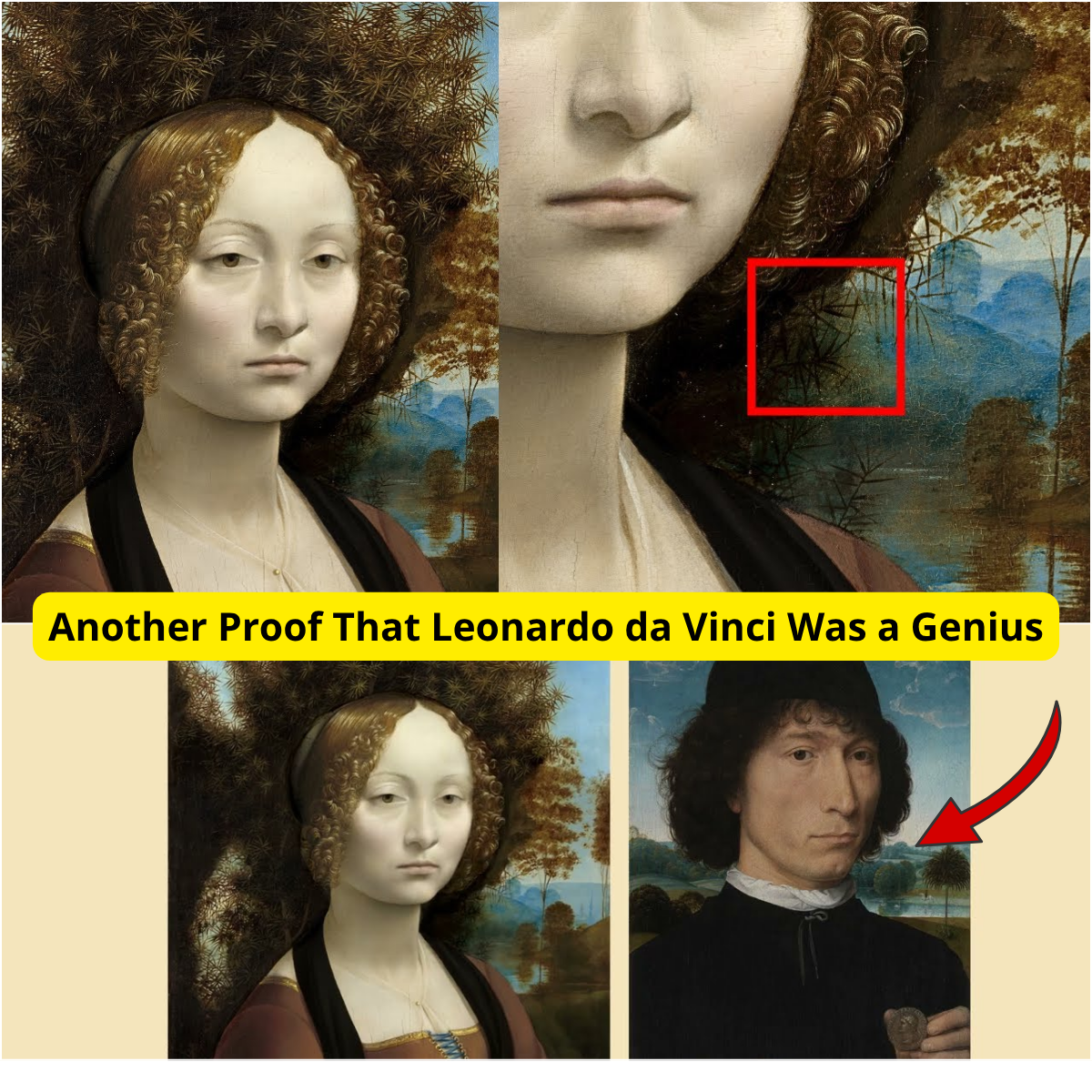
Elena stepped up beside him, her gaze settling on the girl’s incredibly pale skin, which seemed to catch a natural, clean light that softened her features. “She was sixteen, Julian. Born into a high-society family just minutes from the Ponte Vecchio. The city humanists wrote sonnets about her virtue, her beauty, and her intellect. And then, on January 15, 1474, she was married off to Luigi Niccolini. He was thirty-two—twice her age. It wasn’t a romance; it was a political merger between two powerful Florentine houses.”
“And that’s the standard narrative, right?” Julian said, finally turning his head. “The portrait was commissioned by her family or her new husband to commemorate the wedding. A public declaration of lineage and status. It fits perfectly into the textbook Renaissance timeline.”
“It does,” Elena replied, her tone shifting into something more mysterious. “Until you turn the painting over.”
The Reverse Inscription
Elena led Julian around the freestanding glass kiosk to the back of the display. Unlike most paintings of the era, which left the reverse side bare or covered in rough gesso, Leonardo had treated the back of the poplar panel as a secondary canvas.
Painted on the back was a meticulously rendered emblem: a central sprig of dark green juniper, flanked on the left by a glossy laurel leaf and on the right by a graceful palm branch. A swirling parchment banner entwined the plants, bearing the Latin inscription: Virtutem forma decorat.
“Beauty adorns virtue,” Julian read aloud, his eyes tracking the elegant calligraphy. “The juniper is an obvious pun on her name—ginepro in Italian. It stands for chastity. But the laurel and the palm… those aren’t family crests for the Benci or the Niccolini families.”
“No, they aren’t,” Elena said, her eyes shining with the excitement of a scholar holding a missing piece of a puzzle. “The laurel represents the intellectual world, poets, and humanists. The palm represents moral victory and strength of character. But more importantly, Julian, the laurel and the palm together were the personal heraldic emblem of Bernardo Bembo.”
Julian felt a familiar thrill ripple through his chest. “The Venetian ambassador.”
“Exactly,” Elena nodded. “Bembo arrived in Florence as the diplomat representing the Republic of Venice between 1475 and 1476. He was a brilliant, highly educated humanist, and when he met Ginevra, he became completely captivated by her. Not as a physical lover—Florentine high society practiced an intense, highly formalized version of Platonic adoration. They exchanged letters, poems, and gifts publicly. It was seen as a sign of supreme intellectual refinement. Bembo actually commissioned ten different local poets to write sonnets dedicated to her wit and beauty, calling her the most beautiful woman in Florence.”
“So the husband didn’t pay for this portrait,” Julian said, turning back to look through the glass toward the front of the panel. “The platonic admirer did.”
“We have more than just circumstantial evidence now,” Elena whispered, leaning in closer. “A recent technical study using infrared reflectography looked beneath the paint layers of that emblem on the back. Do you know what the scanners found buried under the Latin inscription? Bembo’s personal life motto: Honor and Virtue. Leonardo had painted Bembo’s exact device first, and then later covered it with the banner dedicated to Ginevra.”
Julian looked at the dark backdrop of the juniper bush behind Ginevra’s head on the front panel. The dense needles provided a stark, contrasting wall that pushed her pale face forward, making her feel present, almost touchable.
“It’s a double identity,” Julian said quietly. “The painting is a physical object that textually belongs to two different stories at the exact same time. On the front, she is the young Florentine bride locked in a landscape that fades into an infinite, bluish aerial perspective—a technique Leonardo was just beginning to invent in Verrocchio’s workshop when he was twenty-one. But on the back, she is the intellectual muse of a Venetian diplomat, her symbol literally bracketed by his own arms.”
The Maker’s Mark
Julian leaned down, adjusting his focus to the upper-right quadrant of the front image, where the dark sprigs of juniper met the soft edge of Ginevra’s golden, curled hair. The transition wasn’t sharp; there were no harsh, definitive lines defining where the curls ended and the shadow began. It was the early infancy of sfumato—Leonardo’s signature technique of blending tones like smoke fading into the air.
“Look right here, Elena,” Julian said, pointing with a gloved finger to a tiny, irregular texture in the oil film. “Under a raking light, you can see them clearly.”
Elena adjusted her angle, squinting through the glass. “The fingerprints.”
“Yes,” Julian breathed. “Leonardo didn’t just use brushes for this portrait. He was experimenting with the medium, using his actual thumbs and fingers to smear the wet pigment, softening the transitions of her skin and blurring the sharp edges of the foliage. These are the literal ridges of his skin, left behind in the oil more than half a millennium ago. When you look at this painting, you aren’t just looking at an image of Ginevra; you’re looking at the physical impact of Leonardo’s hand working through a problem in real-time.”
“What problem?” Elena asked.
“The problem of life,” Julian said, stepping back to take in the entire composition. “Before Leonardo, an Italian portrait was a static document. It said: This person existed, they owned this specific velvet gown, and they belonged to this specific merchant. But Leonardo was obsessed with the movement of the mind—what he called the ‘moti mentali’. He wanted to paint the soul behind the eyes.”
He pointed to the open background landscape behind Ginevra, where a distant lake reflected a cold, pale sky, and the mountains dissolved into a soft, hazy blue horizon.
“He used aerial perspective not just because he understood how light scatters through air, but because it creates a sense of infinite distance,” Julian continued. “He places this young woman—who is trapped in an arranged marriage, whose life is completely bounded by the walls of Florence—against a background that has no end. Her expression isn’t just sad; it’s introspective. She’s looking at us, but she’s thinking about something completely outside the frame of her world.”
Two Sides of a Coin
The museum announcement began to chime softly through the overhead speakers, signaling that the gallery would be closing in fifteen minutes. The crowd of tourists had thinned out, leaving Julian and Elena alone in the quiet enclosure with the young noblewoman.
“It makes you wonder if the mystery can ever really be solved,” Elena said, looking at the dual-sided panel. “Did Bembo commission the entire thing from the start, or did he buy an unfinished portrait that had been abandoned when the Benci family couldn’t pay for it? Or maybe, did Ginevra herself look at the two men who claimed her—one by law, one by poetry—and choose to let Leonardo record her own silent distance from both of them?”
“We’ll never have the receipt,” Julian admitted, a slight smile touching his face. “The exact date of the painting is still a moving target—anywhere between 1474 and 1478. The people who argued over this panel in the palaces of Florence have been dust for five centuries. Their political alliances are forgotten, and the Benci fortune is gone.”
He looked one last time at the reverse side, where the painted banner tied the juniper, laurel, and palm together in an eternal, silent knot.
“But that’s the genius of it,” Julian said as they began to walk slowly toward the exit. “Leonardo didn’t paint a consensus. He painted a question. He took a sixteen-year-old girl who was supposed to be a passive symbol of wealth and turned her into an enigma. Whether it was paid for by the husband or the admirer doesn’t even matter anymore. In the end, the only person who truly captured Ginevra was the twenty-one-year-old kid who left his fingerprints in her hair.”
They stepped out into the main rotunda, the heavy mahogany doors closing behind them, sealing the young Florentine woman back into her quiet, temperature-controlled sanctuary, where her pale eyes would continue to watch the centuries change, facing the world completely unbothered by its definitions.