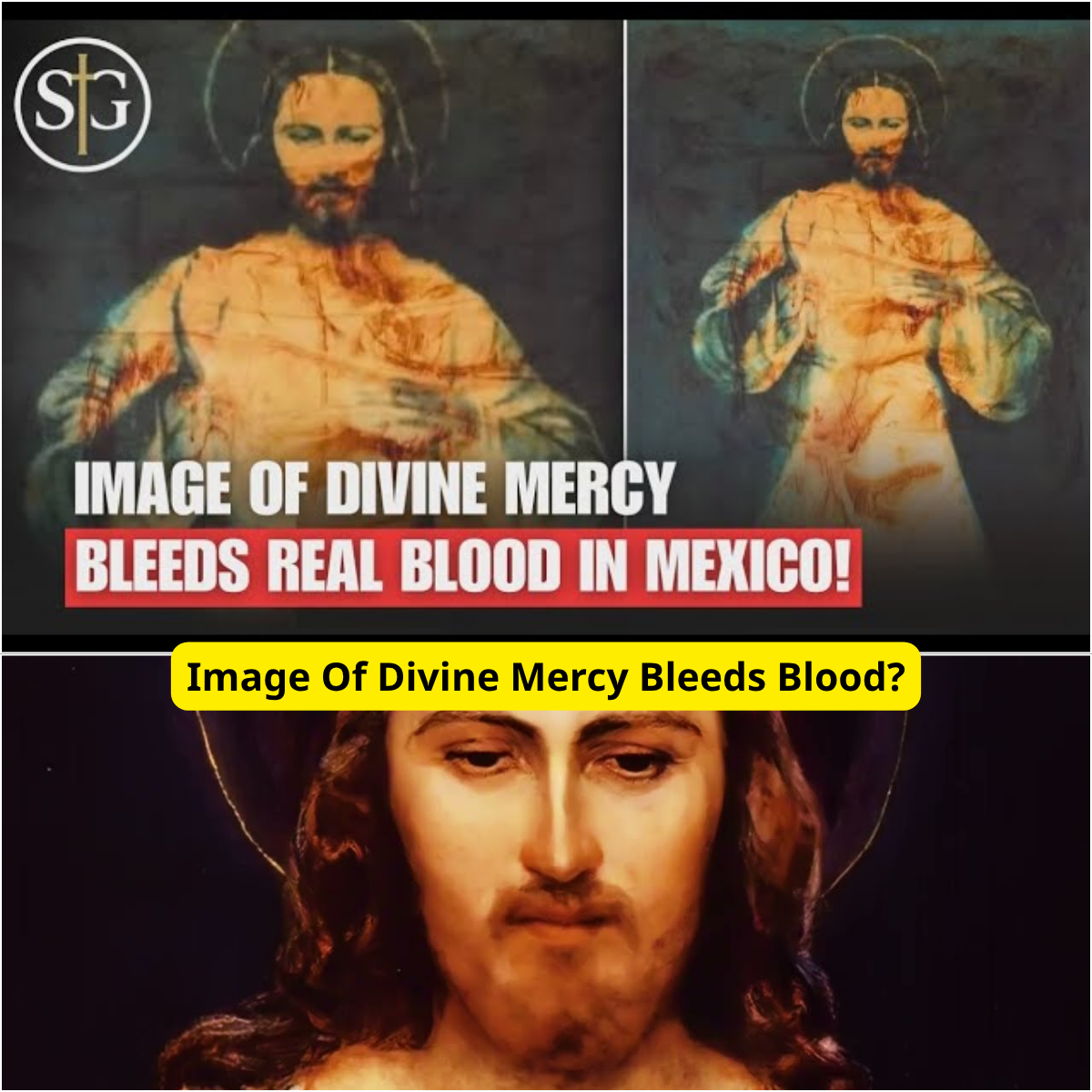
Image Of Divine Mercy Bleeds Blood?
Image Of Divine Mercy Bleeds Blood?
The humidity of Mumbai in late June did not merely hang in the air; it dissolved everything it touched. It softened the mortar between the colonial-era bricks of St. Michael’s Church, turned the pages of the parish registers into damp tissue, and left a permanent sheen of salt on the skin of anyone brave enough to walk the crowded avenues of Mahim.
Inside the rectory, Father Julian Vance adjusted the wooden blades of the ceiling fan, though they did nothing but churn the heavy, soup-like air. At thirty-nine, Julian was an American Jesuit from Boston, possessing a degree in chemical engineering from MIT and a license in fundamental theology from Rome. He had been sent to Mumbai on a temporary cultural exchange, tasked with helping the archdiocese catalog its historical relics. He was a man who looked at a stained-glass window and saw copper oxides and iron silicates before he saw the faces of the saints.
Across the desk sat Father Donath D’Souza, a senior parish priest whose white cassock was immaculate despite the oppressive heat. Between them lay a framed, high-quality lithograph of the Divine Mercy—the iconic image of Jesus with his right hand raised in blessing, his left hand touching his chest, from which two brilliant rays of red and pale light emanated.
“The crowd is wrapped around the block twice, Julian,” Father Donath said, his voice flat with the exhaustion of a man who hadn’t slept in thirty-six hours. “The local police have already put up steel barricades near the railway station. It’s reached the local television networks.”
Julian leaned over the desk, pulling a small jeweler’s loupe from his pocket. He turned on a high-intensity desk lamp and focused the lens on the image.
Directly at the center of the print, right where the painted chest of Christ met the burst of symbolic light, a dark, irregular crimson blossom had formed. To a casual observer staring through the dim, candle-lit shadows of a church nave, it looked exactly like a fresh chest wound. It looked like blood, slowly thickening and weeping down the pale blue tunic of the savior.
“It appeared last night at exactly 8:30,” Donath continued, rubbing his temples. “Right at the conclusion of the novena for Our Lady of Perpetual Help. A woman from the fishing colony fell to her knees and screamed that the Lord was bleeding for the sins of the city. By midnight, we had three thousand people in the courtyard. Not just Catholics, Julian. Hindus, Muslims, Sikhs. They are all standing in the mud outside, waiting for a glimpse.”
Julian adjusted the loupe, his professional training tuning out the distant, rhythmic chanting of the rosary filtering through the heavy teak doors of the church.
“The pigment is water-soluble, Donath,” Julian murmured, his voice retaining the cool, precise cadence of a laboratory instructor. “Look at the margins of the streak. The capillary action has pulled the red dye along the grain of the paper stock. This isn’t an exudate from a biological source. It’s an organic ink under hydraulic stress.”
Donath sighed, a sound that carried the weight of Mumbai’s teeming millions. “Tell that to the thousand people who have been standing in a line that stretches over a kilometer in the monsoon rain. To them, it is a sign. To them, the heart of God is breaking over Mahim.”
The Surge at the Gates
By five o’clock that evening, the situation had shifted from a parish curiosity to an administrative crisis. Cardinal Oswald, the Archbishop, had issued a strict directive from the diocesan headquarters: No declarations of the supernatural. Secure the artifact. Invoke scientific analysis.
Julian walked through the side transept of St. Michael’s, guarded by two parish volunteers in white armbands. The interior of the church was a cavern of heat, illuminated by the flickering yellow glow of five hundred votive candles. The smell of burning paraffin mixed with the scent of wet umbrellas, damp wool, and the sharp, earthy tang of the street outside.
The line of devotees moved in a slow, agonizing crawl past the sanctuary rail. Julian watched them—an elderly Catholic woman in a traditional sari weeping silently; a young Hindu man with a red tilak on his forehead, his hands pressed together in profound reverence; a Muslim merchant who had closed his shop early just to see the print.
For a moment, the sheer density of human hope in the room threatened to crack Julian’s clinical detachment. They didn’t care about paper quality or ink chemistry. They lived lives defined by immense labor, economic precarity, and the constant pressure of a city of twenty million people. They wanted to know that the infinity behind the stars was paying attention to their poverty.
“Father,” a voice called out from the line. An old man reached out, his hand trembling, trying to touch the sleeve of Julian’s cassock. “Is it true? Is the Lord showing us his wounds because the war is coming?”
Julian stopped, looking into the man’s rheumy, cataract-filmed eyes. The engineer in him wanted to explain the atmospheric dew point of western India during the summer solstice. The priest in him simply reached out and took the man’s calloused hand.
“The mercy of Jesus is real, my friend,” Julian said softly, using the local phrase he had practiced. “But we do not need this piece of paper to prove it. He is already with you in the breaking of the bread, and in your home.”
The man looked confused, but he nodded, comforted by the tone if not the theology, and moved along with the current of the crowd.
Julian stepped behind the altar cloth, where Father Donath and the parish priest, Father Raphael, were waiting with a wooden crate lined with velvet. With careful, gloved hands, Julian lifted the framed Divine Mercy image down from its temporary easel. A collective gasp rose from the front pews, followed by a surge of bodies against the altar rail.
“Please, keep back,” Father Raphael announced into the microphone, his voice echoing off the concrete rafters. “The image is being taken for preservation and study on the orders of the Archbishop. The church remains open for prayer.”
As Julian carried the box through the sacristy door, he felt like a thief who had just stolen the only light in the valley.
The Laboratory of the Archdiocese
The analysis did not take place in a secret Vatican vault, but in a clean, fluorescent-lit laboratory at the University of Mumbai’s department of chemical technology, rented for three hours after midnight under a nondisclosure agreement.
Julian sat before a high-resolution scanning electron microscope, his collar unbuttoned, a mug of lukewarm tea resting near his elbow. Across the stainless-steel table stood Dr. Asha Kulkarni, a senior forensic analyst who specialized in document authentication for the state police. She was a woman of science, completely indifferent to the internal politics of the Catholic hierarchy.
“The paper is a standard three-hundred-gram cotton-blend lithographic stock, Father Vance,” Dr. Kulkarni said, displaying a highly magnified cross-section of the paper fibers on a digital monitor. “It was printed by an offset press in Italy around 2004. The inks used are typical commercial synthetic pigments.”
“Show me the red rays emanating from the heart,” Julian said, leaning closer to the screen.
Kulkarni tapped her keyboard. The image zoomed into the boundary where the red beam met the dark crimson stain. Under eighty-times magnification, the orderly dots of the printing press looked like an array of red hills, but between them, the paper fibers were swollen and distorted, clogged with a thick, glossy substance that had dissolved the original pattern.
“We ran the liquid chromatography-mass spectrometry on the scraping from the center,” she said, sliding a printed chart across the table. The graph showed a series of sharp, jagged peaks representing molecular weights. “There are no cellular walls. No hemoglobin. No traces of iron-porphyrin complexes. It is completely devoid of biological material, Father. It isn’t blood.”
Julian looked at the chart. A strange, contradictory sensation settled in his chest—a mixture of intellectual vindication and a profound, heavy sadness. “Then what caused the oxidation?”
Kulkarni pointed to a small vent in the laboratory ceiling where the air conditioning hummed. “Look at your own records for the church. St. Michael’s is located less than a half-mile from the coast. Your doors are wide open during the novenas. On June twenty-seventh, your local relative humidity hit ninety-eight percent at dusk. The print was housed in a cheap, unsealed frame with a backing made of low-grade particleboard.”
She shifted the slide to show the rear of the paper. “The particleboard contained a high concentration of urea-formaldehyde resins. When the moisture in the church rose to a certain saturation point, the paper absorbed the water like a sponge. The water liquefied the red dye in the halo around the heart, and the chemical outgassing from the rotting wood backing caused the pigment to separate and migrate toward the lowest point of the frame, creating a classic chromatography streak. It’s an administrative error, Father. The frame was essentially a small chemical kiln.”
Julian sat in silence for a long time, the hum of the microscope the only sound in the white room. “A natural machine,” he murmured. “Moisture, air quality, and cheap glue.”
“Exactly,” Kulkarni said, turning off the monitor. “A perfect storm of coastal weather and manufacturing defects. It’s an interesting case of material degradation, but it isn’t a miracle.”
The Pastoral Ledger
The official report was published three months later, in the September issue of the archdiocesan weekly newsletter. The text was brief, parsed with the careful, protective vocabulary of a legal document:
“…The scientific analysis conducted by independent experts has established that there were no traces of blood or biological matter within the red rays emanating from the heart of Jesus in the image at St. Michael’s Church. The phenomenon has been attributed to high monsoon humidity and atmospheric changes affecting the composition of the print pigments…”
Julian sat in a small café near the Gateway of India, holding a copy of the newsletter. The monsoon had passed, leaving the city washed in a clean, sharp September light. The crowds at Mahim had returned to their normal sizes, the steel barricades had been stored away, and the daily news cycles had moved on to political scandals and cricket matches.
Father Donath sat across from him, stirring sugar into his tea. “You look troubled, Julian. The report is out. The truth has been served. The Archbishop is pleased that we avoided a theological embarrassment.”
“I was thinking about Mexico,” Julian said, staring out at the grey waves of the Arabian Sea. “In the diocese of Valle de Chalco, around 2015. A similar thing happened to a Divine Mercy image in the chapel of the fifth apparition. Red spots appearing on the face and chest. The people there still flock to it. The church hasn’t given a definitive judgment there either. We always find ourselves in this position, Donath. Armed with microscopes, telling people that their signs are just damp paper.”
“And does that damage their faith?” Donath asked quietly.
“It makes us look like the gatekeepers of a cold house,” Julian admitted. “We tell them what isn’t real, but we don’t always give them an alternative for what is.”
Donath leaned forward, his dark eyes reflecting the bright Indian sky. “You are thinking like an engineer again, my brother. You think the value of the event was inside the frame. The miracle at St. Michael’s didn’t happen on the paper.”
Julian frowned. “What do you mean? The paper was a failure of glue and humidity.”
“The miracle,” Donath said, pointing out toward the crowded street where people of every faith were navigating the afternoon traffic together, “was that for four days, three thousand people who usually ignore or fear one another stood in the same dirt, shared their water bottles, held umbrellas over each other’s children, and looked at the heart of Christ with the same hope. The ink ran because of the weather, yes. But the love that ran through that line didn’t come from the monsoon.”
Donath tapped the newsletter with his finger. “Our faith is not rooted in a lithograph from Italy. It is rooted in the certainty of a mercy that doesn’t need a chemical signature to be real. Thomas didn’t believe until he put his fingers into the wounds, but Jesus told him: Blessed are those who have not seen and yet have believed. The analysis protects us from superstition, Julian. But it cannot limit the grace that uses even our mistakes to call us together.”
The Unbroken Ray
Two weeks later, Julian was preparing his bags for his return flight to Boston. His work with the relics was finished; his ledgers were clean, his boxes packed with the clinical efficiency that defined his life.
Before heading to the airport, he made one final stop at St. Michael’s Church. It was a Tuesday afternoon, and the building was largely empty. The high altars were quiet, the air inside smelling once again of simple wood and old stone, no longer charged with the frantic energy of the June crowds.
The original Divine Mercy print had been replaced by a new copy, identical in every way, but housed this time in a sealed, professional frame with an acid-free mat board and a UV-protected glass shield. No ink would ever run in this frame; no moisture could penetrate the seal. It was perfectly preserved, perfectly stable, and perfectly dead.
Julian walked up to the sanctuary rail and knelt down on the wooden cushion. He looked up at the image of the savior. The red and pale rays shone out from the painted chest, sharp and clear against the blue background.
He pulled his small notebook from his pocket—the one containing the chemical formulas, the chromatography graphs, and the mass spectrometry data from the university lab. He looked at the charts, then at the altar.
Slowly, deliberately, Julian closed the notebook and slipped it into his pocket. He didn’t need the numbers anymore. He looked at the painted face of Christ, his own mind finally settling into a quietness that owed nothing to logic.
“I don’t need to see the blood, Lord,” Julian whispered into the empty church, his voice blending with the distant rumble of the Mahim traffic outside. “The mercy was already there before the ink ran. Teach me to trust the current, even when the paper is dry.”
He stood up, adjusted his coat, and walked out into the warm, bright afternoon, leaving the laboratory behind, his heart finally balanced between the precision of the law and the infinite, unmeasured depth of the light.