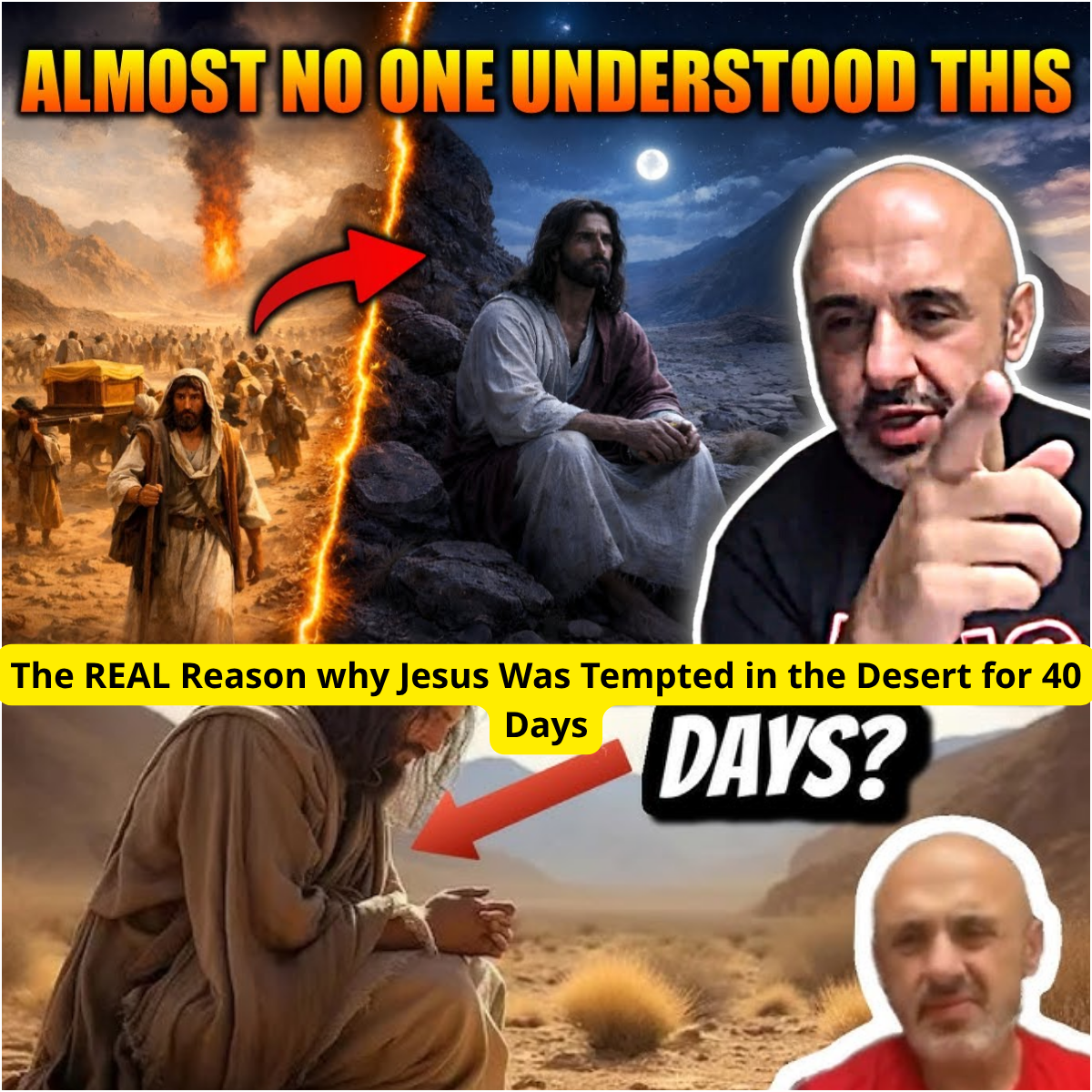
The REAL Reason why Jesus Was Tempted in the Desert for 40 Days
The REAL Reason why Jesus Was Tempted in the Desert for 40 Days
The neon sign of The Midnight Grind flickered, casting long, fractured shadows across the sticky vinyl of the booth. Outside, a sudden Chicago downpour lashed against the glass, blurring the headlights of the elevated train rattling along the tracks above. Inside, the air smelled of stale coffee, burnt toast, and the distinct, ozone tang of old books.
David sat with his head in his hands, staring at a stack of heavily annotated printouts. Across from him, Professor Marcus Vance—a man whose silver hair and tailored tweed jacket usually exuded absolute, unflappable academic authority—looked uncharacteristically disheveled. His tie was loosened, and his eyes had a frantic, electric brightness to them.
“You’re missing the forest for the trees, David,” Marcus said, his voice a low, intense whisper that cut through the low hum of the diner’s refrigerator. “You’re looking at the New Testament as if it’s a collection of isolated stories. It’s not. It’s a beautifully orchestrated symphony of echoes. Every single note struck in the gospels was tuned centuries earlier in the wilderness.”
David rubbed his temples, feeling the beginning of a massive headache. He was a graduate student, a kid from Ohio who had come to the university to study ancient texts, but lately, Marcus’s late-night seminars felt less like history and more like unraveling a cosmic code. “Professor, I get the basics. But you’re telling me that when Matthew or John wrote these verses, they weren’t just recording biography—they were executing a deliberate structural mirroring?”
“Exactly,” Marcus said, leaning forward, slamming a worn leather-bound Bible onto the table. “Think about the sheer weight of fear. Let’s go back to the beginning of the nation. Numbers, chapter thirteen. The Israelites are standing on the precipice of everything they’ve been promised. God tells them to scout the land of Canaan. One man from each of the twelve tribes. Twelve spies. Among them, Joshua and Caleb. They spend forty days walking through the valleys, climbing the ridges, mapping out the future.”
“And they came back with giant grapes,” David muttered, remembering Sunday school.
“They came back with a paradox,” Marcus corrected sharply. “They said, ‘The land is amazing, just like God said—flowing with milk and honey.’ But then the other ten spies—the ones whose names history chose to forget—spread a poison of panic. They said, ‘We have a problem. The Nephilim are there. The sons of Anak.’ The Anakim. David, these weren’t just tall men; the text calls them giants. They were a remnant of something terrifying that existed even after the flood. And the ten spies looked at them and felt utterly insignificant. They said, ‘We became like grasshoppers in our own sight, and so we were in their sight.’“
Marcus flipped the pages of his Bible with a practiced, aggressive speed. “Listen to the raw terror in Numbers thirteen, verses thirty-one to thirty-three: ‘We are not able to go up against the people, for they are too strong for us.’ They gave a bad report, calling it a land that ‘devours its inhabitants.’ They wept. They cried out in the night. They wanted to turn the entire exodus around and crawl back to the chains of Egypt because they were terrified of the giants. They doubted God’s absolute ability to destroy what stood in their way.”
“So God got angry,” David said, tracking the narrative.
“Anger doesn’t fully capture it,” Marcus said, his voice dropping an octave. “It was a sentence of poetic justice. Look at Numbers fourteen. God looks at this trembling, unfaithful generation and says, ‘Your sons shall be shepherds for forty years in the wilderness. You’re going to stay right here until your corpses come to an end.’ Think about that. An entire generation doomed to wander in circles until they drop dead in the sand. Only Joshua and Caleb, the two who believed, would ever see the Promised Land. Even Moses, Aaron, and Miriam would die in the dust.”
Marcus tapped his finger heavily on the table. “But look at the why, David. Why forty years? Numbers fourteen, verse thirty-four lays down the foundational law of prophetic mathematics: ‘According to the number of days which you spied out the land, forty days, for every day you shall bear your guilt a year, even forty years.’ A day for a year. A forty-day scouting trip becomes a forty-year prison sentence.”
David watched a droplet of rain trace a jagged path down the window pane. “Okay, so forty days equals forty years. It’s a specific punishment for a specific rebellion.”
“It’s a design pattern,” Marcus countered, his eyes widening. “It’s a scriptural principle that repeats. Look at Ezekiel chapter four. God tells the prophet to lie on his left side to bear the iniquity of the house of Israel. For how long? Three hundred and ninety days, corresponding to the three hundred and ninety years they sinned. Then he has to turn onto his right side and bear the guilt of Judah for forty days. God explicitly tells him: ‘I have set it for you, a day for each year.’ The principle is absolute. The heavens operate on a scale where a day can mirror a year.”
Marcus paused, letting the silence stretch between them. The waitress walked past, pouring fresh coffee into their mugs, casting a suspicious glance at the open Bibles and the intense expressions of the two men.
“Now, David,” Marcus whispered, his voice trembling with a strange excitement. “Flip the switch. Let the light go on in your mind. If a day equals a year in the economy of scripture… why did Jesus spend forty days in the wilderness?”
David froze, his coffee mug halfway to his mouth. The connection hit him with the sudden, jarring force of a physical blow. “The temptation in the desert,” he murmured.
“Exactly!” Marcus nearly shouted, catching himself and lowering his voice as a patron in a distant booth turned to look. “He is Israel! Matthew, Mark, Luke, and John weren’t just writing a story; they saw the grand design. Jesus goes into the wilderness for forty days because he is reliving, recapitulating, the entire history of the nation. Where the nation failed for forty years, he succeeds in forty days. His forty days are their forty years. He is walking back into the crucible of the desert to face the exact same testing ground.”
Marcus opened a secondary notebook, filled with Greek and Hebrew roots scribbled in red ink. “Look at the mechanics of the temptation. Matthew chapter four. The Spirit leads Jesus into the wilderness to be tested by the devil. He fasts for forty days and forty nights, and when he is starving, the tempter comes and says, ‘If you are the Son of God, command that these stones become bread.’ And what does Jesus do? Does he conjure a theological argument out of nowhere? No. He quotes scripture. He says, ‘It is written, man shall not live on bread alone, but on every word that proceeds out of the mouth of God.’“
“He’s quoting Deuteronomy,” David said, his mind racing to keep up.
“Deuteronomy eight, verse three!” Marcus beamed, slamming his hand on the notebook. “And look at the context of that quote. Moses is speaking to the Israelites at the end of their forty-year wandering. He tells them to remember how God led them in the wilderness for forty years to humble them, to test them, to see what was in their heart. He let them go hungry and then fed them with manna to teach them that man does not live by bread alone. Jesus walks into the desert, experiences the raw, agonizing reality of human weakness and hunger—something his eternal spirit had never felt before—and he chooses to subjugate his flesh entirely to the Father’s will. He quotes the exact manual written for the wilderness generation!”
Marcus flipped his notebook pages aggressively. “And it gets deeper. The next temptation. The devil takes him to the pinnacle of the temple and tells him to throw himself down, quoting a psalm about angels protecting him. And Jesus replies, ‘It is written again, you shall not tempt the Lord your God.’ He’s quoting Deuteronomy six, verse sixteen. But do you know what the rest of that verse says, David? ‘You shall not tempt the Lord your God, as you tempted him in Massah.’“
David leaned forward, the noise of the diner fading into absolute insignificance. “Massah. Where the Israelites complained about water.”
“Yes! And look at who was being tempted in the original story. In the wilderness, the Israelites lusted exceedingly and tempted God in the desert. Psalm one hundred and six, verse fourteen says they tempted God in the wilderness by questioning his ability and his goodness. They acted like the children of Belial—a Hebrew term for the wicked, the lawless, which Paul later explicitly defines as a name for Satan himself. The wicked Israelites were acting like Satan’s children, tempting God in the desert. And now, in Matthew four, who is standing in the desert being tempted by Satan, by Belial himself? Jesus.”
Marcus’s voice was barely a breath now, but it carried the weight of an avalanche. “Thomas Aquinas noticed this centuries ago. He cited the early church fathers who pointed out the terrifying double meaning in Jesus’s response. When Jesus looks at Satan and says, ‘You shall not tempt the Lord your God,’ he isn’t just saying he won’t tempt his Father. He is issuing a sovereign rebuke. He is saying, ‘Satan, Belial, you know the ancient law. You are standing in the desert tempting me, just like your spiritual children tempted me at Massah. Do not tempt the Lord your God.’ He is identifying himself as the very God who endured the rebellion in the sands of Sinai.”
David felt a chill run down his spine, completely independent of the air conditioning rattling above their heads. The structural symmetry was too precise to be accidental. “It’s like a mirror reflecting a mirror,” he whispered.
“It is an airtight theological trap,” Marcus said fiercely. “And the parallels don’t stop at the temptation. Look at the crowd’s reaction to Jesus throughout the gospels. In Numbers fourteen, verses ten and eleven, the people are ready to stone Joshua and Caleb for telling them to trust God. Suddenly, the glory of the Lord appears, and God says to Moses: ‘How long will this people provoke me? How long will they refuse to believe in me, in spite of all the signs I have performed among them?’ God was enraged because despite the plagues, the splitting of the sea, the pillars of fire, they treated him with contempt.”
Marcus pointed a trembling finger at a passage from the Gospel of John that he had highlighted in bright yellow ink. “Now look at John chapter twelve, verse thirty-seven. Read it out loud, David.”
David cleared his throat, his eyes scanning the printed text. “‘Even after Jesus had performed so many signs in their presence, they still would not believe in him.’ It’s… it’s the exact same language.”
“Exactly!” Marcus said, his fist hitting the table in rhythm with his words. “Nothing new under the sun. The same God who performed miracles in Egypt and was rejected by an unbelieving generation in the desert was now performing miracles in the streets of Jerusalem, and he was being rejected by the exact same spirit of unbelief. If you don’t believe in the signs, you are repeating the ancient pattern of the wilderness rebellion. You are aligning yourself with the children of Belial.”
David leaned back in the booth, his mind spinning. “So who was the God in the desert, Professor? If Jesus is recapitulating this… are you saying he was there all along?”
“Paul explicitly says so,” Marcus said, his eyes burning with absolute certainty. “First Corinthians, chapter ten. Paul writes that all our fathers were under the cloud, all passed through the sea, and all drank the same spiritual drink. And then he drops the hammer: ‘For they drank of that spiritual rock that followed them, and the rock was Christ.’ End of story, David. Christ wasn’t a historical afterthought. He was in the cloud. He was sustaining them supernaturally in the wilderness. He was the one they provoked, the one they tested, and now he had come in the flesh to fight the battle they had lost.”
Marcus closed his Bible, the heavy leather cover making a solid, definitive thud against the table. He looked at David, his expression softening slightly but losing none of its intensity. “This is what we call typology. Jesus is the true Israel. And Matthew knew his Bible better than any modern critic ever could. Think about the infancy narratives. Why does Jesus flee to Egypt?”
“To escape Herod,” David answered automatically.
“To escape Herod, an Edomite king who ordered the slaughter of every male child under the age of two,” Marcus categorized, lean lines of logic forming in the air with his gestures. “Does that sound familiar? A wicked ruler commands the murder of Hebrew infant boys, and a savior has to be hidden. It’s Pharaoh and Moses all over again. The nation of Israel fled from a tyrant in Egypt into the wilderness. Jesus, representing the nation, flees from a tyrant in Judea into Egypt, and then comes back out.”
Marcus leaned forward again, his voice dropping to a sharp, analytical edge. “This is where the critics fail, David. They claim the gospel writers just made up these stories to force a connection to the Old Testament. But think about it logically. If Matthew was a fraud fabricating a myth, why would he make the story imperfect?”
David blinked. “What do you mean, imperfect?”
“If you’re writing a counterfeit story to make Jesus look exactly like Israel, you make the details match perfectly,” Marcus explained, a brilliant smile breaking across his face. “Israel didn’t flee into Egypt to escape Pharaoh; they went to Egypt because of a famine, and they fled from Egypt to escape Pharaoh. If Matthew is making it up, he writes that Joseph took Jesus to Egypt because of a famine, matching the national history with absolute precision. But he doesn’t. He records the messy, historical reality: they fled to Egypt to escape a Judean king, and then God called his son out of Egypt, fulfilling Hosea eleven, verse one: ‘When Israel was a youth, I loved him, and out of Egypt I called my son.’ Jesus went to Egypt as a child, around two years old—a youth—and came back out as a youth.”
Marcus stared at David, letting the full weight of the argument settle into the damp air of the diner. “The very fact that the story of Christ doesn’t align with the national history of Israel in every superficial detail proves the authenticity and the integrity of the New Testament writers. Matthew isn’t inventing a myth; he is recording history as it happened, and in that history, he is recognizing the supernatural, structural symmetry of a sovereign God who repeats his themes. He sees that the life of Christ is a grand recapitulation. Where Israel failed under the weight of fear, crumbling before the giants and wandering for forty years, Christ stood firm against the father of lies for forty days.”
The rain outside began to slow, the heavy downpour tapering off into a soft, steady drizzle that streaked the neon reflections on the asphalt. Inside the booth, the stack of papers lay quiet, the ancient texts fully exposed under the harsh fluorescent lights of The Midnight Grind.
David looked down at his own hands, then at the open pages of the gospels. For the first time in his academic career, the words on the page didn’t feel like dead ink or distant mythology. They felt like a living, breathing mechanism, an intricate, ancient architecture designed to hold a truth that had survived the shifting sands of the desert and the cynical passage of millennia.
“He gave them the cue and the clue,” David whispered, finally understanding the grand design. “He walked into the desert to fight the battle the nation lost.”
“And he won,” Marcus said softly, leaning back into the vinyl cushions, a quiet satisfaction finally settling over his face. “Where they crumbled, he conquered. And that, David, is why a day for a year changed the history of the world.”