Michael Jordan Defends Larry Bird — Fans React 😳🔥
The Coldest Killer in the Garden: Why Michael Jordan Still Defends the Legend of Larry Bird
In the modern landscape of the NBA, greatness is often measured in vertical leaps, exit velocity, and the curation of a “human highlight reel” for social media consumption. We are obsessed with the physics of the game—the sheer, unadulterated athleticism that allows a player like LeBron James to chase down a block or Giannis Antetokounmpo to cover the court in three strides. But if you ask Michael Jordan—the man who became the global standard for basketball divinity—about the hierarchy of the hardwood, he doesn’t start with a dunk. He starts with a slow-moving, trash-talking forward from French Lick, Indiana.
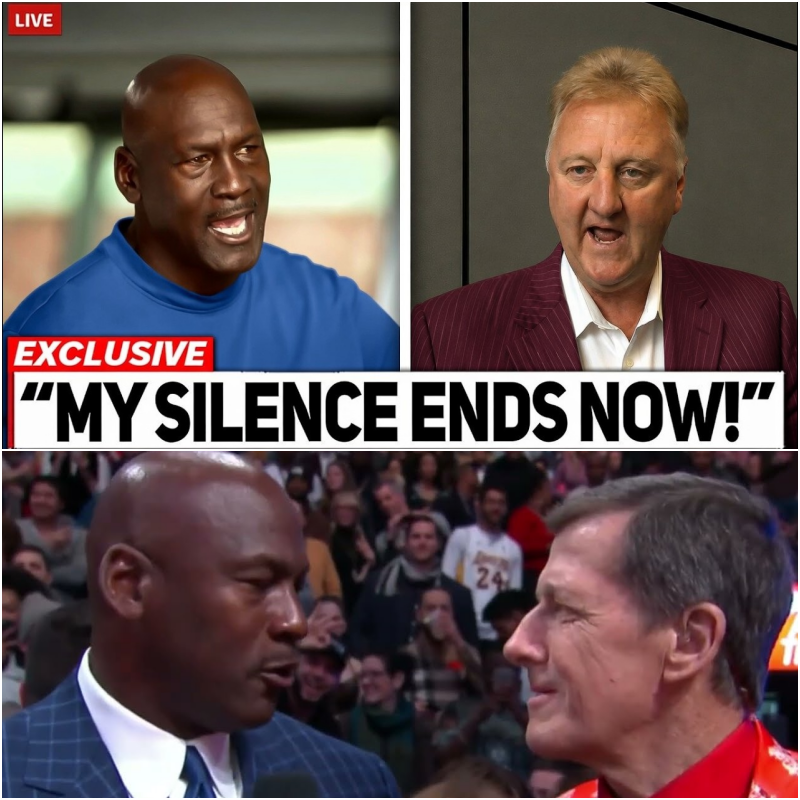
The viral resurgence of Jordan’s defense of Larry Bird isn’t just a nostalgia trip; it is a necessary corrective for a generation of fans who have mistaken “highlights” for “greatness.” To Jordan, and the pantheon of 1980s legends who bled on the parquet floor of the Boston Garden, Bird wasn’t just a shooter. He was a psychological predator.
The Fire and the Fuel
To understand why Jordan defends Bird with such uncharacteristic fervor, one must understand the environment in which His Airness ascended. In the early 80s, as Jordan entered the league, the narrative was set: Jordan was the future, but Magic Johnson and Larry Bird were the gatekeepers of the “Gold Standard.”
“Well, you know, you’re not as good as Magic Johnson. You’re not as good as Larry Bird,” Jordan once recalled of the whispers that followed his early seasons. For a man who took a polite “hello” from an opponent as a personal insult, this comparison was “wood on the fire.” It drove Jordan to reach a level of dominance previously unseen, culminating in the 1986 playoff performance where he dropped 63 points on Bird’s Celtics. After that game, Bird famously remarked, “I think it’s just God disguised as Michael Jordan.”
Yet, the respect was a two-way street. Jordan didn’t hand out accolades lightly. He treated every peer as a challenge and every comparison as a threat. So, when Jordan openly acknowledged that Bird sat in a class above almost any other small forward in history, it wasn’t a PR move. It was a warrior recognizing a fellow killer.
The Mental Architecture of Greatness
The disconnect between Bird’s reputation and the modern fan’s perception lies in the visual. Today’s fans see a man who lacked a 40-inch vertical, someone who looked like he’d be more at home at a neighborhood barbecue than a professional basketball court. But the players who stood across from him saw a different animal entirely.
Magic Johnson, the smiling face of the Lakers’ “Showtime,” credited Bird with saving the league, but he also feared him. Magic would call associates just to confirm that what he was seeing on the scout film was real: “This guy could truly play.”
What Bird lacked in “twitch” athleticism, he more than made up for in mental processing. He saw the game three moves ahead, like a grandmaster playing speed chess against toddlers. He didn’t just score; he controlled the tempo, the spacing, and the psyche of his opponents.
Charles Barkley, no stranger to a loud mouth himself, described Bird as one of the boldest trash-talkers to ever lace up sneakers. But Bird’s talk was different from the “noise” we hear in today’s microphones. It was calculated. It was a promise.
“Who’s Finishing Second?”
Perhaps the most legendary distillation of the Larry Bird experience occurred in the locker room of the inaugural Three-Point Contest. While other elite shooters were stretching and focusing, Bird walked into the room, looked around at his competition, and asked a simple, chilling question: “Which one of you is finishing second?”
He didn’t wait for an answer. He walked onto the court, kept his warmup jacket on, and proceeded to dismantle the field. As the final ball left his hand, Bird raised a single finger to the rafters before the ball even cleared the rim. It wasn’t just confidence; it was a total lack of doubt.
Dominique Wilkins, “The Human Highlight Film,” recalls his rookie season when Bird greeted him not with a handshake, but with a warning. Bird told the explosive rookie that he didn’t belong in the league. On the very next possession, Bird scored, then turned to Wilkins to make sure he felt the weight of it.
“Bird wasn’t beating you physically,” the legends say. “He was stepping into your confidence and taking it.”
The “Shot to Save Your Life”
There is a famous quote from Pat Riley, the architect of the Lakers’ dynasty and the man who spent the better part of a decade trying to find a way to stop the Celtics. Riley once said: “If I need a shot to win the game, I’ll take Jordan. But if I need a shot to save my life, I’m taking Larry Bird.”
Think about the magnitude of that statement. This is the man who coached Magic Johnson and Kareem Abdul-Jabbar, yet he looked at the icy focus of Larry Bird as the ultimate insurance policy.
That “life-saving” reliability was born from a toughness that is rarely discussed today. By the late 1980s, Bird’s body was a wreckage of spinal issues and broken bones. Teammates recall Bird lying on the sidelines between shifts with heat packs strapped to a back that was screaming in pain. Then, the buzzer would sound, Bird would stand up, and he would drop a 30-point triple-double.
“If I can walk, I can play,” Bird famously said. Carl Malone, one of the most physically imposing players in history, summed it up perfectly: “Bird wasn’t quicker than you. He was tougher than you.”
The 60-Point Prophecy
For those who think Bird was merely a “system player” or a beneficiary of the era’s slower pace, one needs only to look at his 60-point masterpiece against the Atlanta Hawks. Before the game, Bird reportedly told teammates and opponents alike that he was going for 60.
He then proceeded to call his shots like a pool shark. “Left wing, off the glass.” Swish. “Corner three.” Swish. It reached a point of such absurdity that the Hawks’ own bench—the players tasked with stopping him—were falling over each other in laughter and awe. They weren’t just watching an opponent; they were witnessing a miracle. When the other team starts rooting for you, you have officially transcended the game.
Would Bird Survive Today?
The perennial debate among barbershops and sports talk radio is how the legends of the past would fare in the modern era. Critics point to Bird’s lack of “elite” speed. But Jordan’s defense of Bird suggests the opposite: Bird might be more dangerous today.
In an era of increased spacing, where the three-pointer is the primary weapon and hand-checking is a relic of the past, Bird would be a nightmare. His IQ, his passing ability—which was arguably superior to his shooting—and his 6’9″ frame would make him the ultimate “point-forward” in a positionless league.
But more importantly, Bird’s “killer instinct” is a trait that has no expiration date. Jordan respected Bird because Jordan respected killers. He respected players who could get inside his head and teach him something about the mental side of the game.
Why the Respect Matters
When Michael Jordan defends Larry Bird, he is defending the soul of basketball. He is reminding us that the game is played from the neck up as much as it is from the neck down.
Bird earned his respect in the trenches of the Boston Garden, in the legendary battles against Magic that saved the NBA from financial ruin, and in the quiet moments of agony where he willed a broken body to perform. He didn’t need a social media team to craft a “brand.” His brand was the scoreboard.
Jordan didn’t create Larry Bird’s greatness. He simply confirmed it for those who weren’t paying attention. He reminded us that legends aren’t just measured by the stats they leave behind, but by the fear they instilled in the people who had to face them.
If the conversation of the “Greatest of All Time” includes terms like mental control, clutch performance, and the ability to break an opponent’s spirit before the game even begins, then Larry Bird isn’t just an afterthought. He is in the room. And as he might tell you himself, he’s probably just waiting to see who’s finishing second.