“Buy A New Car,” The Dealerships Told The CEO…Then A Single Dad Opened The Hood And Shocked Everyone
“Buy A New Car,” The Dealerships Told The CEO…Then A Single Dad Opened The Hood And Shocked Everyone
The sleek, minimalist glass-and-steel showroom of Downtown Porsche was dead silent, save for the low, predatory hum of the climate control system. Clare Vaughn stood perfectly frozen, her tailored wool coat draped over one arm, staring at the man behind the service desk.
The service manager closed the leather-bound repair folder with a soft, final thud and exhaled slowly, refusing to meet her eyes. “Transmission’s gone, Ms. Vaughn. Total internal failure. Frankly, given the age of the vehicle and the labor costs required to source a classic assembly, you should buy a new car.”
Clare stared at him, her jaw tightening. Three other high-end dealerships across the city had already delivered the exact same verdict, verbatim. But this car wasn’t just an asset to be balanced on a spreadsheet. The triple-black 1997 Porsche 911 Carrera 4S was the last gift her father had left her before his passing fourteen months ago. Lately, the car could barely shift gears, grinding violently whenever she attempted to engage third.
In a wave of suffocating desperation and grief, Clare climbed back into the shuddering sports car and drove. She needed to get away from the sterile, judgmental lights of downtown, away from the backlit corporate logos and the pitying stares of men in pressed shirts. She pushed the car past the city limits, following a winding county road into the thinning gray afternoon, until the drivetrain gave one final, catastrophic lurch and died completely.
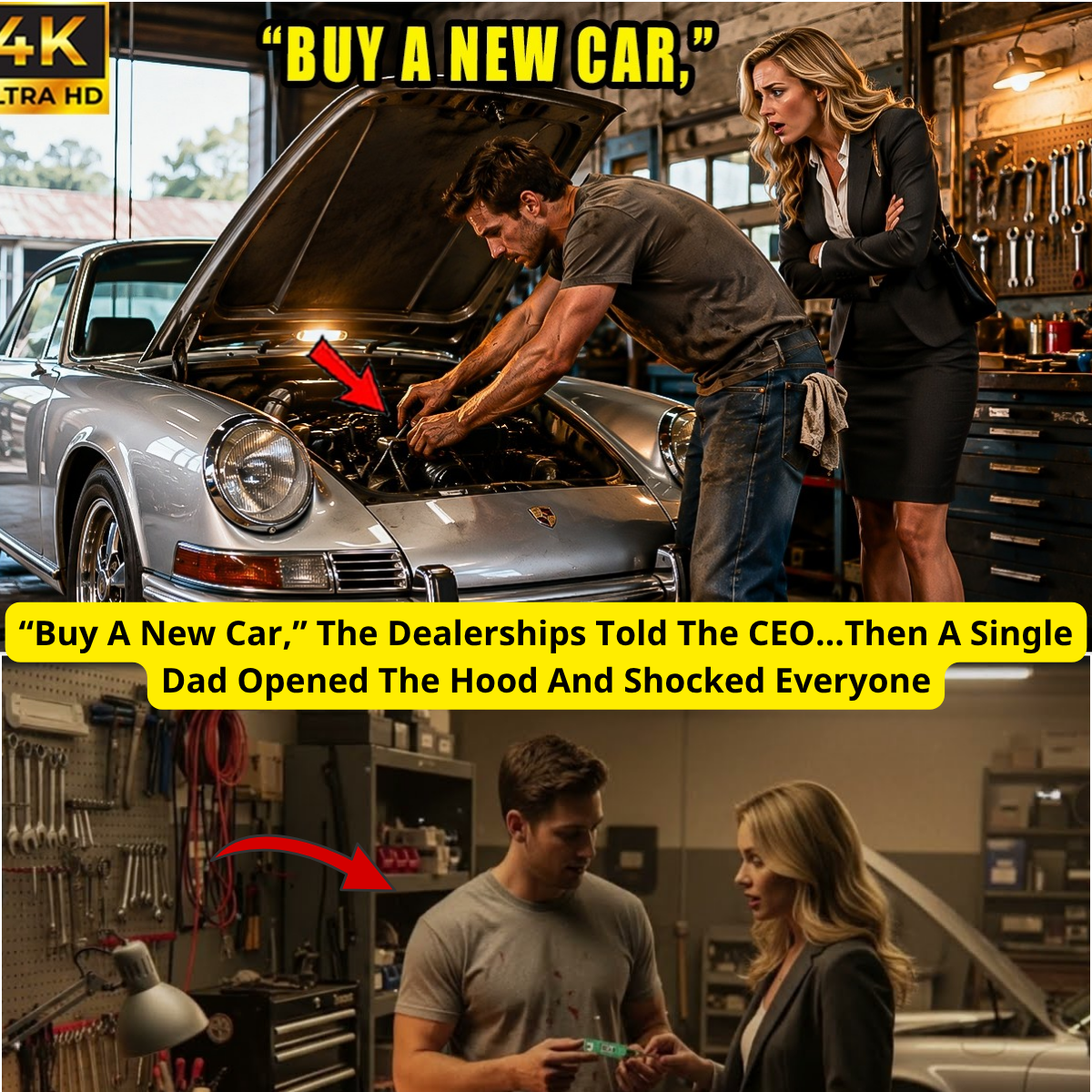
The car coasted to a halt on the gravel shoulder, its dashboard illuminated in an angry orange glow. Right there, tucked behind a row of overgrown boxwood hedges, sat a low concrete building. Hand-painted letters on a faded plywood sign read: Mercer Auto Repair.
The parking lot was cracked, with weeds pushing through the asphalt. Two older American sedans sat on jack stands near a side wall, and a single folding metal chair sat by the front door like a permanent fixture. Nothing about this weathered roadside garage suggested it belonged in the same universe as a vintage air-cooled Porsche.
Clare pulled out her phone to call roadside assistance. She had already dialed the first three digits when the shop’s side door creaked open. A young girl, around twelve or thirteen years old, stepped out carrying a tray of clean ratchet heads. She began transferring them one by one to a pegboard on the outer wall with methodical precision. She paused, looked at the stalled luxury car, looked at Clare through the windshield, and disappeared back inside without a word.
A minute later, a man stepped through the same door. He was lean, unhurried, and wore a gray work shirt with a faded name patch on the chest that read Dean. Oil stains ran up both of his forearms in the distinct, embedded pattern of someone who worked close to machinery rather than merely around it.
He walked over to the Porsche without speaking. He stood beside the rear engine bay for a moment, and then, without asking for permission, he popped the latch and lifted the heavy decklid. He didn’t reach for a digital diagnostic scanner. He didn’t pull out a tablet. He simply stood very still, resting both hands on the edge of the engine bay, and listened.
He wasn’t listening to anything Clare could hear. He was attuned to the faint ticking and settling of the cooling metal, reading the specific, silent language of a drivetrain that had just given up under a heavy load. After perhaps fifteen seconds of absolute stillness, the man straightened up and looked at Clare. His expression was neither diagnostic nor performative. It was simply certain.
“Your transmission’s perfectly fine,” he said quietly.
Clare let out a sharp, cynical breath, the frustration of the past week boiling over. “That’s not what four separate authorized dealerships told me.”
The man glanced back at the intricate mechanical maze of the flat-six engine, then back at her. “I know,” he said flatly. “And they were wrong.” Then, he turned and walked back into his shop.
The Architecture of Routine
Clare followed him inside. The interior of Mercer Auto Repair was not what she expected, though as the CEO of a mid-sized logistics company, she wasn’t entirely sure what she had anticipated.
A radio on a high shelf played low, instrumental jazz. Despite the advanced age of the building, the tool organization was immaculate. Wrenches were arranged perfectly by metric size; diagnostic leads were coiled in identical, uniform circles; and a hand-labeled parts drawer system ran the entire length of the back wall. It was the workspace of someone who had thought deeply about how to find things in the dark. Clare recognized that quality instantly. It was the hallmark of people who relied entirely on themselves.
“Who told you the transmission was dead?” Dean asked, his back to her as he searched through a heavy steel cabinet.
“Every certified Porsche technician in Chicago,” Clare said, leaning against a clean workbench. “The last one was Tyler Knox at the Northside center. He looked at a computer printout for eight minutes and told me it was a total loss.”
Dean emerged with a handheld inspection light and a set of old testing leads. “They didn’t actually listen to the car. They listened to the software. Software tells you where a system recorded a problem, not where the problem actually is. Those are two very different questions.”
As Dean walked back out to the car, Clare’s phone buzzed in her pocket. It was Tyler Knox. She let it go to voicemail. Thirty seconds later, a text flashed on her screen: Clare, the window on that certified pre-owned 718 Cayman is closing. Let me know when you want to execute the trade-in on the dead asset.
Her jaw tightened. She deleted the message and watched Dean slide beneath the rear of her car, trailing his light along the undercarriage. He moved with a deliberate economy of motion, tracing the wiring harness like a traveler running a finger across an old map, looking for the exact point where the terrain stopped making sense.
He paused twice. The second time, he stayed completely still for nearly two minutes, his light angled sharply upward toward a cluster of electrical connectors near the top of the transmission housing.
“Found it,” Dean’s voice echoed from beneath the chassis. He slid out from under the car and climbed to his feet, wiping his hands on a shop cloth. “Shift sensor module secondary feedback loop. It’s a matchbook-sized component. It’s sending a corrupted, hyper-elevated load signal to the Transmission Control Unit. The car’s brain thinks the gearbox is under catastrophic mechanical stress that it isn’t actually experiencing, so the safety protocol steps in and refuses to engage the gears.”
Clare stared at him, stunned. “Four service departments wanted to charge me up to twenty-six thousand dollars for a complete transmission swap… because of something the size of a matchbook?”
“Every shop that ran a standard factory OBD scan saw transmission fault codes, because that’s the terminal downstream point of the loop,” Dean explained calmly. “The factory protocol tells them to replace the entire assembly and move on. None of them pulled the sensor harness to trace the voltage drop back to the source. But the transmission itself is structurally perfect.”
“Can you fix it?” Clare asked, her voice hushed.
Dean rubbed the back of his neck. “The module was discontinued eight years ago. Porsche doesn’t manufacture the legacy replacement part anymore. But I can fabricate a workaround. Give me tonight.”
The young girl, Sadi, appeared at Dean’s elbow, handing him a clean bottle of water. She looked at Clare with a quiet, knowing expression. “Dad only gets that quiet when he’s already figured out how to build it.”
The Ghost in the Racing Circuit
Clare decided to stay. She told herself it was because her logistics mind demanded she see the data verified, but deep down, she knew it was because this garage felt real in a world that had become entirely performative.
Over the next several hours, through Sadi’s spare, proud comments and Dean’s reluctant deflections, Clare pieced together the story of the man working under the chassis of her father’s car.
Ten years ago, Dean Mercer hadn’t been a small-town mechanic. He had been the lead transmission systems engineer for a prominent top-tier endurance racing team on the IMSA circuit. He was an absolute savant, the guy called into the pit lane at 3:00 AM during the 24 Hours of Daytona when a half-million-dollar prototype drivetrain failed in a way nobody could explain.
But then, his wife, Rachel, had been diagnosed with a progressive, degenerative illness. Dean didn’t hesitate. He walked away from the high-octane racing circuit, the corporate sponsorships, and the prestigious offers. He packed up Sadi, drove back to his hometown, took over his grandfather’s old roadside garage, and scaled his entire life down to a size he could manage while being a present, full-time father. He chose obscurity over success, and he had built that quiet life with an intentionality that made it feel incredibly profound.
“Cars talk,” Dean muttered around midnight, returning from his back room with a pencil-sketched wiring diagram and an old cardboard box of vintage electrical components. “Most people just stopped learning how to listen.”
Clare wrote that phrase down on the back of a receipt from her purse. It felt like the exact philosophy her father had lived by.
By 2:00 AM, the world outside was pitch black, and the jazz on the radio had drifted into a low, atmospheric blues. Sadi was fast asleep in the back office, curled up on a folded moving blanket with a vintage paperback novel resting against her chest.
Under the harsh glare of a halogen workbench light, Dean worked with the precision of a neurosurgeon. He had opened the plastic casing of the failed sensor module. Under a jeweler’s loupe, he pointed a fine metallic probe at a microscopic hairline fracture running diagonally across one of the copper conductor pathways. It was completely invisible to the naked eye.
“This is the ghost in your machine,” Dean said. “When the engine bay gets warm, the plastic expands, the copper pathway separates by a fraction of a millimeter, and the signal dies. The software reads it as a broken transmission.”
He spent the next two hours remapping the signal calibration of a completely different vintage sensor module he had salvaged from an old German touring car part in his inventory. He altered the housing with a hand file, re-soldered the connector leads to match the 911’s wiring harness, and cross-checked the voltage parameters against his hand-drawn schematic twice before installing it.
At 4:17 AM, the heavy aluminum hood of the Porsche was closed with a solid, satisfying thump. Dean wiped his grease-stained hands on a cloth and handed Clare the keys.
“You figured all that out in one night?” she asked, her voice thick with awe.
“I figured it out in five minutes,” Dean replied without an ounce of pride. “It just took the rest of the night to build the solution.”
Clare climbed into the driver’s seat and turned the ignition key.
The air-cooled flat-six engine roared to life instantly, settling into a perfectly smooth, mechanical idle that had none of the frantic shuddering from the previous afternoon. She depressed the clutch and moved the shifter through the gates. First. Second. Third. Fourth. The linkages engaged with a crisp, bolt-action precision. The car moved beautifully. It had always been capable of this; it had simply been failed by a system that trusted its digital reports more than the physical evidence.
When Clare asked for the bill, Dean named a figure that was barely one-twentieth of the lowest estimate she had received from the downtown dealerships. She wrote the check with a hand that shook from a profound mix of relief and gratitude.
The Geology of Momentum
As the sun began to break over the Chicago skyline, Clare drove home. The Porsche surged beneath her, alive and completely restored. The moment she arrived at her apartment, she didn’t sleep. Instead, she dialed her close friend Naomi Pierce.
Naomi was an investigative journalist for the Chicago Business Chronicle who specialized in the city’s luxury automotive market—and who had been tracking consumer complaints against predatory dealership service practices for months. Clare’s midnight text had piqued her interest, but seeing the physical evidence changed everything.
By 7:00 AM, Naomi had already driven out to Mercer Auto Repair, photographed the microscopic fracture under Dean’s jeweler’s loupe, interviewed a very tired Dean, and published a blistering exposé online.
The headline was devastatingly simple: The Ghost in the Diagnostic: How City Dealerships Are Condemning Fixable Classics, and the Roadside Genius Saving Them.
The article was incredibly meticulous. It explicitly named the four luxury dealerships, printed their multi-thousand-dollar diagnostic estimates side-by-side, and then explained Dean’s matchbook-sized fix in plain, undeniable terms. It cited Tyler Knox’s facility specifically, quoting his advice to “treat the car as a dead asset.”
The response was an absolute landslide.
By midday, the article had gone viral across automotive forums, PCA (Porsche Club of America) networks, and local business subreddits. It touched a raw, collective nerve. Hundreds of luxury car owners who had felt systematically exploited by dealership service centers began sharing the story.
By 2:00 PM, the first car arrived at Mercer Auto Repair that hadn’t come via a local breakdown. A wealthy surgeon drove his late-model Range Rover forty minutes from the west side, desperate for Dean to look at a persistent transmission hesitation that three authorized shops had failed to fix. An hour later, a flatbed tow truck dropped off a twin-turbocharged Maserati with an electrical fault that a downtown dealer had quoted eight thousand dollars just to diagnose.
The supercars came gradually at first, and then with a momentum that felt almost geological—slow, massive, and entirely unstoppable. Within two weeks, the cracked asphalt lot of Mercer Auto Repair looked like the staging ground for an international automotive festival. A British racing green Aston Martin sat beside a rare McLaren; a vintage Ferrari belonging to an elite Northside collector occupied the space near the jack stands.
The owners arrived tentatively, wearing bespoke suits and expensive watches, expecting a massive gap between their sophisticated vehicles and the rustic setting. But they left completely converted. They had witnessed a level of pure, intuitive craftsmanship that money simply couldn’t buy in a corporate showroom.
One sunny afternoon, Sadi stood in the doorway of the garage, watching a cluster of high-net-worth individuals standing by the hedges, drinking black coffee out of paper cups and talking to each other with the pure excitement of people who had discovered a hidden truth.
She turned to her father, who was wiping a wrench with his usual unhurried calm. “I told you people would see you someday, Dad,” she said softly.
Dean looked out at the million dollars worth of exotic steel filling his gravel lot, then down at his daughter. A small, genuine smile broke through his weathered face. “Yeah, kiddo. You did.”
The Final Test
The public reversal of fortune did not sit well with Tyler Knox.
The young executive had watched his dealership’s service intake numbers drop noticeably over a ten-day period, but worse than the financial dip was the humiliation. His entire brand was built on an untouchable aura of tech-driven authority, and it was being dismantled by a man working out of a concrete shack with hand tools.
Knox spent days making quiet phone calls—to connections in the county zoning compliance board, to regulatory inspectors, and to legal teams, looking for any bureaucratic leverage to shut down the small roadside operation. But the momentum behind Dean Mercer was already too massive, backed by influential clients who carried immense political and financial weight in the state.
Then, exactly three weeks after Clare’s car had died, a transport truck arrived at Mercer Auto Repair carrying a vehicle that defied everything the garage had ever seen.
It was a 1967 Ferrari 275 GTB/4—a pristine, multi-million-dollar masterpiece of automotive history, finished in deep Rosso Corsa paint. It was a vehicle so rare and historically significant that its presence on a gravel county road felt almost surreal.
The man who stepped out of the transport cab was Warren Hale. At sixty-one, Hale was a legend in the American automotive world. He was a retired motorsport engineer, a former endurance team owner, and currently one of the most prominent vintage car investors in North America. He was a man who didn’t go anywhere without knowing exactly who he was dealing with. He had heard Dean Mercer’s name whispered decades ago in the pits at Sebring, and he had read Naomi’s article with a highly trained, analytical eye.
Hale stood with his arms folded across his chest, watching the tow operator carefully lower the Ferrari onto the uneven asphalt. He looked at the cracked pavement, then at the low concrete building, and finally at Dean, who had walked out of the shop bay.
“It has a high-RPM fuel starvation issue that two factory-certified restoration teams in New York have spent six months trying to trace,” Hale said, his voice carrying the weight of absolute authority. “They want to pull the entire numbers-matching engine block and rebuild the top end from scratch. It’ll cost a fortune and ruin the car’s original preservation status.”
Dean walked over to the legendary Ferrari. He didn’t look intimidated by the price tag or the man standing before him. He reached out, his grease-stained hand resting gently on the warm louvers of the classic hood, and leaned his ear close to the machine.
He listened to the heartbeat of the engine as it idled, looking for the tiny, hidden fracture in the system that everyone else had bypassed.
“Your top end is fine,” Dean said quietly, looking up at the racing legend. “The factory teams are looking at the fuel delivery volume, but they aren’t looking at the atmospheric pressure variance inside the secondary fuel cell vent line. It’s pulling a vacuum on itself at high speeds.”
Warren Hale stared at Dean for a long, silent moment. A slow, deeply respectful grin spread across the older man’s face. He reached out and shook Dean’s hand, the firm grip of two craftsmen recognizing each other across a generational divide.
“I knew it,” Hale murmured. “The dealerships have plenty of technicians, Dean. But they don’t have any mechanics left.”
From the office window, Sadi watched her father smile and wave the rare Ferrari into Bay 1. The cold November rain was long gone, replaced by the clear, bright light of a new season. And as Clare Vaughn drove past the hedges a few minutes later just to wave hello, the steady, beautiful roar of restored engines echoed out into the open sky—a reminder that no matter how loud the world becomes, truth always belongs to the ones who know how to listen.
https://youtu.be/7eDkDcmBhAk?si=uOOP_FDFD5Y-3zDo