Victor Wembanyama Looks Unstoppable
Victor Wembanyama Looks Unstoppable
I. THE TITAN OF TEXAS: VICTOR WEMBANYAMA’S MASTERPIECE
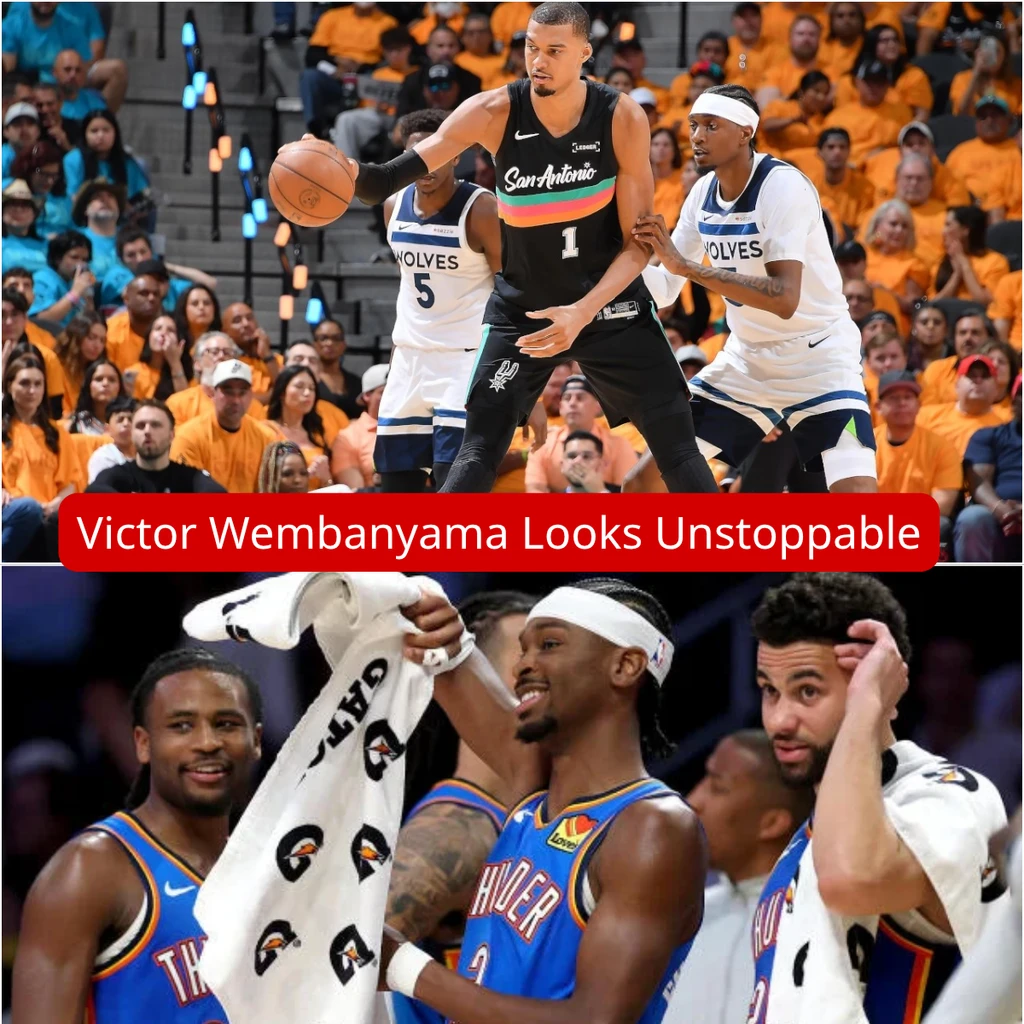
The air in San Antonio feels different this morning. It’s the kind of thick, celebratory atmosphere that only follows a performance destined to be etched into the “all-time” category. As the San Antonio Spurs secured a pivotal 2-1 series lead over the Minnesota Timberwolves last night, the basketball world wasn’t just talking about a win—they were talking about the total gravitational shift caused by Victor Wembanyama.
If game one was a feeler and game two was a battle, Game Three was a coronation. Wembanyama didn’t just play basketball; he manipulated the dimensions of the court.
The Fourth Quarter: A Fever Dream in the Paint
While Wemby had 15 points early, it was the final frame where he decided to break the game. The sheer variety of his offensive arsenal left the Wolves’ defense—the best in the league—looking like a frantic scramble drill.
One particular sequence had the crowd on their feet: Wemby, mismatched against the physical Julius Randle, missed a shot only to play “volleyball with himself.” Using his 8-foot wingspan, he tapped the ball off the glass multiple times above Randle’s reach before finally flushing the putback. It wasn’t just a score; it was a demoralizing display of biological inevitability.
Then came the skill. Against Rudy Gobert—the man who has defined rim protection for a decade—Wemby unleashed a sequence that felt like a video game glitch. He hit the fellow Frenchman with a crossover, transitioned into a fluid spin, and rose for a fading two-pointer. Gobert, despite his length, had no shot at a contest. It was a “passing of the torch” moment delivered with a cold-blooded fadeaway.
The “Wemby Effect” on Defense
The box score tells one story, but the “Wemby Effect” tells another. NBA.com tracking data revealed a staggering reality: the Timberwolves attempted 18 shots at the rim, but were forced into 25 “short-mid” attempts (floaters, jumpers in the paint) and 16 pure mid-range jumpers.
This is the Wemby tax. Players like Jaden McDaniels and Donte DiVincenzo (IO) found themselves searching for 12-footers because the rim was essentially closed for business. We saw it in the eyes of the Minnesota drivers—players taking an extra half-second to gather, or launching sweeping, exaggerated layups just to clear Victor’s reach. They weren’t playing against a man; they were playing against a fear of the ceiling.
II. THE WOLVES’ WOLFGANG: SEARCHING FOR ANSWERS
For the Timberwolves, this loss feels like hitting a brick wall at 80 miles per hour. Anthony Edwards continues to “grind” his way to points, hitting tough turnaround twos over Stephon Castle and feasting on floaters when Wemby goes to the bench. But the sustainable offense isn’t there.
Late-Game Paralysis
The most concerning stretch for Minnesota came in the fourth quarter following a timeout. With 14 seconds on the clock, the Wolves looked lost. Edwards held the ball while the rest of the team stood frozen—no screens, no flashes to the middle, no movement. Whether it was a breakdown in play-calling or the sheer exhaustion of trying to solve the San Antonio defense, it highlighted a team that is starting to crack under the pressure of the 2-1 deficit.
The Efficiency Crisis
The numbers for the Wolves’ supporting cast were grim:
Jaden McDaniels: 5-for-22
Julius Randle: 3-for-12
Donte DiVincenzo: 4-for-12
How did they stay in the game? Pure grit on the offensive glass. Minnesota managed to turn the game into a rock fight through second-chance points, but as the series shifts, relying on “hustle points” against a team with an 8-foot vacuum cleaner in the middle is a losing strategy.
III. THE KNICKERBOCKER CLINIC: PHILLY ON THE ROPES
While the West is a battle of giants, the East is witnessing a systematic dismantling. The New York Knicks have taken a 3-0 lead over the Philadelphia 76ers, and they’ve done it by proving they are the deeper, smarter, and more cohesive unit.
The Unsung Heroes: Mitchell Robinson and Landry Shamet
While Jalen Brunson continues to be the engine, the story of Game Three was the impact of the “Blue-Collar” Knicks. Mitchell Robinson (Mitch) put on a defensive clinic in his 19 minutes of play.
Mitch wasn’t just a rim protector; he was a heat-seeking missile on the perimeter. He was seen “hedging” high on Paul George, rushing him into turnovers, and then recovering instantly to challenge Joel Embiid in the post. His screening for Brunson—often described as “clearing the runway”—gave the Knicks’ star the daylight he needed to bury Philly’s hopes late in the shot clock.
Landry Shamet provided the “scary” spacing. Between his transition threes and his gravity on the wing, he forced Philly into impossible defensive rotations.
The Cat and Brunson Two-Man Game
Late in the game, the Knicks leaned into a Jalen Brunson/Karl-Anthony Towns (CAT) two-man action. Despite Philly trying to switch wings like Paul George and Kelly Oubre Jr. onto Towns, the Knicks didn’t blink. They exploited the “unswitching” confusion of the Sixers’ defense. At one point, Oubre played off Towns too hard, leading to an easy middle-flash by Josh Hart that went completely ignored by a demoralized Philly defense.
IV. THE SIXERS’ UNCERTAIN HORIZON
For Philadelphia, a 3-0 deficit is usually the death knell. Tyrese Maxey remains efficient, but when he’s only taking 12 shots while role players like Kelly Oubre and Victor Walle (VJ) are hoisting more, the hierarchy is broken.
The Roster Trap
Looking ahead, the Sixers are in a precarious position. With Embiid and Paul George locked into massive contracts, the “Process” has reached its final form—and it looks remarkably like a first-round exit. While they have future picks (including the 2028 Clippers pick), their immediate path to improvement is limited to “moves on the margins.”
They must resign Oubre to maintain a semblance of wing depth, but the reality is clear: the Sixers are betting the house on the health of two stars who have historically struggled to stay on the floor when it matters most.
V. THE NON-STAR PLAYMAKING REVOLUTION
One of the most insightful takeaways from this slate of games is the rise of the “Secondary Playmaker.” We saw it with Stephon Castle’s elite skip passes when the defense swarmed Wemby. We saw it with Josh Hart’s ability to find the open man when the defense doubled Brunson.
In the modern NBA, having a “Derrick White-type” player—a non-point guard who can read the floor at an elite level—is no longer a luxury; it’s a requirement for a championship run.
CONCLUSION: A SHIFT IN POWER
As the Spurs head into Game Four with a chance to put a stranglehold on the series, and the Knicks look to complete the sweep, the narrative of the 2026 playoffs is coming into focus. It is the era of the “Unicorn” in San Antonio and the “Grit and Grind” revival in New York.
For the Wolves and Sixers, the clock isn’t just ticking on their seasons—it’s ticking on their current identities. Can Anthony Edwards find a way over the Wembanyama wall? Can Philly find a spark of life to avoid the broom? The world is watching.