A Farmer Shot Bigfoot Stealing His Livestock… Then..
A Farmer Shot Bigfoot Stealing His Livestock… Then This Happened
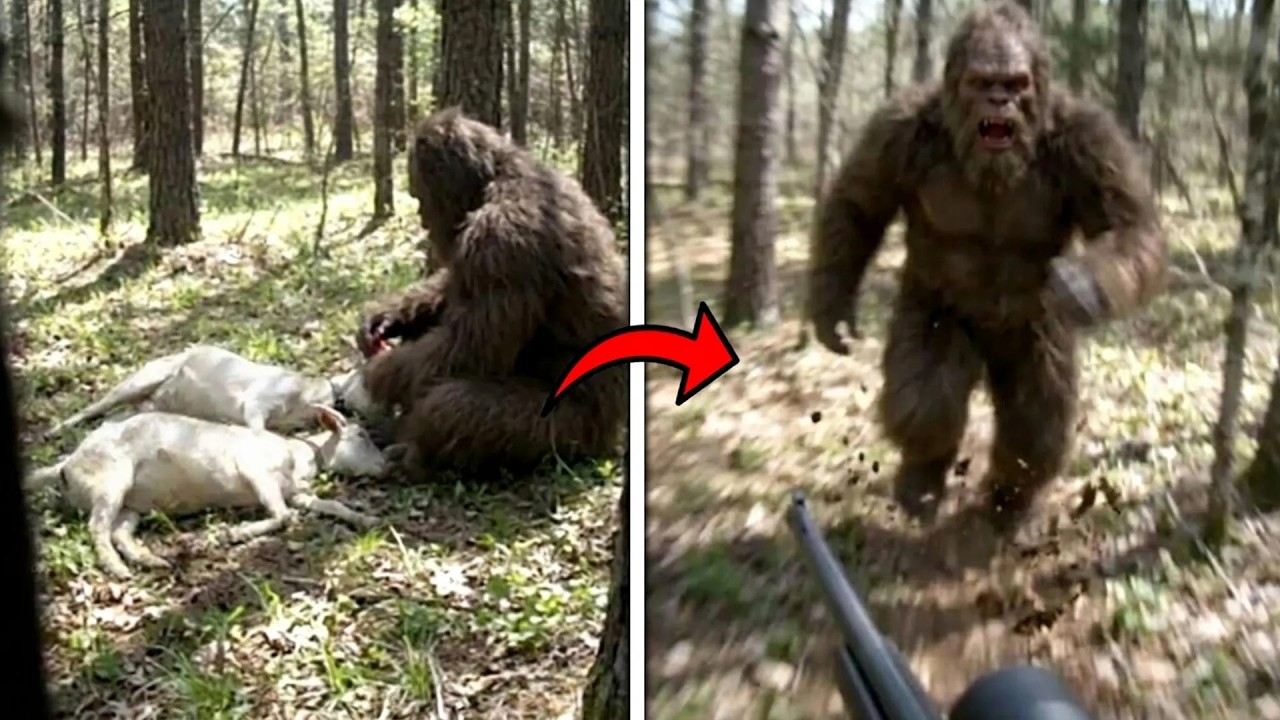
THE NIGHT THE WOODS TOOK REVENGE
Introduction
For twenty-two years, Marcus Webb believed the forest beyond his ranch was simply wilderness—dark, old, and dangerous in the ordinary ways. Bears tested fences. Coyotes circled calves. Elk broke wire during rutting season. But on one cold October night in 2016, something walked out of the Cascade woods that did not behave like any animal he had ever known. It did not just hunt. It punished. And when Marcus fired one shot into its body, the creature made him understand that some things in the forest do not run from men with rifles. Some things remember.
Chapter One: The Quiet Before the Bellowing
My name is Marcus Webb, and for most of my life, I believed a man could learn the land if he stayed with it long enough. I believed that if you watched the weather, tracked the soil, learned the habits of your animals, listened to the wind moving through the timber, and respected the old rules of the mountains, then nothing on your property could truly surprise you. That belief lasted until the night of October 14th, 2016, when something came out of the trees east of my pasture and changed the meaning of fear for me forever.
I ran a 240-acre cattle ranch outside Packwood, Washington, tucked into the Cascade foothills about fifteen miles from the nearest real town. The ranch had belonged to my uncle before me, though he never loved the place the way I did. To him, it was a business. To me, it was a life measured in fence repairs, calving seasons, winter feed bills, and mornings when fog sat so low over the pasture that the cattle looked like ghosts moving through milk. I had lived there for more than two decades, and by 2016, I knew every dip in the field, every deadfall in the eastern timber, every section of fence that liked to lean after a hard rain.
October had been quiet that year. Too quiet, maybe, though I did not think so at the time. The herd was healthy. The calves were putting on weight. We had not had predator trouble since late summer, when a black bear tested the eastern fence twice and moved on after I fired a shot near the tree line. Coyotes worked the perimeter every now and then, but coyotes are cowards when cattle bunch together. They like weakness, isolation, confusion. They do not like grown animals turning on them in a group.
The woods beyond my eastern pasture were thick, steep, and older than anything on the ranch. Most people who visited the place noticed them first. They rose behind the property like a black wall, fir and cedar and hemlock layered so densely that even daylight seemed to have trouble getting in. Hunters used to ask permission to cross my land and enter those woods. Some still did. But even the most confident ones came back quieter than they left. They would talk about strange knocking sounds, heavy movement beyond sight, and game trails that seemed to end where no animal should have stopped walking.
I never made much of it. Woods make noise. Men hear patterns when they are alone and scared.
That was what I believed.
On October 14th, the day had been ordinary in every way that mattered. I remember that clearly, maybe because the night that followed was so impossible. I checked the water troughs in the morning, patched a loose gate latch near the south pasture, and spent part of the afternoon working on a hydraulic line in the equipment shed. The sky stayed low and gray all day. Not stormy, just heavy. The kind of Pacific Northwest gray that makes the whole world feel damp before rain even falls.
By evening, the temperature dropped fast. I fed the dogs, made coffee I did not need, and sat at the kitchen table going over receipts. The house was quiet except for the refrigerator hum and the occasional creak of old boards settling under the cold. Around 9:30 p.m., I remember stepping onto the porch and looking toward the pasture. The cattle were scattered in loose groups. Nothing was moving near the tree line. No dogs barking. No coyotes calling. No owl, even.
Just quiet.
Fifteen minutes later, that quiet broke.
At first it was only one animal bawling. Then three. Then the whole field seemed to come awake at once. Cattle make different sounds for different kinds of trouble, and anyone who has raised them long enough knows the difference. There is the irritated sound when they want feed. The restless lowing when something small is circling outside the fence. The sharp alarm when a calf gets separated from its mother.
This was none of those.
This was panic.
It rose out of the pasture in waves, deep and frantic and layered with the pounding movement of heavy bodies. I stood up so fast my chair hit the floor behind me. For one frozen second, I listened. Beneath the cattle, beneath the panicked bawling, I heard something else.
Footfalls.
Not hooves.
Something heavy moving through wet soil.
I took my flashlight from the hook by the door and grabbed my .308 rifle from the cabinet. I did not feel afraid yet. Not exactly. Concerned, alert, annoyed maybe. A predator in the pasture was a problem, but it was a problem I understood. Bear, cougar, maybe men trying to steal livestock. Those were possibilities with names, and anything with a name felt manageable.
I stepped outside into the cold and crossed the yard toward the eastern pasture fence. The sound worsened as I got closer. The cattle were not gathered in one place the way they would be if coyotes were pushing them. They were splitting, bunching, scattering, then bunching again. Something was inside the field with them.
When I reached the fence, I raised the flashlight.
The beam cut across the pasture.
And there, one hundred fifty yards out, I saw it.
At first, my mind tried to make it a bear. That was the only shape it could accept. Huge, dark, broad across the shoulders. But then it turned slightly, and the outline changed. It was upright. Not rearing, not standing for a moment the way a bear can. Upright as a man is upright, but wrong in every proportion.
It had a calf by the hind legs.
The calf was alive, kicking hard, trying to twist free, its front hooves digging into the grass as it was dragged backward toward the eastern tree line. The thing holding it moved with deliberate ease, as if four hundred pounds of terrified animal meant nothing at all. It was covered in dark hair, almost black in the flashlight beam, though parts of its shoulders shone with a brownish cast when it shifted.
I did not breathe.
The word came to me before I could stop it.
Bigfoot.
I had heard stories, same as everyone in that part of Washington. Sightings near logging roads. Prints found in mud. Hunters claiming something followed them back to camp. I had laughed at half of them and ignored the other half. But standing at that fence, watching that impossible creature drag my calf across open pasture, I understood suddenly that disbelief is a luxury men enjoy only until reality steps into the light.
I shouted.
“Hey!”
The creature stopped.
Its head turned toward me.
The flashlight caught its eyes, and they shone greenish and steady. Not like the quick flash of a deer. Not like the nervous shine of an animal startled by light. These eyes held. They focused. They knew exactly where I was.
For several seconds, neither of us moved.
Then it turned back toward the trees and continued dragging the calf.
That insulted something in me. I can admit that now. It was not just fear or duty. It was anger. That was my animal. My land. My fence. My field. I had shouted, and this thing had dismissed me like I was nothing more than weather.
So I raised the rifle and fired a warning shot into the air.
The .308 cracked across the pasture, hard enough to echo off both tree lines. The cattle froze. The whole night seemed to flinch.
The creature released the calf.
Then it stood to full height.
I still struggle to put an exact number on how tall it was. Eight feet seems too small. Eight and a half, maybe. The fence posts behind it stood five feet above the ground, and its shoulders rose well over them. Its head sat forward slightly, low between massive shoulders, giving it a hunched power that made it seem even larger. It was not shaped like a man in a costume. It was not shaped like a bear. It was built like something that belonged to an older world.
Then it screamed.
The sound began low, deep enough that I felt it in my ribs before I fully heard it. It rose into a roar that filled the pasture and rolled into the forest behind me. It lasted maybe four seconds, maybe five. Long enough for my hands to tighten on the rifle. Long enough for every animal in that field to go silent.
Then it bent, picked up the calf again, and disappeared into the trees.
I stood there at the fence, breathing hard, rifle raised at nothing.
That was the first mistake I made.
I thought the worst thing that could happen had already happened.
Chapter Two: Into the Tree Line
I called my neighbor Tom Harrison at 10:02 p.m. Tom was the kind of man who answered the phone like he had been expecting trouble his whole life. He lived three miles down the road, had worked ranches since he was twelve, and did not waste words when something serious was happening.
“Someone’s stealing cattle,” I told him.
It was the only sentence I could make myself say.
Tom did not ask who. He did not ask how many. He only said, “I’m coming.”
He arrived thirteen minutes later with his two sons, Eli and Grant. Both were grown men, both raised around livestock, both armed when they stepped out of Tom’s truck. The headlights swept across my yard and briefly caught the front of the barn, the chicken coops beyond it, the dark pasture, and the black mouth of the eastern woods.
Tom looked at me once and knew there was more to the story than cattle theft.
“What did you see?” he asked.
I wanted to tell him the truth. Instead, I said, “Something took a calf into the trees.”
He stared at me for a moment, then looked toward the forest.
“Bear?”
“No.”
That was all I said.
We crossed the pasture together with flashlights and rifles. The cattle were still pressed against the far fence, their bodies tight together, breath steaming in the cold. None of them wanted to be near the eastern side. The drag mark was easy to follow, a wide flattened path through grass and soft soil leading straight to the trees. It looked like someone had pulled a heavy tarp full of wet sand across the field.
At the tree line, we stopped.
No one said anything. The forest ahead was black and still. Our flashlight beams caught trunks, branches, wet leaves, and nothing else. But the drag mark continued inward, disappearing into fern and shadow.
Tom’s older son Eli whispered, “What the hell dragged it?”
I did not answer.
We entered the woods.
The moment we crossed under the trees, the ranch seemed to vanish behind us. Sound changed. The pasture noise dropped away, and every step became too loud. Branches cracked under our boots. Wet brush scraped our jeans. The smell of cedar, mud, and cold earth surrounded us.
We found the calf about two hundred yards in.
It lay in a shallow depression beside a fallen log, its body twisted at an angle that made Tom stop walking before I did. The calf was dead. Its neck had been broken cleanly. No feeding. No tearing. No obvious attempt to hide the carcass. It had been carried or dragged into the woods, killed efficiently, and abandoned.
Tom crouched beside it, shining his flashlight over the ground.
“That doesn’t make sense,” he muttered.
No, it did not.
A bear kills to eat. A cougar kills to eat. Coyotes kill ugly, but they kill with purpose. This looked like a message written in a language none of us wanted to understand.
Grant turned slowly, sweeping his light through the trees.
“Do you hear that?”
At first, I heard only my own breathing. Then, from back toward the ranch, there came a sharp wooden crack. Another followed. Then a burst of frantic clucking.
The chicken coop.
We ran.
Branches whipped my face as we pushed back through the timber. The forest floor seemed determined to trip us, but fear makes men careless and fast. When we broke out into the pasture, the sounds were louder. Chickens shrieking. Wood breaking. Something heavy moving inside the largest coop.
The coop door had been torn completely off.
Not opened. Not broken at the latch. Torn away and thrown several feet aside.
Our lights converged on the entrance.
There was a shadow inside.
Then it moved.
The creature was crouched in the coop, impossibly large for the space, its shoulders brushing the beams. It was not thrashing. It was not acting like a predator trapped among birds. It was moving with calm, horrible method. It picked up a hen in both hands, twisted once, dropped it, and reached for another. One after another. Quick. Efficient. Almost bored.
For a second, all four of us stood there watching.
Then I raised my rifle.
Tom said, “Marcus—”
But I had already fired.
The shot struck the creature high in the upper chest or shoulder. I know it hit because the body reacted. It flinched backward half a step, twisting slightly as if the impact had surprised it more than injured it.
Then it turned.
The face in the flashlight beams is something I still see when I wake in the dark. Heavy brow. Flat, dark nose. Mouth wider than it should have been. Hair matted around the shoulders. Eyes burning with reflected light. But what stayed with me most was not the animal part.
It was the recognition.
It knew I had hurt it.
Its roar came short and violent, directed straight at us.
Then it charged.
There are moments when the body decides before the mind finishes thinking. I ran. Tom and his sons split toward the truck. I turned toward the barn because it was closer than the house, and because in that instant, a wall seemed better than open ground.
I heard it behind me.
Not just running. Closing.
The ground shook under its steps. I reached the barn door, threw myself inside, and slammed it behind me. I had barely dropped the latch when the impact came.
The whole door jumped inward.
Dust fell from the rafters.
I backed away, rifle raised, heart slamming against my ribs. Another impact hit. Then silence.
For one foolish second, I thought the door had held.
Then the frame began to move.
The creature was not trying to break the door anymore. It had gripped the structural frame around it from outside and was pulling it away from the barn wall. I heard nails scream out of old wood. Then beams cracked one by one in sharp, terrible sequence. The wall bowed inward.
The entire door frame tore loose.
Cold night opened in front of me.
I saw one massive hand grip the siding beside the gap. The fingers curled into the boards, and the creature pulled. A section of wall ripped away.
It was taking the barn apart.
Not smashing blindly. Not trying once and giving up. It moved laterally across the front face, gripping boards, pulling them outward, exposing the frame beneath. Some boards splintered. Some came away whole. Nails snapped and pinged against the floor. The front of the barn peeled open piece by piece.
I fled through the back.
Behind me, wood screamed and metal roofing buckled. I ran across the yard toward the house without looking back until I reached the porch. When I turned, the front third of my barn was open to the night. The creature was still there, working across the wall as if dismantling something it had decided should no longer exist.
That was when I understood the second mistake.
I had not defended my ranch.
I had challenged it.
And it had accepted.
Chapter Three: Ninety Minutes of Ruin
Inside the house, I locked the door out of habit, though I knew the lock meant nothing. I stood at the living room window with the rifle in my hands and watched my ranch become a place I no longer recognized.
Tom’s truck was parked near the driveway, headlights on. I could see movement inside it, shadows shifting, phones raised, men trying to document what no one would believe without proof. The creature ignored them at first. It finished with the barn only when the front wall had been torn open from the left corner to nearly two-thirds across. Two roof sections had partially collapsed into the interior. A place I had repaired, painted, cursed, and depended on for years stood exposed like a broken rib cage.
At 11:03 p.m., the creature left the barn and walked back toward the cattle pasture.
Three young steers were in the near section, separated from the main herd by panic and bad luck. They moved too late. The first barely made it ten yards before the creature caught it by the neck and put it down with a movement so fast I almost could not process it. Contact, pressure, collapse. Two seconds, maybe less.
The second steer ran harder. It cut left across the field, hooves tearing wet soil, breath white in the dark. The creature followed in long, ground-eating strides. It did not sprint the way a predator sprints. It surged forward with terrifying efficiency, closing distance as if the steer were moving through water. It caught the animal by the hind legs, pulled it down, and ended the struggle with one brutal downward motion.
I lowered the rifle.
There was no shot. No angle. No certainty. And beneath those practical reasons was the truth: I was afraid to fire again.
The third steer made it the farthest. It crossed nearly the full width of the pasture, heading for a broken section of shadow near the far fence. For a moment, I thought it might escape into the dark beyond the field. Then the creature reached it.
What happened next remains the single strongest image in my mind from that night.
The creature wrapped its arms around the steer’s torso and lifted it off the ground.
All four hooves left the pasture.
That animal weighed more than seven hundred pounds. I knew its weight because I had logged it two weeks earlier. The creature carried it thirty feet while it kicked and twisted in the air. Then, with a motion that looked less like throwing and more like discarding, it hurled the steer into the fence line.
The impact snapped six treated posts.
I remember making a sound then. Not a word. Not a prayer. Just something small and helpless that came out of me before I could stop it.
The creature stood near the broken fence for a few seconds. Then it turned toward the equipment shed.
My shed housed two tractors, an ATV, tools, fuel, spare parts, and farm implements collected over two decades. The rolling door was industrial gauge, heavy enough that I had always trusted it against weather, theft, and anything else I could imagine.
The creature gripped the bottom edge and yanked it upward off the track in one motion.
The sound carried across the property like metal being tortured.
Then it went inside.
For several minutes, I could not see it. I could only hear what it was doing. The ATV overturned first, a crash of metal and plastic against concrete. Then shelving units came down one by one along the wall, spaced apart by several seconds, as if it were moving methodically from one to the next. Tools scattered across the floor. Wrenches and sockets rang against concrete. Something heavy struck one of the tractors. Then again.
The shed went quiet.
I stood at the window, barely breathing.
The creature emerged carrying a full fifty-five-gallon diesel drum overhead.
Full, that drum weighed close to four hundred pounds. It held it with both hands, arms raised, and walked toward the smaller barn at the same deliberate pace it had used all night. Not rushed. Not straining. Not adjusting under the weight.
It stopped about twenty feet from the smaller barn and threw the drum through the wall.
The drum smashed through siding and disappeared inside. Diesel poured into the floorboards. The smell reached the house minutes later, sharp and oily, threading through the cold air. By luck, nothing ignited. I have thought about that many times. If there had been one spark, one exposed wire, one forgotten heat source, the night could have become something even worse.
At 11:26 p.m., it returned to the chicken coops.
There were three coops on the property. The largest had already been torn open. The second and third were smaller wooden structures on the south side of the barn complex, each holding about twenty hens. They had been built solidly enough for raccoons, coyotes, and winter wind.
They were not built for this.
The creature did not bother with doors anymore. It put both hands against the wall of the second coop and pushed inward. The frame collapsed in one motion. Birds burst into the yard, flapping wildly into darkness. Most did not get far. The creature moved through the wreckage, killing what it could reach with the same quick, practiced motions I had seen before.
Then it did the same to the third.
I had raised some of those hens from chicks. I knew the ridiculous ones, the aggressive ones, the one that always escaped and somehow returned by sunset. That kind of detail may sound small compared to steers and barns and impossible creatures, but ranch life is made of small attachments. You do not admit affection for every animal, but it finds you anyway.
In less than ten minutes, fifty-one chickens were dead.
Tom chose that moment to move.
His truck rolled backward toward the driveway, headlights swinging across the yard. The creature saw the light and turned. For a second, its body lowered slightly, shoulders rising, head angling forward.
Then it charged.
Tom’s truck accelerated hard. Gravel sprayed under the tires. The creature pursued from about one hundred yards out, covering the first half of that distance with astonishing speed. Later, Tom told me the speedometer hit thirty-five before they reached pavement, and that the creature stopped not because it could not continue, but because it chose not to.
I saw that choice from the window.
It pulled up at a specific point in the driveway, planted its feet, and let the truck go.
Then it roared.
That roar lasted nearly six seconds. It rolled through the house even with every window shut. It was not like the first roar in the pasture, and not like the sharp roar after I shot it. This was broader, longer, almost declarative. It sounded less like threat than announcement.
I do not know who it was announcing to.
The forest answered with silence.
Afterward, it stood in the driveway, chest moving, blood visible on its right shoulder where my bullet had struck. Around it lay ninety minutes of destruction. The barn torn open. The coops collapsed. Three steers dead. The equipment shed violated. A diesel drum embedded in the smaller barn wall. My ranch, which had been orderly and quiet two hours earlier, looked as if a storm with hands had passed through it.
Then the creature turned back toward the pasture.
I thought it was leaving.
I was wrong.
Chapter Four: The Thing at the Tree Line
The creature walked slowly through the field.
That slow walk frightened me more than the charge.
During the destruction, it had moved with purpose. Terrible purpose, yes, but something I could follow. It responded to my shot. It attacked structures. It killed animals. It chased the truck. All of that was monstrous, but in the moment, it formed a sequence.
What came next had no sequence I understood.
It stopped beside the first steer it had killed and stood over it for close to thirty seconds. It did not feed. It did not touch the body. It simply looked down. The cattle on the far side of the field remained pressed together, silent and trembling.
Then it moved to the broken fence line where the third steer had struck. It examined the snapped posts. I do not know another way to describe it. It looked at them. Then it gripped one of the remaining upright posts with both hands.
I thought it would rip the post out.
It did not.
It held it for several seconds, then let go.
That gesture has haunted me more than I can explain. Destruction I could understand, at least in the broad language of rage. But restraint, after everything it had already done, opened a colder question. Why hold the post and spare it? Why stop? Why decide?
The creature continued toward the eastern edge of the pasture. Its steps were unhurried now. Almost reflective. At the tree line, it stopped.
Then it turned back toward the ranch.
I stood at the living room window with the rifle in my hands, frozen in place. The house was dark behind me. My own reflection hovered faintly in the glass, pale and wide-eyed, but beyond it the creature stood between pasture and forest, looking back at everything it had done.
The pause lasted twenty or twenty-five seconds.
That may not sound long. In ordinary life, twenty-five seconds is nothing. It is the time it takes to pour coffee, tie a boot, wait for a gate to swing shut. But when something impossible stands at the edge of your land after destroying your world, twenty-five seconds becomes a lifetime.
It was not resting.
It was not listening.
It was looking.
I felt, with a certainty I did not want, that it was registering the scene. The broken buildings. The dead animals. The silent house. The truck lights far down the road. Me at the window. Maybe it could see me. Maybe it could not. But it knew the ranch was watching it back.
Then it stepped into the trees and vanished.
Nobody went after it.
That may sound obvious, but people have asked me over the years why we did not track it immediately, why we did not call more men, why we did not pursue it with rifles and spotlights and dogs. Those people were never there. They did not hear the barn come apart. They did not see seven hundred pounds of steer lifted off the ground. They did not watch a creature take a bullet, react with anger instead of fear, and spend the next ninety minutes proving that every wall we trusted was temporary.
Tom returned with his sons before midnight and stayed until sunrise. None of us slept. Eli sat in the truck with the engine running and headlights pointed toward the eastern trees. Grant stayed near the house with me. Tom walked the driveway twice with a flashlight, checking tracks, damage, shadows, anything that might tell us whether the thing had circled back.
The forest remained silent.
That silence was worse than the noise.
When something is roaring, breaking, moving, killing, you know where it is. When the forest goes quiet afterward, every tree becomes a hiding place. Every patch of darkness becomes a possible shoulder, a possible face, a possible pair of greenish eyes waiting just beyond the beam.
At first light, the ranch looked smaller.
That was my first thought. Not ruined, though it was. Not damaged, though it was badly damaged. Smaller. As if the night had reduced it from a place I controlled to a clearing inside something larger that had merely tolerated me.
The main barn’s front wall was gone from the left corner to nearly two-thirds across. The exposed frame leaned inward. Two roof sections had collapsed, crushing a workbench and part of the tool storage. Boards lay scattered across the yard, some split, some pulled clean with nails still embedded.
The smaller barn had a two-foot breach where the diesel drum had gone through. Fuel still seeped into the floorboards. The smell hung heavy across the yard.
The equipment shed was chaos. The ATV lay overturned. Shelving units were flattened. Tools were everywhere. The front loader assembly on one tractor had cracked in two places, something the repairman later told me should not have happened without extraordinary force.
The coops were worse in a quieter way. Broken wood. Feathers. Stillness. I counted fifty-one dead chickens before I stopped counting and started carrying bodies.
The steers lay where they had fallen. The first two close together in the near field. The third at the shattered fence line, posts splintered outward from impact. I stood beside that fence for a long time. The ground was torn where the animal had hit. Six treated six-by-six posts had snapped.
The footprints near the eastern fence were the clearest physical record.
I measured several before the dew softened them. Eighteen inches long. Five toes. Full heel impression. The stride spacing was close to sixty inches. The depth varied, but in the softer ground, the impressions were deep enough that my own boot placed beside one looked ridiculous, like a child’s print beside a grown man’s.
I photographed everything.
The drag mark from the calf still ran from the center pasture to the trees, a wide compressed channel in the grass. I followed it to the edge of the woods but did not go farther. I stood where it disappeared beneath the branches and looked into the timber.
The forest looked normal in daylight.
That was almost offensive.
Birds moved in the upper branches. Moisture dripped from needles. Ferns leaned under dew. Nothing about it suggested that, only hours earlier, something had stepped out of that green darkness and rewritten my understanding of the world.
Near the first chicken coop, I found blood.
Not chicken blood. This was where the creature had stood when I fired. Dark red, almost brown in the morning light, pooled lightly in the dirt and smeared against broken boards. I collected what I could with the materials I had on hand and stored it cold. I did not know what I expected to do with it. I only knew that proof mattered, even if I was not sure proof would help.
By noon, word had started to move.
Not the truth. I did not tell the truth. Tom did not either, not then. We told people there had been a predator attack and structural damage. That phrase became a kind of shield. Predator attack. It sounded official enough to end some questions. Structural damage. It sounded expensive enough to distract from the stranger parts.
But people noticed.
They saw the barn. They saw the fence. They saw the tracks before rain ruined them. A sheriff’s deputy came out, looked at the damage, asked careful questions, and wrote down answers that did not explain anything. Wildlife officers came two days later. One suggested bear. Another said no bear he knew opened a rolling door like that. Neither wrote Bigfoot in any report.
Nobody wanted to be the first serious person to say the unserious word.
I understood.
I did not want to say it either.
Chapter Five: The Lab File
Six weeks after the attack, the blood results came back.
I had sent the sample to a small independent lab through a wildlife contact who owed me a favor. I did not tell them what I thought it was. I labeled it as unknown predator blood collected after livestock loss. That was true, technically. Maybe not complete, but true enough.
The technician called me directly.
That alone made my stomach tighten. Labs send emails when results are normal. They call when something is wrong.
“Mr. Webb?” he said. “I’m calling about your sample.”
I was standing in the kitchen when the call came in. The same kitchen where I had been sitting before the cattle started screaming. I remember looking out the window toward the repaired pasture fence while he spoke.
“What did you find?” I asked.
There was a pause.
“It’s primate.”
I said nothing.
He continued, choosing his words carefully. “It is not bear. Not cougar. Not canine. Not bovine contamination. Not human, either, based on the markers we tested. It shows primate characteristics, but we could not match it to a catalog species in the databases available to us.”
The world did not tilt. It should have, maybe. Instead, it became terribly still.
“Could it be contaminated?” I asked.
“Contamination is always possible,” he said, in the tone of a man who had already considered that and did not believe it explained enough. “But the sample was viable. The results were consistent enough that I wanted to ask where exactly this came from.”
“A predator attack,” I said.
“What kind of predator?”
“I don’t know.”
Another pause.
Then he said, “If you have more material, you should send it.”
I told him I would think about it.
I never followed up.
People ask why. They imagine that if they had proof of something extraordinary, they would push it as far as it could go. They would call universities. They would contact television crews. They would demand recognition. Maybe they would. Maybe that is what people do when proof is exciting.
But proof was not exciting to me.
Proof meant the thing was real.
Proof meant the thing that tore apart my barn, killed my animals, and stood at the tree line looking back was not a hallucination born from panic and darkness. It meant that the forest beyond my pasture contained something unknown, something strong enough to challenge every assumption I had built my life on.
And worse than that, proof meant questions.
How many were there?
Why had it come to my ranch?
Why had it taken the calf into the woods, killed it, and left it?
Why had it returned to the chicken coop?
Why had it destroyed structures after I shot it?
Why had it stopped at the tree line and looked back?
The practical aftermath consumed the next several months. Insurance handled some damage and rejected other parts. The barn repairs cost more than I wanted to admit. Replacing livestock was easier than replacing confidence. Every night chore changed after that. I installed more lights, motion sensors, cameras, stronger gates. I reinforced structures that no ordinary animal would test. I bought another rifle and hated myself for feeling safer with it.
But safety never truly returned.
The cattle changed too. Animals remember land differently than humans do. For weeks, they avoided the eastern pasture. Even when feed was placed there, they hesitated. They bunched at dusk. They startled at wind from the trees. One older cow refused to cross a certain section near the drag mark for nearly a month.
The dogs would not go near the tree line after dark.
That may have troubled me most.
Dogs invent courage when men need it. Mine had always barked at coyotes, chased raccoons, and warned off strangers. After that night, they stayed close to the house when the sun went down. If something moved in the eastern woods, they did not bark. They whined.
By December, snow came early to the higher ridges. The ranch settled into winter routine, though routine felt like theater now. Feed. Repair. Check water. Count animals. Watch trees. Sleep badly. Wake at every sound.
Tom visited more often than before. He never said he was checking on me, but he was. Sometimes he came with coffee. Sometimes with tools. Sometimes he stood beside me at the pasture fence and said nothing for ten minutes.
One afternoon, he brought up the videos his sons had taken.
“You should keep copies somewhere else,” he said.
“I have.”
“You should show somebody.”
“I did.”
“The lab?”
I nodded.
“What’d they say?”
I told him.
Tom looked toward the trees and rubbed his jaw. He was quiet for a long time.
Finally, he said, “Then it wasn’t just big.”
“No,” I said.
He exhaled slowly.
“That’s worse.”
He was right.
If it had been only size, we could have built bigger fences. If it had been only strength, we could have stayed farther away. If it had been only animal rage, we could have understood it as dangerous but simple.
But it was not simple.
A simple animal does not dismantle a barn board by board after being shot. A simple animal does not destroy the things around a man before leaving him alive to see it. A simple animal does not walk back through the pasture afterward and take stock.
By spring, grass returned to the field. Repairs were mostly finished. The new chickens learned the coops as if nothing had ever happened there. Fresh cattle grazed near the repaired fence, though the older animals still preferred the western side.
The ranch looked normal again.
I almost convinced myself that normal was possible.
Then, in late May, I found the first sign that it had come back.
Chapter Six: The Return
It was not dramatic at first.
No screaming cattle. No broken walls. No roaring from the driveway.
Just a footprint.
I found it near the creek bed at the north edge of the property, pressed into damp sand where the water curved around a stand of alder. Eighteen inches long. Five toes. Full heel. The same general shape as the prints from October, though this one was cleaner than most of those had been.
I stood over it for a full minute before I allowed myself to breathe.
The first thought was denial. Maybe an old print. Maybe a trick of water and shadow. Maybe some combination of elk track and erosion forming the shape my mind feared most.
Then I saw the second print.
And the third.
They followed the creek for about forty yards before vanishing into rockier ground.
Whatever had made them had moved along the northern edge of my ranch during the night.
It had not attacked.
It had not approached the barns.
It had simply passed through.
That should have comforted me. It did not.
I called Tom. He came within the hour, and this time neither of us softened the language.
“It came back,” I said.
Tom looked at the prints and nodded.
“Same one?”
I looked toward the eastern woods.
“I don’t know.”
We followed the tracks as far as we could. They moved from the creek toward a patch of timber that connected with the larger forest system east of my land. At one point, we found where it had stopped beside a fence and placed one hand on the top rail. Not broken it. Not pushed it down. Just gripped it. Mud marked the wood in a long smear.
That handprint was wider than my spread fingers by several inches.
Tom stared at it.
“Marcus,” he said quietly, “this thing knows your place.”
I wished he had not said that.
For the next three weeks, signs appeared and vanished like fragments of a message. A motion light triggered at 2:13 a.m., but the camera showed only darkness and one blurred shape too close to the edge of the frame to identify. The cattle bunched twice without visible cause. The dogs refused to leave the porch after midnight. One morning, I found three rocks lined neatly on a stump near the eastern pasture.
That last detail sounds absurd until it happens on your land.
Three rocks.
Not fallen. Not natural. Placed.
I did not touch them for two days.
On the third day, they were gone.
Sleep became thin. I moved through daylight like a man waiting for a verdict. Every evening, I checked locks, lights, cameras, fences, and rifles. Every morning, I checked for tracks. I hated the ritual and depended on it.
Then came June 18th.
The night was warm, windless, and moonless. Around 1:40 a.m., I woke to a sound from outside.
Not cattle.
Not chickens.
A knock.
Three heavy strikes from the direction of the woods.
Wood on wood.
I sat up in bed, every part of me instantly awake.
The knocks came again.
Three.
Then silence.
I took the rifle and moved downstairs without turning on lights. Through the kitchen window, the yard looked still. The barn, repaired and darker than the sky behind it, stood in place. The coops were quiet. The pasture lay in shadow.
Then another knock came, closer.
This time from the eastern fence line.
Three heavy strikes.
I saw movement after the final one.
A shape stood near the fence, darker than the dark around it.
My hands tightened around the rifle.
The shape did not move toward the animals. It did not approach the house. It stood facing the property, exactly as it had stood at the tree line months before.
Then it raised one arm.
For one insane second, I thought it was waving.
But it was not.
It held something.
A fence post.
One of the old broken posts from the October attack, or one that looked like it. I do not know where it had found it. I had replaced the fence months earlier and stacked the broken timber behind the shed before hauling most of it away. Maybe I missed one. Maybe it had taken one. Maybe it had kept it.
The creature held the post upright for several seconds.
Then it placed it on the ground at the edge of the pasture.
Carefully.
Deliberately.
After that, it turned and walked back into the trees.
I did not follow.
At sunrise, I went out with Tom. The post lay exactly where I had seen it placed. It was an old treated six-by-six, snapped at one end, weathered and splintered. On one side were dark stains that might have been soil, oil, or something else. I recognized the angle of the break.
It was from the section of fence destroyed when the steer had been thrown.
Tom looked at the post, then at me.
Neither of us spoke for a long time.
Finally, he said, “That ain’t an animal.”
I wanted to argue. I wanted to cling to some category that made the world manageable. Instead, I looked toward the trees.
“No,” I said. “It isn’t.”
Chapter Seven: What the Forest Remembers
I still live on that ranch.
People ask why. The answer is complicated and simple at the same time. Land is not just dirt when you have given your life to it. It becomes memory, labor, debt, pride, grief, and identity. Leaving would have meant admitting that one night had taken not only my animals and money, but the whole shape of my life.
So I stayed.
But I no longer pretend the forest is empty.
Since 2016, I have had other incidents. Nothing like that first night, and I pray nothing ever like it again. But there have been signs. Prints after rain. Knocks from deep timber. The feeling of being watched while repairing fence near dusk. Once, in winter, I found a deer carcass placed just outside my eastern property line, untouched except for a broken neck. I left it there. By morning it was gone.
I do not shoot toward the woods anymore.
That is not bravery or cowardice. It is education.
There are men who hear this story and want the rifle part to be different. They want me to say I regret not firing more. They want a version where enough bullets solve the problem, where human courage and ammunition stand between civilization and the dark. I understand that impulse. I had it too.
But that night taught me something ugly.
A rifle does not make you the dominant creature in every encounter. Sometimes it only makes you noticed.
I have spent years thinking about the creature’s behavior. Not just its strength, though that is impossible to forget. Not just its size. The behavior is what remains unanswered.
It took a calf but did not eat it.
It killed chickens systematically but did not feed.
It destroyed my barn after being shot, not before.
It chased Tom’s truck and stopped by choice.
It returned months later and placed a broken fence post at the pasture edge.
These are not random acts in my mind. I do not know what pattern they form, but I know there is one.
Maybe the calf was trespass in reverse. Maybe it saw my cattle as animals occupying land it considered part of its range. Maybe my warning shot was understood as a challenge. Maybe the bullet changed the encounter from theft to punishment. Maybe the destruction was not rage but communication. A demonstration. A correction. A lesson.
Or maybe I am doing what humans always do when faced with terror.
Maybe I am inventing meaning because meaning is easier to live with than chaos.
Still, I return to those twenty-five seconds at the tree line.
After all the noise, after all the destruction, after the last steer lay still and the truck had fled, it stopped and looked back. Nothing forced it to do that. No animal need explained it. The ranch was already broken. I was no threat. Tom was gone. The night belonged to it.
And yet it looked back.
That look is the part I cannot bury.
In that stillness, I felt something looking not at food, not at danger, not at movement, but at consequence. It had changed the place. It knew it had changed the place. And before returning to the forest, it observed the result.
That is what frightens me most.
Not that Bigfoot may exist.
Not that it is strong.
Not that it can kill livestock, break barns, outrun trucks, and carry weights no man could move.
What frightens me is the possibility that it understands more than we want it to.
Because if it understands, then every story we tell ourselves about wilderness is incomplete. We think of the forest as habitat, resource, scenery, danger, mystery. We do not think of it as territory watched by something that may have its own memory, its own boundaries, its own rules for insult and response.
I crossed one of those rules.
I did not know it at the time.
But ignorance did not protect me.
The lab file still exists. The photos still exist. Tom’s sons still have their videos, though none of us released the clearest parts. People say proof should belong to the public. Maybe they are right. But proof has a cost when the thing proven can walk back out of the trees any night it chooses.
My official losses were fifty-one chickens, three steers, one calf, and eighty-five thousand dollars in structural damage.
That is what the insurance forms could measure.
They could not measure the way my dogs stopped barking at the woods.
They could not measure the way my hand still freezes over the light switch some nights.
They could not measure the silence after the roars.
They could not measure what it feels like to stand on land you own and realize ownership is just paperwork written by people, while the forest keeps older records.
I used to believe there were two worlds: the human world of houses, fences, rifles, trucks, barns, and laws, and the animal world of hunger, instinct, territory, and fear.
Now I believe there is a third world.
It stands between the trees and waits for us to misunderstand it.
On October 14th, 2016, I shot something I should have let walk away.
It came out of the woods carrying one of my animals.
It went back into the woods carrying my certainty.
And months later, when it returned with that broken fence post and placed it at the edge of my pasture, I understood the message as clearly as I have ever understood anything in my life.
The ranch was mine only as long as the forest allowed it.
And the forest remembered.