The ACTUAL Prophecies of Anna Maria Taigi
The ACTUAL Prophecies of Anna Maria Taigi
The most terrifying thing about Anna Maria Taigi was not that she saw the future. It was that she saw it while washing clothes, raising children, serving dinner, and living the hidden life of an ordinary Catholic mother.
Most prophets in the popular imagination stand on mountains, write in caves, or speak before kings. Anna Maria Taigi did none of that. She was not a queen, scholar, abbess, theologian, or political revolutionary. She was a wife. A mother. A poor Roman woman who cooked, cleaned, cared for her family, endured a difficult marriage, and carried the burdens of ordinary life with extraordinary spiritual intensity. That is what makes her story so unsettling. The visions did not come to someone removed from the world. They came to a woman standing inside the daily battlefield of family, poverty, suffering, prayer, and sacrifice.
Born in Siena in 1769 and later living in Rome, Anna Maria Taigi became known not simply for piety, but for a mysterious spiritual gift that witnesses described with awe: a kind of luminous “sun” or globe through which she allegedly saw distant events, hidden spiritual realities, future troubles, the condition of souls, and movements in the Church and the world. To those who believed in her gift, it was as if heaven had opened a window before a woman who never sought fame. To skeptics, such claims belong to the realm of private devotion, legend, and later exaggeration. But even cautious readers cannot deny one thing: the figure of Anna Maria Taigi has haunted Catholic imagination for nearly two centuries.
Her prophecies are often repeated online in dramatic fragments. Wars. Revolutions. Darkness. Chastisement. A great restoration. A pope chosen in a miraculous way. Saints Peter and Paul appearing. Nations returning to the Church. Three days when the world itself seems wrapped in judgment. But when people ask for the “actual” prophecies of Anna Maria Taigi, they are really asking a deeper question: what did this woman truly warn about, and why do her warnings still frighten people today?
The first thing to understand is that Anna Maria Taigi’s prophecies do not belong to public revelation. They are not Scripture. They are not Catholic dogma. No Catholic is required to treat every popular quotation attributed to her as certain, especially because private revelations often pass through biographies, devotional books, translations, oral retellings, and later compilations. Over time, one mystic’s words can be blended with another’s. A warning can be expanded. A detail can be sharpened. A local prophecy can become global in popular imagination.
That caution matters.
But caution does not mean emptiness.
At the heart of Taigi’s prophetic reputation is not curiosity about dates. It is a moral warning. Her visions, as preserved in Catholic devotional tradition, consistently point to sin, chastisement, purification, conversion, the triumph of the Church, and the need for prayer. She was not presented as a fortune-teller. She was presented as a soul allowed to see, in frightening symbolic form, what happens when humanity rejects God.
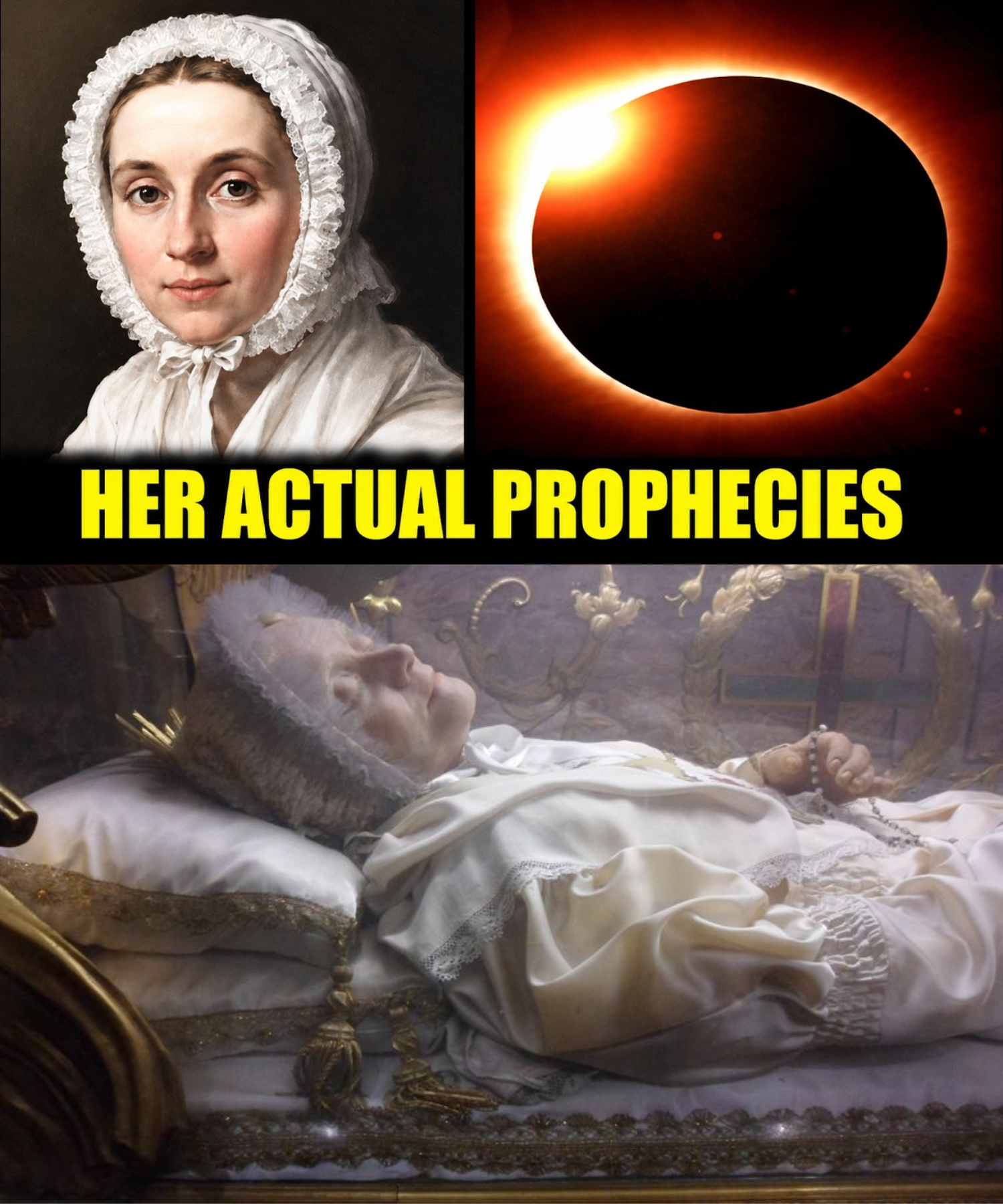
The most famous prophecy attributed to her is the Three Days of Darkness. In its commonly repeated form, it describes a future chastisement in which the whole earth is covered by an intense darkness lasting three days and three nights. During that time, ordinary artificial light supposedly fails, the air becomes dangerous, and the faithful are told to remain indoors, pray, and use blessed candles. The darkness is described not simply as a natural eclipse or storm, but as an act of divine judgment and purification.
This prophecy is the one that made her name known far beyond traditional Catholic circles.
It is also the one most surrounded by confusion.
Many online versions include precise rules, dramatic punishments, and terrifying details that may not all be securely traceable to Taigi herself. Some versions sound more like later apocalyptic folklore than carefully documented testimony. Others blend her alleged prophecy with warnings attributed to other Catholic mystics, especially those who also spoke of chastisements, darkness, or end-time purification. This is why anyone writing honestly about Anna Maria Taigi must say: the Three Days of Darkness is strongly associated with her in popular Catholic tradition, but not every detail circulating today can be confidently called her own exact words.
Still, the symbolism is powerful.
Darkness in biblical language is never merely the absence of light. It is judgment, blindness, fear, mourning, and the stripping away of human confidence. Egypt was covered in darkness before the Exodus. Calvary was covered in darkness when Christ hung on the cross. The human soul falls into darkness when it refuses grace. So even if one reads the Three Days of Darkness cautiously, the message remains severe: a world that rejects divine light may one day be forced to experience what that rejection truly means.
That is why the prophecy keeps returning in times of crisis.
War comes, and people remember Taigi.
Revolutions shake nations, and people remember Taigi.
The Church suffers scandal, and people remember Taigi.
The world grows darker in spirit, and people remember the woman who warned that darkness could become visible.
But Taigi’s prophetic tradition was not only about darkness. It also spoke of restoration. One popular prophecy attributed to her says that after a period of chastisement, Saints Peter and Paul would appear, preach throughout the world, and designate a new pope. A great light would shine, Christianity would spread, nations would return to the Church, and a time of renewal would follow before later trials. This part of the tradition is often overshadowed by the terrifying imagery, but it is essential. The chastisement is not presented as God’s hatred of humanity. It is presented as purification for conversion.
That distinction is crucial.
Catholic prophecy, at its best, is not disaster entertainment. It is not meant to make people addicted to fear. It is meant to awaken repentance. If Anna Maria Taigi saw future punishments, the point was not to make people calculate dates but to make them change their lives. Pray. Repent. Go to confession. Trust Christ. Stop mocking God. Stop treating sin as harmless. Stop assuming civilization can survive while abandoning holiness.
This is the real center of her prophecies.
Not the candles.
Not the dates.
Not the speculation.
Repentance.
Another major theme in Taigi’s prophetic reputation is war and revolution. She lived during one of Europe’s most convulsive periods: the aftermath of the French Revolution, the rise and fall of Napoleon, the turmoil of the Papal States, and the early tremors of the modern political age. Rome itself was not protected from upheaval. The Church faced humiliation, pressure, occupation, and uncertainty. In that context, Taigi’s visions of conflict were not abstract. She lived near the wound.
Tradition says she foresaw political events, dangers to the Church, and sufferings that would come upon nations. Some later writers even credited her with foreseeing major wars of the modern era. Whether every such attribution is historically secure is another matter. But the spiritual pattern is clear: she saw history not as random political motion, but as a moral drama. Nations, rulers, armies, revolutions, and ideologies were not merely human forces. They unfolded under the gaze of God.
That is a deeply Catholic view of history.
It does not mean every battle can be reduced to a simple punishment. It means human history is accountable. Nations can sin. Leaders can rebel. Peoples can grow proud. Civilization can become intoxicated with its own power. When that happens, disaster is not merely political. It is spiritual.
Taigi’s warnings make the modern reader uncomfortable because they refuse to separate public catastrophe from private sin. We prefer to blame systems, governments, economies, enemies, or historical forces. She forces a harder question: what if the crisis outside us is connected to the disorder inside us?
What if revolutions begin in hearts before they burn in streets?
What if darkness in the world begins with darkness in the soul?
This is where Anna Maria Taigi becomes more than a prophecy figure. She becomes a mirror.
Unlike many apocalyptic voices, she did not live as if holiness meant escaping family life. She was married to Domenico Taigi, a difficult and temperamental man by many accounts. She raised children. She endured exhaustion. She practiced charity. She welcomed the poor. She prayed intensely while living a life that most people would not call glamorous. This matters because her prophecies were not separated from her sanctity. The Church did not honor her because she frightened people with predictions. She was honored because she lived heroic virtue in ordinary circumstances.
That is the part sensational retellings often miss.
People want the prophecy without the penance.
They want the warning without the holiness.
They want to know whether darkness is coming, but not whether they themselves have become dark.
Anna Maria Taigi’s life does not allow that separation. Her alleged visions are inseparable from her sacrifice. If she saw the future, she also carried the cross. If she warned about chastisement, she also prayed for sinners. If she knew hidden things, she did not use them to become powerful. She remained small, obedient, poor in spirit, and hidden.
That makes her more frightening, not less.
Because it means the message did not come from someone seeking attention.
It came from someone trying to disappear into God.
The “mystic sun” associated with Taigi is one of the strangest elements of her story. Witnesses and biographers describe it as a luminous globe visible to her interiorly, through which she could see events near and far, past and future, souls and spiritual realities. Whether one accepts this literally or devotionally, the image itself is unforgettable. A woman in a modest Roman home, looking not into a crystal ball, but into a mysterious light permitted by God. Not occult divination, but private revelation. Not control over the future, but suffering knowledge under obedience.
In Catholic spirituality, that distinction is everything.
The occult tries to seize hidden knowledge.
True prophecy receives only what God permits, for God’s purpose.
This is why Taigi’s prophetic gift, as understood by devotees, was not entertainment. It was burden. She did not use the future to make herself safe. She used knowledge as an invitation to prayer and sacrifice. The more she saw, the more she suffered. That is the pattern of real Christian mysticism: the closer the soul comes to God, the more deeply it shares His grief over sin.
Her prophecies about chastisement therefore should not be read like headlines. They should be read like tears.
A mother sees children running toward fire.
A saint sees nations walking toward judgment.
A mystic sees souls laughing on the edge of a cliff.
That is the tone behind the warnings.
The prophecy of restoration also reveals something essential. Taigi’s message was not despair. A false prophet leaves people terrified and trapped. A true warning opens a road back to God. In the popular Taigi tradition, after darkness comes light. After chastisement comes renewal. After purification comes a new springtime for the Church. The suffering is real, but it is not meaningless. God wounds only to heal. He permits shaking only to loosen the grip of idols.
This is why people should be careful not to turn Taigi into a prophetess of doom alone. Her warnings are severe, but Christian prophecy is never finally about doom. It is about God’s victory.
The darkness does not win.
Christ does.
The Church may be humiliated, but not destroyed.
Nations may rebel, but grace can reclaim them.
The world may be chastised, but mercy remains the deepest word.
This balance is what makes her alleged prophecies spiritually serious. They are neither comfortable nor hopeless. They do not flatter modern optimism. They do not feed pure despair. They stand between terror and mercy, saying: judgment is real, but so is conversion.
For modern readers, the most practical question is not “When will the Three Days happen?” It is “What would I do if I truly believed God sees everything?” That question changes the prophecy from spectacle into examination of conscience.
Would I forgive?
Would I confess?
Would I stop living in secret sin?
Would I pray the Rosary?
Would I return to Mass?
Would I repair my family?
Would I give up hatred?
Would I stop mocking holy things?
Would I prepare my soul instead of obsessing over world events?
That is the proper response to Taigi.
Not panic.
Not date-setting.
Not hoarding candles while refusing repentance.
Not watching prophecy videos while remaining spiritually asleep.
The actual message is much harder than fear. Fear is easy. Repentance is hard.
Anna Maria Taigi’s prophecies also force a challenge upon the Church itself. If her warnings about purification are taken seriously, then Catholics cannot simply point at the world and say, “They are the problem.” Private revelations often warn the faithful first. The Church must be holy. Priests must be faithful. Families must pray. Catholics must stop treating grace casually. The world is not converted by a Church that imitates the world. Renewal begins when believers become saints.
That is why Taigi, the wife and mother, matters so much.
She shows that prophecy is not only for pulpits and monasteries. The future of the Church is also fought in kitchens, bedrooms, sickrooms, marriages, nurseries, and hidden sacrifices. A mother praying in the home may be carrying more of history than a king on a throne. A poor woman offering suffering for sinners may understand the fate of nations better than diplomats.
That is the reversal Christianity always brings.
The hidden soul may see more than the powerful.
The final warning of Anna Maria Taigi is not that Catholics should live obsessed with catastrophe. It is that ordinary life is never merely ordinary. Every choice prepares the soul either for light or darkness. Every family is a battlefield. Every prayer matters. Every sin matters. Every act of repentance pushes back the night.
If the Three Days of Darkness are ever fulfilled literally, the world will know. But even before any such event, spiritual darkness already exists. People live in it. Families suffer under it. Nations legislate from it. Churches can be tempted by it. Souls can become accustomed to it.
That is why her message feels current.
Not because every rumor online is accurate.
Because the human heart has not changed.
The actual prophecies of Anna Maria Taigi, stripped of exaggeration and read with Catholic caution, point toward a simple and terrifying truth: God is patient, but not mocked. History is moral. Sin has consequences. Chastisement is possible. Renewal is possible. The Church will suffer, but Christ will not abandon her. Darkness may come, but light belongs to God.
The reader who understands this will stop asking only, “What did she predict?”
They will ask, “What must I change?”
That is the question every true prophecy is meant to create.
And perhaps that is why Anna Maria Taigi still disturbs the modern world. She did not offer prophecy as entertainment. She offered it as warning. A warning from a woman hidden in ordinary life, looking into a mysterious light, seeing the storms of history gather, and begging souls to return before darkness falls.
The future she saw may frighten us.
But the deeper terror is that we might hear the warning and remain exactly the same.