An 1800 BC Babylonian Clay Tablet Solved What Took Google Quantum Chip 30 Years
An 1800 BC Babylonian Clay Tablet Solved What Took Google Quantum Chip 30 Years
A clay tablet smaller than a modern phone sat unread for thousands of years, covered in wedge-shaped numbers no ordinary person could understand. Then mathematicians realized it contained something shocking: a level of numerical precision that makes the ancient world look far more advanced than we were taught.
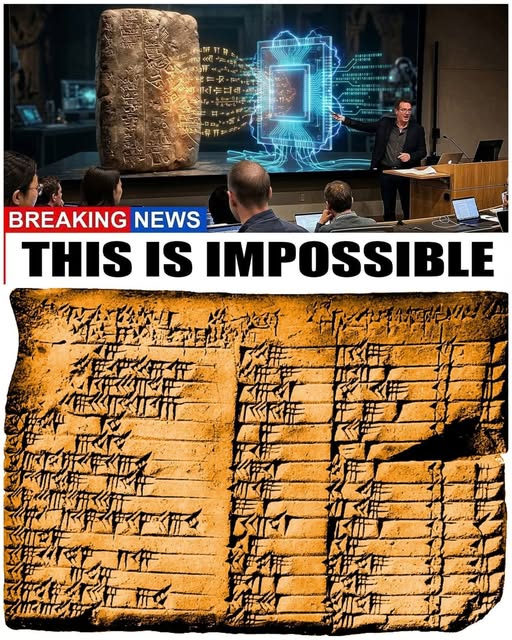
The tablet is known today as Plimpton 322. It is not golden. It is not decorated with kings, gods, battles, or curses. At first glance, it looks almost boring: a broken brown slab of clay marked with neat columns of cuneiform numbers. Yet hidden in those numbers is one of the strangest mathematical achievements ever recovered from the ancient world.
For decades, scholars have argued over its purpose. Some say it is a table of Pythagorean triples. Others say it was a teaching tool. Some believe it was used for surveying, construction, or advanced geometry. A more dramatic modern interpretation suggests it may be the oldest known trigonometric table in history—created more than a thousand years before Greek mathematicians formalized the ideas most students learn today.
That alone would be remarkable.
But the reason this tablet has exploded back into public fascination is the comparison being made between ancient mathematics and modern computing. In 2024, Google announced Willow, a powerful quantum chip that performed a benchmark calculation in minutes and advanced the long struggle to reduce quantum errors as systems scale. The modern achievement was presented as a breakthrough in a field that has battled one of computing’s hardest problems for decades.
And then people looked back at Babylon.
Nearly 4,000 years ago, long before electricity, silicon chips, calculus, algorithms, or digital computers, Babylonian scribes were already working with exact ratios, complex number systems, and right-triangle relationships in a way that still impresses mathematicians today. They did not have quantum processors. They did not even have paper. They had clay, styluses, and a number system based on 60.
Yet that system gave them something modern math sometimes sacrifices: exactness.
That is the heart of the mystery.
Plimpton 322 is usually dated to the Old Babylonian period, around 1800 BC. It contains rows of numbers associated with right triangles—sets of numbers that satisfy the relationship later known as the Pythagorean theorem. The most famous example taught in school is 3, 4, 5: a triangle where 3² + 4² = 5². But Plimpton 322 contains much larger and more sophisticated examples, including values such as 119, 120, 169 and 3367, 3456, 4825.
These are not random numbers.
They are carefully arranged.
That is what stunned researchers. Whoever made the tablet was not merely guessing. The numbers follow a pattern. They reflect deep understanding of relationships between the sides of right triangles. The tablet’s broken edge suggests it may once have contained more rows, meaning the surviving fragment could be only part of a larger mathematical system.
The Babylonians used a sexagesimal system, meaning base 60. Modern people still use fragments of that system every day without thinking about it: 60 seconds in a minute, 60 minutes in an hour, 360 degrees in a circle. Base 60 has powerful mathematical advantages because 60 can be divided evenly by many numbers: 2, 3, 4, 5, 6, 10, 12, 15, 20, and 30. This makes fractions cleaner and calculations more exact in certain contexts.
That advantage may explain why Babylonian mathematics could reach astonishing accuracy.
Modern trigonometry often depends on angles, sine, cosine, and tangent. We use approximations, decimals, and calculators. The Babylonian system behind Plimpton 322 appears to rely not on angles, but on ratios of sides. This means the scribes may have thought about right triangles in a way fundamentally different from modern school geometry. Instead of asking, “What is the angle?” they may have asked, “What are the exact relationships between the sides?”
That difference is more than technical.
It reveals a different mathematical mind.
The Babylonians were not copying Greek geometry because Greek geometry had not yet reached its classical form. They were solving practical and theoretical problems using their own system. They had methods, tables, and numerical techniques suited to surveying land, building structures, calculating slopes, and managing the practical demands of an urban civilization.
This is where the comparison to Google’s quantum chip becomes symbolically powerful. Google’s Willow represents a cutting-edge attempt to overcome modern computational limits. Quantum computing is strange because it uses principles of quantum mechanics to process information in ways classical machines cannot easily replicate. But quantum systems are fragile. Errors are a major obstacle. Building a useful quantum computer means finding ways to control, correct, and scale systems without letting noise destroy the calculation.
Modern computing fights uncertainty with error correction.
Babylon fought complexity with exact ratios.
Different worlds. Different tools. Same human obsession: how do we calculate what ordinary methods cannot handle?
That is why the headline feels so compelling. The Babylonian tablet did not solve Google’s quantum benchmark, of course. It was not running algorithms or manipulating qubits. But it did something philosophically similar: it showed that a civilization with limited material technology could design a mathematical system of extraordinary power by choosing the right structure.
The Babylonians did not need a chip.
They had a system.
This is a lesson modern people often forget. We assume intelligence advances only when machines advance. But ancient mathematics proves that human thought can reach astonishing heights with simple materials. A clay tablet can preserve a calculation for nearly four millennia. A stylus can carve a pattern that outlives empires. A scribe in an ancient city can pose a question that still challenges professors in modern universities.
Plimpton 322 forces us to abandon the lazy idea that ancient people were mathematically primitive.
They were different, not dumb.
The Old Babylonian world was filled with scribal schools, administrative needs, trade, land management, temple economies, astronomy, architecture, and law. Mathematics was not abstract decoration. It was part of civilization’s operating system. Scribes had to calculate areas, volumes, interest, wages, rations, field boundaries, building dimensions, and astronomical cycles. They worked in a world where numbers mattered because cities depended on them.
The clay tablet therefore belongs to a broader culture of calculation.
Babylonian mathematical tablets show that students practiced problems involving rectangles, squares, reciprocal tables, quadratic equations, and geometric relationships. These were not accidental achievements. They were products of a trained intellectual class. The existence of Plimpton 322 suggests not one lone genius, but a mathematical tradition sophisticated enough to produce and preserve advanced tables.
That is perhaps even more impressive.
A single genius is extraordinary.
A culture that trains people to think this way is civilization-changing.
The debate over the tablet’s purpose remains intense. The popular trigonometric-table interpretation is exciting, but not universally accepted. Some scholars argue that Plimpton 322 was not “trigonometry” in the modern sense because it does not explicitly use angles or trigonometric functions. Others see it as a list of Pythagorean triples generated for educational or computational purposes. Some believe it may have helped teachers create problems involving right triangles. Still others suggest it had practical uses in construction or surveying.
This disagreement does not weaken the tablet’s importance.
It strengthens it.
A boring artifact does not keep scholars arguing for decades. Plimpton 322 remains alive because its mathematical structure is too deliberate to ignore and too unusual to explain completely. Each interpretation reveals another layer of Babylonian skill. Whether it was a trigonometric table, a teaching aid, a generator of right-triangle problems, or a tool for exact geometry, the tablet proves that Old Babylonian mathematics was far more advanced than most people imagine.
The comparison with modern quantum computing also raises a deeper question: what does it mean to “solve” a problem?
Modern science often solves by building powerful machines. Ancient scribes solved by creating powerful notation. Google’s Willow chip depends on extraordinary hardware, cryogenic environments, quantum states, and error correction. The Babylonian tablet depended on mental structure, sexagesimal notation, and exact numerical relationships. One represents the frontier of physics-based computation. The other represents the frontier of human symbolic reasoning in the ancient world.
Both are attempts to overcome limitation.
Modern computers fight the limits of classical processing.
Ancient scribes fought the limits of memory, measurement, and manual calculation.
The most astonishing thing about Plimpton 322 is that its precision survived without any of our modern tools. The scribe did not have a digital calculator. He did not have graph paper. He did not have algebraic notation as we use it today. He did not have a printed table of functions or a university textbook. Yet the numbers on the tablet show an exactness that still feels almost futuristic.
That exactness is what makes people compare it to modern computation.
We live in an age obsessed with speed. Google’s quantum announcement stunned the world partly because it claimed a calculation could be performed in minutes that would take classical supercomputers incomprehensibly long. But Babylon offers a different kind of awe: not speed, but endurance. The tablet did not calculate in minutes. It preserved a mathematical method for thousands of years.
Google’s chip shocked the present.
The Babylonian tablet shocked the future.
Because we are the future that finally learned how to read it.
The tablet also reminds us that mathematical truth is not owned by one era. The relationship between the sides of a right triangle was true before Pythagoras, before Babylon, before writing, before civilization. Humans discover such truths, but they do not invent the reality behind them. A triangle obeys its geometry whether carved in clay, drawn on papyrus, printed in a textbook, or processed in a quantum simulation.
That continuity is beautiful.
It means a Babylonian scribe and a modern quantum engineer, separated by nearly 4,000 years, are both participating in the same human act: searching for order hidden beneath complexity.
One looks at triangles.
One looks at qubits.
Both ask: what pattern governs this?
The drama of Plimpton 322 comes from the realization that ancient minds were not merely recording myths and taxes. They were building abstract systems capable of precision. They were solving mathematical problems in ways that still feel elegant. They were doing something modern culture often associates only with laboratories and advanced technology: compressing complexity into a usable form.
That is exactly what a powerful table does.
Before computers, tables were tools of intelligence. Astronomical tables, logarithm tables, trigonometric tables, navigation tables—all allowed humans to perform difficult calculations by organizing knowledge in advance. Plimpton 322 may belong to that ancient family of computational aids. If so, it was not just a record. It was a machine made of numbers.
A clay computer, in the broadest sense.
Not mechanical.
Not electronic.
But computational.
The phrase may sound exaggerated, but it captures something real. A table stores results so future users do not have to derive everything from scratch. It reduces effort. It standardizes knowledge. It allows complicated relationships to become accessible. That is what computation has always been about: not merely machines, but methods.
Babylon understood method.
This is why the tablet should change how we tell the story of mathematics. Too often, history jumps from Egypt and Babylon to Greece as if the real intellectual awakening began only with Greek geometry. Greece was enormously important, but it did not emerge from nothing. Earlier civilizations developed powerful techniques, even if they expressed them differently. Babylonian mathematics was not a primitive prelude. It was a sophisticated tradition with its own logic.
The Greeks gave us proof in a form that shaped Western mathematics.
The Babylonians gave us calculation systems that were practical, exact, and deeply clever.
Both matter.
The public fascination with Plimpton 322 also reveals a hunger for ancient intelligence stories. People are tired of hearing that the past was simple. They want to know whether forgotten civilizations understood things we have overlooked. Sometimes that curiosity leads to wild claims: aliens, lost supertechnologies, secret codes beyond evidence. But Plimpton 322 does not need fantasy to be thrilling.
The truth is already shocking.
A 3,800-year-old clay tablet contains a structured list of right-triangle ratios so sophisticated that modern mathematicians still debate its purpose.
That is enough.
No aliens required.
No lost quantum computer hidden in Babylon.
Just human intelligence, sharpened by need and preserved by clay.
The lesson is humbling for the modern world. We often measure progress by the complexity of our devices. But devices are only one form of intelligence. Ancient people developed mental technologies: writing, number systems, tables, calendars, legal codes, geometric methods, accounting systems, and astronomical records. These were not less important than machines. They were the foundation that made machines possible.
Without symbols, there is no mathematics.
Without mathematics, there is no physics.
Without physics, there is no quantum chip.
In that sense, the line from Babylon to Google is not ridiculous at all.
It is historical.
The clay tablet and the quantum processor belong to the same long story of humans learning to capture invisible order. One sits in a museum. One sits in a lab. One was pressed with a reed stylus. One was fabricated with advanced engineering. One stores ancient ratios. One manipulates quantum states. But both represent the same refusal to accept confusion as final.
That refusal is civilization’s engine.
So did an 1800 BC Babylonian clay tablet really solve what took Google’s quantum chip 30 years?
Literally, no.
Symbolically, the comparison reveals something profound. Google spent decades pursuing a breakthrough in quantum error correction and computational performance. Babylonian scribes, thousands of years earlier, created exact mathematical tools that solved problems of geometry with a precision that still astonishes modern scholars. The similarity is not in the specific problem. It is in the ambition: to create a system that makes the impossible manageable.
The Babylonians did it with base 60 and clay.
Google does it with qubits and superconducting circuits.
The distance between them is almost unimaginable.
The connection between them is unmistakable.
Both remind us that intelligence is not defined by the material it uses. It can live in silicon. It can live in superconducting chips. It can live in chalk on a board. It can live in a stylus pressed into wet clay under the hot sky of ancient Mesopotamia.
And sometimes, the oldest tool in the room still has the power to humble the newest machine.
Plimpton 322 does not prove the Babylonians had modern science. It proves something more interesting: modern science has ancestors older, stranger, and more brilliant than we often admit. Before computers calculated, scribes tabulated. Before quantum chips challenged supercomputers, clay tablets challenged time.
The tablet survived kings, wars, languages, empires, and nearly four thousand years of silence.
Now it speaks again.
And what it says is simple:
The ancient world was not waiting for intelligence to arrive.
It had already begun calculating the future.