This 4,000-Year-Old Sumerian Tablet May Prove an Asteroid Destroyed Earth’s First Empire
4,000 YEAR OLD CLAY REVEALS ASTEROID STRIKE THAT ENDED THE FIRST EMPIRE
In the hushed galleries of the British Museum, amid treasures from forgotten kingdoms, rests a modest clay artifact no larger than a dinner plate.
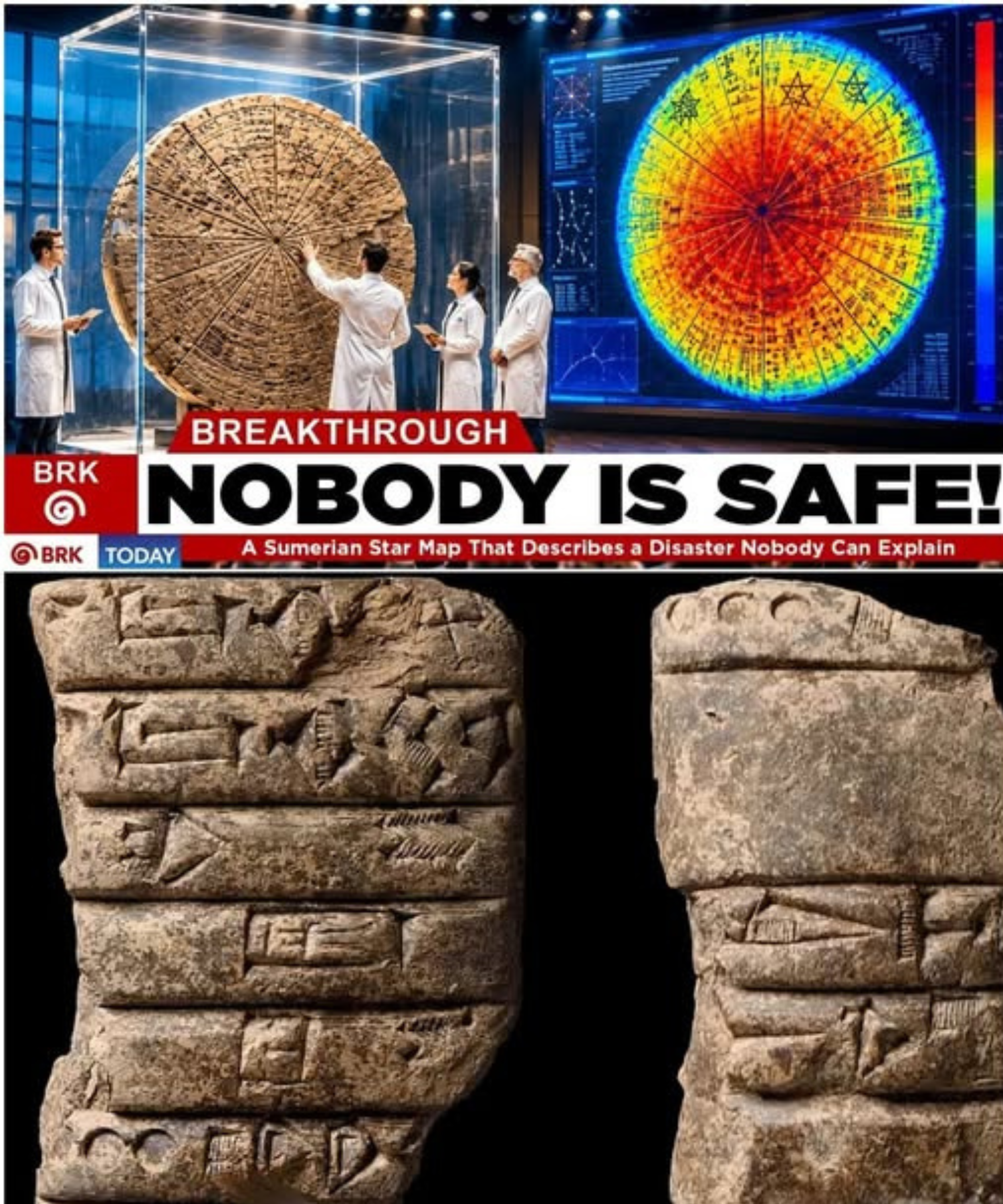
Cataloged simply as K8538, this 4,000-year-old Sumerian tablet—also known as the Planisphere—has quietly defied scholars for over a century.
But recent interpretations suggest it may hold something far more explosive than mere star charts: irrefutable evidence of a cataclysmic asteroid or comet impact that obliterated Earth’s first true empire, the mighty Akkadian realm, and plunged the ancient world into centuries of chaos.
Imagine the scene around 2193 BCE.
The Akkadian Empire, forged by the legendary conqueror Sargon the Great around 2334 BCE, stood as humanity’s first grand experiment in centralized imperial power.
Stretching from the Persian Gulf to the Mediterranean, encompassing what is now Iraq, Syria, and parts of Turkey and Iran, it unified diverse Sumerian city-states under a single ruler.
Akkad, its fabled capital—whose exact location remains lost to time—boasted advanced irrigation systems, bustling trade networks, sophisticated administration, and a military that projected power across vast distances.
Palaces gleamed, temples honored gods like Enlil and Inanna, and scribes meticulously recorded harvests, laws, and conquests on clay tablets.
This was the pinnacle of early civilization, a beacon of innovation and ambition in the cradle of humanity.
Then, without warning, the sky betrayed them.
According to controversial yet meticulously argued analyses by researchers Joachim Seifert and Frank Lemke, K8538 is no ordinary astronomical diagram.
It is a frame-by-frame eyewitness “cartoon” sequence—eight sequential pictographs—documenting the approach, flight, and devastating impact of a large comet or asteroid.
Copied over millennia from an original Sumerian record and preserved in King Ashurbanipal’s library at Nineveh, the tablet captures observations likely made from an astronomical tower roughly 100 kilometers from the strike zone.
The observer, perhaps a priest-astronomer attuned to celestial omens, meticulously noted angles, times, and visual phenomena with trigonometric precision that rivals modern calculations.
The drama unfolds in vivid stages.
In the first sections, a faint object emerges near the Pleiades, growing brighter night by night with a developing tail and coma.
Measurements indicate its relentless advance across the sky, tracked over days and nights.
By the later frames, the object swells dramatically, hurtling toward the horizon.
The climax: a brilliant flash lighting the sky at impact around midday on what corresponds to September 22, 2193 BCE, followed by towering plumes of ash and dust rising from the marshes of the Tigris-Euphrates delta.
No massive blast wave is described; instead, a choking tempest of superheated debris and sediment engulfs the land, burying cities in “Su-Bir”—sinking, scattered fly ash.
This was no distant event.
Proponents pinpoint the impact at Umm al-Binni, a crater-like feature in southern Iraq near the suspected site of Akkad itself.
A roughly 3.4-kilometer-wide crater formed as the bolide slammed into densely populated wetlands, vaporizing or incinerating everything nearby.
The capital Agade (Akkad) and major centers like parts of Lagash vanished under layers of debris.
Survivors in distant cities penned haunting “City Laments”—poetic tablets describing divine wrath, storms of fire and dust, collapsing temples, and fields turned to wasteland.
“The gods cursed Akkad,” one such text echoes, with Enlil unleashing a roaring storm that subjugated the once-mighty empire.
The human toll defies imagination.
Tens of thousands—perhaps hundreds of thousands—perished instantly or in the aftermath.
Irrigation canals, the lifeblood of Mesopotamian agriculture, silted up or evaporated under ensuing mega-droughts.
A generation-long silence falls in the archaeological record: no commercial tablets, no building inscriptions, no military dispatches between roughly 2193 and 2157 BCE.
Society didn’t just falter; it froze in shock, with scribes too devastated or scattered to document daily life.
When records resume under figures like Gudea of Lagash and the Ur III dynasty, the scale is diminished.
The Akkadian golden age never fully recovered.
This singular cosmic strike, researchers argue, triggered or amplified the infamous 4.2 kiloyear event—a global climatic downturn marked by abrupt cooling and aridification lasting centuries.
Proxy data from ice cores, lake sediments, and speleothems worldwide show a sharp temperature drop and prolonged droughts.
Civilizations crumbled in domino fashion: the Old Kingdom of Egypt faced famine and unrest, leading to its collapse; the Indus Valley saw urban decline; China’s Liangzhu culture disintegrated; even distant societies felt the ripple effects.
A single rock from space, perhaps a few hundred meters across, unleashed energy equivalent to thousands of Hiroshima bombs, reshaping human history.
Skeptics abound, of course.
Mainstream Assyriologists and the British Museum traditionally classify K8538 as a Neo-Assyrian planisphere—a schematic star map or astrological tool from around 650 BCE, depicting constellations for divinatory purposes.
Interpretations linking it to a specific impact, whether in Mesopotamia or the earlier Köfels event in Austria (proposed by Alan Bond and Mark Hempsell for 3123 BCE), remain fringe in academic circles.
Critics argue the tablet’s symbols align better with mythological sky lore than literal event logging, and geological confirmation of a massive impact crater at Umm al-Binni is debated or underexplored due to the region’s challenging terrain.
Yet the tablet’s precision—distances measured in “kush” (cubits), timed observations spanning days, sequential progression demanding the tablet be rotated like a storyboard—fuels fascination.
It reads less like abstract astrology and more like emergency documentation of an unfolding apocalypse.
If accurate, it represents the world’s earliest scientific record of a Near-Earth Object impact, predating modern astronomy by millennia.
The Sumerians, masters of observation without telescopes, charted its path from emergence near Triangulum (Mul-Apin, seat of the gods) through Orion, calculating flight times down to hours and minutes.
Picture the terror on the ground.
Farmers tending verdant fields look up to see a second sun blazing across the daylight sky.
Priests in ziggurats chant futile prayers as the object grows from a star-like point to a monstrous fireball trailing smoke.
The impact flash turns night to day momentarily, followed by earthquakes, roaring winds, and black blizzards of ash that choke rivers and poison soil.
Survivors huddle in darkness, recounting how the gods punished hubris or tested faith.
Echoes of this trauma may linger in later myths—biblical tales of Sodom and Gomorrah, floods, plagues, or divine fire from heaven—filtered through oral traditions across cultures.
The Akkadian Empire’s fall was not inevitable from internal rot alone.
Overextension, rebellions, and Gutian invasions played roles in historical accounts, but underlying environmental stress from the impact provided the knockout blow.
Sargon’s descendants, including Naram-Sin, had expanded aggressively, but no army could repel the heavens.
The empire that unified the known world dissolved into city-state fragments, its capital erased so thoroughly that later Babylonians searched in vain for its ruins.
Today, this narrative challenges our understanding of vulnerability.
Modern society, with nuclear arsenals and space programs, still faces asteroid threats.
NASA’s efforts to catalog and deflect Near-Earth Objects echo the Sumerian astronomer’s vigilance.
K8538 serves as a stark reminder: civilizations rise on ingenuity but can fall to indifferent cosmic forces in an instant.
Excavations and climate studies continue.
Satellite imagery hints at structures near Umm al-Binni possibly linked to Akkad.
If confirmed, the tablet transforms from enigmatic artifact to smoking gun of one of history’s greatest disasters.
Geologists seek shocked quartz, iridium layers, or tektites at the site; historians re-examine lament tablets for impact metaphors.
As we peer into the past through this humble clay disc, questions multiply.
What if the impact had missed?
Would the Akkadian legacy have endured, influencing later empires more profoundly?
How many other ancient collapses hide extraterrestrial causes?
The tablet doesn’t just record stars—it whispers of fragility, resilience, and the thin line between glory and oblivion.
In an era of climate anxiety and space exploration, K8538’s message resonates powerfully.
Humanity’s first empire learned the hardest lesson: the sky, source of life-giving sun and rain, can also deliver apocalypse.
We ignore its warnings at our peril.
The clay endures, the story unfolds, and the stars above remain both inspiration and threat.
Perhaps the next great discovery lies not in digging deeper into earth, but in scanning the heavens with the same urgency as that long-ago Sumerian watcher on his tower, who etched eternity into fragile clay as his world burned.