These CREEPY Encounters Captured in Woods will Leave You Shocked!
These CREEPY Encounters Captured in Woods will Leave You Shocked!
We live in an era that was supposed to have outgrown the dark. In our brightly illuminated, hyper-connected landscape, where satellites map every square foot of the globe and smartphones turn every citizen into a walking archivist, the ancient terrors of the wilderness should have withered away under the unyielding glare of public scrutiny. Yet, the opposite has occurred: our screens have become the new frontier for the unexplained, a digital campfire where raw, jarring, and deeply unsettling footage suggests that the ancient things lurking in the shadows have not left us—they have merely learned to adapt to the lens.
Part I: The Silhouettes in the Timber
For generations, the North American wilderness has been treated as a blank canvas for human anxiety. The deep forests of the Pacific Northwest, the rocky crags of California, and the dense hollows of the Appalachian chain are vast spaces where human civilization feels less like a permanent fixture and more like a temporary trespasser. It is within these deep woods that the oldest modern cryptid mythos—that of Sasquatch—continues to find its visual evidence, shifting from the grain of mid-century film to the stark, unforgiving resolution of the digital age.
Consider the legacy of the Marble Mountains in Northern California. In 2001, a youth group embarked on a routine wilderness camping expedition into one of the state’s most isolated backcountry regions. What was intended to be a lesson in self-reliance quickly devolved into a masterclass in primal panic. The group’s leader, a man named Jim Mills, began documenting an unusual architectural anomaly deep within a thicket of pine: a massive, crude structure constructed from heavily matted-down tree branches, woven together with a structural intent that defied the nesting habits of any known native wildlife.
As Mills moved his camera to capture the interior of the shelter, the atmosphere of the excursion fractured. In the distance, silhouetted against the bright mountain sky, a towering, dark, bipedal figure emerged from the ridge line, moving down the slope with an effortless, fluid stride that covered immense ground in seconds. The entity paused, its massive frame turning toward the youth group as if cataloging their presence, before vanishing into the heavy brush.
Location: Marble Mountains, California
Date of Capture: July 2001
Public Release: 2011 (Posthumous)
The footage remained locked in Mills’s private collection for a decade, withheld from the public until after his passing in 2011. This prolonged delay has lent the Marble Mountains footage a unique credibility among researchers; it lacked the immediate commercial opportunism that characterizes modern digital hoaxes. It stands as a quiet, chilling testament to an encounter that the witness preferred to carry to his grave rather than defend to a cynical public.
The phenomenon is not isolated to the West Coast. In 2012, near the small town of St. Elmo, Illinois, a resident captured a similarly baffling encounter on the edge of an open agricultural field. The video documents a massive, shadowy form gliding slowly through the tall grass. Unlike a human walking through a rough field, the entity’s upper torso remained perfectly level, moving with a smooth, almost mechanical trajectory that suggested an immense physical power hidden beneath its dark coat. The moment the figure seemed to realize the camera’s lens was fixed upon it, its behavior shifted; it dropped low, reversing its direction with an agility that left the videographer fleeing the perimeter.
Further east, the history of Pennsylvania’s wilderness contains its own distinct chapter in the annals of homnid folklore. Throughout the 1970s, residents of Blakeslee, Pennsylvania, reported encounters with an entity that deviated sharply from the standard descriptions of the dark-furred Sasquatch. Dubbed the “Pennsylvania White Bigfoot,” this creature was described as a towering, six-to-seven-foot beast covered in thick, matted, dirty-white fur.
In a rare piece of archival footage from the region, a nighttime search party’s camera briefly illuminates the interior of a dense thicket. For a fraction of a second, the light catches the face of an immense, pale-furred creature. Rather than the static mask of a cheap costume, the video documents the creature’s face twisting in a fast, instinctual reaction to the artificial light, its features shifting and contorting as it ducks beneath the branches to escape detection. The speed of the musculature movement has long stymied special effects analysts, who argue that the brief anatomical transformation points toward a living, breathing biological organism rather than a latex mask.
Even the convenience of modern infrastructure has not insulated travelers from these encounters. In 2023, passengers aboard a historic scenic train winding through the remote wilderness of Southwest Colorado found their vacation interrupted by the impossible. Looking out through the windows at the pristine mountain slopes, multiple tourists documented a large, heavily haired figure moving parallel to the tracks. As the train roared past, the creature executed a deliberate tactical maneuver, crouching down low to blend its massive frame directly into the scrub oak and gray earth of its environment. The collective gasps preserved on the smartphone audio tracks capture the precise moment when casual observers realize that the wild places of the American continent are still occupied by things that refuse to be categorized.
Part II: The Skeletons in the Shadows
While the wilderness offers a vast sanctuary for biological anomalies, a far more philosophically disturbing category of footage occurs when the entity in question lacks a clear biological framework. Across the globe, independent recordings have captured figures that resemble human anatomy stripped down to its barest structural components: moving skeletons and translucent silhouettes that seem to exist between states of material reality.
In 1957, the rural communities of Emerson County were plagued by a series of bizarre reports concerning what locals described as “translucent people”—shapes that walked through yards and pastures, casting no distinct shadows and appearing to be made of condensed fog or distorted light. The stories were filed away as regional eccentricity until August 1997, when a discarded video camera was discovered in a ditch just two miles from the original sighting cluster.
When local authorities processed the old tape inside the deck, the atmosphere in the precinct turned cold. The footage, shaky and poorly lit, documented a clearing under the evening sky where a distinctly translucent, human-like figure was moving through the brush. The entity possessed no discernible clothing or facial features; it was a shifting, semi-transparent column of energy that mimicked the gait of a man. The tape ends abruptly as the figure turns its featureless head toward the camera, causing a sudden burst of static and tracking distortion across the magnetic tape. To this day, the Emerson County tape remains an unsolved forensic anomaly, a piece of physical evidence that validates forty years of whispered local rumors.
Location: Emerson County
Historical Reports: 1957
Physical Evidence Recovered: August 1997 (VHS Magnetic Tape)
Similarly terrifying manifestations have been captured within the decaying architectures of the religious world. In Nicaragua, a night walker exploring the exterior of an abandoned, historical convent came face-to-face with a sight that defies classical biological categorization. Moving slowly through the courtyard shadows was a figure that appeared to be a human skeleton wrapped in a tattered, black burial shroud.
The witness’s flashlight illuminated long, coarse hair cascading down to the entity’s waist, but it was the motion of the entity that triggered an immediate, throat-catching panic. Its body moved with a broken, discordant geometry, its joints popping and angling in ways that suggested a skeletal system completely detached from normal human kinesis. The silent, rhythmic advance of the shrouded figure drove the witness to scream, dropping the camera as he fled into the safety of the public streets.
This archetype of the hyper-extended, skeletal entity is not confined to Latin America. In a quiet, unnamed residential village, a homeowner was awakened in the early morning hours by an intense, erratic scratching noise originating from his front yard. Climbing to his third-story terrace to survey the property under the stars, the resident pulled out his phone just as a pale, skeletal figure darted across the asphalt below.
The entity moved with a blur of impossible speed, its limbs transitioning so rapidly that the camera’s shutter struggled to resolve its form. It possessed a elongated, unsettling face that seemed to look straight through the upper terrace, moving with an erratic, insectoid pathing that left the watcher frozen in profound psychological shock.
Part III: The Skinwalkers and the Primal Hunt
In the folklore of the American Southwest, particularly within the traditions of the Navajo Nation, there is no entity spoken of with greater hesitation than the skinwalker—a malevolent witch capable of transforming into, or possessing, the bodies of animals and human facsimiles. For centuries, this tradition was kept strictly within tribal boundaries, but the proliferation of security grids and wilderness cameras has brought the phenomenon into the digital space.
Imagine a group of friends camping deep within a national forest, sitting around a lantern playing cards past midnight. The recording, intended to document a peaceful weekend, captures a sudden, unnatural stillness in the surrounding woods—the “quiet zone” phenomenon where insects and nocturnal predators simultaneously cease all vocalization. A soft rustling behind a nearby oak prompts the campers to swing their high-powered flashlights into the tree line.
“Hello?” one of the campers calls out, his voice shaking. “Is someone out there?”
The light beam settles on a pale, hairless, human-like figure standing entirely naked in the brush. The entity’s eyes are not animalistic; they are pitch-black voids that absorb the flashlight’s glare without reflecting an orb glow. It stands perfectly immobile, its long, thin limbs locked in an unnatural posture, staring at the camp with a chilling, vacant intensity. The video dissolves into chaotic, screaming movement as the friends abandon their gear, running for their vehicles as the entity begins to mirror their movements through the high canopy.
Entity Typology: Skinwalker / Mimic Manifestation
Primary Behavioral Marker: Kinetic Mirroring and Acoustic Suppression
Territorial Focus: Southwestern Swamps and Remote Forest Systems
This predatory kinesis was documented in another viral recording from a suburban property bordering a wilderness preserve. A home security system captured an entity crawling along the concrete perimeter of a backyard swimming pool. The creature’s limbs were disproportionately long, its spine bending upward in a horrific inversion of human anatomy. It approached the water’s edge, its head twisting 180 degrees to scan the dark windows of the home, before scaling the vertical brick wall of the residence with the effortless adhesion of an arachnid and vanishing into the roof shadows.
In the deep swamplands of Archer, Florida, a similar sense of unseen surveillance haunts the local residents. A homeowner, filming his dog in the backyard during a midnight bathroom run, noticed two distinct pairs of glowing eyes watching from the edge of the cypress swamp. What transformed the footage from a routine encounter with local wildlife into a subject of intense paranormal debate was the altitude of the light sources: the glowing eyes were positioned more than eight feet off the ground, far too high for a native panther or black bear.
The community had long reported rhythmic, deliberate knocks on the trunks of their homes and the sound of heavy bipedal footsteps pacing the marshlines. The footage preserves the terrifying stillness of the two entities as they observe the domestic pet, completely unbothered by the flashlights, existing as permanent, watchful sentinels on the border between suburban safety and the primeval swamp.
Part IV: The Bestiaries of the Deep and the Ruins
As we move further down the rabbit hole of captured anomalies, we encounter footage that challenges not just our understanding of spiritual manifestations, but our very definition of Earth’s zoological history. These are the cases where the camera captures entities that seem to have stepped directly out of ancient bestiaries or the pages of mythological texts.
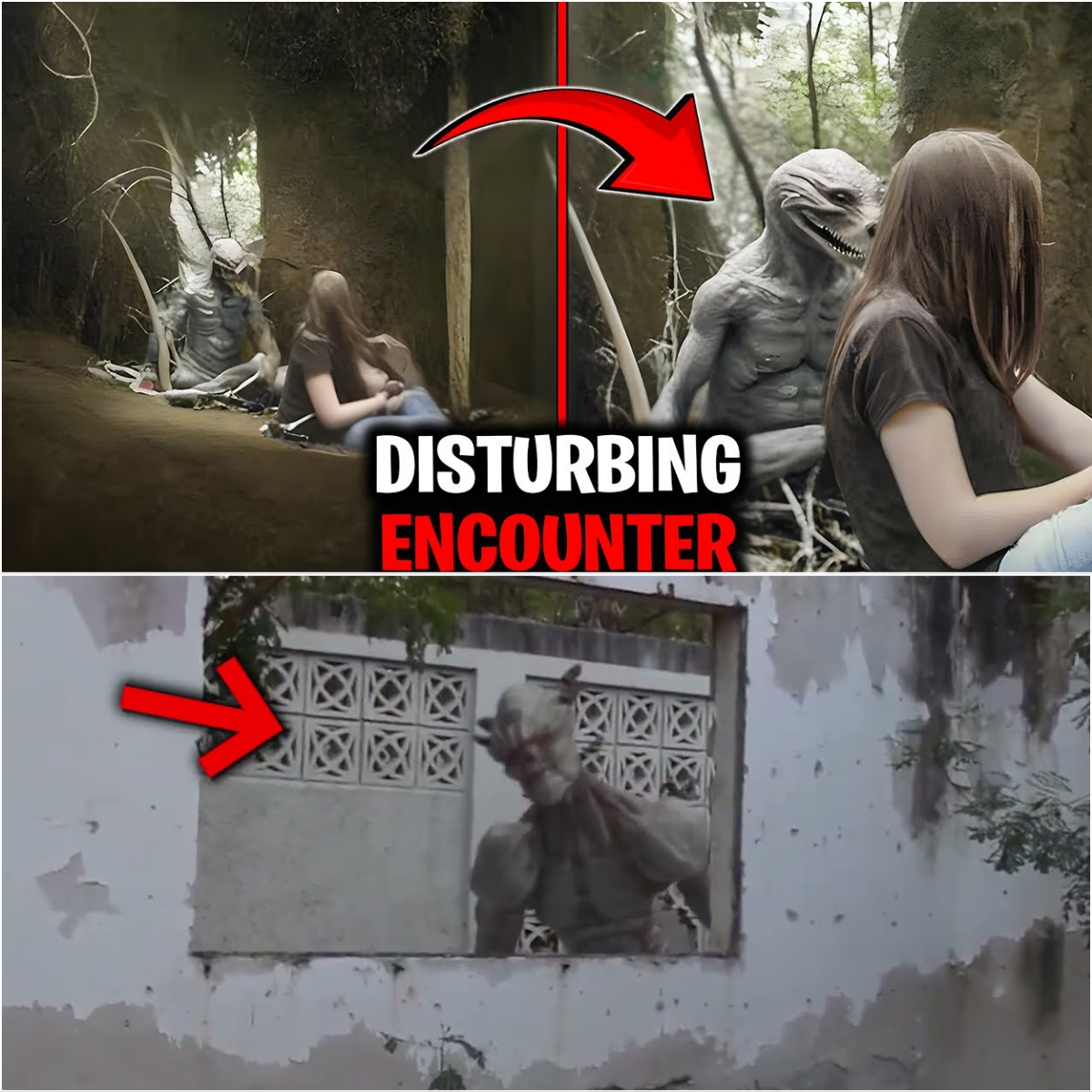
In the sun-bleached landscape near Managua, Nicaragua, a witness walking near an industrial road during broad daylight documented a pair of creatures that appeared to defy the laws of evolutionary biology. The video, though shaking with the witness’s adrenaline, clearly shows two entities possessing the heavy, feathered bodies of immense birds, yet their heads are entirely reptilian—featuring elongated jaws, brown scaly skin, sharp teeth, and heavy claws that gleamed under the midday sun. The creatures moved with a coordinated, aggressive curiosity, advancing toward the witness with a heavy, rhythmic stride that suggested an apex predator hunting on open ground. The recording cuts short as the man turns to run, his breath hitching in a state of absolute existential confusion.
A similarly mythological terror was captured rising from the dark waters of an isolated northern lake. The still, glass-like surface of the water begins to churn violently without any wind provocation, before a massive, dark form breaks the surface. The creature, captured from a distance by an amateur fisherman, possessed a thick mane of long, black hair, an array of sharp teeth, and two immense, curved tusks protruding from its lower jaw. The entity appeared to be in a state of intense, localized rage, thrashing against the water as if disturbed by an unseen grievance buried deep within the lakebed, before sinking back into the black depths, leaving only a massive wake behind.
Location: Isolated North American Lake System
Anatomical Markers: Cranial Tusks / Long Black Mane / Dense Skeletal Mass
Inferred Behavior: Subterranean Hibernation / Localized Territorial Rage
In the modern urban landscape, the deployment of consumer drone technology has opened up spaces that were previously inaccessible to human eyes—specifically the upper floors of abandoned, structurally compromised industrial buildings. A popular digital creator, flying a drone through the broken window of a long-deserted factory, captured an image that altered the intent of his broadcast.
As the drone hovered in the rafters of a daylight-lit warehouse floor, the camera tilted down toward a shadowed doorway. Sitting in the dust was a large, dark creature, partially hidden by the architecture, actively consuming something on the floor. The entity’s silhouette was completely non-human, featuring elongated, multi-jointed limbs and a predatory posture that suggested a beast comfortable in absolute isolation. The live feed preserves the raw, unedited panic of the drone operators, who can be heard whispering in disbelief as the creature briefly raises its head, its eyes reflecting the drone’s optical sensors before the aircraft is pulled violently from the air.
Part V: The Changelings and the Goblins
The smallest entities often carry the deepest psychological weight. Throughout European and early American folklore, stories of pucks, goblins, and duendes—small, trickster spirits that inhabit caves and the foundations of old homes—were used to explain the mysterious disappearance of items or sudden, unprovoked animal panics. In the digital age, these small entities have begun making their own uninvited appearances on film.
In a dense, ancient forest in rural England, a team of professional investigators spent days deploying specialized low-light cameras in an area long associated with regional fae folklore. After a prolonged period of silence, their patience was rewarded with a sequence of footage that has become a cornerstone of modern cryptid analysis. The lenses captured a group of tiny, distinct figures moving between the roots of an old oak tree. These entities, measuring no more than eighteen inches in height, did not conform to the shapes of small woodland mammals; they possessed a complex, bipedal anatomy, moving through the shadows with a deliberate, stealthy coordination that suggested a small, intelligent community living completely parallel to the human world.
Folklore Classification: Duendes / Earth Spirits
Documented Height: 1.5 – 2 feet
Primary Habitat: Subterranean Root Systems / Cave Entrances
A more aggressive encounter with this diminutive genus occurred on a quiet rural road at exactly 3:00 a.m. A night-shift security worker, patrolling an isolated stretch of tarmac near an industrial site, noticed a small shape standing motionless under the perimeter lights. Approaching slowly with his vehicle, the worker pulled out his phone to record what he assumed was a stray animal.
The entity standing in the road was roughly a foot and a half tall, resembling a standing mouse or small primate, but possessing massive, hyper-expressive eyes that reflected the vehicle’s headlights with an intense, amber glow. It remained completely motionless, anchoring its gaze directly onto the driver with a chilling level of intellectual awareness. The air inside the cabin felt instantly heavy, a silent confrontation between the modern worker and a creature that seemed to belong to the pre-industrial foundations of the land.
This sense of ancient, hidden communities is echoed in the deep jungle systems of South America, where a group of wilderness hikers stumbled upon a hidden cave network far from any local villages. Entering with their helmet cameras active, the group expected to find interesting geological formations; instead, they discovered a population of strange women living within the dark recesses. These individuals possessed deep, dark skin, wild, unkempt hair that reached their shoulders, and eyes that blazed with an intense, defensive rage. Dressed entirely in garments woven from raw leaves and forest fibers, they stood frozen in front of the cameras, their expressions ancient and unyielding, as if they had inhabited the subterranean dark for centuries, entirely untouched by the passing of human epochs.
The Persistent Shadow on the Lens
What are we to make of this modern catalog of terrors—this convergence of Bigfoot sightings in the Illinois fields, skinwalkers by California pools, and dragon-faced entities in the daylight of Nicaragua?
The materialist skeptic will always find a path to comfort. They will point toward the rolling shutter defects of cheap digital sensors, the sophisticated compositing capabilities of modern video editing suites, or the ancient human capacity for elaborate hoaxes. And in many cases, they will be entirely correct; the digital ecosystem is rife with fabrications designed to harvest clicks and monetize human curiosity.
Yet, when you strip away the easily debunked performances, a stubborn core of evidence remains. The true power of these videos lies not in their clarity, but in their consistency. Why do independent witnesses, separated by decades, languages, and geographic borders, continue to capture the exact same kinetic patterns, the same red-glowing horned profiles, the same skeletal distortions, and the same terrifying, intelligent stillness?
The proliferation of cameras has not driven the monsters from our world; it has simply changed the terms of our relationship with them. We no longer look out into the dark forest and wonder if something is there. We check our security feeds, we zoom in on the pixels of our trail cams, and we find ourselves staring face-to-face with an ancient, ancient reality that has been watching us from the shadows since the very beginning of time.