(THEY TELL PEOPLE NEVER TO CAMP HERE!) A DANGEROUS 24 HOURS CAMPING In HAUNTED APPALACHIANS
THEY TELL PEOPLE NEVER TO CAMP HERE! A Dangerous 24 Hours Camping In The Haunted Appalachians
They warned us not to stay after dark. We laughed, hiked past the last safe marker, set up camp anyway—and by 3 a.m., we understood why locals never sleep in that hollow.
The Appalachians are beautiful in daylight. That is the first thing people always say, and it is true. The mountains roll like dark green waves across the eastern United States, older than memory, older than most of the bones buried beneath them. In the morning, mist hangs between the ridges like breath. In the afternoon, sunlight filters through the trees and turns every creek into a ribbon of silver. But by night, those same mountains become something else entirely.
They do not feel empty.
They feel occupied.
That was the feeling we ignored when we drove into a remote stretch of Appalachian backcountry for what was supposed to be a 24-hour camping challenge. The plan was simple: hike into a hollow locals had been warning people about for decades, spend one full night there, record the experience, and leave the next morning with a scary but harmless story.
We had heard the rumors before we arrived. Every haunted place has rumors. People said the hollow was cursed. They said campers heard voices from the ridge after midnight. They said fires went out for no reason, tents were touched by unseen hands, and dogs refused to cross the creek leading into the valley. Some claimed old mining accidents had left the area restless. Others spoke of something much older than ghosts—something that moved through the trees pretending to be human.
The locals did not agree on what haunted the place.
They agreed on one thing only: never camp there.
We stopped at a small gas station about twelve miles from the trailhead to buy water, batteries, and firewood. The woman behind the counter noticed our packs and asked where we were headed. When my friend Mason told her the name of the hollow, her expression changed so quickly that the whole trip should have ended right there.
“You boys filming one of those videos?” she asked.
Mason smiled. “Just a night in the woods. Nothing crazy.”
She looked at the firewood in his arms. “That place doesn’t like fire.”
We laughed awkwardly because none of us knew what to do with that sentence.
Then she leaned forward and said, “If you hear someone calling from uphill, don’t answer. If you hear someone calling from downhill, leave. And if you hear your own voice, run.”
That warning stayed with us longer than we admitted.
There were three of us: Mason, who filmed everything; Tyler, who treated fear like entertainment; and me, the one who kept pretending I was calm because the camera was on. We had camped before. We knew how to handle rain, cold, darkness, and animals. We carried bear spray, a first-aid kit, paper maps, headlamps, extra food, and a satellite messenger. We were not reckless beginners.
But we were arrogant in the way people get when they mistake preparation for control.
The trail started easy. A narrow dirt path wound through rhododendron, hemlock, and old hardwood trees. Leaves covered the ground in thick brown layers. The air smelled damp and metallic, like wet stone and decaying wood. Every few hundred feet, Mason stopped to film the landscape while Tyler joked about ghost miners and Appalachian demons.
For the first hour, nothing happened.
Then we crossed the creek.
It was shallow, only ankle-deep, running over flat stones darkened by moss. On the far side, someone had tied three strips of red cloth to a branch. They were faded from weather but still bright enough to look deliberate. Mason filmed them up close.
“Trail marker?” he asked.
Tyler touched one. “Or local decoration.”
I did not like the cloth. I did not like that there were three strips, evenly spaced, tied at eye level. It felt less like a marker and more like a warning someone had made when a sign would not be enough.
Past the creek, the forest changed.
The trees grew closer together. The trail narrowed. The wind seemed to stop reaching the ground. We had entered the hollow just after 4 p.m., but the light faded as if evening had arrived early. The ridge rose steeply on both sides, trapping the air. Somewhere above us, a crow called once and then went silent.
“That’s weird,” Mason said.
“What?” Tyler asked.
“No birds.”
He was right. The forest had gone quiet in a way that felt unnatural. No birdsong. No insects. No squirrels moving through leaves. Only our footsteps and the occasional creak of trees shifting against each other high above.
We found the campsite near a flat clearing beside a ring of blackened stones. It was obvious other people had camped there before, though not recently. The fire ring was full of old ash, but the ground around it was strangely clean, almost swept. A fallen log lay at the edge of the clearing like a boundary. Beyond it, the trees thickened into a wall of shadow.
Tyler dropped his pack. “Perfect.”
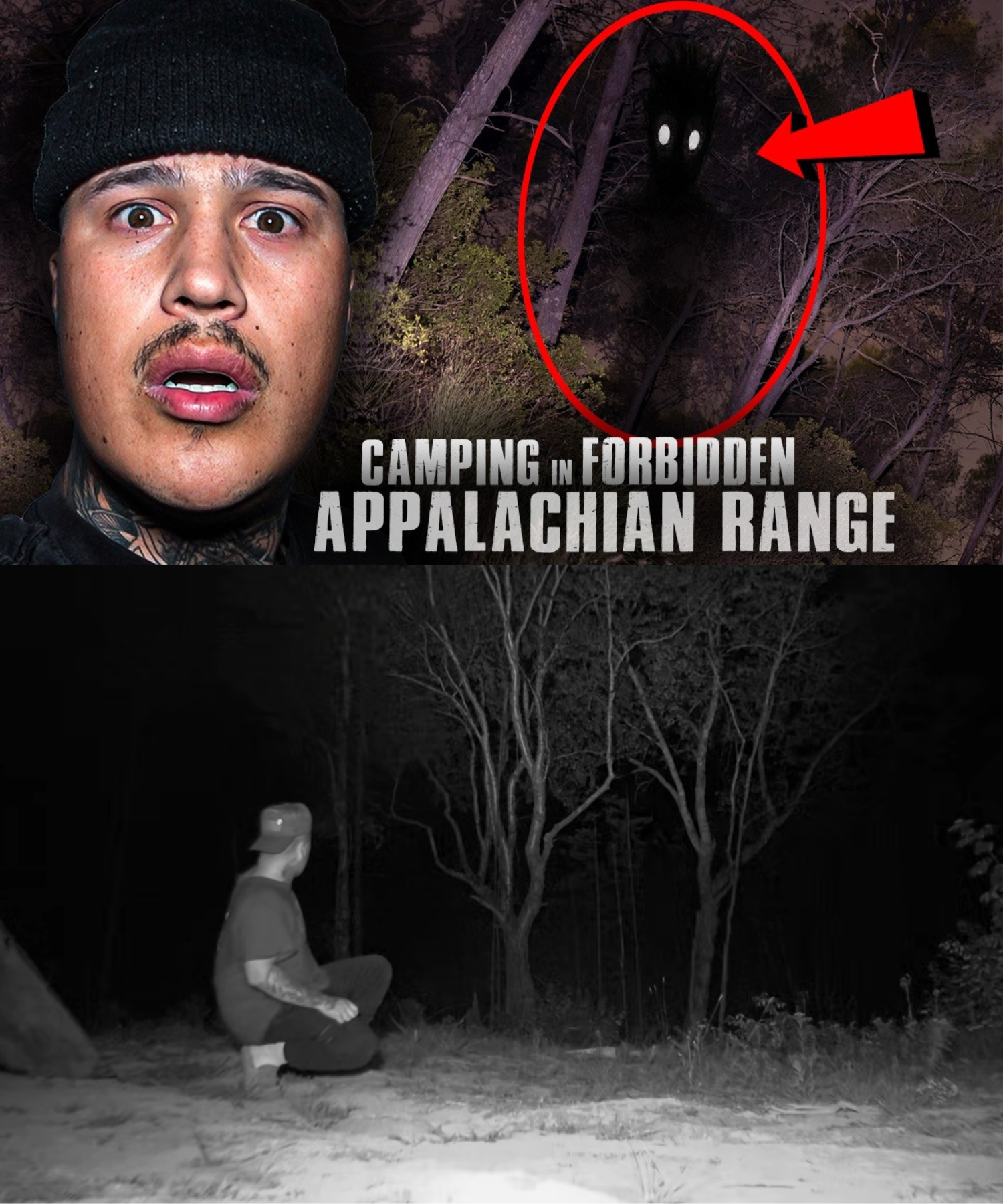
I wanted to suggest moving somewhere else, but pride stopped me. Nobody wants to be the first one to admit a place feels wrong.
We set up the tents, hung our food, placed two trail cameras facing opposite sides of camp, and put an audio recorder near the fallen log. Mason filmed an introduction while Tyler built a fire. The wood smoked heavily at first, then caught, and for a while the mood improved. Fire has a way of making humans believe they own the dark.
By 8 p.m., we were eating beside the flames, laughing more loudly than necessary. The hollow was cold now. The ridge above us had become a black shape against a darker sky. Every sound from camp seemed trapped beneath the trees.
At 9:13 p.m., we heard the first whistle.
It came from uphill.
One clear note.
Human.
Tyler stopped mid-sentence. Mason turned the camera toward the ridge.
The whistle came again, farther left this time.
“Hello?” Tyler called.
I immediately remembered the gas station woman: If you hear someone calling from uphill, don’t answer.
Nothing replied.
Tyler laughed, but it sounded forced. “Probably another camper.”
“There were no cars at the trailhead,” I said.
“Could be locals messing around.”
Maybe. That was the easiest explanation. The safest one. But if it was locals, they were standing somewhere on a steep wooded slope in complete darkness, whistling at strangers beside a fire.
That did not make me feel better.
At 10 p.m., the fire began dying strangely. Not burning down. Dying. The flames sank low all at once, though there was plenty of wood left. Tyler poked the logs apart. Mason added more kindling. The flames rose again, then leaned sharply toward the fallen log as if pulled by a wind none of us could feel.
Then something knocked from the trees.
Three hard strikes.
Knock.
Knock.
Knock.
The sound came from beyond the fallen log, maybe thirty yards away.
Mason whispered, “That was a branch.”
No one answered because we all knew it was not.
Tyler grabbed a flashlight and swept the beam across the tree line. The light caught trunks, leaves, fog, and nothing else. But the audio recorder near the log blinked steadily, capturing everything.
We stayed awake longer than planned. The fire kept shrinking no matter how much wood we added. Around midnight, Mason checked one of the trail cameras and said it had stopped recording. The batteries were dead. They had been fresh two hours earlier.
The second camera was still working, but the screen showed static before returning to normal.
At 12:41 a.m., we heard voices.
Not loud. Not close. Low murmuring from downhill, near the creek.
Two people, maybe three.
We could not understand the words, only the rhythm of conversation. Tyler stood, gripping the flashlight. “Okay, that’s definitely people.”
He shouted, “Hey! Camp up here!”
The voices stopped immediately.
That was when fear entered the camp properly. Not nervousness. Not excitement. Fear.
A normal person answers. A hiker says sorry. A local laughs. A ranger identifies himself. Even someone trying to scare you makes some kind of noise. But the voices cut off the second Tyler called, as if whoever was down there had been caught doing something they were not supposed to do.
Then a voice from the ridge answered.
“Come down.”
It sounded like Tyler.
Mason turned toward him slowly.
Tyler’s mouth was open, but he had not spoken.
The voice came again from uphill, clearer this time.
“Come down.”
Same tone. Same accent. Same casual confidence Tyler used when he was trying to convince us of a bad idea.
Tyler backed away from the fire.
“Nope,” he said. “No. I don’t like that.”
The fire went out.
Not gradually. It collapsed into smoke and orange ash as if someone had pressed a lid over it. Darkness rushed in so quickly that all three of us reached for our headlamps at once.
From beyond the fallen log came the sound of breathing.
Heavy.
Slow.
Close.
Mason lifted the camera with shaking hands. I turned on my headlamp and aimed it toward the log. The beam hit the bark, the ash ring, the empty ground, and then two pale shapes between the trees.
Eyes.
They were too high.
For one second, none of us moved.
Then the eyes vanished.
The next few minutes are difficult to describe because fear ruins memory. I remember Tyler saying we should leave. I remember Mason saying we needed the cameras. I remember myself stuffing gear into a pack with no order at all. The tents were still up. The food bag was still hanging. The firewood lay scattered around the dead ring.
Then something screamed from downhill.
It was human-like, but not human enough. A long, ripping cry that began as a woman’s scream and ended in something deep and animal. It echoed off the ridge, bounced through the hollow, and seemed to come from every direction at once.
Mason dropped the camera.
Tyler shouted, “Pack later. Move now.”
We abandoned one tent, the cooking pot, and half the gear.
The plan was to follow the trail back to the creek, cross it, and get out. But the hollow had changed in the dark. Our headlamps made the trail look different, flatter in some places, split in others, covered by leaves where we remembered bare dirt. We moved fast, trying not to run. The scream came again, now from uphill.
Then the voices started.
First downhill: murmuring near the creek.
Then uphill: Tyler’s voice, calling, “This way.”
Then behind us: Mason’s voice, whispering, “Wait.”
Mason was right beside me.
He heard it too. I saw his face twist in terror.
“Don’t answer,” I said.
None of us did.
We reached the creek at 2:27 a.m. The red cloth strips were still tied to the branch, moving though there was no wind. On the far bank stood a figure.
It looked like a man in dark clothing, head lowered, arms hanging strangely at his sides. It stood exactly where we needed to cross.
Tyler raised the bear spray. “Move!”
The figure did not move.
Mason whispered, “Look at its legs.”
I did.
The headlamp beam shook too badly for detail, but something was wrong with the proportions. The legs looked too long, the knees bending at a strange angle. It was human enough to be worse than an animal.
Then it spoke in my voice.
“You forgot the camera.”
That broke us completely.
We ran downstream through the creek, splashing over rocks, nearly falling twice. Branches tore at our jackets. Cold water filled my boots. Behind us, something crashed through the brush with terrifying speed, not following directly but moving parallel, keeping pace.
We climbed the opposite bank and found the trail only by luck. Once we were beyond the creek, the sounds stopped. No screams. No voices. No crashing. The forest behind us became silent again.
We did not slow down until we saw the truck.
The time was 3:18 a.m.
We drove to the same gas station and sat in the parking lot until sunrise. None of us wanted to go inside at first. We were muddy, soaked, shaking, and missing half our gear. When the store opened, the same woman from the day before looked at us through the window before unlocking the door.
She did not ask what happened.
She only said, “It called back, didn’t it?”
That sentence hit harder than any scream in the woods.
Mason eventually went back with two local men in daylight to retrieve what we had left. I refused to go. Tyler refused too, though he tried to make it sound like he was just tired. The men found the campsite, but it did not look the way we left it.
The abandoned tent had been folded.
Not collapsed. Folded.
The cooking pot sat upside down in the middle of the dead fire ring. The food bag was still hanging, untouched. The audio recorder near the fallen log was gone. One trail camera had been smashed against a rock. The other was still strapped to a tree, but the memory card had been removed.
Only Mason’s dropped camera remained, lying near the creek.
Its battery was dead, but the footage survived.
Most of the video was useless: darkness, shaking light, our voices, the dead fire, our panic. But there was one clip none of us could explain. It was recorded after Mason dropped the camera. The lens pointed sideways at the creek bank. For almost two minutes, nothing happened.
Then the dark figure stepped into frame.
It crouched beside the camera, close enough that only part of its body was visible. Long fingers reached toward the lens. Before the screen went black, the camera captured a sound so low we had to boost the audio to hear it.
It was my voice again.
But I had not been there.
The voice whispered, “Next time, stay.”
There will not be a next time.
People can believe whatever they want. Maybe locals staged the entire thing. Maybe the figure was a person in the dark. Maybe the voices were echoes. Maybe the screams were foxes or coyotes. Maybe fear turned a bad night into a legend.
I wish I believed that.
But I know what it feels like to hear your own voice come from a mountain ridge while your mouth is closed. I know what it feels like when a fire dies under a clear sky. I know what it feels like when the woods become so quiet that even your breathing seems too loud. And I know what I saw standing across that creek.
The Appalachians are filled with stories because the mountains are old enough to keep them. Some are warnings. Some are memories. Some are explanations for things people survived but never understood.
Ours is simple.
When locals tell you never to camp somewhere, do not treat it like entertainment. Do not assume every warning is superstition. Do not walk past red cloth tied to a branch and call it decoration. Do not answer voices from the ridge. Do not trust a scream just because it sounds human.
And if something in the woods speaks with your voice, leave before it learns anything else.