The real spirit of a boy appeared, wandering through the cemetery, frightened!
The Real Spirit of a Boy Appeared, Wandering Through the Cemetery, Frightened!
The cemetery was supposed to be empty after midnight. But when the security camera turned toward the old children’s section, it caught a small boy walking between the graves—alone, crying, and looking over his shoulder as if something was following him.
At first, the night guard thought it was a living child.
That was the only explanation his mind would accept. A lost boy, maybe six or seven years old, somehow trapped inside the cemetery after the gates had been locked. Children sometimes wandered from nearby houses. Teenagers occasionally climbed the wall on dares. Grieving families sometimes stayed too late and had to be escorted out gently. Cemeteries are strange places after dark, but they are still places of the living before they are places of the dead.
So when Martin Ellis saw the figure on Camera 4 at 12:38 a.m., he reached for the radio immediately.
“Possible child inside the grounds,” he said, sitting up in the small security office near the main gate. “Old east section. I’m going to check.”
The image on the screen was grainy, washed in the gray-green glow of infrared. The boy stood beside a tilted marble angel, his small hands pressed against his chest, his head turning left and right in sharp, frightened movements. He wore what looked like an old-fashioned shirt, pale and loose at the sleeves, with dark trousers ending above the ankles. His hair was cut short, uneven around the ears. He was barefoot.
That detail bothered Martin.
The ground was cold. A thin mist lay over the cemetery grass. It had rained earlier that evening, and puddles shone between the rows. No child would walk barefoot through that place without crying from pain or cold.
But the boy was crying.
Even through the camera feed, Martin could see it. The small shoulders shook. The mouth opened as if calling for someone. The sound did not carry through the system because Camera 4 had no microphone, but the body language was unmistakable. This was not a prank. This was not a teenager in costume. The boy looked terrified.
Martin grabbed his flashlight and keys and stepped outside.
St. Bartholomew Cemetery covered nearly twenty acres on the edge of a fading mill town in Pennsylvania. The oldest graves dated back to the early 1800s, though the cemetery was still used for modern burials on the western side. The east section was different. Older. Quieter. Many of the stones there were weathered beyond reading. Iron fences leaned around family plots. Moss climbed over names. In the children’s section, small lambs, angels, and broken cherubs marked graves so old that even the families had long since stopped visiting.
People always said the east section felt wrong.
Not evil. Not dangerous in the obvious sense. Just heavy. Too still. As if the air there had absorbed more grief than it could release.
Martin did not believe in ghosts. He had worked nights for twelve years, first in factories, then warehouses, then the cemetery. He had seen fog make human shapes, deer move like shadows, plastic flowers roll across paths like hands reaching from graves. He knew how the mind invented stories when the world was dark. He respected the dead, but he did not fear them.
That night, fear found him anyway.
He reached the east section five minutes after leaving the office. The beam of his flashlight swept over headstones, wet grass, and the marble angel from the camera. The boy was gone.
Martin called out carefully.
“Hello? It’s okay. I’m here to help.”
No answer.
He walked deeper between the stones. The mist moved around his legs. Somewhere beyond the fence, a dog barked twice and then went silent. Martin raised the radio to report that he had reached the location, but static cracked through the speaker. That was not unusual in the older section, where the low hill sometimes interfered with signal, but the timing made his throat tighten.
Then he heard it.
A child crying.
Not loud. Not theatrical. A soft, broken sob coming from the direction of the old mausoleums.
Martin turned slowly.
The sound stopped.
He swallowed and moved toward it.
There were three mausoleums at the far edge of the east section, built for wealthy families during the town’s industrial boom. Two were sealed and overgrown. The third, belonging to the Whitcomb family, had been vandalized years before and repaired with a steel security gate. Martin had checked it earlier that week. Nothing unusual. No gaps. No signs of forced entry.
Now, standing beside it, was the boy.
Martin froze.
The child stood with his back to the mausoleum gate, both hands gripping the bars behind him. He looked exactly like he had on the camera: pale shirt, dark trousers, bare feet, damp hair clinging to his forehead. But in person, something was terribly wrong. The flashlight passed over him, but the light did not strike him the way it should have. It seemed to soften around his edges. He was there, clearly there, and yet the stone behind him was faintly visible through his shoulder.
Martin’s breath caught.
The boy looked up.
His eyes were wide with panic.
“Don’t let him take me,” he whispered.
Martin could not move.
The voice was small and thin, but it entered the air with impossible clarity. Not a voice from memory. Not a sound carried by wind. A child’s voice, right there, asking for help.
“Who?” Martin managed.
The boy looked past him toward the rows of graves.
“The man with no face.”
Martin turned instinctively, flashlight slicing across the cemetery.
Nothing.
Only stones.
When he looked back, the boy was gone.
The security office footage later showed Martin running back across the grounds faster than he had moved in years. He locked himself inside, checked Camera 4, then Camera 5, then Camera 6. For several minutes, nothing appeared. He told himself he had imagined the whole thing. Stress. Lack of sleep. Fog. Reflected light. A memory pulled from too many ghost stories told by old caretakers.
Then Camera 6 flickered.
The boy appeared near the chapel steps.
He was running now.
Not walking.
Running.
His arms pumped at his sides. His mouth was open in a silent cry. He looked behind him once, stumbled, recovered, and kept moving toward the chapel door. The camera glitched for half a second, and when the picture cleared, the boy was pressed against the locked chapel entrance, pounding on it with both fists.
Martin heard nothing from outside.
But on the monitor, the child was screaming.
Then something entered the frame behind him.
Not fully.
Only a shadow.
Tall, narrow, darker than the darkness around it. It stretched from the path between the graves, moving slowly toward the chapel steps. It did not walk like a person. It seemed to lengthen as it approached, the head smooth and featureless, the arms hanging too low.
The boy turned, saw it, and flattened himself against the door.
Martin’s hands shook so hard he nearly dropped the phone while calling the police.
By the time officers arrived, the cemetery was quiet.
Martin showed them the footage immediately. The first officer, a young man named Colin Price, watched with a skeptical expression that changed the moment the boy appeared near the mausoleum. The second officer, Sergeant Dana Holt, asked to see the video three times. She did not call it a ghost. She did not call it a hoax either. She asked whether any child had been reported missing in the area.
None had.
The officers searched the cemetery with Martin and two additional units. They checked the mausoleums, chapel, storage sheds, maintenance garage, and tree line. No child. No footprints. No signs of trespass. The east section grass remained wet and soft, but the only tracks near the chapel belonged to Martin and the responding officers.
That was when Sergeant Holt noticed something carved into the lower corner of the chapel door.
The letters were old, shallow, and partly filled with paint from later repairs.
E.W.
A date beneath them: 1894.
Martin had worked there for years and had never noticed the marks.
The next morning, the cemetery director searched burial records. The initials led to a grave in the east children’s section: Elias Whitcomb, died October 17, 1894, age seven.
The Whitcomb mausoleum belonged to his family.
Elias had been buried nearby, not inside the mausoleum, because he died before the family tomb was completed. The records gave no detailed cause of death, only the word “accident.” But old newspaper archives told a darker story.
In the autumn of 1894, Elias Whitcomb disappeared during a funeral service for his grandfather. He had reportedly wandered away from the mourners near dusk. Searchers found him hours later inside the half-built family mausoleum, unconscious and freezing, with bruises on his arms and dirt under his fingernails. He died two days later.
The official explanation was that the boy had become trapped after workers left materials blocking the entrance.
But one newspaper printed a line from a grieving aunt that chilled everyone who read it: “The child kept saying a man was in there with him, though no man was found.”
After Elias died, the Whitcomb family left town within a year. The mausoleum was completed but rarely visited. Rumors grew around it for decades. Children claimed they heard crying near the gate. Groundskeepers found small muddy handprints on the chapel door. One caretaker in the 1930s reportedly quit after seeing “a pale boy running among the stones.” None of those stories had ever been proven. Most were dismissed as cemetery folklore.
Until the camera caught him.
The footage spread after someone inside the police department leaked a short clip to a local paranormal forum. Within days, it was everywhere. Some viewers believed it was one of the clearest ghost videos ever recorded. Others immediately called it fake. They pointed to the camera glitches, the dramatic timing, the old records conveniently matching the figure, and the shadow that looked almost too perfect for a horror story.
Skeptics offered several explanations.
A child actor could have been filmed in the cemetery before the footage was staged. A digital figure could have been inserted. The old record of Elias Whitcomb could have inspired the hoax. Martin could have been involved, or fooled by someone else. The “man with no face” shadow could have been a compression artifact, a person in dark clothing, or a trick of moving fog.
Those explanations were possible.
But they did not explain Martin’s reaction before he knew anything about Elias. They did not explain why the boy appeared on multiple cameras from different angles. They did not explain the lack of footprints in wet grass. They did not explain why the original security file, reviewed by two officers before the leak, reportedly showed no obvious signs of tampering.
Most of all, they did not explain what happened three nights later.
After the story went viral, Sergeant Holt returned to the cemetery privately. She later admitted she should not have gone alone, but the case had disturbed her. She was not there as a ghost hunter. She wanted a practical explanation. She wanted to see where the cameras were positioned, where shadows might fall, how the mist moved near the chapel, whether headlights from the road could cast figures through the trees.
At 12:38 a.m., the same time Martin first saw the boy, her body camera recorded audio near the Whitcomb mausoleum.
A child’s voice said, “I can’t find my mother.”
Holt did not hear it at the time.
The audio was discovered later.
What she did hear was knocking from inside the mausoleum.
Three knocks.
A pause.
Three more.
She called for backup immediately and stood twenty feet from the gate with one hand on her flashlight and the other near her weapon. The gate was locked. The interior was dark. No one should have been inside.
When backup arrived, they opened the mausoleum.
Nothing living was there.
But on the dusty stone floor, beside the rear wall, someone had drawn a small shape with one finger.
A child’s hand.
The cemetery director ordered the east section closed for “restoration assessment,” but everyone knew the real reason. Too many people were trying to sneak in at night. Some brought cameras. Some brought candles. Some shouted Elias’s name between graves, hoping to provoke an appearance. One group livestreamed themselves near the chapel and left screaming after one member claimed a cold hand grabbed his sleeve.
That circus angered Martin more than anything.
“He’s scared,” he told a reporter. “Whatever that boy is, whatever people think they saw, he looked scared. This isn’t entertainment.”
That changed the tone of the story.
For the first time, people stopped talking only about proof and began talking about compassion. If the footage showed a hoax, then someone had exploited the image of a dead child for attention. If the footage showed something real, then a frightened spirit was being hunted by strangers with cameras. Either way, the spectacle felt wrong.
A local pastor, Father Michael Brennan, asked permission to hold a small prayer service near Elias’s grave. The cemetery agreed, as long as it remained private. Only Martin, Sergeant Holt, the cemetery director, and two descendants of the Whitcomb family attended.
They cleaned the grave first.
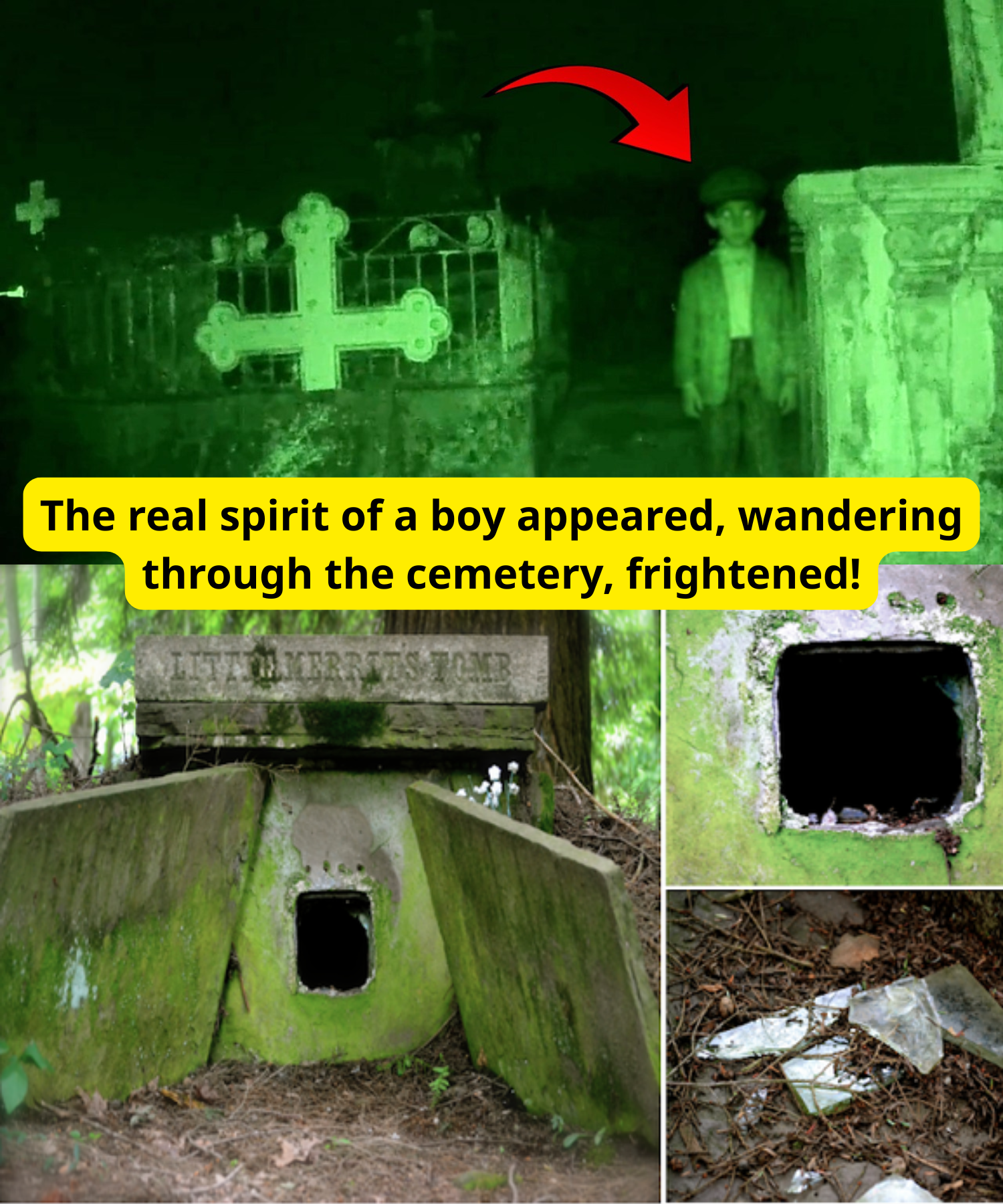
The stone was small and partly sunken. The inscription was barely readable beneath moss and weathering:
Elias Whitcomb
Beloved Son
1887–1894
Someone placed a white candle beside it. One of the descendants, a woman in her seventies, brought a small tin soldier that had belonged to a child in the family. She said she did not know whether Elias’s spirit was truly there, but if any part of the story was real, she wanted him to know he had not been forgotten.
Father Brennan prayed for peace, for the dead, for the living, and for any wounded memory still trapped in fear.
The air grew very cold.
Martin later said he heard the crying again, but softer this time. Not panic. Grief.
Then Camera 4, still active near the children’s section, recorded its final strange clip.
At 1:12 a.m., the boy appeared beside his own grave.
He was no longer running.
He stood quietly near the candle, looking down at the stone. For several seconds, he did not move. Then he turned toward the path leading out of the east section. A woman-shaped light appeared at the edge of the frame—soft, indistinct, almost impossible to see unless the footage was slowed. The boy took one step toward it.
Then another.
Before leaving the frame, he looked back once.
Not at the camera.
At the grave.
Then he was gone.
No shadow followed him.
Since that night, there have been no confirmed sightings of the boy. The east section remains open during daylight but locked more carefully after dusk. The Whitcomb mausoleum was repaired and sealed. Elias’s grave was restored with help from local volunteers. The viral footage still circulates, though many versions are heavily edited, brightened, dramatized, and set to frightening music that misses the sorrow at the heart of the story.
Skeptics still call it a hoax.
They may be right.
Believers call it evidence of a trapped child spirit finally finding peace.
They may be right too.
But the people who were there speak of it differently. They do not talk first about proof, ghosts, or fame. They talk about the look on the boy’s face. The fear. The confusion. The way he seemed less like a monster from the afterlife and more like a lost child still trapped inside the worst night of his life.
That is why the footage continues to move people.
Not because it shows death as horror.
But because it shows grief as something that can echo for more than a century.
If Elias Whitcomb appeared in that cemetery, frightened and wandering, then perhaps he was never trying to scare anyone.
Perhaps he was still looking for the door.
Still searching for his mother.
Still running from the faceless thing that fear had become in his final memory.
And perhaps, on one quiet night when the living finally stopped chasing proof and offered prayer instead, the little boy in the old cemetery was no longer alone.