Padre Pio’s Astonishing Vision: The Hidden Reason Jesus Wrote on the Sand
Padre Pio’s Astonishing Vision: The Hidden Reason Jesus Wrote on the Sand
Part 1
The letter was found in New York City beneath a loose floorboard in a parish rectory that no one had renovated since 1957. St. Catherine’s stood in Queens, wedged between a laundromat, a Dominican bakery, and a row of brick apartment buildings where families argued in three languages and prayed in four. Father Gabriel Moreno had been pastor there for only six months when the ceiling in the old records room began leaking during a brutal March rainstorm. He expected mold, ruined baptismal certificates, maybe a rat nest. He did not expect a tin box wrapped in oilcloth, sealed with wax, and marked in faded Italian: For the priest who must speak when mercy is forgotten.
Inside the box were twelve letters, a black-and-white photograph of Padre Pio, a small cloth glove stained with age, and one handwritten manuscript labeled in English: The Vision of the Sand. Father Gabriel knew enough Church history to be cautious. Padre Pio’s name had been attached to plenty of exaggerations, rumors, and devotional stories that grew larger with every retelling. Still, the manuscript unsettled him before he read a single page. The paper smelled faintly of incense and old smoke. The handwriting was not Padre Pio’s, but a note at the top claimed it was copied from a testimony given privately by an Italian friar who had heard Padre Pio describe a vision near the end of his life.
The first line was enough to make Father Gabriel sit down.
I saw Our Lord bend down, and I understood that He wrote in the sand because He refused to carve shame into stone.
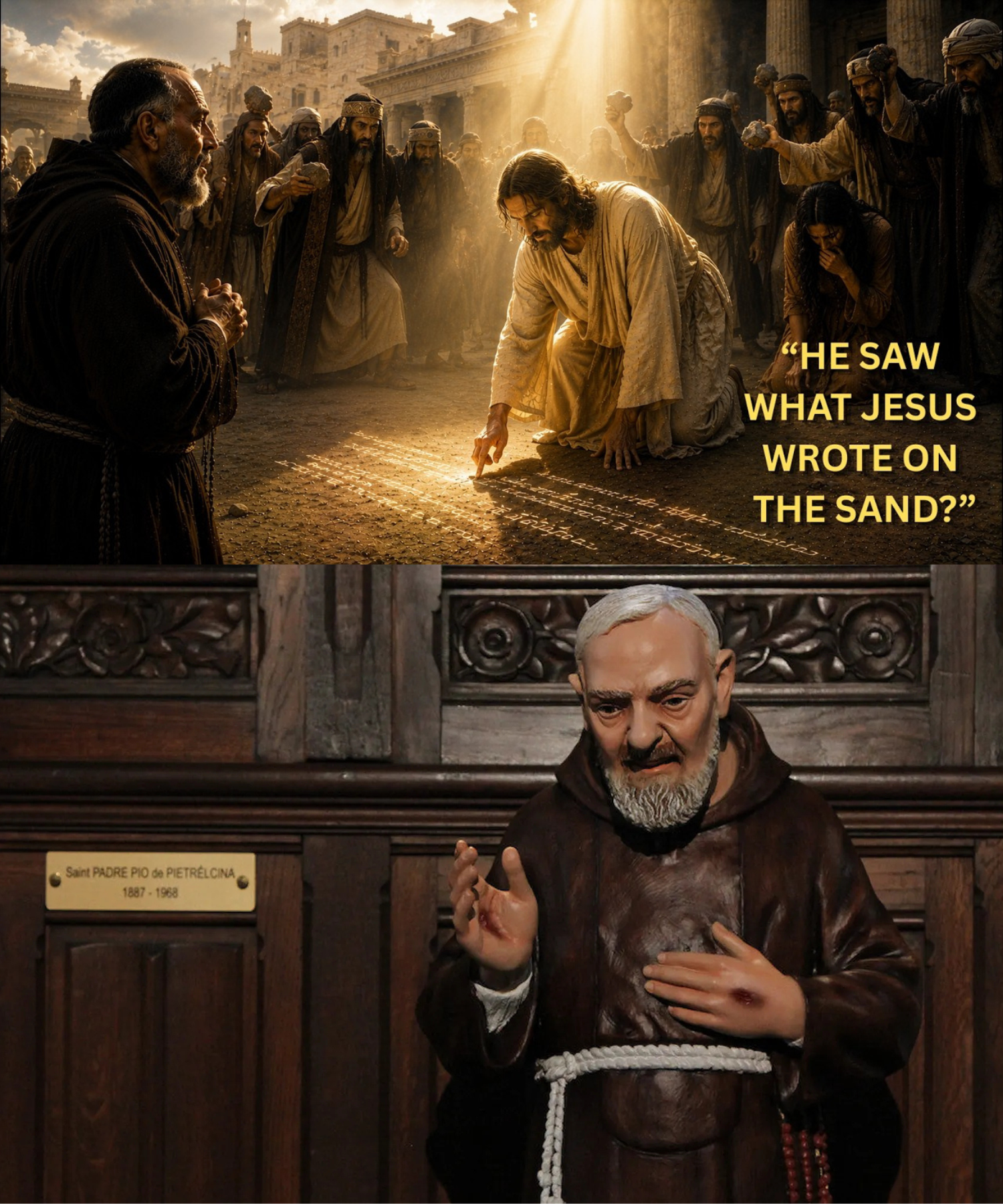
Father Gabriel read it twice, then a third time. The manuscript described the Gospel scene everyone thought they knew: the woman dragged before Jesus, the accusers armed with law, the trap laid by men who wanted blood disguised as righteousness. “Teacher, this woman was caught in adultery.” The law demanded punishment. The crowd demanded an answer. And Jesus bent down and wrote on the ground.
For centuries, Christians had wondered what He wrote. Names? Sins? A verse? A judgment? A hidden accusation? Padre Pio’s alleged vision offered something different. It said Jesus wrote not to expose the woman, but to interrupt the machinery of public condemnation. He wrote in dust because dust does not keep records the way stone does. He wrote where wind, footsteps, and mercy could erase.
By midnight, Father Gabriel had called Dr. Clara Bennett, a Catholic historian at Fordham University known for being both devout and impossible to fool. Clara arrived before sunrise, still wearing rain boots and an expression that said she had already prepared seven reasons the manuscript was probably not authentic. She read the first pages at the rectory kitchen table while Father Gabriel made coffee he forgot to serve. Outside, Queens woke slowly: buses hissing, delivery trucks backing up, schoolchildren shouting beneath umbrellas.
Clara did not speak for twenty minutes.
Finally, she looked up. “This is dangerous.”
“Because it might be false?”
“No,” she said. “Because it might be useful.”
Father Gabriel frowned. “Useful?”
“People love turning mercy into a weapon. If this gets out badly, someone will make it sound as if sin does not matter. Someone else will make it sound as if Padre Pio revealed secret sins of everyone in the crowd. The truth, if there is truth here, is more demanding than both.”
She turned another page. Near the middle of the manuscript, the copyist had written a line in all capital letters: THE LORD DID NOT WRITE TO EXCUSE SIN. HE WROTE TO SAVE THE SINNER FROM BEING DESTROYED BY THOSE WHO LOVED CONDEMNATION MORE THAN JUSTICE.
Father Gabriel felt that sentence move through him like a bell.
By noon, Clara had arranged for scans of the manuscript. By evening, she had contacted a paper specialist in Ohio and a forensic handwriting analyst in Los Angeles. By the next morning, the story had already escaped them. A young volunteer cleaning the records room had taken a photo of the tin box and posted it online with the caption: Padre Pio secret letter found in Queens?? Within hours, Catholic Twitter, skeptical Reddit threads, YouTube prophecy channels, and Italian devotional forums were ripping the image apart. Some declared it a miracle. Others called it fraud. A priest in Ohio asked whether it would explain “what Jesus really wrote.” A Los Angeles producer offered to buy documentary rights before anyone had even authenticated the paper.
Father Gabriel stood in the empty church that night and looked at the crucifix above the altar.
“What did You write?” he whispered.
The church answered only with silence.
But on the marble floor near the confessional, where no dust should have been, a thin line of sand appeared overnight.
Part 2
The sand in St. Catherine’s became the first public sign, though Clara hated that word. Signs invited hunger, and hunger invited distortion. Still, the sand was there. A pale, fine line stretching from the confessional to the altar rail, as if someone had dragged one finger through dust that did not belong in the building. Father Gabriel swept it up himself before Mass, hoping to prevent panic. The next morning, it returned. This time, the line curved into a single word.
Mercy.
By then, the manuscript had reached Ohio. Not physically—the original remained locked in New York—but digital scans were sent to Dr. Hannah Ward, a conservator at a Catholic university outside Columbus. Hannah specialized in paper, ink, and devotional manuscripts carried by immigrant communities into America. She was the kind of scholar who could date a letter by the way ink bled into cheap paper. She was also a widow, though she rarely introduced herself that way. Her husband had died three years earlier after a long illness that had turned their marriage into a hospital corridor. Since then, Hannah had become precise because precision did not ask her to feel.
The manuscript’s paper, she concluded, was mid-twentieth century. The ink matched materials available in the 1960s or early 1970s. The English translation was likely made in America, perhaps by an Italian immigrant priest or nun. That did not prove Padre Pio had spoken the vision, but it proved the document was not a modern internet hoax. The oilcloth, wax, and tin box were also decades old. Whoever hid it had done so long before viral religion existed.
Hannah called Clara from her lab in Ohio. “It’s old enough to matter.”
“Old enough to be real?”
“Old enough to be dangerous,” Hannah said.
Everyone was using that word now.
The Los Angeles analyst, Mateo Ruiz, focused on the handwriting. He had left forensic police work for private document analysis after a murder trial broke him in ways he never explained. He lived in East L.A., worked in a converted garage behind his sister’s house, and distrusted religious artifacts because fraud often wore holy clothes. But the manuscript interested him. The main text was copied by one hand, steady but emotional. Marginal notes were added later by another hand, likely Father Lorenzo Bellini, a Franciscan who had lived in New York in the 1970s and died in Ohio in 1986. Mateo found his records in a Los Angeles archive connected to immigrant clergy.
One marginal note stood out: Padre Pio said the sand was chosen because accusation wants permanence, but God gives repentance room to move.
Mateo sat with that line for a long time.
He had a daughter, Isabella, twenty-four, who had not spoken to him in almost a year. The argument had been ugly. He had accused her of ruining her life. She had accused him of loving her only when she obeyed. Since then, Mateo had replayed their fight so often that his memory had carved it into stone. Every word. Every insult. Every look on her face. He told himself he wanted reconciliation, but if he was honest, he also wanted the record preserved. He wanted the court transcript of fatherly pain. He wanted proof that he had been right.
That night, after studying the manuscript, Mateo dreamed of Jesus kneeling in a Los Angeles street after rain, writing in wet sand beside a storm drain. Around Him stood people holding phones instead of stones. On every screen was someone else’s shame.
When Mateo woke, he called Father Gabriel.
“I don’t know if your manuscript is authentic,” he said. “But I think it knows us.”
Meanwhile, the internet continued doing what crowds have always done. It dragged people into public squares. Influencers made videos speculating that Jesus had written the woman’s secret sins. Others claimed He wrote the names of the hypocrites. Some used the story to attack church discipline. Others used it to attack sinners more creatively. The woman in the Gospel disappeared under everyone’s argument about her.
Then Clara published her first article from New York: The Sand Was Not a Weapon.
It began: “If the manuscript is worth reading, it is not because it satisfies curiosity about what Jesus wrote. It is because it asks why we want to know.”
That line reached millions.
And in Ohio, Hannah Ward read it alone in her lab, looked at the manuscript scan, and finally admitted what she had avoided for three years: she had forgiven death less than she had forgiven her husband for leaving her in it.
Part 3
The second sign appeared in Ohio during a lecture Hannah had not wanted to give. The university chapel was full, mostly because the phrase “Padre Pio vision” had drawn everyone from devout Catholics to bored students hoping for a spectacle. Hannah stood at the podium with the manuscript scans behind her and began with all the disclaimers Clara had insisted on. The document was not authenticated as Padre Pio’s direct writing. The vision was a reported tradition copied by later hands. The Church had not ruled on it. No one should build doctrine on private revelation. No one should treat viral claims as truth. Several people in the audience visibly deflated.
Then she spoke about the sand.
“In the Gospel,” she said, “the accusers want Jesus to answer in a way that traps Him. If He says stone her, they use Him. If He says release her, they accuse Him of rejecting the law. But instead of entering their violence, He bends down. The manuscript’s central claim is that Jesus writes in sand because He refuses to let accusation control the terms of justice.”
A student raised his hand. “So sin doesn’t matter?”
Hannah looked at him. “If sin did not matter, mercy would mean nothing.”
The chapel quieted.
She continued, “Jesus does not say the woman’s sin is unreal. He says, ‘Go, and sin no more.’ But He also does not allow her to be destroyed by people whose righteousness has become appetite. The sand interrupts the crowd long enough for conscience to return.”
As she said that, a sound moved through the chapel. Not loud. More like wind across a desert. People turned. Near the side aisle, a thin layer of sand had appeared across the stone floor. No door was open. No window was cracked. The sand shifted as if touched by an invisible finger. It formed words slowly enough that half the room began crying before the phrase was complete.
Where are your stones?
No one moved.
A young woman in the back dropped her phone.
Hannah stood frozen at the podium while the phrase remained for perhaps twenty seconds. Then the chapel’s heating system clicked on, air moved, and the words blurred into meaningless dust.
The video spread before the university could stop it.
In New York, Clara watched the clip with dread. In Los Angeles, Mateo watched it three times and then opened the last text thread with his daughter. In Queens, Father Gabriel knelt in the confessional and whispered, “Lord, help us understand before we exploit this.”
But exploitation had already begun. People online started asking, “Who are your stones?” Some used it well, examining grudges, public shaming, family cruelty. Others weaponized it instantly, accusing anyone who defended moral standards of being a Pharisee. Father Gabriel preached that weekend with unusual force.
“Do not misunderstand mercy,” he said. “Jesus did not save the woman so she could return unchanged. He saved her because condemnation is not conversion. But neither is excuse. Mercy is not God pretending sin is harmless. Mercy is God refusing to let sin have the final word.”
The homily traveled almost as far as the sand video.
In Los Angeles, Mateo drove to his daughter Isabella’s apartment and sat outside for forty minutes without going in. He had brought no speech, no defense, no fatherly lecture. Only a handwritten note. It said: I have been holding stones. I am sorry. He slipped it under her door and left before she could answer, because for once he did not want to force a verdict.
That night, he dreamed again of Jesus writing in wet sand.
This time, when the Lord lifted His hand, Mateo saw what He had written.
Not sins.
Names.
Part 4
The name theory changed everything because it was the opposite of what people expected. For centuries, many imagined Jesus writing sins in the sand—private crimes of the accusers, secret hypocrisies, hidden shame. That interpretation had power because it felt like justice. Expose the exposers. Humiliate the humiliators. Turn the crowd’s weapon back on itself. But the manuscript’s fourth section, which Clara had not yet published, suggested something else. In Padre Pio’s alleged vision, Jesus wrote names—not to condemn, but to restore personhood.
The woman had been reduced to her sin: “caught in adultery.” The accusers had become a mob. The law had become a weapon. The crowd had become faceless. So Jesus bent down and wrote names in sand: the woman’s true name, known to God; the names of the men holding stones; the names of their mothers; the names of those they had harmed; the names of the dead who had prayed for them; the names of children who would inherit their cruelty if mercy did not interrupt them.
According to the manuscript, Padre Pio saw that every stone fell when each accuser remembered he was not only judge, but son, sinner, debtor, and man made of dust.
Clara hesitated to publish that section because it could not be verified. Then a third sign appeared in New York.
At St. Catherine’s, during a Friday evening penance service, parishioners were invited to write on small cards the names of people they needed to forgive or ask forgiveness from. The cards were not read publicly. They were placed face down in baskets before the altar. After the service, Father Gabriel found a thin layer of sand spread across the altar step. Written in it were names. Not the private names from the cards, thank God. Different names. Forgotten names from the parish’s old records: people who had been publicly shamed, expelled, abandoned, or erased across decades. A teenage mother from 1941. A man accused of theft and later found innocent. A woman denied burial because of scandal. A child born out of wedlock whose baptism record contained no father’s name. The sand had written the names of those the parish itself had once reduced to shame.
Father Gabriel sat on the altar step and wept.
The next morning, he did something that divided the parish. He read the names aloud—not to renew shame, but to repent of it. He spoke carefully, protecting descendants where needed, explaining that the Church is holy because of Christ but her members have often failed mercy. Some parishioners were angry. “Why bring up old scandals?” one man demanded after Mass. “Those people are dead.”
Father Gabriel answered, “Because the Lord wrote on sand, not stone. We are the ones who kept carving.”
That line became the title of Clara’s next article.
In Ohio, Hannah read the New York story and thought about her husband, Mark. During his illness, she had secretly resented him for needing so much, for shrinking their world, for leaving her with debt and silence. After he died, she turned that resentment into guilt, and then guilt into numbness. She had made herself both accuser and accused. That weekend, she visited his grave for the first time in months. She brought no flowers. Only a page from the manuscript, folded in her coat pocket.
“I forgive you for dying,” she said, embarrassed by the sentence and relieved by it. “And I ask forgiveness for being angry that you did.”
Wind moved over the cemetery grass. Nothing supernatural happened. But Hannah felt something inside her uncurl.
In Los Angeles, Isabella finally called Mateo.
He answered too quickly.
“I got your note,” she said.
“I meant it.”
“I know.”
Silence.
Then she said, “I have stones too.”
Mateo closed his eyes.
For the first time in a year, father and daughter stayed on the phone without trying to win.
Part 5
The deeper manuscript pages focused on the ground itself. Padre Pio’s alleged vision did not treat the sand as a random surface. It said Jesus wrote on the earth because the earth remembered Adam. “You are dust, and to dust you shall return.” Every person in the scene—the accused woman, the accusers, the watching crowd—was made from dust. The Lord wrote in the very material from which human beings were formed, as if reminding them: before you throw stones, remember what you are.
Father Gabriel brought that insight to a youth retreat in upstate New York, where teenagers listened with the guarded boredom of young people used to adult moral speeches. He placed a bowl of sand on a table and asked each student to take a handful. Some laughed. Some rolled their eyes. Then he said, “This is closer to your body than your reputation is. This is closer to your beginning than your social media profile is. You are dust loved by God. So is the person you hate.”
No one laughed after that.
One boy asked, “What if the person really did something wrong?”
Father Gabriel nodded. “Then justice matters. Truth matters. Safety matters. But hatred does not become holy because the other person is guilty.”
That line reached Mateo in Los Angeles through a retreat clip. He sent it to Isabella. She replied with a single heart.
Meanwhile, the manuscript’s authenticity remained contested. Scholars in New York argued over provenance. A Franciscan historian in Boston found records confirming Father Lorenzo Bellini had visited Padre Pio in Italy in the 1960s. A convent archive in Ohio contained letters from Bellini describing “a teaching on the sand that broke my pride.” None of this proved the vision exactly as copied, but it strengthened the historical chain. Mateo’s handwriting analysis suggested the manuscript had been copied from earlier notes, perhaps after Bellini arrived in America. Hannah’s paper analysis supported the timeline.
Still, Clara refused to call it “Padre Pio’s secret prophecy.” She called it “a devotional testimony attributed to Padre Pio’s circle.” Viral channels hated that phrase. It was not exciting enough. Clara did not care.
Then the Los Angeles sign occurred.
It happened during a public screening of Mateo’s short documentary about the manuscript. The screening was held in a small Catholic cultural center in East L.A., attended by clergy, skeptics, artists, and families. Mateo had included interviews with Clara, Father Gabriel, Hannah, and several theologians. He had also included his own reconciliation with Isabella—not as spectacle, but as confession. Near the end, the film showed a close-up of sand while Father Gabriel’s voice said, “Jesus wrote where mercy could erase what hatred wanted to preserve.”
At that moment, the projector cut out.
The room went dark.
People murmured. Phones lit up. Then, on the blank screen, words appeared as if written by a finger through dust:
Do not call clean what I have forgiven.
A woman in the front row began sobbing. A priest whispered, “Lord, have mercy.” Mateo stood frozen near the back of the room, staring at the screen. The words remained for seven seconds, then vanished when the projector restarted.
The clip went viral, of course. People argued whether it was a technical glitch, a staged effect, or a miracle. Mateo released the raw projector files. No inserted frame was found. Skeptics remained unconvinced. Believers became more convinced than was safe. Clara urged caution again.
But the sentence had already entered hearts.
Do not call clean what I have forgiven.
Some interpreted it correctly: if God forgives, do not keep treating the repentant as permanently stained. Others misread it as “nothing needs repentance.” Father Gabriel corrected that from the pulpit. “The Lord says to the woman, ‘Go, and sin no more.’ Forgiveness is not denial. It is resurrection.”
America, addicted to permanent records, struggled with that. The internet never forgets. Families never forget. Churches sometimes never forget. Political tribes never forget. Employers, schools, gossip circles, comment sections—everywhere, people loved carving shame into stone and calling it accountability.
The manuscript asked whether mercy had any future in a world where nothing disappears.
Part 6
The final section of the manuscript revealed why Padre Pio’s vision had allegedly shaken him so deeply. According to the copyist, Padre Pio saw that the accusers did not leave only because they remembered their own sins. They left because, for one terrible moment, they saw what they were becoming. Each man holding a stone saw his own soul hardening into the thing in his hand. They saw that judgment without humility turns the judge into stone before it kills the sinner. Jesus wrote on sand because sand is stone broken down. Dust humbled. Rock made gentle.
Clara read that line in New York and had to stop.
Sand is stone that has learned mercy.
It was too beautiful, almost too perfect, and she distrusted beautiful things when they fit too neatly. Yet she could not shake it. The image explained something she had seen everywhere since the manuscript emerged: hard people softening. Not excusing evil. Not abandoning justice. Softening enough to become human again.
Hannah used the line in Ohio during a lecture to medical students about grief, guilt, and forgiveness. She spoke about caregivers who resent the sick, families who accuse themselves after death, patients ashamed of needing help. “Medicine records everything,” she said. “Charts, scans, numbers, failures. But healing also requires knowing what should not be carved forever.” Afterward, a student approached her and confessed that she had been secretly furious at her disabled brother for years. Hannah did not absolve her. She listened. Sometimes listening is the first grain of sand.
In Los Angeles, Mateo and Isabella began working together on a longer documentary. Their relationship was still fragile. They argued over editing, theology, and whether Mateo was making himself look too sympathetic. Isabella insisted on including her side fully. “If the film is about mercy,” she said, “you do not get to control the record.” Mateo accepted that, though it hurt. Especially because she was right.
The documentary’s strongest scene showed a circle of people in Los Angeles writing accusations in sand: against parents, children, ex-spouses, priests, themselves, God. Then, after prayer and conversation, they decided which accusations required action, which required boundaries, which required justice, and which were only stones they had carried too long. Some words were left. Some were erased. The film refused cheap closure.
Noah Reed, the journalist, wrote a review from Brooklyn that captured it well: “The lesson is not that every accusation should vanish. The lesson is that no accusation should become a false god.”
That line spread widely.
Then Father Gabriel received a letter from a prison in California. The writer was a man named Anthony Bell, serving a long sentence for violent assault. He had seen the Los Angeles documentary on a prison television and wanted to ask whether mercy applied to someone who had truly done terrible harm. “I am not innocent,” he wrote. “I am not the woman in the story. I am one of the men with stones, and maybe also the sinner on the ground. If Jesus writes in sand, does He write for me too?”
Father Gabriel wrote back: “Yes. But mercy will not lie to you. Begin with truth. Then repentance. Then reparation where possible. Then hope.”
That correspondence became, years later, one of the most powerful chapters in Clara’s book about the manuscript. Anthony did not become a saint overnight. But he began writing letters of apology he did not demand be answered. He entered a restorative justice program. He stopped pretending remorse was the same as despair. “Stone wants me frozen forever,” he wrote once. “Sand tells me I can still become dust in God’s hands.”
By then, the manuscript had done what true private devotion sometimes does: it had not changed doctrine, but it had awakened conscience.
Part 7
The Church investigation took years, and its conclusion satisfied almost no one. The manuscript was declared historically interesting, spiritually valuable, and worthy of private reflection, but not authenticated as a direct revelation from Padre Pio. The faithful were free to read it prudently, but no one was obliged to believe it. Sensational channels declared cover-up. Skeptics declared victory. Clara thought the cautious conclusion was exactly right. Real discernment rarely feeds the crowd.
Father Gabriel placed a copy of the manuscript in St. Catherine’s memorial archive with a note: Read slowly. Do not weaponize. Above the parish confessional, he placed a small bowl of sand. Not for theatrics. Not for ritual. Just a reminder. People noticed. Some touched it before confession. Some avoided it. A few cried when they saw it.
In Ohio, Hannah started a grief and mercy program called Sand and Stone. It helped people distinguish between guilt that leads to repentance, shame that leads to paralysis, anger that protects, anger that poisons, memory that honors, and memory that imprisons. The program spread to hospitals, retreat centers, and prisons. Hannah often began sessions with the manuscript’s central sentence: He wrote in sand because He refused to carve shame into stone.
In Los Angeles, Mateo and Isabella’s documentary premiered at a modest theater, not one of the glamorous ones. Father Gabriel flew in from New York. Clara came. Hannah came from Ohio. Anthony Bell could not attend, but he sent a letter that Isabella read aloud with his permission. It ended: “If mercy is real, it does not make me less responsible. It makes responsibility possible without self-destruction.”
The audience sat in silence afterward.
That silence meant more to Mateo than applause.
After the screening, Isabella stood outside under the Los Angeles night sky with her father. “Do you think we’re okay?” she asked.
Mateo looked at her carefully. “No.”
She laughed.
He continued, “But I think we’re not writing in stone anymore.”
That was enough.
The final sign, if it was a sign, happened in New York on the anniversary of the manuscript’s discovery. Father Gabriel was hearing confessions late into the evening. Rain tapped against the church windows. The city outside was loud, impatient, alive. After the last penitent left, he entered the sanctuary and saw sand spread across the marble floor near the altar. His first thought was irritation—someone had spilled the bowl from the confessional. Then he saw the writing.
It was not a public message this time. It was a list of names.
Rosa. Anthony. Isabella. Mateo. Hannah. Thomas. Clara. Gabriel. Mark. Evelyn. Daniel. Dozens more. Names of people touched by the manuscript, living and dead, guilty and wounded, accusers and accused. Father Gabriel knelt beside the sand and realized he had misunderstood part of the vision. Jesus did not write abstractions. He wrote persons back into the story.
By morning, the sand was gone.
Father Gabriel told only Clara.
She asked, “Why not tell everyone?”
He smiled tiredly. “Because not everything written in sand is meant to become a headline.”
Part 8
Years later, the manuscript became known across America as The Sand Vision. Scholars continued debating its origins. Devotional Catholics cherished it carefully. Skeptics dismissed it. Some people exaggerated it despite every warning. But in New York, Ohio, and Los Angeles, where the story had first unfolded, its real fruit remained quieter than the controversy. Confession lines grew. Restorative justice programs expanded. Families spoke after years of silence. Grief groups learned to name anger without worshiping it. Pastors preached mercy with more precision. The phrase “sand, not stone” entered ordinary language among people who had never read the manuscript at all.
Clara eventually wrote the definitive book, refusing every sensational title proposed by publishers. She called it What Mercy Refuses to Carve. The final chapter argued that the mystery of what Jesus wrote on the ground cannot be solved like a puzzle because the Gospel itself does not preserve the words. That omission is part of the revelation. If the words mattered most, Scripture would have kept them. Instead, it preserves the gesture: Jesus bending down, writing where writing can vanish, standing up only to call the sinless to throw first, then bending down again as each accuser leaves.
The gesture is the message.
God lowers Himself. God interrupts violence. God gives conscience time to awaken. God refuses to let the sinner be reduced to sin or the accuser reduced to accusation. God writes in dust because human beings are dust, and dust can still receive the touch of God.
In Ohio, Hannah visited her husband’s grave every year on the manuscript anniversary. She no longer came to apologize for anger. She came to remember love without denying pain. Sometimes she brought sand from the retreat center garden and let it fall through her fingers onto the grass. “Stone becomes sand,” she would whisper. “Sand becomes soil.”
In Los Angeles, Mateo and Isabella continued making films together, though not always peacefully. Their best work came from refusing to make mercy sentimental. They told stories where forgiveness cost something, where justice mattered, where repentance had a body. At the end of every production, Mateo placed a small bowl of sand near the monitor. Crew members thought it was superstition. Isabella called it accountability.
In New York, Father Gabriel grew old at St. Catherine’s. He never again found a line of sand across the chapel floor, but sometimes, after a long day of confessions, he would see one or two grains near the altar and smile. The manuscript had taught him that priests must be careful not to become men with stones disguised as defenders of truth. It had also taught him that mercy without truth is only fog. Jesus had held both. The sand had held both.
One autumn evening, a young woman came into St. Catherine’s and sat in the back pew. Father Gabriel recognized the look of someone deciding whether to run. After a long while, she approached him and said, “Father, if I tell you what I did, you will hate me.”
He looked toward the small bowl of sand near the confessional.
“No,” he said softly. “But I may ask you to let Christ tell the truth with you.”
She began to cry.
Outside, Queens moved as always—sirens, buses, rainwater, laughter from the bakery, arguments from apartment windows, children running toward home. Inside, the church smelled faintly of wax and dust. Father Gabriel led the woman toward the confessional, not as a judge eager for a verdict, but as a sinner entrusted with a door.
That night, after locking the church, he found one word written in the sand bowl.
Not by any hand he had seen.
Begin.
He stood there for a long time.
And he understood, finally, the hidden reason Jesus wrote on the sand.
Not to satisfy curiosity.
Not to expose secrets for the crowd.
Not to erase justice.
But to show that mercy creates a place where a human life can begin again before the record becomes a tomb.
Stone remembers accusation.
Sand makes room for repentance.
And in every generation—New York, Ohio, Los Angeles, anywhere people gather with stones in their hands—Christ bends down once more, writing where the proud must lower their eyes, where the ashamed can still hear His voice, and where the wind of mercy may yet pass over what hatred wanted to preserve forever.