The Coral Castle Problem—A Modern Man Who Moved 30-Ton Stones Alone and Took the Method to His Grave
The Coral Castle Problem — A Modern Man Who Moved 30-Ton Stones Alone and Took the Method to His Grave
He was barely over five feet tall, weighed around a hundred pounds, and worked mostly at night. Yet somehow, Edward Leedskalnin carved, moved, balanced, and raised stones weighing more than cars, trucks, and even small houses.
Coral Castle does not look like a normal building. It feels like a dare carved into stone. Standing in Homestead, Florida, under the heat and glare of the South Florida sun, the strange monument seems to ask every visitor the same question: how did one small, secretive man move all of this by himself?
The walls are made of massive blocks. The furniture is stone. There are chairs, tables, crescents, towers, a sundial, an obelisk, a telescope aligned with the North Star, and the famous nine-ton gate that once turned so smoothly a child could push it open. The whole place feels like a private kingdom built by someone who understood stone in a way most people do not understand paper.
And that is where the mystery begins.
Edward Leedskalnin was not a wealthy industrialist. He did not command an army of workers. He did not own modern cranes, hydraulic lifts, or construction equipment. He was a Latvian immigrant, quiet, thin, eccentric, and fiercely private. He built Coral Castle over decades, often working when others were asleep, refusing to let people watch closely. When asked how he did it, he offered answers that only deepened the mystery. He claimed he understood the laws of weight and leverage. He hinted at knowledge of magnetism. He reportedly said he had discovered the same secrets used by the ancient Egyptians.
Then he died.
And whatever exact method he used went with him.
That is the Coral Castle problem.
It is not that no explanation exists. Engineers can point to tripods, block-and-tackle systems, pulleys, winches, fulcrums, rollers, wedges, counterweights, and patient mechanical advantage. Skeptics are right to say that no supernatural force is required to move heavy objects if a person understands leverage and takes enough time. Human beings have been moving massive stones for thousands of years with simple tools and intelligent planning.
But Coral Castle refuses to become ordinary because of scale, secrecy, and personality.
The stones are not small. The labor was not minor. The builder was not physically imposing. The work was not widely witnessed. The final result still stands, confusing visitors who look at the walls, the carved furniture, and the celestial alignments and wonder how a man living alone could maintain such obsession for so long.
Leedskalnin’s life story only adds to the legend. According to the most repeated version, he was heartbroken after his young fiancée in Latvia called off their wedding shortly before the ceremony. He left Europe, eventually reached Florida, and transformed his grief into stone. Coral Castle became a monument to a lost love, a private cathedral of rejection, endurance, and control. The woman he called his “Sweet Sixteen” never came back. So he built something that could not leave.
That emotional origin matters because Coral Castle is not merely engineering. It is psychology made physical. Every heavy stone seems to carry more than weight. It carries loneliness. It carries obsession. It carries a message from a man who had little power over love, but absolute control over the rocks he cut, shaped, and raised.
Perhaps that is why he guarded his methods so fiercely.
To reveal the method would have reduced the miracle.
If people saw the ropes, pulleys, supports, rails, and slow repetition, they might admire him less. The castle depended not only on stone, but on mystery. Leedskalnin understood that. He let visitors pay to see the finished work, but he did not allow them to see enough of the process to destroy the legend. In that sense, he was not only a builder. He was a showman of secrecy.
Still, secrecy alone cannot move stone.
That is why the practical question remains so fascinating. How did he actually do it?
The most reasonable answer begins with mechanical advantage. A small person can move a very heavy object if force is multiplied through pulleys, levers, and careful positioning. A block-and-tackle system can reduce the effort needed to lift or shift weight. A tripod made from strong timbers can support hoisting equipment. Rollers can help move blocks horizontally. Wedges can split stone. Jacks can raise heavy material little by little. A patient worker can lift a massive block an inch at a time, support it, reset the tools, and repeat the process until the impossible becomes ordinary.
But when people hear that explanation, they often feel unsatisfied.
Not because it is wrong, but because it sounds too clean.
It does not fully capture the heat, the mosquitoes, the darkness, the danger, the precision, the years of repetition, and the strange solitary discipline required. Saying “he used pulleys” is like saying a cathedral was built with hammers. True, but incomplete. Tools explain the physics. They do not explain the man.
Leedskalnin was not simply lifting blocks. He was quarrying them, shaping them, transporting them, setting them upright, balancing them, and arranging them into a coherent sculpture garden. Some stones had to be positioned with extreme care. Others had to work mechanically, like the famous gate. That gate alone became part of the myth because of its astonishing balance. It weighed several tons, yet once turned with remarkable ease because it was mounted on a central pivot with bearings. The secret was not magic. It was precision.
Precision can feel like magic when people do not see the labor behind it.
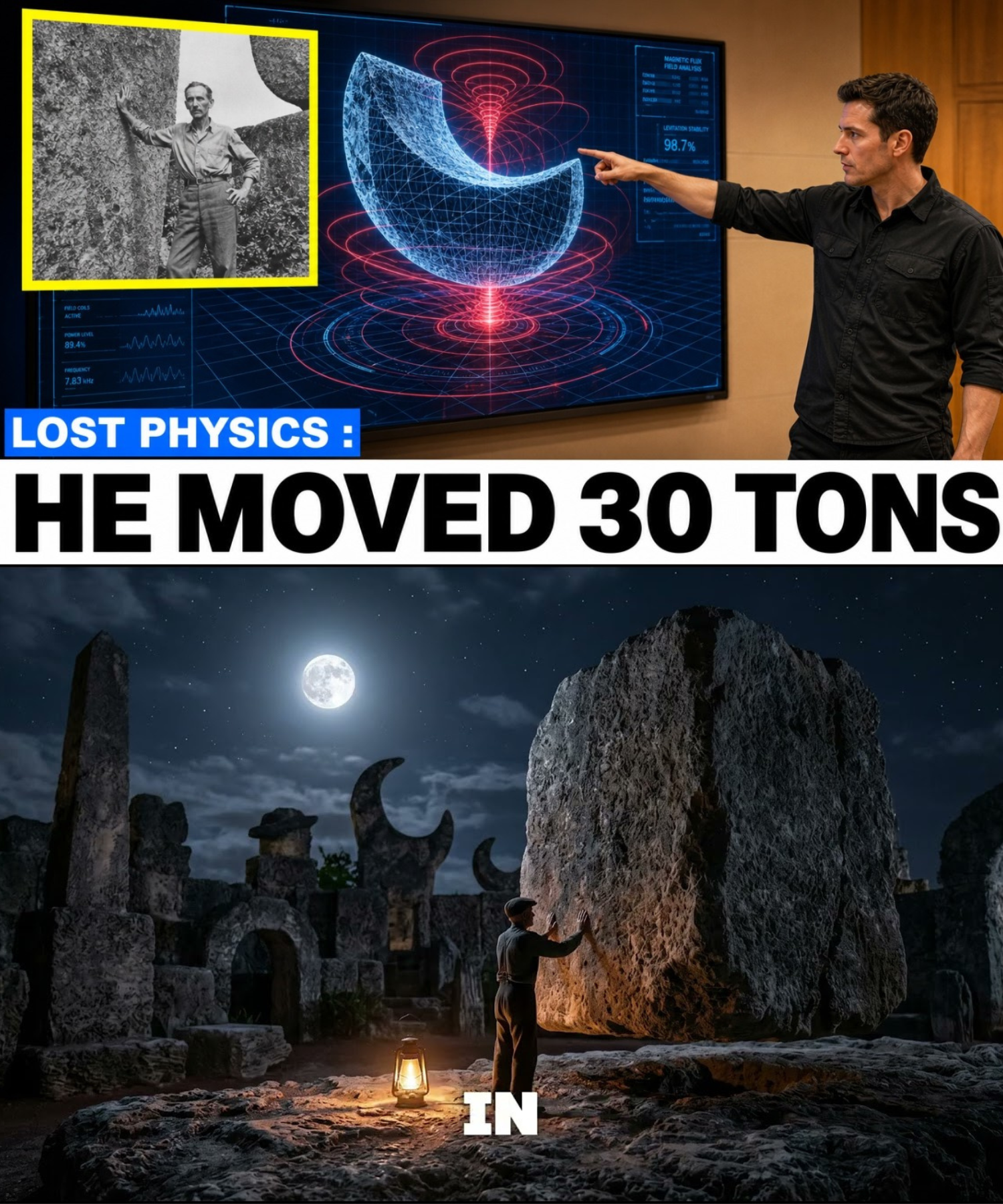
That may be the key to Coral Castle. Leedskalnin’s achievement does not require levitation to be extraordinary. It requires something more unsettling: relentless patience. He did not need to move every stone quickly. He only needed to move each stone eventually. One night at a time. One lift at a time. One adjustment at a time. For nearly three decades.
Modern people struggle with that kind of timescale. We expect speed. Heavy machinery has trained us to believe massive construction happens through noise, crews, engines, and visible power. Coral Castle comes from another rhythm. It is the rhythm of a man alone in the dark, using small advantages repeatedly until huge objects obey.
That is what makes it feel ancient.
The comparison to the pyramids and Stonehenge is not accidental. Coral Castle seems to compress the ancient megalithic problem into modern history. When people ask how ancient builders moved stones, the answer is often: organization, labor, ramps, sledges, ropes, levers, rollers, and brilliant practical knowledge. But skeptics of ancient achievements often reject those explanations because they want a lost technology. Coral Castle reverses the problem. Here was a modern man, documented and photographed, using basic means to create something that still feels impossible.
If Leedskalnin could do it in the twentieth century, perhaps ancient builders could do even more with larger communities and generations of skill.
Yet Leedskalnin also fed the more mysterious interpretations. He wrote and spoke about magnetism in unusual ways. He was fascinated by electrical currents, cosmic forces, and hidden natural laws. Some later enthusiasts claimed he discovered anti-gravity, earth energies, magnetic levitation, or a forgotten science. The romance of those theories is easy to understand. Coral Castle looks like the kind of place that should have a secret beyond wood and rope.
But the surviving evidence points more strongly toward ingenious mechanical methods than supernatural forces. Photographs and artifacts show tools. The stone itself, oolitic limestone, is porous and lighter than many visitors assume, though still extremely heavy. The site contains evidence of practical labor, not impossible technology. A man with enough time, knowledge, and stubbornness could have accomplished astonishing things.
The real mystery is not whether physics was broken.
The real mystery is how one man became so committed to mastering it.
Leedskalnin’s small size has become central to the legend. People love the contrast: a tiny man moving gigantic stones. But size can mislead. Strength matters less when tools multiply force. Knowledge matters more. Leedskalnin may not have been powerful in the way a weightlifter is powerful, but he understood how to make weight negotiate. He knew how to raise a stone without fighting all of it at once. He knew how to balance mass so it could turn. He knew that a heavy object, once properly supported, could be controlled through patience and geometry.
That is a different kind of strength.
It is the strength of understanding.
There is also the matter of risk. Working alone with multi-ton stones is dangerous even with good equipment. One mistake could crush a foot, snap a rope, tip a block, or kill instantly. Leedskalnin’s ability to work for years without catastrophe suggests he was careful, methodical, and deeply familiar with his materials. He was not merely lucky. He knew what he was doing.
But he let the world think he knew even more.
Visitors often asked him the secret. His answers were evasive. He did not provide a clear blueprint. He did not publish a construction manual. He did not train apprentices. He did not create a school. Instead, he preserved the aura of a man who had unlocked something forbidden. That choice may have been pride. It may have been marketing. It may have been loneliness. It may have been his way of keeping control over the one thing life had not taken from him.
The method was his.
The castle was his.
The mystery was his.
When he died in 1951, that mystery hardened around the stones.
Today, Coral Castle survives as both tourist attraction and unresolved argument. Some visitors come for romance, drawn by the story of the rejected lover. Others come for engineering, trying to imagine the rigging systems and work sequences. Others come for the paranormal possibilities, hoping the site contains traces of lost energy or magnetic secrets. The castle allows all of them to bring their own questions.
That flexibility is part of its power.
A purely explained structure might become a footnote. A completely impossible structure would become fantasy. Coral Castle sits in the middle. It is explainable enough to be real and strange enough to remain legendary.
The most important thing to remember is that mystery does not have to mean ignorance. Sometimes mystery is not the absence of explanation, but the presence of multiple explanations layered together. Coral Castle can be a feat of leverage and a monument to heartbreak. It can be a practical engineering achievement and a spiritual obsession. It can be built with simple tools and still be extraordinary. It can be demystified mechanically while remaining mysterious psychologically.
That is why the story continues.
People do not only want to know how Leedskalnin moved the stones. They want to know what kind of inner force moves a man to spend nearly thirty years doing it alone.
Heartbreak explains the beginning, perhaps. But it does not explain every night. It does not explain every cut, every lift, every bruise, every adjustment, every hour spent under Florida darkness shaping rock into a private universe. Love lost may have started the work, but obsession sustained it. And obsession can be more powerful than romance.
Coral Castle feels like a place built by someone who could not change the past, so he changed matter instead.
Stone became his language.
Balance became his answer.
Secrecy became his revenge.
When visitors stand before the walls today, they often ask whether Leedskalnin had help. In a way, he did. He had physics. He had time. He had tools. He had grief. He had pride. He had the stubbornness of a man who wanted the world to look at what he had done and admit it could not easily explain him.
That may be the true achievement.
Not that he moved stone.
But that he turned stone into a question.
The Coral Castle problem is not solved by choosing between magic and mechanics. Mechanics almost certainly moved the stones. But magic, in the human sense, moved the story. The visible structure is made of limestone. The invisible structure is made of secrecy, heartbreak, rumor, and the enduring human desire to believe one person can still do something impossible.
Leedskalnin took his exact methods to the grave, but perhaps that was not an accident. Perhaps he knew that a fully revealed secret would become smaller. A diagram can explain a lift. It cannot explain the silence of a man working alone at night, the glow of lamps against white stone, the slow rise of a thirty-ton block, or the strange satisfaction of knowing that someday people would stand there and wonder.
In the end, the stones remain.
The man is gone.
The method is debated.
And Coral Castle continues to do what it has always done best: make the modern world feel, for a moment, as baffled as it feels before the pyramids.
A small man moved massive stones in secret.
He said he understood weight and leverage.
Maybe that was the whole answer.
Maybe it was only the answer he wanted us to have.
Either way, he built the castle. And after all these years, the stones still refuse to give him up.