Why People Can’t Go To Antarctica…
HIDDEN BASES AND FORBIDDEN ZONES FUEL GLOBAL MYSTERY
The frozen continent at the bottom of the world remains one of the most restricted places on Earth.
While millions dream of setting foot on its pristine ice, the vast majority of people will never go.
The reasons are layered: extreme danger, astronomical costs, strict international law, and persistent rumors of hidden activities that governments refuse to discuss openly.
What looks on the surface like sensible environmental and scientific protection may hide deeper geopolitical, military, and possibly even anomalous realities that make unrestricted access impossible.
The Antarctic Treaty, signed in 1959 by 12 nations and now with over 50 signatories, is the primary legal barrier.
It designates Antarctica as a continent for peaceful scientific research only.
Military activity, nuclear testing, and mineral exploitation are explicitly banned.
Any nation or individual wanting to operate there must notify others and allow inspections.
On paper, this promotes cooperation and prevents any single country from claiming territory.
In practice, it creates a highly regulated environment where independent explorers, journalists, or curious civilians face enormous bureaucratic and logistical hurdles.
Tourism does exist, but it is tightly controlled.
Around 50,000 to 100,000 tourists visit annually, mostly via expensive cruise ships that only touch the Antarctic Peninsula during the short summer season.
These trips are costly (often $10,000–$50,000+ per person), weather-dependent, and limited in scope.
Visitors stay on designated routes, cannot freely roam, and are heavily supervised to protect the fragile ecosystem.
Independent travel or private expeditions require permits that can take years to approve, massive insurance, environmental impact assessments, and sponsorship from a Treaty nation.
The vast interior, including the interior ice sheet and Mount Vinson, remains almost entirely off-limits to casual visitors.
The physical barriers are equally forbidding.
Antarctica is the coldest, windiest, and driest continent on Earth.
Temperatures regularly drop below -80°C (-112°F) in winter.
Blizzards can reduce visibility to zero.
The interior is a high-altitude polar desert where altitude sickness compounds the cold.
Fuel, food, and equipment must be specially prepared.
Rescue operations are extremely difficult and expensive.
A single mistake can be fatal, and governments are reluctant to allow unprepared people to risk their lives in a place where search-and-rescue is nearly impossible for much of the year.
Yet the real intrigue lies in what the Treaty might be protecting.
The continent is enormous — larger than Europe and the United States combined — but only a tiny fraction is regularly visited.
Vast areas, especially around certain “no-fly” or restricted zones, are effectively off-limits.
Some researchers and whistleblowers claim the Treaty serves as a convenient cover for classified activities.
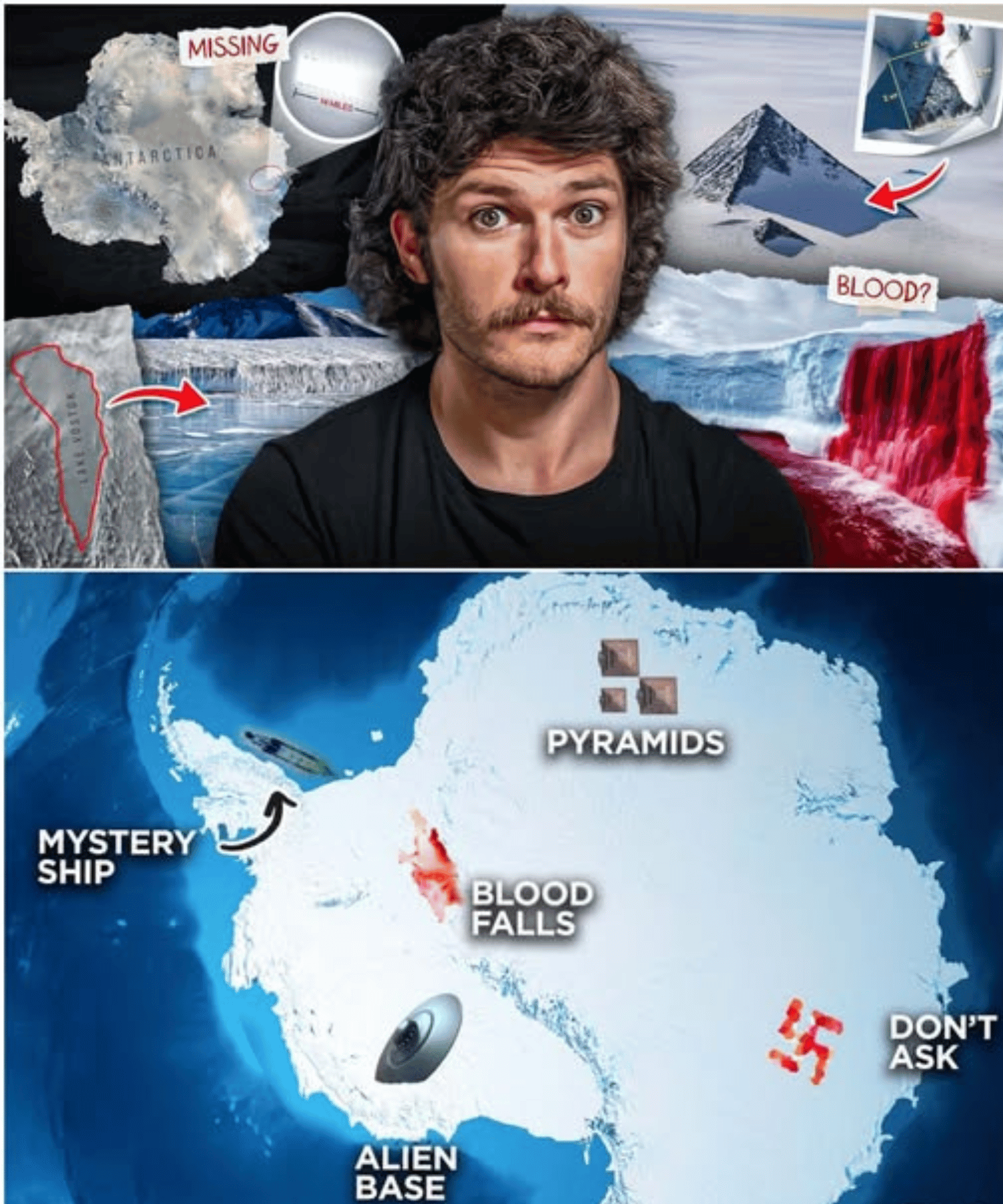
Rumors persist of underground bases, recovered non-human technology, ancient structures beneath the ice, and even entrances to inner-Earth theories.
While most mainstream scientists dismiss these ideas, the extreme secrecy surrounding certain regions fuels speculation.
Operation Highjump in 1946–47, led by Admiral Richard Byrd, remains one of the most mysterious official expeditions.
Officially a training and mapping mission, it involved 4,700 personnel, 13 ships, and multiple aircraft.
Byrd reportedly spoke later of encountering advanced technology and vast ice-free areas.
Some accounts (though debated) describe encounters with disc-shaped craft and warnings about future threats from the polar regions.
The operation ended abruptly, and much of the data remains classified or heavily redacted.
Similar secrecy surrounds later missions, including reports of unusual seismic activity, magnetic anomalies, and restricted zones near the South Pole.
Modern satellite imagery and ground-penetrating radar have revealed subglacial lakes, mountain ranges, and unusual geometric formations beneath miles of ice.
Some features appear too regular to be purely natural.
Combined with accelerating ice melt due to climate change, more anomalies are becoming visible each year.
Whistleblowers and researchers like Linda Moulton Howe have claimed that multiple nations maintain secret bases for both scientific and less transparent purposes.
The Antarctic Treaty’s inspection clause is rarely enforced in practice, allowing plausible deniability.
The environmental argument for restriction is strong and legitimate.
Antarctica holds 70% of the world’s fresh water.
Its ecosystems are fragile and slow to recover.
Unregulated tourism or mining could cause irreversible damage.
The Treaty has successfully prevented large-scale exploitation for over 60 years.
However, critics argue the rules disproportionately favor governments and large institutions while shutting out independent verification.
Private expeditions that try to explore restricted areas often face diplomatic pressure, denied permits, or logistical sabotage.
Cost remains the biggest practical barrier for ordinary people.
A basic tourist cruise starts at tens of thousands of dollars.
A fully supported private expedition to the interior can run into the millions.
Logistics require icebreakers, specialized aircraft, fuel depots, and experienced guides.
Only a handful of operators have the capability, and they work within strict guidelines.
For most humans, Antarctica might as well be on another planet.
The psychological and symbolic weight is undeniable.
Antarctica represents the last true frontier on Earth — a blank canvas at the bottom of the globe that captures human imagination like few other places.
The combination of natural hostility, legal restrictions, and persistent rumors creates a perfect storm of mystery.
Some believe the restrictions protect fragile science.
Others suspect they hide something far more significant: evidence of ancient civilizations, non-human intelligence, or strategic military assets.
Recent years have seen increased activity.
China, Russia, and the United States are all expanding research stations.
Tourism numbers have grown.
Private companies are pushing for more access.
As climate change accelerates ice melt, previously hidden features are emerging, and pressure for transparency is mounting.
The question is no longer whether people can go to Antarctica — thousands already do each year — but how freely, how deeply, and what exactly they are allowed to see.
The frozen continent keeps its secrets well.
Its extreme environment, international treaty, massive scale, and layers of official secrecy ensure that the average person will never walk its interior ice freely.
Whether those barriers protect science, fragile ecosystems, national security, or something far stranger remains one of the most compelling unanswered questions of our time.
Antarctica does not simply keep people out because it is cold.
It keeps people out because, in ways both obvious and mysterious, the world has decided that some places — and perhaps some truths — must remain guarded.
For now, the ice holds its silence.
But as technology improves, ice melts, and curiosity grows, the reasons why people can’t freely go to Antarctica may eventually be forced into the light.
Until that day, the southernmost continent remains Earth’s greatest restricted wonder — beautiful, deadly, and profoundly off-limits to almost everyone.