A Lake Monster Has Been Sighted in Canada Since the 1800s — The Truth About OgopogoA Lake Monster Has Been Sighted in Canada Since the 1800s — The Truth About Ogopogo
A Lake Monster Has Been Sighted in Canada Since the 1800s — The Truth About Ogopogo
On a postcard-perfect summer afternoon, British Columbia’s Lake Okanagan looks like a deliberate advertisement for the idyllic life. Sailboats lean gracefully into a warm valley breeze; terraced orchards hang heavy with ripening fruit along the sun-baked hillsides; and generations of families crowd the wooden docks, chasing melting ice cream before it can escape down the wrists of sticky children. This is the pristine, commercial brochure of the Canadian interior. Yet, beneath the keel of those pleasure boats lies an entirely different reality—a drowned, lightless canyon dropping vertically to a depth of more than 230 meters, where the water remains locked in a perpetual, freezing dark. For over two centuries, this abyss has maintained a shadow history that the tourism boards systematically sanitize: a continuous, documented ledger of ordinary citizens who have stopped their cars along the cliffside highways, dropped their oars in sudden panic, and watched a massive, serpentine entity cut loops through the glass-flat water. This is the reality of Ogopogo, a phenomenon far older, deeper, and more culturally fraught than the smiling green cartoon stamped on the cheap souvenir mugs of Kelowna.
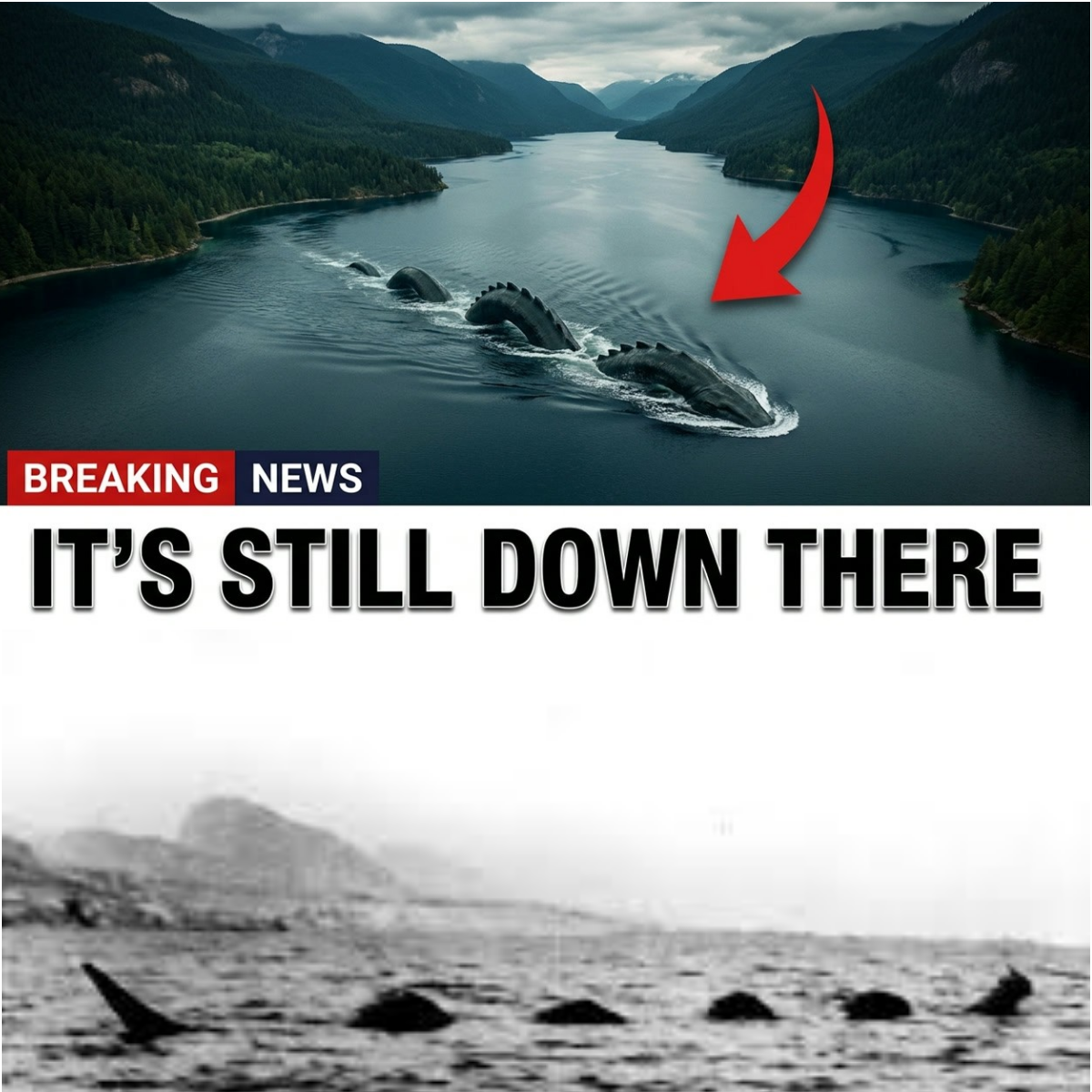
The Topography of Concealment: A Fjord in Exile
To understand why the mystery of Lake Okanagan has successfully resisted the absolute demystification of the twenty-first century, one must first discard the traditional American concept of a lake. This is not a shallow, sunlit basin bounded by gentle, sandy slopes. Stretching roughly 135 kilometers down the narrow interior of British Columbia, Okanagan behaves less like a standard lake and more like an inland fjord—a deep, jagged scar carved into the earth by retreating glacial ice sheets during the last maximum.
The geography of the lake is uniquely built to keep secrets. Its underwater walls drop away almost instantly from the shore, plunging into pitch-black depths within a few strokes of the beach. This vertical terrain creates an environment that is profoundly hostile to human exploration and remarkably frustrating to modern technology:
Acoustic Confusion: The steep, chaotic underwater rock walls and shelving ledges routinely defeat sonar arrays, bouncing back distorted, fragmented echoes that are nearly impossible for marine analysts to read with any degree of certainty.
The Abyss of Scale: The sheer volume of water contained within a trench 135 kilometers long and over 760 feet deep means that any large, reclusive biological mass could spend an entire lifespan navigating zones that will never be touched by human eyes or illuminated by a submersible’s torch.
Thermal Isolation: Below the top layer of seasonal warmth, the lake drops into a permanent, bone-chilling cold that limits human dive times and preserves the lightless depths as an unmapped wilderness.
When the surface of such a massive body of water goes perfectly still on a hot August evening, it creates an immense optical amphitheater. The lake does not just harbor a legend; its physical architecture acts as a natural laboratory designed to challenge, distort, and occasionally shatter the conventional rules of human perception.
The Desecration of Naha-at-k: From Sacred Covenant to Vaudeville Joke
Long before European fur traders, ranchers, and land speculators arrived with their notebooks and steam-driven paddle wheels, the water was intimately known by the Syilx (Okanagan) people. In their deep, generational understanding of the landscape, the lake was home to Naha-at-k (or Nxaitk), a powerful, sacred water being.
Crucially, Naha-at-k was never a campfire monster invented to frighten children into obedience, nor was it a folklore curiosity to be traded for casual entertainment. It was a respected, fearsome manifestation of the water’s inherent danger and spiritual autonomy, tied to specific, treacherous geography along the lake—most notably around the jagged, isolated outcrop of Rattlesnake Island.
The Syilx people approached these waters with a profound gravity that modern visitors rarely comprehend. Traditional accounts describe travelers offering small tokens, gifts, or animals to the lake before attempting to cross the deep currents near the island, ensuring safe passage through an ecosystem that could turn lethal in a matter of seconds. It was a survival strategy masquerading as theology, an acknowledgement that human beings were merely temporary guests on a sacred and unpredictable altar.
The transition from Naha-at-k to “Ogopogo” represents a classic, deeply uncomfortable chapter in the history of North American cultural appropriation. The name that now adorns the roadside fruit stands and commercial boat tours does not possess an indigenous lineage; it was lifted directly from a British music hall novelty song that achieved viral popularity in 1924. The silly, bouncing vaudeville tune featured a nonsense chorus about a mythical creature whose “mother was an earwig” and whose “father was a whale.”
Settlers found the comedic song highly amusing and casually pasted the colonial label over the ancient water being like a corporate sticker slapped across a priceless Renaissance canvas. Over the subsequent decades, the process of commercial sterilization was completed. The feared, majestic spirit of the abyss was systematically flattened into a smiling, friendly green sea serpent with a goofy grin—a concrete statue erected on a public beachfront for tourists to climb on. By converting a sacred cultural warning into a marketable beach mascot, pop culture effectively disarmed the mystery, rendering the lake safe for real estate development and family vacation packages while burying the true history of the water beneath layers of plastic kitsch.
The Settler Ledger: A Century of Reluctant Witnesses
Despite Hollywood’s best efforts to domesticate the phenomenon, the water itself has spent the last 150 years refusing to cooperate with the tourism narrative. From the mid-1800s onward, an independent, cross-generational ledger of anomalous sightings began to compile itself within the local archives—recorded not by eccentric fringe elements or profit-driven promoters, but by practical, highly reluctant members of the growing settler community.
The early valley was an isolated, demanding frontier, dependent on steam-driven paddle wheels churning up and down the long stretch of water to haul freight and passengers between remote wilderness settlements. From the decks of these commercial vessels, ordinary citizens began reporting a recurring, deeply jarring sight. Passengers would suddenly crowd the wooden railings to watch a dark, massive silhouette keeping perfect pace with the ship; ranchers watering their livestock along the shore would watch in stunned silence as a series of undulating loops broke the surface of the calm water, moving cleanly against the prevailing current before sliding noiselessly back into the deep.
What makes this historical record so difficult for strict materialists to easily wave away is the remarkable consistency of the descriptions across independent witnesses who were separated by decades, miles, and social status:
The Serpentine Silhouette: Witnesses consistently describe a long, dark, cylindrical body breaking the surface not as a single, rounded fish back, but as a sequence of multiple humps arranged in a distinct, undulating line.
The Raised Head: The descriptions frequently converge on a stark, specific anatomical detail—a distinct head, resembling that of a horse or a sheep, held high above the water on a thick, muscular neck, scanning the shoreline before submerging.
The Mechanics of Motion: Unlike a sturgeon or a standard fish, which moves through horizontal lateral undulation, the Okanagan anomaly is consistently described as moving with a vertical rolling motion, its coils looping through the water in slow, rhythmic vertical arcs.
Furthermore, the psychological profile of these witnesses adds a layer of credibility that complicates simple skepticism. These were outdoor professionals—boat captains, seasoned hunters, and multi-generational lakeshore families—who possessed an intimate, daily familiarity with how logs, river otters, and wind patterns behaved on the water. In the vast majority of historical newspaper accounts, these individuals came forward with extreme reluctance, often expressing deep embarrassment and explicitly stating that they wished they had something more ordinary to report to their neighbors.
The Fulen Film: An Object Without a Ruler
For generations, the phenomenon remained a battle of spoken testimony—a collection of fleeting stories that vanished as quickly as the wakes on the water. That narrative paradigm was permanently shattered on a clear summer afternoon in August of 1968, when a motorist named Art Fulen was driving along the high highway that cuts through the steep cliffs overlooking the lake.
Fulen was not a monster hunter; he was an ordinary traveler equipped with a standard 8mm home movie camera, the kind families used to document road trips and childhood birthdays. Looking down from his high vantage point at the vast, sunlit expanse of the open water, he spotted a large, dark mass moving purposefully across the flat surface under its own clear power. He pulled his vehicle to the shoulder, stabilized his camera against the frame, and captured what would become the most intensely analyzed piece of cryptozoological footage in Canadian history.
The Fulen film does not present a blurry, split-second splash. It shows a distinct, dark, solid mass traveling across the open water in a straight, unswerving line, pushing a substantial, V-shaped bow wave out behind it. The sequence runs long enough to demonstrate an undeniable intentionality of movement—the object is clearly traversing the lake, maintaining its direction, and creating a significant surface disturbance that does not resemble the chaotic drifting of an inanimate log.
When the footage emerged, it underwent rigorous, computer-assisted technical analysis by independent photographic experts and military analysts. The conclusions reached by these studies were both tantalizing and deeply frustrating:
Physical Authenticity: The analysis definitively ruled out the possibility of a hoax, a double exposure, a film flaw, or a simple smear of light. The object on the celluloid was confirmed to be a real, three-dimensional, solid mass occupying physical space on the surface of the water.
The Paradox of Scale: While the film successfully verified the existence of the object, it utterly failed to resolve its identity due to a fatal geographic flaw. Because Fulen filmed from a great distance looking down at the open center of the lake, the frame contains absolutely no external points of reference—no nearby boats, docks, swimmers, or shorelines. Without a known object to measure it against, analysts admitted that the dark mass could just as easily be a 40-foot biological anomaly or a 4-foot flock of water fowl.
The Fulen film became the ultimate Rorschach test for the Okanagan Valley. To believers, the sustained, powerful bow wave was definitive proof of an unknown creature cruising the depths. To skeptics, it remained a classic riddle with the single most important piece of data—scale—deliberately cut out of the frame by the vastness of the landscape.
The Physics of Deception: The Lake as a Visual Machine
If there is no prehistoric leviathan swimming beneath the orchards of Kelowna, how does one account for a century of consistent, highly credible sightings from witnesses who have nothing to gain and everything to lose by speaking out? The answer provided by modern limnology and atmospheric physics is perhaps far more elegant and unsettling than any biological monster: the lake itself is a massive, geological machine designed to manufacture illusions.
Due to its unique shape—long, narrow, steep-walled, and perfectly aligned with the intense winds that pour down the valley mountain chutes every afternoon—Lake Okanagan is highly susceptible to a phenomenon known as a seiche. A seiche is a massive, slow-moving, and often invisible internal wave that sloshes back and forth across the entire length of a deep lake, driven by sustained atmospheric pressure and sudden wind shifts.
When these powerful internal currents interact with the steep underwater topography and varying thermal layers of the lake, they can generate what physicists call “standing wave trains” on the otherwise calm surface. To an observer standing on the shore, a standing wave train manifests as a perfectly straight line of dark, rounded humps that appear to rise, fall, and propagate forward across the water under their own independent power.
This mechanical process cleanly accounts for the most baffling, consistent details found in the settler ledger:
The Multiple Coils: The moving row of rounded backs that witnesses interpret as the coils of a giant serpent are, in reality, the rhythmic crests of a specialized wave formation organized by depth and wind.
The Illusion of Intent: Because the waves are propagating forward through a localized current, they appear to cut across the lake in a straight line, leaving a sustained wake that looks identical to the path of a swimming animal.
The Dissolving Anatomy: This explanation reveals why, in almost every detailed report, the “creature” never quite resolves into a clear, sharp biological entity before it suddenly fades from view; there is no animal to resolve into, merely an organized pattern of water that dissolves back into the ambient lake when the wind energy dissipates.
When you overlay this powerful limnological phenomenon with the mundane toolkit of the Canadian wilderness—a “deadhead” log floating vertically just beneath the surface and bobbing in the current, a family of river otters swimming in a tight, synchronized single-file line to create the illusion of a single undulating body, or a flock of cormorants losing their individual outlines in the intense evening glare—the necessity for a prehistoric survivor disappears. The lake stands revealed as a masterful illusionist, using nothing more than wind, water, and light to project the eternal image of the serpent onto the minds of those who watch the shore.
The Eternal Divide: The Ledger vs. the Machine
Ultimately, the mystery of Lake Okanagan refuses to resolve into a neat, comfortable verdict, leaving the observer suspended between two equally compelling, irreconcilable arguments.
The case for the believer rests on a mountain of historical convergence. It asks us to accept that a sacred, multi-generational indigenous tradition, a century of independent reports from practical, local outdoorsmen, and a technically verified film of a solid physical mass are all describing the exact same entity by pure coincidence. It points to an abyss deep enough to hide an elephant and asks if it is truly scientific to declare that we have mapped every dark corner of a drowned fjord that human eyes have never seen.
The case for the skeptic lands with the crushing, unyielding weight of material science. It notes with quiet finality that in over 150 years of intense human habitation, industrial fishing, and recreational boating along these shores, not a single carcass has ever washed up on an orchard beach, not a single bone has been dragged up in a commercial net, and not a single piece of Ogopogo evidence has ever survived independent, peer-reviewed scientific validation. It reminds us that there is an immense amount of money to be made in keeping the legend swimming, and that the human brain is hardwired to find life in the movements of the inanimate world.
As the sun dips below the western mountains and the shadows stretch across the long expanse of Okanagan water, the postcard image begins to fade, replaced once again by the deep, lightless cold of the interior. When the water turns wrong on a quiet evening and the humps begin their silent march across the glass-flat surface, the lake does not offer an answer. It merely asks a question, leaving every witness to decide for themselves which reality they are willing to live with before the darkness closes over the wake without a trace.