Glenn Greenwald on MAGA and JD Vance: “He Knows It’s a BROKEN Coalition!”
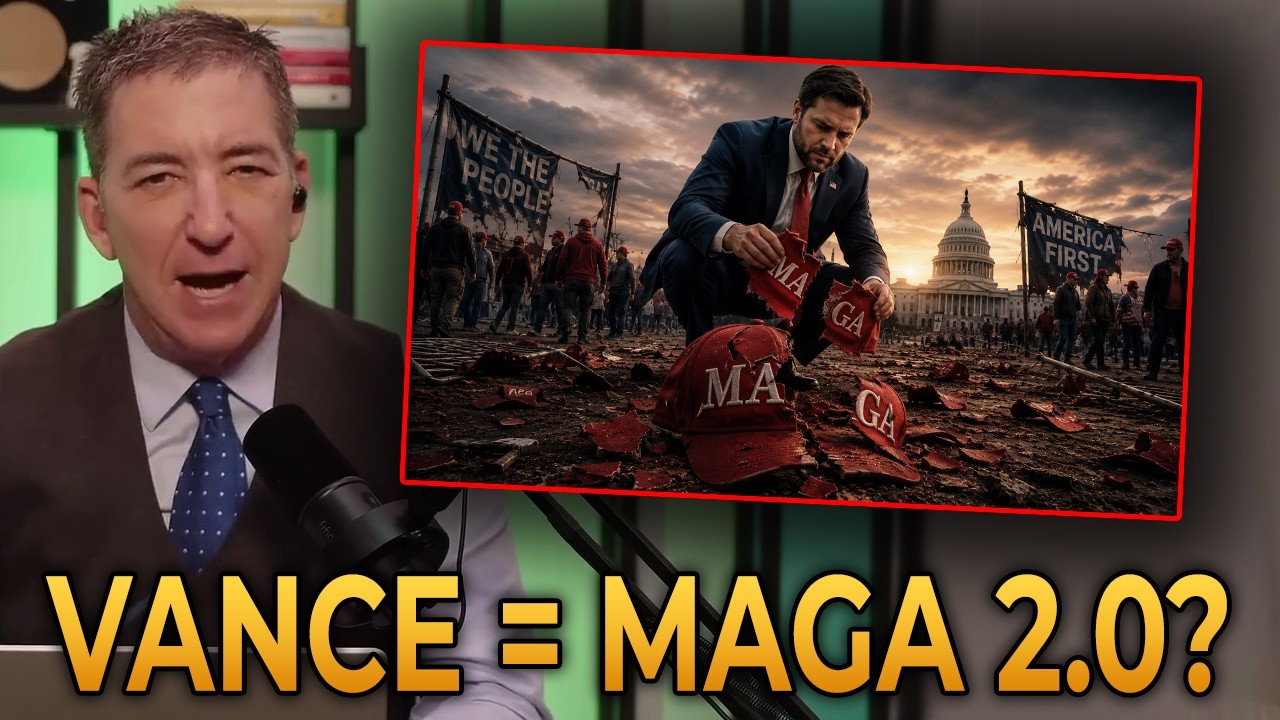
Is JD Vance Positioning Himself to Inherit MAGA? The Growing Battle for the Future of the Republican Party
The battle over the future of the Republican Party may have already begun—and it isn’t really about Donald Trump anymore. Behind the headlines, behind the foreign policy debates, and behind the public messaging surrounding the Middle East, a much larger political contest appears to be unfolding. At its center stands Vice President JD Vance, a politician whose recent rhetoric has prompted supporters and critics alike to ask the same question: is he speaking from conviction, or is he preparing for 2028?
That question has become increasingly difficult to ignore. As the once-unified MAGA coalition fractures over foreign policy, government spending, and campaign promises, ambitious Republicans are quietly positioning themselves for whatever comes next. Some observers believe Vance is trying to emerge as the natural heir to the populist wing of the GOP. Others argue he is simply reinventing himself after becoming closely associated with some of the administration’s most controversial decisions.
Whatever the answer, the debate surrounding Vance reveals something much bigger than one politician’s future. It exposes a Republican movement searching for a new identity—and a conservative base increasingly divided over what “America First” actually means.
A Movement That No Longer Looks United
For nearly a decade, Donald Trump dominated Republican politics in a way no modern politician had managed before. The MAGA movement became synonymous with Trump himself, built around his personality, his messaging, and his ability to reshape the Republican Party.
But political coalitions rarely remain frozen in time.
As disagreements have emerged over foreign policy, federal spending, immigration, and other priorities, the coalition that once appeared remarkably cohesive has shown visible signs of strain. While many Republicans remain loyal to Trump personally, there is growing debate over what the movement should become after his presidency.
That uncertainty creates an obvious question: who becomes the next standard-bearer?
Several names frequently surface in that conversation. Marco Rubio represents one path—a more traditional Republican establishment figure with extensive foreign policy experience. JD Vance represents another, attempting to retain elements of Trump’s populist appeal while appealing to younger conservatives who increasingly question America’s role overseas.
According to journalist Glenn Greenwald, Vance appears acutely aware of this changing landscape.
His argument is straightforward: Vance understands that the political coalition which carried Trump to power is changing, and he is adapting his public positions accordingly.
The Politics Behind the Messaging
Greenwald argues that Vance has become increasingly vocal about issues that resonate with younger Republicans, particularly skepticism toward interventionist foreign policy.
Polling over recent years has suggested that younger conservatives often express greater reluctance toward prolonged overseas military involvement than previous Republican generations. That shift has created political space for candidates willing to distance themselves from older neoconservative approaches.
From this perspective, Vance’s recent messaging serves a broader political purpose.
Rather than simply responding to current events, he may be laying the groundwork for a future presidential campaign by positioning himself closer to the evolving preferences of Republican primary voters.
Whether one agrees with that interpretation or not, it reflects a broader reality of American politics: ambitious politicians frequently adjust their messaging as coalitions evolve.
The important question is whether those changes represent genuine ideological development or calculated political strategy.
Critics Point to Vance’s Earlier Positions
One of the biggest challenges facing Vance is his own political history.
Critics argue that his recent image as a restraint-minded voice on foreign policy contrasts sharply with earlier statements supporting tougher action against Iran.
This perceived inconsistency has fueled accusations that Vance is attempting to rewrite his political identity.
Supporters counter that politicians can evolve as circumstances change and that changing one’s views is not necessarily evidence of bad faith.
Opponents respond that meaningful evolution requires openly acknowledging previous positions rather than quietly shifting emphasis.
The disagreement ultimately comes down to credibility.
Can voters trust that today’s rhetoric reflects deeply held beliefs, or is it simply preparation for tomorrow’s election?
The 2028 Calculation
Every vice president inevitably faces the same political challenge.
They must remain publicly loyal to the sitting president while simultaneously building an independent political identity.
That balancing act becomes especially difficult when parts of an administration become unpopular with key voting blocs.
If Republican primary voters continue moving toward a more restrained foreign policy outlook, Vance may find himself trying to satisfy two competing audiences:
Defending the administration he serves.
Convincing future primary voters that he represents something different.
This is hardly a unique problem.
American political history contains numerous examples of vice presidents attempting to preserve loyalty while quietly distinguishing themselves for future campaigns.
Whether Vance succeeds may depend less on his current messaging than on how Republican voters ultimately judge the broader Trump administration.
Rubio Versus Vance: Two Competing Futures
The conversation increasingly centers on an emerging contrast.
Marco Rubio is often viewed as representing the traditional Republican foreign policy establishment, even as he has aligned himself with Trump politically.
JD Vance, meanwhile, attempts to present himself as more closely connected to populist conservatives skeptical of intervention abroad.
If Republican voters remain committed to populism, Vance could hold an advantage.
If the party shifts back toward conventional conservatism, Rubio could become the stronger candidate.
The race may ultimately become less about personalities than about which vision of the Republican Party prevails.
The Information Divide
One of Greenwald’s broader observations extends beyond any individual politician.
He argues that Americans increasingly consume entirely different versions of reality depending on where they receive their news.
Traditional cable networks, podcasts, YouTube channels, independent journalists, and social media influencers often focus on completely different stories.
As a result, politically engaged Americans may possess entirely different understandings of what matters.
Someone who primarily follows conservative cable television may hear constant discussion about border security and inflation.
Someone immersed in independent political media may spend far more time hearing about cryptocurrency ventures, lobbying, surveillance technology, or foreign investment.
Neither audience necessarily encounters the other’s information ecosystem.
This fragmentation creates enormous challenges for democratic debate because citizens are often arguing from completely different factual starting points.
The Rise of Independent Media
Despite these concerns, independent media has dramatically expanded the range of viewpoints available to the public.
For decades, a relatively small number of television networks and major newspapers exercised enormous influence over political narratives.
Today’s environment is far more decentralized.
Independent journalists routinely investigate stories that receive little attention from traditional outlets.
Likewise, established media organizations continue producing investigations unavailable elsewhere.
The result is a far more competitive information landscape.
That competition undoubtedly creates confusion at times, but it also allows audiences access to perspectives that previously struggled to reach national attention.
The challenge for consumers is separating well-supported reporting from speculation and partisan advocacy.
Can Vance Really Unite the Populist Right?
Perhaps the most important political question is whether Vance could genuinely unify the Republican populist movement after Trump.
That task may prove extraordinarily difficult.
Trump’s appeal was never based solely on policy.
His personality, celebrity status, communication style, and willingness to challenge Republican orthodoxy created a political coalition unlike anything the GOP had previously experienced.
Replacing that combination will not be easy.
Even if Vance successfully adopts much of Trump’s messaging, many voters may still view him as too closely connected to the current administration.
Others may appreciate his communication style while remaining unconvinced that he represents genuine political change.
The distinction between inheritance and imitation could become decisive.
Ambition Is Not the Same as Success
There is little doubt that ambitious politicians think years ahead.
Potential presidential candidates constantly evaluate demographic trends, ideological shifts, and emerging voter priorities.
That does not necessarily make every political adjustment cynical.
Nor does it guarantee success.
American politics is filled with carefully constructed succession plans that never materialized.
Unexpected events reshape elections.
New candidates emerge.
Public opinion changes rapidly.
What appears inevitable one year can become irrelevant the next.
Whether JD Vance ultimately becomes the leading figure of the Republican Party depends on countless variables far beyond his own messaging.
The Republican Party at a Crossroads
The larger story is not simply about JD Vance.
It is about a Republican Party entering one of its most uncertain periods in decades.
Trump fundamentally transformed the GOP, but no political movement remains centered on one individual forever.
Eventually every movement confronts the same question:
What comes next?
Will Republicans continue embracing populism while redefining what “America First” means?
Will they return toward a more traditional establishment model?
Or will an entirely new coalition emerge that blends elements of both?
These questions remain unanswered.
Final Thoughts
The debate surrounding JD Vance reflects much more than one politician’s ambitions. It captures a Republican Party wrestling with its post-Trump identity, a conservative movement divided over foreign policy and populism, and a media environment in which competing narratives shape how millions of Americans interpret the same events.
Supporters see Vance as a politician adapting to changing realities and positioning himself to lead the next chapter of the movement. Critics see a calculated political operator attempting to distance himself from controversial decisions while preserving his path to the presidency.
Ultimately, voters—not commentators—will determine which interpretation carries greater weight.
As the 2028 election cycle gradually comes into view, every speech, policy position, and public appearance will likely be examined through that lens. Whether JD Vance emerges as the heir to Trump’s political coalition or becomes another ambitious figure unable to unite a fractured Republican base remains an open question.
What is already clear, however, is that the struggle to define the future of the Republican Party has begun long before the first primary votes are cast.