Unbelievable Footage Of Impossible Creatures Caught On Camera!
Unbelievable Footage Of Impossible Creatures Caught On Camera!
LOS ANGELES — There is a distinct, unsettling frequency to the modern midnight drive, a quiet anxiety that begins where the streetlights end and the dashcam’s lens takes over. In an era when every square meter of the planet has been mapped by satellites and every human interaction is mediated by data, we are supposedly a society cured of shadows. Yet, across the glowing screens of millions of Americans, a different reality is unfolding: a chaotic digital folklore of prehistoric beasts lumbering across desolate highways, skinwalkers howling past security perches, and spectral figures defying gravity beneath rural bridges.
These viral snippets of “shocking footage”—rapidly consumed via social media feeds and late-night video essays—reveal that our appetite for the unexplainable has not been dulled by the information age. If anything, our hyper-surveilled environment has merely forced the monsters of our collective imagination to adapt, trading the campfire stories of the past for the grainy pixels of a CCTV stream. What we are witnessing is not a resurgence of ancient superstition, but a high-tech re-enchantment of a world we thought we had completely tamed.
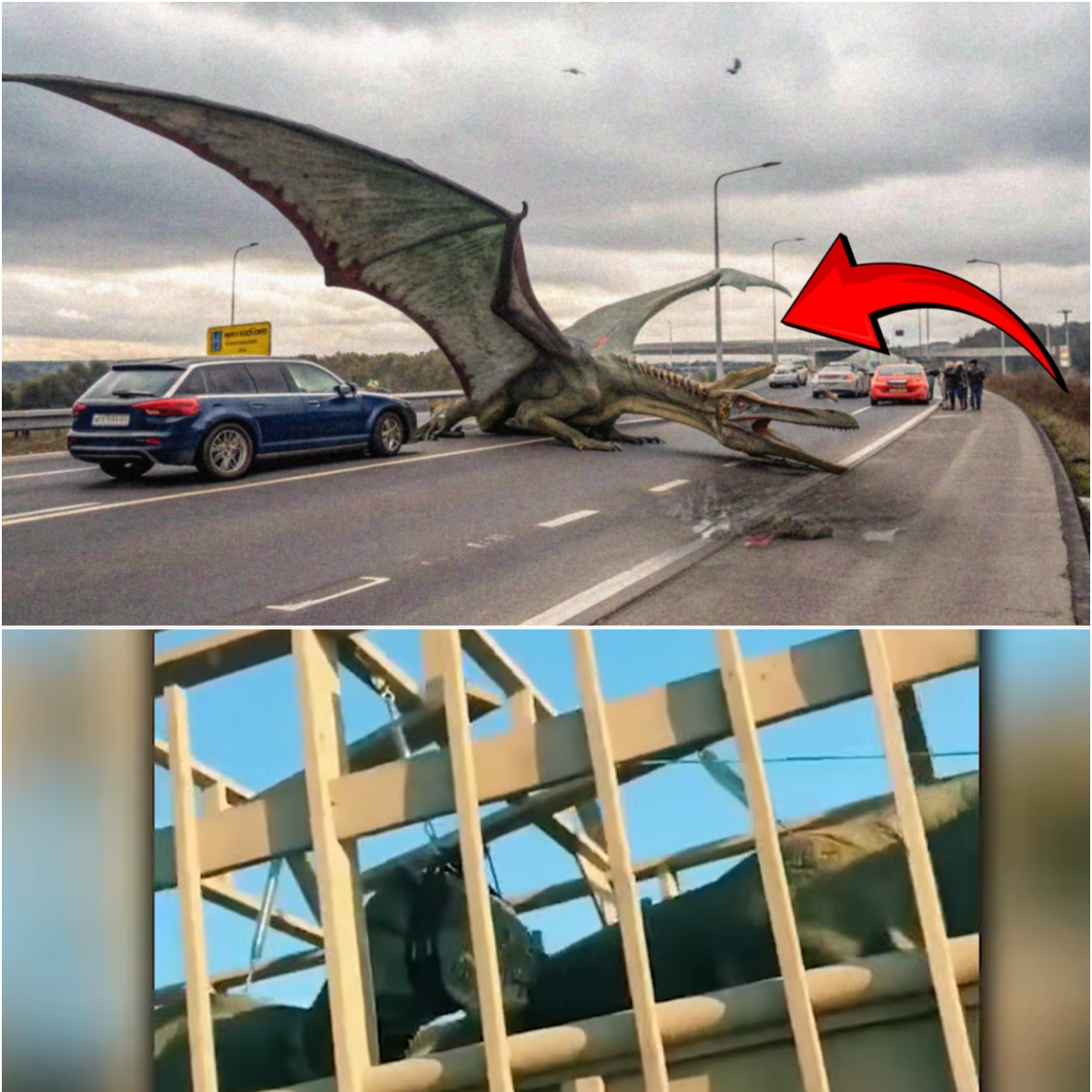
The Digital Bestiary: Jurassic Sightings on the Interstates
For decades, the standard scientific consensus has been comforting in its finality: the non-avian dinosaurs perished roughly 66 million years ago, leaving behind nothing but fossilized bone and stone impressions. But on the modern internet, the Mesozoic era regularly bleeds into suburban traffic.
Among the most pervasive sub-genres of online cryptid footage are the “dinosaur encounters.” In these clips, motorists film what appear to be massive, multi-ton theropods pacing through semi-rural backyards or blocking two-lane asphalt roads while locals brandish makeshift torches. In more intimate, handheld videos, agile packs of Compsognathus—the tiny, bird-like scavengers popularized by Hollywood—are depicted swarming a filmmaker in the brush, culminating in the surreal comedic horror of a prehistoric reptile snatching a smartphone and sprinting into the wilderness.
To the digital-native audience, the appeal of these videos relies on an uncanny juxtaposition. We are accustomed to seeing dinosaurs rendered with immaculate, million-dollar visual effects in cinema seats. However, when a Stegosaurus appears in a low-resolution clip captured by a trembling bicyclist navigating a foggy trail, or when a dashcam catches a pair of Triceratops stepping into the headlights of a late-night taxi, the brain experiences a glitch in its media literacy.
"The power of this footage doesn't lie in its cinematic perfection," notes an independent digital media analyst based in California. "It lies in its casualness. It adopts the visual grammar of the mundane—the shaky hand, the autofocus lag, the dirty windshield—to make the impossible feel deeply ordinary."
Even more compelling to the online rumor mill are the structural artifacts of institutional cover-ups. Viral videos frequently depict heavy flatbed trucks under heavy rain, hauling reinforced containers from which the distinct, snarling heads of Velociraptors appear to protrude, secured by heavy industrial webbing. The accompanying commentary rarely attributes these sights to Hollywood prop transportation or animatronic engineering. Instead, the internet leans into the narrative of the clandestine: secret research facilities, rogue genetic editing labs, and deep-state cloning projects that have quietly breached containment, turning the American highway system into a pipeline for modern-day monsters.
The Hominid and the Hex: Cryptids in the Security Feed
Where dinosaurs cater to our fascination with the primeval, a darker class of internet footage taps into an older, more intimate terror: the sub-human and the supernatural lurking right outside our windows.
Consider the “trail camera capture,” a staple of American wilderness lore. In these brief, terrifying sequences, motion-activated lenses meant for tracking deer instead register pale, emancipated humanoids crawling on all fours across empty roads, or dark, hunched figures burrowing into the red clay of an Ohio construction site. To the online communities that catalog these clips, these are not wandering wildlife or eccentric trespassers; they are identified with specific names drawn from regional folklore and internet mythology—the Rake, the Wendigo, or the Native American Skinwalker.
The setting for these encounters has evolved from the deep woods to the perimeter of human industry. Security guards on night duty in desolate machinery yards film shadows that dart with unnatural velocity the moment a flashlight beam hits them. In remote villages, surveillance cameras capture solitary women sitting entirely motionless on sandy ground, their fingers unnaturally elongated, performing rigid, rhythmic gestures that viewers quickly dub a “witch’s vigil.”
The horror of the security feed is its cold objectivity. A security camera has no imagination; it does not panic, it does not breathe heavily, and it does not have an artistic agenda. When it captures an anomalous shape—whether it is a bizarre, bird-like hybrid with a human face lurking in an abandoned industrial building, or a creature moving upside down beneath a concrete bridge, its legs gliding along the understructure as if gravity were optional—the camera records it with the same flat indifference it would show to a passing stray dog. It is this lack of human drama within the medium itself that gives the footage its chilling authenticity.
The Phantoms of the Concrete: Ghostly Sentinels at 3:00 A.M.
If the highway is the stage for prehistoric revivals, it is also the home of the classic American ghost story, updated for the dashboard camera. The archetype of the “Vanishing Hitchhiker” has been a fixture of the American consciousness since the days of the stagecoach, but the internet has given this spirit a permanent, digital record.
A frequent narrative template involves a long-haul truck driver cruising through the desert stretches of Arizona or New Mexico in the dead of night. At precisely 2:30 or 3:00 a.m., the headlights illuminate a pale, transparent figure standing by the roadside—often a woman dressed in white, completely motionless against the black void of the desert. The driver slams on the brakes, the camera pans, and the figure is gone, leaving behind nothing but the crackle of the CB radio and an overwhelming sense of isolation.
Unlike the monsters of flesh and bone, these phantoms are explicitly tied to the history of the infrastructure itself. In the comment sections below these videos, locals regularly chime in with historical context, pointing out that the specific stretch of highway has been the site of numerous fatal accidents over the decades. The digital apparition becomes a monument to tragedy, a visual manifestation of lingering trauma that the asphalt has absorbed.
When police review the official highway surveillance footage and find absolutely nothing on the digital tape, the mystery only deepens. The internet does not conclude that the driver fell asleep or suffered a hallucination; rather, it decides that certain spiritual frequencies can only be caught by the cheap, unshielded sensors of a commercial dashcam, transforming consumer electronics into accidental tools of spiritual mediumship.
The Anatomy of the Hoax: Why We Choose to Believe
To the skeptic, the proliferation of these videos is easily explained by a combination of sophisticated CGI, practical pranks, clever marketing campaigns, and the democratization of video editing software. A miniature dinosaur eating out of a bird cage is an elaborate puppet; a massive snake coiled on a jungle road is a well-placed prop or a trick of perspective; a strange, shimmering object flying over Berlin with a silvery trail is a custom-built drone or a digital artifact caused by a dirty lens filter.
Yet, to focus exclusively on the technical mechanics of the deception is to miss the entire cultural point of the phenomenon. The millions of views, shares, and passionate debates that follow every “unexplained” video indicate that a significant portion of the public wants these creatures to be real. In a world that has been thoroughly demystified by science and organized by corporate algorithms, the presence of a dinosaur in a backyard or a phantom on a highway represents a beautiful, terrifying loophole.
"We live in a world where everything is known, tracked, and predictable," says a sociologist specializing in digital folklore. "Believing in a cryptid or a skinwalker caught on a security tape is a form of rebellion. It means there are still blank spaces on the map. It means the world is still larger than our ability to explain it."
Furthermore, this digital folklore provides a strange sense of community. The comment section beneath a shaky, night-vision video of a “Dire Wolf” hunting along a snowy roadside becomes a modern town square. Here, individuals from completely different backgrounds gather to analyze frames, swap stories of their own anomalous encounters, and build a collective mythology. They are engaging in an adversarial relationship with the mainstream narrative of a fully understood world, asserting their right to look at a glitching screen and see a monster.
The Permanent Shadow
Ultimately, the videos we watch on our phones in the dark are a modern manifestation of the oldest human impulse: the need to populate the night with terrors that match our internal anxieties. The ancient Greeks had the wilderness of Arcadia; the medieval Europeans had the deep, uncharted forests; modern Americans have the empty highway, the abandoned warehouse, and the edge of the suburban development.
The creatures we run from in our nightmares have simply found a new habitat. They no longer hide in the thickets of unmapped jungles or the depths of unexplored oceans; they hide in the compression artifacts of a low-bitrate video, the blind spots of a security perimeter, and the glare of oncoming high beams. As long as our technology leaves even a single frame of darkness unresolved, the human mind will fill that space with something ancient, fierce, and beautifully alive.