Archaeologists Studied the First Pharaoh’s Burial Chamber – What They Found Shouldn’t Exist
Archaeologists Studied the First Pharaoh’s Burial Chamber — What They Found Shouldn’t Exist
The burial chamber was small, burned, broken, and almost empty. But in the debris around Egypt’s first pharaoh, archaeologists found the blueprint of an empire that should not have been so advanced so early.
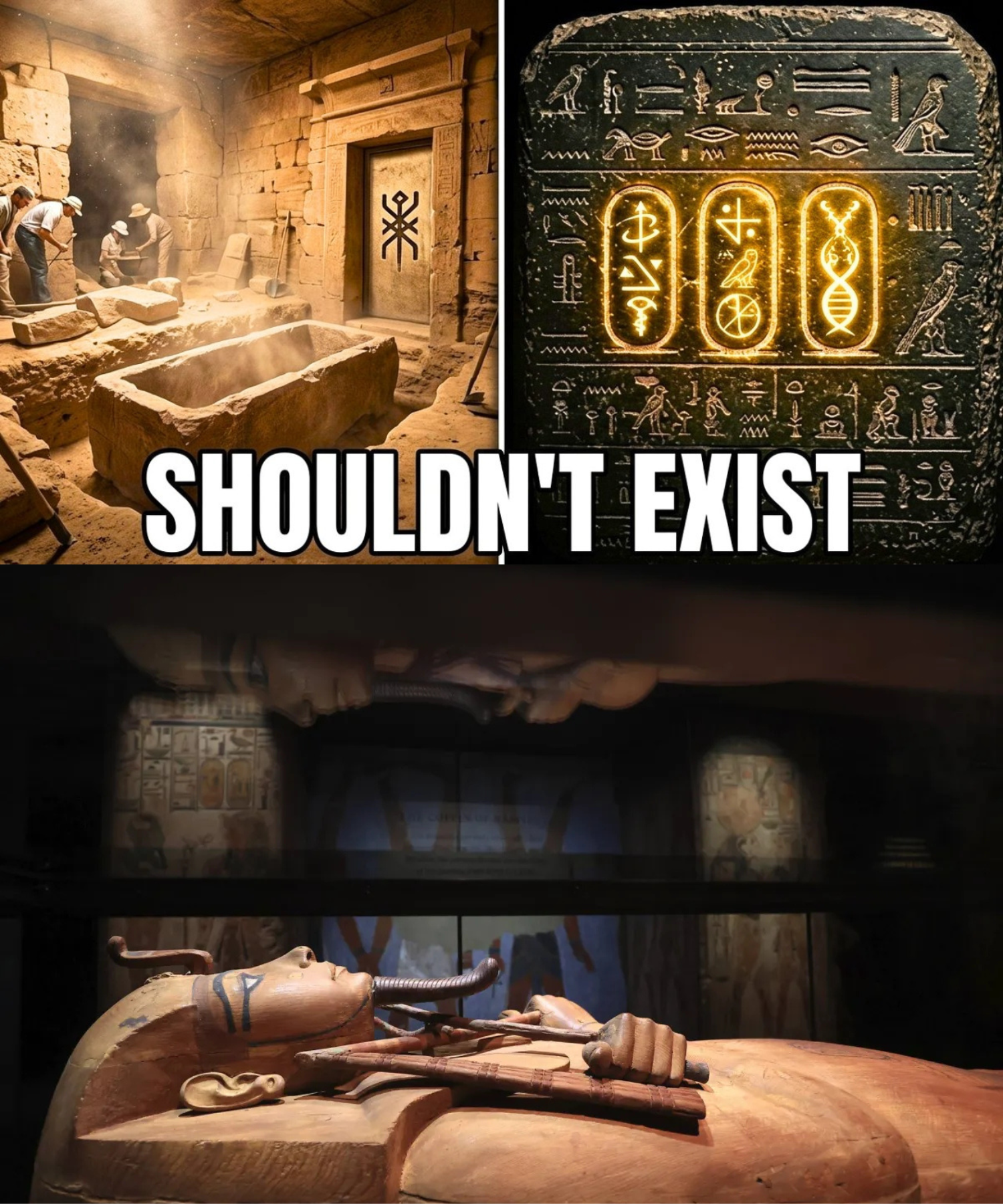
For thousands of years, Egypt’s kings were remembered through pyramids, temples, golden masks, colossal statues, and names carved so deeply into stone that even time struggled to erase them. But the beginning was not gold. It was mudbrick, timber, desert sand, broken pottery, ivory tags, sealed jars, burned floors, and a tomb at Abydos that looked almost too humble to belong to the man who may have started it all.
His name was Narmer.
To many scholars, Narmer stands at the threshold of pharaonic history—the king often associated with the unification of Upper and Lower Egypt, the ruler whose famous palette shows him wearing the crowns of both lands, crushing enemies, and stepping into the visual language that would define Egypt for more than three thousand years. Later tradition remembered a founder called Menes. History, archaeology, and royal memory do not always line up neatly, but Narmer remains the figure most powerfully connected to Egypt’s first great political transformation.
That is why his burial chamber matters.
A king who supposedly began one of the longest-lasting civilizations in human history should have left behind something grand, something unmistakable, something worthy of pyramids yet to come. But at Umm el-Qa’ab, the royal cemetery near Abydos, the tomb attributed to Narmer is not a pyramid. It is not a stone temple. It is not a glittering chamber filled with treasure. It is a pair of modest mudbrick-lined chambers, badly robbed and damaged, lying in a desert cemetery where later Egyptians believed the tomb of Osiris himself could be found.
At first glance, it seems disappointing.
Then you understand what was around it.
That is where the mystery begins.
The burial chamber itself is only the center of a much larger story. Around these early royal tombs, archaeologists found evidence of ritual power, trade, writing, sacrifice, imported goods, administrative control, and a mortuary system that already carried the DNA of later Egypt. The shocking thing was not one golden artifact that “shouldn’t exist.” It was the whole system. Egypt did not appear slowly and clumsily from nothing. By the time of its first kings, it already had kingship, bureaucracy, sacred imagery, long-distance exchange, elite craftsmanship, and a terrifyingly serious belief in the afterlife.
That should make every reader stop.
Because the beginning of Egypt does not look like a beginning.
It looks like a civilization that had been preparing itself in the shadows.
The tombs at Umm el-Qa’ab had suffered greatly. They were plundered in antiquity. Their roofs and wooden structures were burned. Later excavations were not always careful. Some early diggers damaged or scattered material before modern archaeological methods could protect it. Yet even through all that destruction, enough survived to reveal something astonishing: Egypt’s earliest kings already ruled a world of organization.
Tiny labels made of ivory and ebony carried some of the earliest known royal records. Seal impressions showed names, authority, storage, and administration. Jars once held wine, oils, resins, and offerings. Stone vessels demonstrated technical skill. Copper tools and ivory carvings spoke of elite craft. Imported materials hinted at contact far beyond the Nile Valley. Surrounding graves and ritual spaces showed that the king’s death was not treated as the end of a human life, but as a transfer of power into another realm.
This was not a simple village chief buried with a few personal possessions.
This was a king being installed into eternity.
And that changes everything.
The first “thing that shouldn’t exist” is writing—or at least writing in an early administrative form so close to the dawn of kingship. In Narmer’s world, symbols were not merely decorative. They were tools of rule. A name could be stamped. A jar could be marked. A delivery could be recorded. A king could exist not only as a man but as an official sign, repeated on objects, tags, seals, and monuments. That may sound ordinary to modern people, but it was revolutionary.
Writing allowed power to travel.
A king could not stand in every storeroom, workshop, field, and tomb. But his name could. His seal could. His officials could mark property, movement, tribute, and ritual goods under royal authority. This is how a kingdom becomes more than a battlefield victory. It becomes an administration. The first pharaoh was not simply a warrior with a crown. He was the head of a system that could gather resources, organize labor, move goods, and speak through marks pressed into clay or carved into ivory.
That should not feel small.
That is the beginning of the state.
The second “impossible” discovery is the reach of early Egypt’s trade. Objects and materials associated with the earliest royal tombs show that the first kings were not isolated rulers of a narrow valley. Abydos itself sat near routes that connected the Nile Valley with desert roads, oases, and paths toward the Red Sea. Early Egypt had access to goods, materials, and ideas moving across surprising distances. Wine jars from the Levant, cedar or other prized woods from outside Egypt, lapis-like luxury materials, oils, resins, and other exotic goods all point toward a world already connected.
Modern people often imagine ancient civilization beginning locally and only later expanding outward.
But the first pharaoh’s world was already plugged into networks.
This matters because it means Egypt’s rise was not only a story of the Nile. It was also a story of roads, deserts, boats, trade, diplomacy, conquest, and symbolic control. A king who could command goods from beyond his homeland was not just wealthy. He was demonstrating cosmic reach. His tomb became a map of power. Every foreign jar, every rare material, every crafted object said the same thing: the king’s authority did not stop at the edge of one town.
It stretched beyond the visible horizon.
The third discovery is darker.
Human sacrifice.
Around early royal tombs and mortuary enclosures at Abydos, archaeologists found strong evidence that some courtiers, servants, and retainers may have been killed and buried to accompany the king into the afterlife. This practice appears mainly in the First Dynasty and did not continue in the same form throughout Egyptian history. Later Egyptians solved the problem differently, using servant figurines and symbolic substitutes. But at the beginning, the belief may have been brutally literal: the king would need people in the next world, and those people would go with him.
This is one of the most disturbing windows into early pharaonic power.
It shows that kingship was not merely political. It was total. The king’s death could reach into the lives of others. His afterlife required a court. His eternal journey may have demanded attendants. The tomb was not a private grave. It was a royal event that could consume human beings.
That is terrifying.
But it also reveals how seriously the early Egyptians took the afterlife. They did not view death as disappearance. They viewed it as continuation, transformation, and dangerous passage. If a king remained powerful after death, then his burial had to be equipped like a palace, a ritual center, and a launch point into eternity. Every offering mattered. Every container mattered. Every servant mattered. Every sealed chamber mattered.
The king did not simply die.
He moved.
The fourth discovery is the strange relationship between Narmer’s small tomb and the giant civilization that followed. The chamber itself is modest compared with later royal monuments. There is no pyramid, no granite sarcophagus, no painted underworld books, no golden mask. And yet, the essential ideas are already there: royal identity, sacred kingship, ritual burial, offerings, administrative labels, elite craft, foreign goods, and the belief that death required preparation.
In other words, the seed of the pyramid age was already buried in the mudbrick tombs of Abydos.
That is the real shock.
The pyramids did not come from nowhere. They grew from a royal theology already forming in the First Dynasty. The first pharaoh’s burial chamber may look simple, but it contains the logic that later produced stone mountains. Once a king becomes more than a man, once his death becomes a national ritual, once his afterlife becomes the concern of a state, then monumental tomb-building is almost inevitable. The material changes. Mudbrick becomes stone. Small chambers become enormous complexes. But the idea is already alive.
Narmer’s world was the spark.
Later Egypt was the fire.
The fifth discovery is that early Egypt’s royal cemetery was remembered and revisited long after those first kings were gone. Umm el-Qa’ab did not remain just an abandoned burial ground. In later periods, Egyptians associated the area with Osiris, lord of the dead. Pilgrims came. Offerings were left. Pottery accumulated in huge quantities. The place became sacred memory layered on top of royal history. The tombs of early kings were no longer only graves of rulers; they became part of Egypt’s religious landscape.
This matters because it shows how the first pharaohs became more than historical figures.
They became ancestors of the sacred order.
Abydos itself became one of Egypt’s great holy places, tied to death, resurrection, pilgrimage, and the hope of eternal life. The earliest royal burials helped shape that sacred geography. In a way, Narmer and his successors were not only buried in Abydos; they helped make Abydos holy.
The desert remembered them.
Egypt remembered through ritual.
And later generations walked over the same ground believing the boundary between life and death was thinner there.
This is the kind of discovery that feels impossible because it compresses so much time into one place. A king from the dawn of history. A cemetery of first rulers. A later cult of Osiris. Pilgrims leaving pottery centuries afterward. Modern archaeologists digging through layers of devotion, robbery, fire, and memory. The site is not one moment. It is a conversation across thousands of years.
That is what the first pharaoh’s burial chamber really gives us.
Not a single secret object.
A chain of meaning.
But the public often wants something more dramatic: a battery, a machine, an alien artifact, a lost technology, a map of Atlantis, a forbidden object that “shouldn’t exist.” Those ideas spread because they are easy to understand. One impossible artifact overturns history. One hidden device explains everything. One conspiracy makes the past feel simple.
Real archaeology is more difficult and more powerful.
The things that truly “shouldn’t exist” are not always shiny. Sometimes they are systems appearing earlier than expected. Administrative control before later empire. International exchange before full dynastic grandeur. Human sacrifice inside a civilization later famous for symbolic substitutes. Early writing at the edge of recorded history. Royal ideology already mature in a mudbrick tomb.
That is far more important than fantasy.
Because it means human society can become complex faster than we imagine when geography, ambition, belief, trade, violence, and organization converge.
The first pharaoh’s burial chamber tells us that Egypt did not begin as a primitive sketch waiting for greatness. It began with an astonishing concentration of power. Someone was already organizing labor. Someone was already commanding craftsmen. Someone was already collecting goods. Someone was already defining kingship as sacred. Someone was already marking names and identities. Someone was already turning death into a political and religious event.
That someone was the early pharaoh.
The man in the chamber may be gone.
But the machine around him had already started.
Look at the Narmer Palette, though it was not found in his tomb. It shows the same world in visual form: the king larger than others, enemies defeated, crowns of Upper and Lower Egypt, divine symbols, controlled chaos, ritual violence, and an image of kingship so powerful that later Egyptian art would echo it for millennia. The palette is not a casual picture. It is a declaration. It says the king is order. The king conquers chaos. The king stands between human and divine. The king is Egypt embodied.
Now place that idea beside the burial chamber.
The tomb is not just where the king’s body went.
It is where that ideology was buried, preserved, and renewed.
Even if the chamber was robbed, its meaning was not stolen.
The mudbrick walls, the offerings, the labels, the surrounding ritual spaces, and the royal cemetery all reveal that Egypt’s first kings had already invented one of the most powerful political ideas in human history: the divine monarchy. Pharaoh was not merely a chief. He was the axis of the world. His life ordered the land. His death required ritual continuity. His name survived through signs. His body became part of sacred geography.
This idea would dominate Egypt for over three thousand years.
And the earliest evidence of it lies not in a pyramid, but in a damaged tomb in the desert.
That is why the first pharaoh’s burial chamber matters more than people expect. It humbles the imagination. We are used to measuring greatness by size. The Great Pyramid overwhelms us because it is enormous. Tutankhamun’s tomb overwhelms us because it is golden. Karnak overwhelms us because it is vast. But Narmer’s tomb overwhelms in another way. It is the beginning before the spectacle. It is the root before the tree. It is small enough to disappoint tourists and important enough to change history.
The most shocking discoveries are sometimes quiet.
A broken label.
A burnt timber.
A seal impression.
A jar fragment.
A subsidiary grave.
A chamber wall.
A name.
Together, they whisper something enormous: Egypt was already becoming Egypt.
This is also why the phrase “the first pharaoh” is complicated. Ancient tradition speaks of Menes. Archaeology points strongly to Narmer as a unifying king. Some scholars connect Menes with Narmer, others with Hor-Aha, and some see the question as more complex. The beginning of Egyptian kingship was not written in a modern history textbook. It was preserved in fragments, later king lists, monuments, seals, tombs, and scholarly reconstruction.
That uncertainty should not weaken the story.
It makes the story more real.
History is not handed to us cleanly. It is recovered from broken things. The first pharaoh is not a simple character standing under a spotlight. He is a figure emerging from clay tags, carved palettes, damaged tombs, later traditions, and archaeological debate. The closer we get to the beginning, the more fragile the evidence becomes—and the more powerful each fragment feels.
That is why the burial chamber feels haunted.
Not by ghosts.
By absence.
The body is gone. The treasures are mostly gone. The wooden roof burned. The tomb was disturbed. The grave goods were scattered. But the evidence that survived is enough to reveal a world already organized around power, death, and eternity.
What should not exist is not one impossible object.
What should not exist is this level of civilization so early.
A king with a name that could be written.
A state capable of mobilizing labor.
A royal cemetery tied to ritual geography.
Imported goods moving across long distances.
Funerary practices involving sacrifice.
Craftsmanship already refined.
Symbols of kingship already stable enough to last thousands of years.
That is the true anomaly.
Not aliens.
Not lost machines.
Human organization.
Human belief.
Human ambition.
Human fear of death.
Those forces built Egypt before stone pyramids ever rose.
If the first pharaoh’s tomb teaches us anything, it is that civilizations are born when people learn to turn memory into structure. Narmer’s world did not simply bury a ruler. It buried an idea so deeply that it grew upward through all later Egyptian history. Every pyramid, every royal cartouche, every coronation, every divine crown, every funerary text, every temple wall showing pharaoh smiting chaos—they all descend from the same early vision.
A king is not only alive while breathing.
A king can continue after death.
A king can organize the living from beyond the grave.
A king can become the center of a nation’s imagination.
That belief changed the world.
Modern readers may search for something that “shouldn’t exist” because they want the past to surprise them. But the earliest pharaohs already do. They surprise us by proving how quickly humans can create sacred power. They surprise us by showing that writing, ritual, trade, violence, and afterlife theology were woven together from the beginning. They surprise us by reminding us that civilization is not gentle at birth. It arrives with beauty, blood, order, fear, and ambition all mixed together.
The burial chamber at Abydos is therefore not disappointing because it lacks gold.
It is terrifying because it contains the beginning of a system that would outlast almost every kingdom on Earth.
A small tomb.
A burned chamber.
A broken archive.
And inside the ruin, the first heartbeat of pharaonic Egypt.
That is what archaeologists really found.
Not an object that should not exist.
A civilization already alive before anyone expected it to be so complete.