TV Debate Erupts After British Man Challenges Muslim Woman Over Cultural Claims
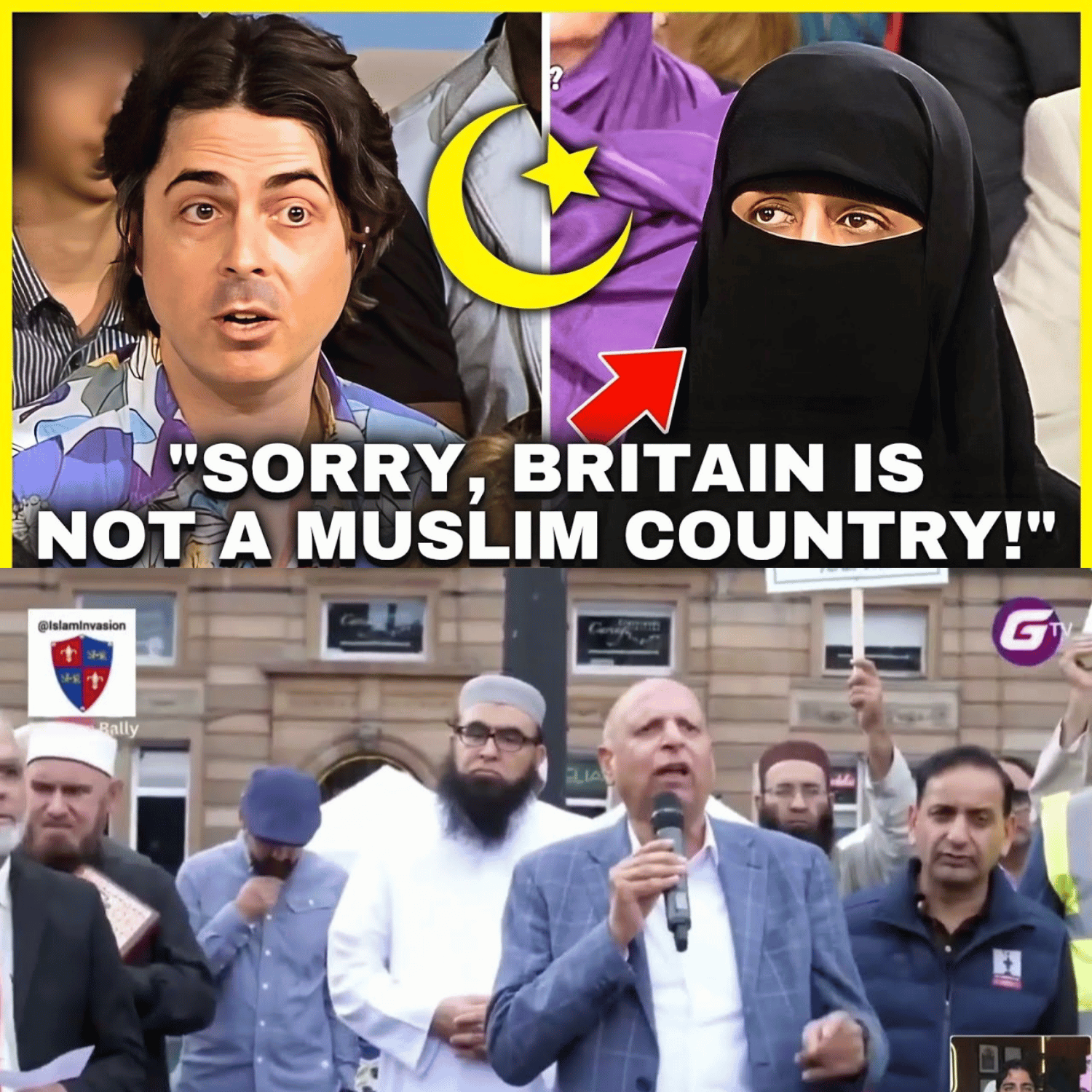
Heated Debate Erupts After Glasgow Speech on Religious Respect Sparks Free Speech and Integration Controversy
A public gathering in Glasgow has triggered an intense online and political debate after a speaker called for global legal protections against insults toward religious figures, including the Prophet Muhammad, while emphasizing the emotional and spiritual significance of religious reverence for Muslims worldwide.
The remarks, captured on video and widely circulated on social media, have reignited longstanding tensions in Europe over the limits of free speech, religious respect, and the role of law in regulating expression.
In the video, the speaker argues that disrespect toward religious symbols and figures is deeply offensive to Muslims and calls for international legal frameworks that would criminalize such actions. He states that reverence for the Prophet Muhammad is central to Islamic belief and expresses hope that governments and international institutions would one day enforce protections against blasphemy.
The comments were met with both support and criticism online. Supporters argue that the speech reflects a legitimate desire for respect and protection of religious identity in increasingly multicultural societies. Critics, however, see the proposal as incompatible with Western free expression norms, which traditionally protect even offensive or critical speech under free speech laws.
The debate quickly expanded beyond the initial speech as commentators began linking the discussion to broader issues of integration and cultural values in Europe.
Free Speech vs. Religious Respect
At the heart of the controversy is a familiar tension in Western democracies: how to balance freedom of expression with respect for religious beliefs.
In countries like the United Kingdom and the United States, freedom of speech is a foundational legal principle. However, religious communities often argue that unrestricted expression can cross into harassment or incitement when it targets sacred beliefs.
Legal experts note that while hate speech laws exist in parts of Europe, outright blasphemy laws have largely been abolished in most Western democracies, reflecting a shift toward prioritizing individual expression over religious protection.
“This is not a new debate,” one legal analyst explained in a televised segment. “The question is where the line is drawn between offensive speech and harmful speech, and different societies answer that question differently.”
Burqa Discussion Adds Another Layer
The controversy broadened further when a separate televised discussion about the burqa resurfaced in connection with the video.
During that debate, participants discussed whether face-covering garments should be restricted in public spaces. One commentator argued that full-face coverings can be alienating in societies where facial expression is central to communication and public trust.
Others defended the right to wear religious clothing, emphasizing personal freedom and bodily autonomy in liberal democracies.
The exchange highlighted a persistent divide across Europe: whether religious expression in public spaces should be fully unrestricted or subject to limitations based on security, communication, or social cohesion concerns.
Cultural Integration and Political Anxiety
As clips from both discussions circulated online, reactions quickly became polarized.
Some viewers interpreted the speeches as evidence of deeper cultural friction in Europe, arguing that liberal societies struggle to reconcile differing value systems within increasingly diverse populations. Others accused commentators of generalizing entire religious communities based on political or ideological interpretations.
Sociologists warn that such viral debates often oversimplify complex realities.
“Europe is not facing a single issue—it’s facing overlapping debates about identity, immigration, religion, and law,” said one academic specializing in migration studies. “When these conversations are reduced to short clips, nuance disappears and polarization increases.”
Workplace Incident Sparks Further Controversy
Adding to the online firestorm, another unrelated clip circulating alongside the debate showed a workplace incident involving a warehouse fire, which some commentators attempted to connect to broader narratives about integration and labor tensions.
Authorities have not confirmed any link between the incident and broader ideological motivations, and officials continue to investigate the case independently. However, online discussions quickly fused the events together, further intensifying emotional reactions.
Experts say this pattern—merging unrelated incidents into a single narrative—is increasingly common in social media environments where viral content spreads faster than verified information.
Street Scene in Italy Fuels Debate on Public Space
Another clip circulating as part of the broader discourse showed a blocked street in Italy, prompting commentary about public order and cultural norms in urban spaces.
Some online voices interpreted the scene as a symbol of broader societal change, while others pointed out that street congestion and public disruptions are common urban issues unrelated to culture or religion.
Urban policy experts caution against drawing sweeping conclusions from isolated footage.
“Public space management is a logistical issue in cities worldwide,” one planner noted. “It becomes politicized when people attach cultural meaning to everyday events.”
Growing Polarization Online
The rapid spread of the video clips underscores how quickly complex cultural and religious discussions can become flashpoints in the digital age. Within hours, what began as a localized speech in Scotland evolved into a multi-layered international debate involving free speech, religious identity, women’s clothing, immigration, and social cohesion.
Social media users on different sides of the debate interpreted the same footage in dramatically different ways. Some saw a legitimate defense of religious respect; others saw a challenge to foundational Western freedoms.
Digital analysts say this reflects a broader trend in online discourse: the fragmentation of shared context.
“People are no longer arguing about the same facts,” one researcher said. “They are arguing from completely different interpretations of reality shaped by algorithmic content feeds.”
Conclusion
As the controversy continues to circulate, no consensus has emerged. Instead, the videos have become part of a larger cultural conversation that extends far beyond Glasgow.
At its core, the debate raises fundamental questions: How should pluralistic societies balance freedom of speech with respect for deeply held beliefs? How can legal systems adapt to increasing cultural diversity? And where is the line between legitimate critique and harmful stereotyping?
For now, the answers remain unresolved—but the intensity of the reactions suggests the conversation is far from over.