YouTuber Travels To Palestine, But Sees A Different Reality Instead!
YouTuber Travels To Palestine, But Sees A Different Reality Instead!
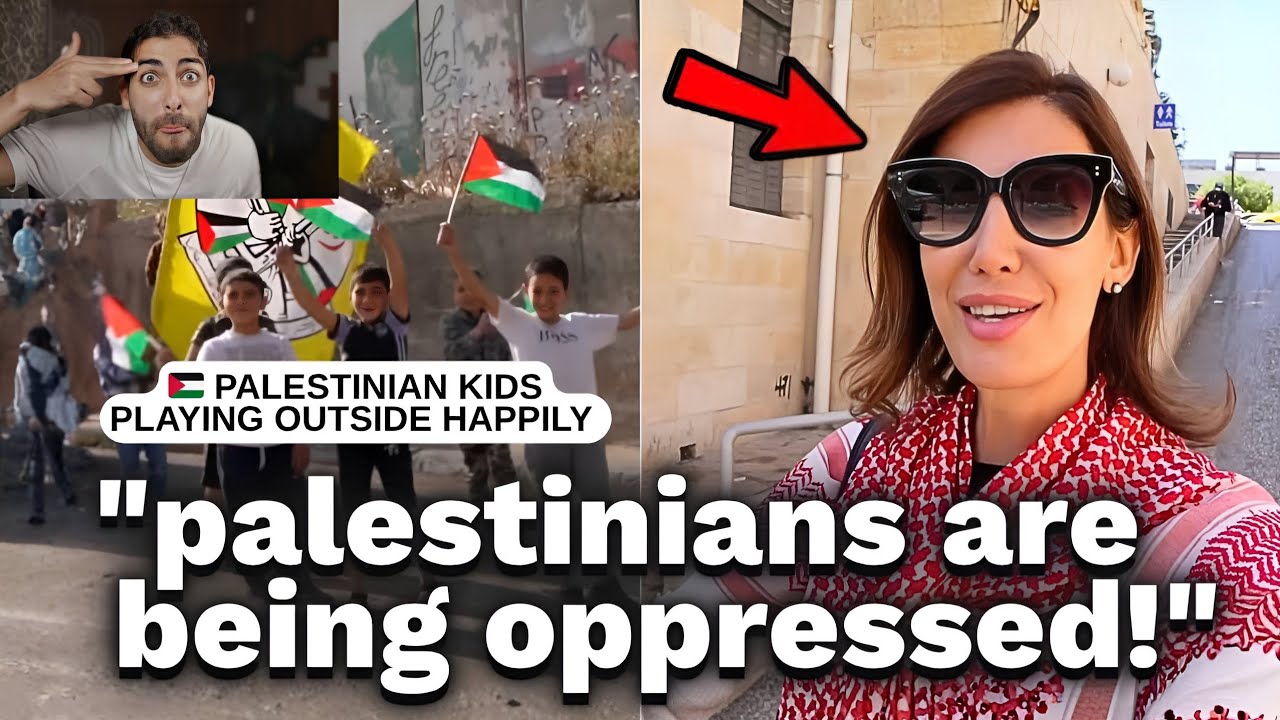
A travel video filmed in Bethlehem and the surrounding Palestinian areas has ignited a heated online debate after a pro-Israel commentator reacted sharply to scenes of the separation barrier, refugee camps, political murals, local guides, and children holding flags. What began as a seemingly ordinary travel vlog quickly turned into a larger argument over history, security, propaganda, tourism, and the way outsiders are introduced to the Israeli-Palestinian conflict.
The original video follows a foreign traveler named Jessica as she visits Bethlehem, walks near the separation barrier, enters a refugee camp, talks to locals, visits the famous Walled Off Hotel, and observes daily life in Palestinian neighborhoods. The tone of her vlog appears curious and sympathetic. She describes the wall as a major structure dividing Palestinian areas from Israeli settlements and presents local voices who explain the hardships Palestinians face.
But the reaction video transforms the trip into something far more confrontational. The commentator repeatedly challenges the way Palestinian reality is presented to tourists, arguing that visitors are shown a carefully selected narrative designed to create sympathy for Palestinians while hiding the security reasons behind Israeli policies. He objects to the term “refugee camp,” questions why Palestinians born in the West Bank are still described as refugees generations later, defends the separation barrier as a response to terrorism, and accuses local guides of promoting one-sided claims.
The result is a video that has drawn strong reactions from both sides of the conflict. Supporters of the commentator praise him for challenging what they see as anti-Israel propaganda. Critics accuse him of dismissing Palestinian suffering, oversimplifying a complex occupation, and turning ordinary scenes of life under restriction into evidence of deception.
At the center of the controversy is one place: the separation barrier near Bethlehem.
For Palestinians and many international visitors, the barrier is a symbol of restriction, humiliation, and separation. It cuts through landscapes, affects movement, and has become one of the most visible physical symbols of the conflict. Its concrete sections near Bethlehem are covered with graffiti, political messages, murals, protest art, and calls for freedom. Tourists often visit it as part of a political education, guided by locals who explain what the wall means for their daily lives.
For Israelis and many supporters of Israel, the barrier is understood very differently. They view it primarily as a security measure built after a wave of suicide bombings and attacks during the Second Intifada. From this perspective, the wall and fence system was not created to humiliate Palestinians, but to stop attackers from entering Israeli cities and killing civilians. The commentator in the transcript makes this argument forcefully, saying the barrier exists because terrorists had entered Israel and carried out bombings against civilians.
This disagreement over the wall captures the entire conflict in miniature. One side sees a structure of control. The other sees a shield against violence. Both interpretations are rooted in real experience. Palestinians experience checkpoints, restricted movement, and separation. Israelis remember buses, cafes, and public places targeted by suicide bombers. The tragedy is that each side’s fear often becomes invisible to the other.
The travel video describes the wall as stretching for hundreds of kilometers and dividing Palestinian territories from Israeli settlements. The commentator disputes parts of that description, emphasizing that much of the barrier is not a concrete wall but fences, trenches, and security infrastructure. He argues that Western tourists are often shown the most dramatic concrete sections while being told that this represents the entire structure.
There is a real media issue here. Visual symbols matter. A towering concrete wall is more emotionally powerful than a distant fence. A mural of resistance is easier to photograph than the memory of attacks that led to the barrier’s construction. For travelers, the wall becomes a moral image. For Israelis, the same wall may represent a reduction in bombings and a hard security lesson learned through blood.
Neither image alone tells the whole story.
The video then moves into one of the most politically sensitive subjects in the Palestinian question: refugee status. Jessica visits Aida Camp, a long-established refugee camp near Bethlehem. The local guide explains that the camp was originally created after 1948, when Palestinians were displaced during the war surrounding Israel’s creation. Over decades, tents became shelters, and shelters became permanent buildings. Families grew. Children, grandchildren, and great-grandchildren were born there. Yet the camp remains known as a refugee camp.
The commentator reacts with disbelief. He argues that if people live in buildings, drive cars, shop in markets, and remain within the same broader land, they should not still be described as refugees. In his view, the continued use of the term is political, designed to preserve global sympathy and maintain pressure against Israel.
This is one of the most complicated parts of the Israeli-Palestinian conflict. Palestinian refugee identity is not only about tents or poverty. It is about displacement, lost homes, inherited claims, and the unresolved status of millions of people whose families left or were forced out during the 1948 war and later conflicts. The United Nations agency responsible for Palestinian refugees recognizes descendants of original refugees, which is different from the way many other refugee situations are handled globally.
For Palestinians, this inherited status reflects an unresolved injustice. They argue that their refugee identity continues because their displacement has never been politically resolved and because many are still denied return to villages, towns, or properties from which their families came.
For critics of the Palestinian position, including the commentator, this system is seen as unique, politicized, and designed to keep the conflict alive. They argue that after more than seven decades, refugee status should not be passed indefinitely from generation to generation, especially when many people live in established urban neighborhoods rather than temporary camps.
Both sides understand that the word “refugee” carries enormous political power. It shapes sympathy. It shapes diplomacy. It shapes demands in peace negotiations. It shapes whether the conflict is seen as a war of two national movements or as an unresolved mass displacement.
That is why the term is so fiercely contested.
The travel video also shows children in the camp holding flags, including flags with weapons depicted on them. The commentator reacts strongly, suggesting that such imagery reflects indoctrination and raises questions about what children are being taught. He argues that if children grow up surrounded by militant symbols, outsiders should not be surprised when hatred continues.
Advertisements
This concern is not entirely imaginary. Across conflict zones, children are often exposed to political symbols, martyr imagery, armed factions, national myths, and stories of victimhood. Israeli children also grow up with security fears, military service as a future expectation, and memories of attacks. Palestinian children grow up with checkpoints, raids, family stories of displacement, and political imagery of resistance. Childhood in a conflict zone is rarely innocent in the simple way outsiders imagine.
However, care is needed when discussing children. A child holding a flag does not determine that child’s future. Children are shaped by many forces: family, school, media, religion, poverty, trauma, opportunity, leadership, and lived experience. To look at children in a refugee camp and assume they will become violent is unfair and dangerous. But to ignore the role of political education and militant symbolism in conflict societies is also naive.
The deeper question is how both peoples can raise children for a future that is not permanently trapped by fear.
Jessica’s video continues through Bethlehem, where she visits local shops, walks through streets, and drinks coffee from a business with a playful imitation of a famous global brand. The commentator uses these moments to argue that Bethlehem and Palestinian areas are often more developed than outsiders expect. He says the areas shown are not scenes of total misery, and he suggests that tourists are encouraged to see only hardship while ignoring signs of normal life.
This is another important tension. Palestinian life is not one-dimensional. There are hotels, cafes, universities, families, businesses, churches, mosques, markets, art galleries, and middle-class neighborhoods. There are also restrictions, economic hardship, unemployment, political dysfunction, Israeli military presence, settler violence in some areas, and deep uncertainty. Showing only suffering can be misleading. Showing only normal life can also be misleading.
Bethlehem is both historic and politically wounded. It is associated with King David, the birth of Jesus, Christian pilgrimage, Palestinian identity, tourism, and the modern conflict. It contains beauty and frustration at the same time. A serious report must resist the temptation to flatten it into either propaganda or paradise.
The Walled Off Hotel becomes one of the clearest examples of conflict tourism. The hotel, famous for its location near the barrier and its politically charged art, attracts visitors from around the world. For Palestinians and their supporters, it offers a creative way to draw attention to life under occupation. For critics, it packages Palestinian suffering into a curated tourist experience, one that may leave guests with a powerful but one-sided impression.
Conflict tourism is complicated. It can educate outsiders, support local economies, and humanize people living under difficult conditions. But it can also turn political pain into performance. Visitors may spend a few hours near the wall, hear one guide, take dramatic photos, and leave believing they understand a conflict that people on both sides have lived for generations.
The commentator argues that tourists are being shown a victim narrative. He says Palestinians repeatedly present themselves as victims while refusing peace offers and refusing to recognize Israel as a Jewish state. He lists historical moments when Arab or Palestinian leaders rejected partition plans or peace proposals, including 1937, 1948, 1967, the Camp David summit, Taba, and 2008.
This argument is common among supporters of Israel: that the Palestinians have missed repeated chances for statehood because their leadership prioritized rejection of Israel over compromise. It is a powerful argument because there have indeed been major diplomatic moments where agreements failed.
But history is rarely that simple. Palestinians and their supporters argue that the offers were often incomplete, unfair, territorially fragmented, or failed to address refugees, sovereignty, Jerusalem, settlements, and security in acceptable ways. Israelis, in turn, argue that perfect offers do not exist and that repeated rejection has prolonged suffering on both sides.
The truth is that failed diplomacy has many authors. Palestinian leaders have made grave mistakes. Israeli leaders have made decisions that deepened mistrust, including settlement expansion and military policies that Palestinians see as oppressive. External actors have also shaped the conflict. The result is a long chain of missed opportunities, broken trust, violence, and political fear.
The video also includes a local Palestinian guide claiming that settlers throw trash, that Palestinians have been shot, and that complaints to Israeli authorities are not properly answered. The commentator dismisses these claims as victimization and counters that Jews are labeled settlers while Arabs who came through earlier historical processes are not described that way.
Here again, language carries enormous weight. To Israelis who see Jewish history in Judea and Samaria as ancient and continuous, the term “settler” may feel politically loaded or unfair. To Palestinians, Israeli communities built in occupied territory represent a major obstacle to statehood and a daily reminder of unequal power. International debate over settlements is one of the hardest parts of the conflict because it combines law, religion, history, land ownership, security, and national identity.
The commentator’s rejection of the term “settler” reflects a view that Jews are indigenous to the land and therefore cannot be foreign colonizers. Palestinians argue that their own long presence, identity, and rootedness are also real. Any honest conversation must acknowledge that both Jews and Palestinians have deep attachments to the land. Denying either people’s connection only makes peace harder.
One of the most striking elements of the reaction video is how sharply it condemns Palestinian narratives while presenting Israeli security explanations as obvious and settled. This is persuasive to viewers who already share the commentator’s assumptions. But for neutral audiences, the tone may feel dismissive. The strongest pro-Israel argument does not need to deny Palestinian hardship. It can say: Palestinian hardship is real, and Israeli security fears are also real. The wall causes suffering, and it also reduced attacks. Refugee identity is politically complicated, and displacement did happen. Palestinian leadership has failed its people, and Israeli policy has also shaped Palestinian life.
A more credible article must hold these tensions together.
The travel vlog and reaction video reveal the larger battle for international opinion. Palestinians often understand that foreign visitors, journalists, activists, and influencers can shape global sympathy. Israelis understand the same thing. Every tour route, mural, checkpoint, guide explanation, and reaction video becomes part of a media war over legitimacy.
Jessica’s trip becomes a case study in how outsiders experience the conflict. She arrives with curiosity, meets friendly locals, sees murals, hears about hardship, and walks through communities with a guide. The commentator watches the same footage and sees selective storytelling, staged victimhood, and missing security context. Both experiences are mediated. Neither is complete.
This is the challenge for any traveler entering a conflict zone. Hospitality is real, but so is narrative. Suffering is real, but so is political framing. The person guiding you may be sincere and still incomplete. The commentator correcting the guide may be informed and still biased. Viewers must ask not only what is being shown, but what is being left out.
The video ends with a harsh message to Palestinians: stop victimizing yourselves, stop teaching hatred, and think about your children’s future. The emotional force of that message comes from a belief that peace is impossible while Palestinian society continues to define itself through resistance to Israel. Many Israelis feel this deeply. They see school materials, public rhetoric, militant funerals, and attacks as evidence that the next generation is being prepared for conflict rather than coexistence.
Palestinians would respond that their children are shaped not by propaganda alone, but by lived reality: checkpoints, military raids, lack of sovereignty, imprisonment, economic limits, and the constant feeling that their lives are controlled by another power. They would say that asking them to stop being angry without changing the conditions that produce anger is unrealistic.
Both sides accuse the other of teaching hate. Both sides say they want their children to live safely. Both sides believe the other must change first.
That is the trap.
What the viral reaction video shows most clearly is not simply the truth or falsehood of one tourist’s experience. It shows how exhausted the conflict’s narratives have become. Every wall is either oppression or protection. Every refugee camp is either proof of injustice or proof of political manipulation. Every child with a flag is either a victim of occupation or a future threat. Every guide is either telling the truth or spreading propaganda.
Reality is harder. People can suffer and still be misled by their leaders. Security measures can save lives and still impose hardship. Refugee identity can be rooted in real displacement and still be politically exploited. Tourism can educate and still oversimplify. Israel can have ancient legitimacy and still face hard questions about policy. Palestinians can have legitimate grievances and still face hard questions about rejectionism, incitement, and governance.
The video has gone viral because it speaks to viewers tired of what they see as one-sided sympathy for Palestinians. It pushes back forcefully against the image of Palestinians as powerless victims and insists that Israeli fear must be part of the story. But its weakness is that it sometimes moves from challenging a narrative to dismissing a people’s pain.
The future of the conflict will not be solved by sympathy alone, and it will not be solved by contempt. It will require a language that can recognize grief without surrendering facts, defend security without erasing dignity, and challenge propaganda without dehumanizing ordinary families.
The traveler saw Palestine and felt moved. The commentator watched the same footage and felt anger. Millions of viewers will choose which feeling they trust.
But perhaps the more important question is what neither side in the video fully answers: how can two peoples teach their children a future beyond walls, camps, flags, checkpoints, fear, and inherited rage?
Until that question becomes more important than winning the narrative war, the videos will keep coming, the reactions will keep spreading, and the conflict will continue to be fought not only on the ground, but inside the imagination of the world.