Tommy Robinson Tries To Enter Al Aqsa Mosque And This Just Happened!
Tommy Robinson Tries To Enter Al Aqsa Mosque And This Just Happened!
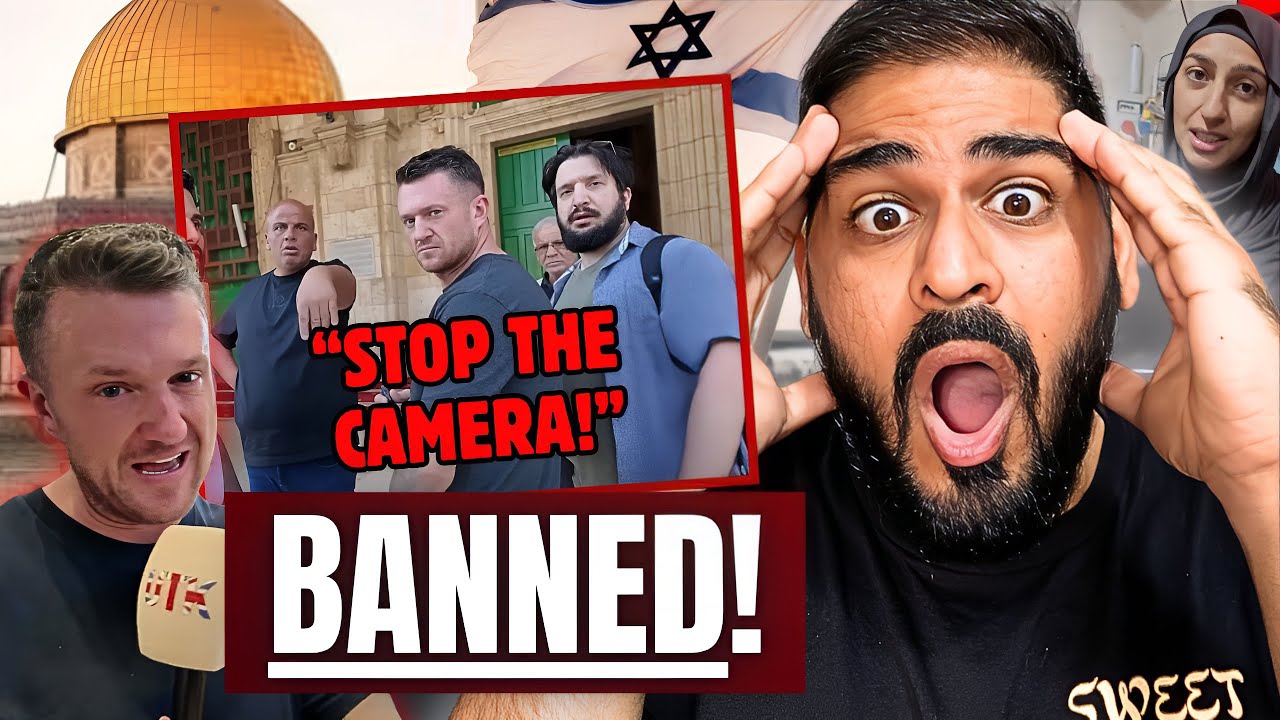
A tense video from Jerusalem has ignited a fierce online debate after Tommy Robinson, the British activist and media figure, appeared at the Temple Mount alongside Apostate Prophet and other companions, only to be told that access to certain areas was “only for Muslims.”
The footage, shared and discussed by pro-Israel commentators, quickly became more than a simple travel clip. It turned into a sharp argument over religion, power, politics, sovereignty, and the fragile rules that govern one of the most contested pieces of land on earth.
At the center of the scene was a moment that seemed ordinary at first but carried enormous symbolic weight. Robinson and his group approached the area around the mosque compound, asking whether they could look inside, take photographs, or enter. A guard or official responded that the space was “only for Muslims.” When one member of the group said he was Muslim, the official asked him to prove it by reciting from the Quran.
That exchange instantly transformed the encounter.
Apostate Prophet, known online for his criticism of Islam and for leaving the faith, responded by reciting the opening of the Quran. The moment drew laughter from the group and immediate reaction from the commentator narrating the clip. To supporters, it looked like a clever reversal. To critics, it looked like a deliberate provocation at a sacred Muslim site. Either way, the scene captured exactly why the Temple Mount remains such a volatile symbol.
The group was not simply visiting a tourist attraction. They were walking into a place where every movement, every camera angle, every prayer, every guard instruction, and every public statement can become international news.
The Temple Mount is sacred to Jews as the site of the ancient temples. Muslims know the wider compound as Haram al-Sharif, home to Al-Aqsa Mosque and the Dome of the Rock. Christians also view Jerusalem’s holy geography as central to biblical history. For centuries, the site has carried layers of faith, conquest, memory, trauma, and national identity.
That is why one short phrase — “only for Muslims” — landed with such explosive force.
Robinson’s group framed the refusal as discriminatory and political. They asked why a Muslim could enter while a Christian or Jew could not. They compared the restriction to access at churches, synagogues, and mosques elsewhere. They argued that in Israel, a Jewish state, the holiest Jewish site should be open to all people, not controlled by rules that appear to privilege one religion over others.
Their anger was visible.
One speaker in the video said he could walk into mosques in the United Kingdom and speak with people there, but at this site, the answer was different. Another person asked whether there were synagogues in Israel that Muslims were forbidden to enter. The answer given in the clip was no. That comparison became the emotional core of the argument: if Muslim visitors can enter Jewish spaces, why are non-Muslims restricted in this Muslim-administered space?
The answer, of course, is not simple.
Supporters of the current arrangement would argue that the restrictions exist to prevent violence, not to humiliate visitors. The Temple Mount is not a normal place of worship. It is a flashpoint. Changes to access and prayer rules have repeatedly triggered regional anger, diplomatic crises, and fears of unrest. From that point of view, the rules are not about fairness in the abstract. They are about preventing the city from catching fire.
But Robinson’s supporters do not see restraint. They see surrender.
They argue that the current arrangement leaves Israel in control of security but not fully in control of religious freedom at its own most sacred site. They see the Jordanian-linked Waqf’s role as an outdated political compromise that has hardened into a system of unequal access. They believe non-Muslims should not have to tiptoe around a place with such deep Jewish and universal significance.
That frustration drove the commentary surrounding the video. The host described the incident as “shameful” and said he felt embarrassed that Robinson had to experience it in Israel. He argued that the country should welcome visitors of all faiths and should not allow any religious authority to block people from entering simply because they are not Muslim.
The language was intense, emotional, and unapologetic.
But underneath the shouting was a real debate that Israel has never fully escaped: who controls the Temple Mount, and what does control actually mean?
Israel captured East Jerusalem in 1967 and has maintained overall security control around the site. Yet the day-to-day religious administration of the Muslim holy compound has remained connected to the Islamic Waqf. That arrangement, often described as the “status quo,” was meant to prevent religious war by preserving Muslim prayer rights while limiting non-Muslim prayer.
Advertisements
For decades, this arrangement was treated as delicate but necessary. Many Israeli leaders defended it publicly, even while parts of the Israeli right criticized it privately. Jewish visitors could ascend during certain hours, but open Jewish prayer was restricted. Tourists could look, but not worship. Police could enforce order, but religious authority was complicated.
The result is a system that satisfies almost no one completely.
Many Muslims fear that any change to the rules is part of a broader attempt to take over Al-Aqsa. Many Jews feel that the existing rules deny them basic religious freedom at their holiest site. Christians and other visitors may feel confused or excluded when told that certain areas are not open to them. Security officials fear that one wrong move could spark unrest far beyond Jerusalem.
That is the impossible environment into which Tommy Robinson walked.
And because Robinson is not an ordinary tourist, the moment was always going to be political. His presence in Israel had already attracted attention. He is a polarizing figure in Britain, praised by supporters as a defender of free speech and criticized by opponents as a provocateur who inflames tensions around Islam and immigration. For his Israeli supporters, his visit carried symbolic value. They see him as someone who has warned for years about Islamist extremism in Europe. For his critics, his appearance at the Temple Mount looked less like a pilgrimage and more like a staged confrontation.
That tension ran through the entire clip.
The group did not hide its frustration. They questioned the rules openly. They laughed when Apostate Prophet recited Quranic verses. They challenged the idea that access should depend on religious identity. They framed the encounter as proof that the site’s administration is political rather than spiritual.
The guard or official, meanwhile, appeared focused on enforcing the rules. He repeatedly said the area was only for Muslims, objected to filming, and told them not to take pictures of him. From his perspective, the group may have looked disruptive, confrontational, and likely to create an incident. At a site where even small provocations can become major news, officials often act quickly to prevent scenes from escalating.
That does not erase the anger felt by the visitors. But it does explain why the encounter unfolded with such tension.
The most powerful part of the video is that nobody involved seemed to be speaking only to the people standing in front of them. Everyone was speaking to an audience beyond the walls.
The guard was defending the rules of the compound. Robinson’s group was speaking to viewers who believe Israel has compromised too much. The commentator was speaking to a pro-Israel audience frustrated by what they see as religious double standards. Apostate Prophet was speaking to followers who view his very presence there as a challenge to religious gatekeeping.
The camera turned a local access dispute into a global argument.
That is the nature of Jerusalem. Nothing there stays small for long.
One denied entry becomes a debate about sovereignty. One prayer becomes a diplomatic incident. One visitor becomes a symbol. One guard becomes the face of an entire system. One short clip becomes evidence, depending on who is watching, of either discrimination or deliberate provocation.
The article-level question is not simply whether Robinson should have been allowed inside. The deeper question is whether the current status quo can survive in an era when every restriction is filmed, every confrontation goes viral, and every side believes it is the victim of historical injustice.
For many pro-Israel viewers, the video confirmed something they already believed: that Israel exercises military and police responsibility over the site while lacking full spiritual freedom there. They ask why Jews cannot freely pray at the place most sacred to Jewish history. They ask why Christians and other non-Muslims should be treated as suspicious outsiders. They ask why a state that presents itself as open and democratic continues to preserve a religious arrangement that feels unequal.
For many Muslims, however, the same video may look very different. They may see a controversial activist arriving with cameras and critics of Islam, pressing guards at a sacred site during a time of extreme regional sensitivity. They may see the demand for open access not as harmless equality but as part of a broader political push to weaken Muslim control over Al-Aqsa. They may fear that “shared access” could eventually become divided control, and divided control could become loss.
That fear is not imaginary. In Jerusalem, history is never far away. Communities remember conquest, displacement, desecration, and broken promises. Sacred sites are not just buildings. They are proof of belonging.
That is why the Temple Mount debate cannot be solved with one slogan.
“Open it to everyone” sounds fair. But how would prayer be managed? Who would decide where people stand? What happens if rival groups begin competing for space? What happens during Ramadan, Jewish holidays, Christian holidays, or moments of war? What happens when extremists on any side try to exploit the new rules?
On the other side, “keep the status quo” sounds safe. But what happens when the status quo feels unjust to millions of Jews and other non-Muslims? What happens when young Israelis no longer accept being told that their holiest site is available only under heavy restrictions? What happens when cameras expose every moment of unequal access to a global audience?
There is no easy answer.
What the video does show is a growing impatience among parts of the Israeli and pro-Israel public. They are no longer content with quiet explanations about stability. They want visible sovereignty. They want equal access. They want a site they consider central to Jewish identity to be opened more fully to the world.
The commentator in the video framed this as a matter of national embarrassment. He said Israel should not allow a foreign-linked religious body to dictate who can pray or enter. He argued that the Jewish state has a duty to make the site welcoming to Jews, Christians, Muslims, and all visitors. He apologized to Robinson for what happened, saying the experience should have been warm and open.
That emotional apology reveals how personally many Israelis take this issue. For them, the Temple Mount is not a distant monument. It is the heart of the story. To see a British visitor and a group of allies turned away because they were not Muslim felt to them like a failure of national dignity.
But opponents would warn that dignity without restraint can be dangerous in Jerusalem. A dramatic change at the site could provoke outrage not only among Palestinians but across the Muslim world. Jordan, Saudi Arabia, Turkey, and other regional players closely watch every shift. Palestinian factions often frame Al-Aqsa as a red line. Israeli security officials know that the compound can become a trigger for wider violence.
That is the terrible balance.
Religious freedom on one side. Public safety on the other. Sovereignty on one side. Regional stability on the other. Historical justice on one side. Fear of escalation on the other.
The Robinson clip sits directly inside that conflict.
It also arrives at a time when the broader argument about Islam, Europe, and Israel has become increasingly charged. In the video, the commentator links Robinson’s experiences in Britain with Israeli concerns about Islamist extremism. He argues that many Israelis, especially Jews from Middle Eastern backgrounds, understand Robinson’s warnings because their families experienced persecution in Muslim-majority countries.
That point is deeply emotional for many Mizrahi Jews, whose family histories include displacement from Iraq, Yemen, Egypt, Syria, Iran, Libya, Morocco, and other countries. Their memories of leaving the Middle East are often tied to fear, antisemitism, lost property, and destroyed communities. When they hear European activists speak about Islamist pressure in Western cities, some feel a direct historical connection.
But this argument also risks flattening complex realities. Muslims are not a single political bloc. The Islamic world is not one story. Many Muslims also suffer under extremist movements, authoritarian governments, and religious coercion. Any serious analysis must separate ordinary Muslim worshippers from political Islamism, and religious devotion from militant ideology.
That distinction matters, especially at the Temple Mount.
The men enforcing access rules may not see themselves as oppressors. They may see themselves as protecting a sacred space from people they believe arrived to provoke. Muslim worshippers may not view restricted access as supremacy. They may view it as the last defense of a site they fear losing.
Likewise, Jews who want to pray there are not automatically extremists. Christians who want to enter are not automatically provocateurs. Ex-Muslims who challenge religious gatekeeping are not automatically insulting the sacred. The problem is that Jerusalem gives every side reasons to suspect the worst.
That suspicion is what turns a short video into a political earthquake.
Robinson’s supporters will likely use the clip as proof that Israel must change the rules. Critics will use it as proof that provocateurs are trying to inflame one of the most sensitive sites in the world. The truth is that the video shows both a real grievance and a real danger.
The grievance is unequal access.
The danger is escalation.
The challenge is whether Israel can address the first without unleashing the second.
For now, the status quo remains under pressure from all directions. Religious activists want more Jewish prayer rights. Muslim authorities fear encroachment. Police must manage daily friction. International governments urge restraint. Online commentators amplify every confrontation. Politicians know that one wrong statement can become a crisis.
And into that already unstable mix came Tommy Robinson, Apostate Prophet, cameras, laughter, questions, and a guard repeating the words that sparked the firestorm:
“Only for Muslims.”
Those words will not disappear quickly. They will be clipped, shared, argued over, condemned, defended, and replayed. For some, they represent discrimination at the heart of the Jewish state. For others, they represent a protective rule at a sacred Muslim site. For everyone else, they reveal how far Jerusalem still is from any peaceful answer to the question of shared holiness.
The clip ends with the commentator turning back to his audience, promoting interviews, merchandise, and future content. But the real story does not end there.
It continues every day at the gates.
It continues whenever a Jewish visitor is told not to pray. Whenever a Muslim worshipper fears Al-Aqsa is under threat. Whenever a Christian tourist wonders why one sacred space feels less open than another. Whenever Israeli police stand between faiths, flags, and cameras.
The Temple Mount remains the place where theology becomes politics in seconds.
Tommy Robinson’s visit did not create that reality. It exposed it.
And that is why the footage struck such a nerve.
Because this was never just about one man being denied access. It was about the unresolved question at the center of Jerusalem itself: can a place claimed by many ever be governed in a way that feels fair to all?
For now, the answer remains painfully uncertain.
But one thing is clear. The world is watching. The cameras are rolling. And the next confrontation at the Temple Mount may be only one question, one prayer, or one denied entry away.