British YouTuber Goes To Pro Palestinian March, Then Things Get HEATED Quickly!
British YouTuber Goes To Pro Palestinian March, Then Things Get HEATED Quickly!
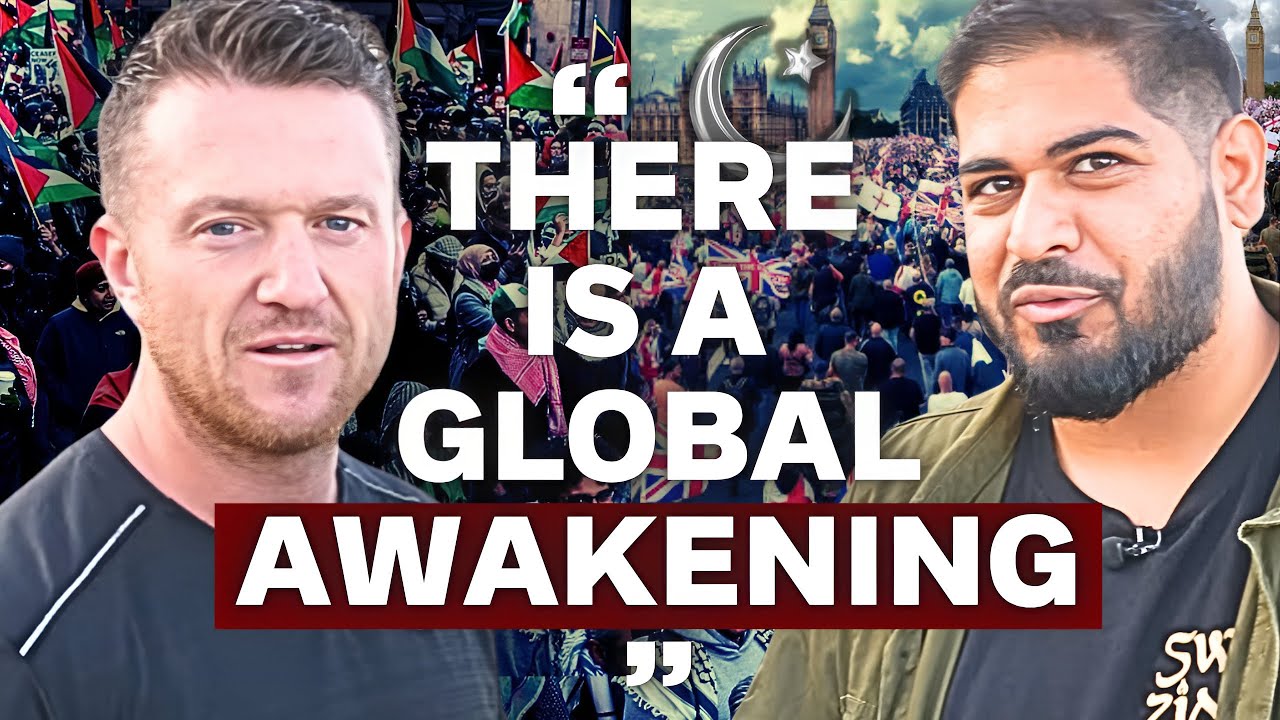
A lengthy interview filmed in Israel with British activist Tommy Robinson has reignited debate across social media over the future of Western politics, the role of alternative media, support for Israel, criticism of Islamism, and the growing divide between establishment institutions and populist movements.
The conversation, conducted in Tel Aviv by an Israeli content creator, unfolds less like a traditional interview and more like a political declaration. Over nearly an hour, Robinson presents himself as a man who believes he was condemned too early, labeled too easily, and ultimately proven right by events that have transformed public opinion in Britain, Europe, and Israel.
His critics see something very different. To them, the interview is another example of inflammatory rhetoric packaged as truth-telling, a platform that risks turning real security concerns into sweeping suspicion toward religious and ethnic minorities. Supporters, however, view the appearance as a symbolic moment: a controversial British figure, long accused of extremism, being welcomed in Israel as a defender of Jewish communities and Western civilization.
At the center of the interview is a broad argument about fear, speech, and political courage. Robinson claims that many people in Britain and Europe privately agree with him but have been frightened into silence by labels such as “far right,” “racist,” or “extremist.” He compares that experience to what he believes is now happening to supporters of Israel, who he says are being intimidated online and in public life by aggressive criticism, misinformation, and political pressure.
The interviewer opens with a provocative question about accusations that Robinson was paid to come to Israel. Robinson dismisses such claims as part of a broader strategy to discredit anyone who publicly defends Israel or Jewish communities. He argues that accusations of financial influence are meant to scare influencers, activists, and ordinary people away from expressing support.
For Robinson, this is not merely about his own reputation. It is about the structure of modern public debate. He believes that powerful narratives are repeated until they become accepted facts, whether or not they are true. In his view, the labels once used against him are now being used against Israel and its defenders.
That theme runs throughout the interview: repetition as political weapon.
Robinson repeatedly argues that phrases such as “far right,” “apartheid,” and “genocide” are deployed not to clarify reality, but to shut down debate. Whether one agrees with him or not, his argument reflects a real frustration shared by many on the populist right: the belief that mainstream institutions no longer debate fairly but instead use moral labels to exclude dissenting voices.
The conversation then turns to Robinson’s past, particularly his involvement in the English Defence League, the street movement he founded in 2009. Critics have long described the EDL as far right and anti-Muslim. Robinson rejects that characterization. He says the organization was created in response to problems he witnessed in Luton, including extremism, criminal gangs, and what he saw as failures by police and local authorities.
He insists that the EDL, during his leadership, included Jewish, Hindu, Sikh, gay, lesbian, and non-white supporters. He presents this as evidence that the movement was not racist or neo-Nazi, but rather focused on opposing Islamist extremism and defending British values.
This is one of the most contested parts of Robinson’s public legacy. Supporters accept his explanation and argue that he was warning about genuine issues long before the establishment was willing to acknowledge them. Critics counter that whatever his stated intent, the movement helped normalize hostility toward Muslims and contributed to a climate of fear and division.
The interview does not resolve that conflict. Instead, it shows how Robinson wants his legacy understood. He does not present himself as a man who has changed. He presents himself as a man whose country has slowly come around to the warnings he made years ago.
“I was saying the same things,” he argues in substance, while suggesting that society has shifted around him.
The interviewer reinforces this idea by describing his own changing perception of Robinson. He says that he once hesitated to platform him because of the negative reputation attached to his name. But after watching older speeches, recent interviews, and clips from over a decade of activism, he concluded that Robinson’s message had been consistent.
That exchange is important because it illustrates the power of alternative media ecosystems. Public figures who were once defined mainly through mainstream media coverage can now rebuild their image through podcasts, livestreams, long-form interviews, and social media clips. A person once dismissed as untouchable by traditional outlets can find large audiences elsewhere, often among viewers who distrust the very institutions that condemned him.
Robinson and the interviewer repeatedly return to this idea: mainstream media has lost its monopoly.
They argue that television channels and newspapers can no longer fully control public narratives because platforms such as YouTube, X, TikTok, and independent podcasts now reach millions directly. Robinson claims that mainstream outlets still behave as if they control public opinion, while alternative voices are already surpassing them in views and influence.
This reflects one of the defining political shifts of the decade. Across Britain, Europe, the United States, and Israel, trust in established media has fallen among large segments of the public. Many people now view legacy outlets not as neutral reporters, but as political actors. In that environment, figures like Robinson can present themselves not as activists trying to bypass journalism, but as journalists replacing a failed press.
Whether that claim is credible depends on one’s view of journalism itself. Robinson’s style is openly activist, emotional, confrontational, and ideological. Traditional journalists would argue that this makes him a campaigner, not a reporter. His supporters would respond that legacy media is also ideological, but hides its bias behind institutional language.
Advertisements
The interview captures that clash perfectly.
Another major theme is Israel. Robinson presents his support for Israel as rooted in a wider defense of Western civilization and democratic values. He says he believes in Jewish self-determination and describes Zionism as the belief that Jews have a right to a homeland. The interviewer shows him ancient coins as symbols of Jewish historical connection to the land, arguing that Zionism is not a modern colonial invention but part of an ancient identity.
Robinson agrees strongly, saying Jewish people should stop apologizing for their national existence and their right to defend themselves. He frames Israel as an embattled democracy surrounded by hostile forces and argues that Western countries should recognize Israel as an ally.
This portion of the interview is likely to resonate deeply with pro-Israel audiences, particularly after the trauma of October 7 and the global wave of protests, boycotts, and accusations directed at Israel. The interviewer describes Israeli and Jewish communities as feeling isolated, misrepresented, and under attack. Robinson responds by saying that courageous people can break through such isolation by refusing to be intimidated.
At the same time, the interview’s treatment of Islam and Muslim communities is highly controversial. Robinson often distinguishes between ordinary Muslims and Islamist ideology, but his language frequently broadens into sweeping claims about Islam, migration, and demographic change. Critics would argue that this pattern makes the distinction unstable and risks portraying entire communities as threats.
This is where the interview becomes most politically explosive.
Robinson argues that parts of Britain have changed dramatically due to migration from Muslim-majority countries and that some towns now face serious problems with crime, extremism, and intimidation. He refers repeatedly to Luton, his hometown, as the place that shaped his worldview. He describes growing up around Muslim communities, witnessing hostility toward Jews, and becoming convinced that authorities were failing to confront dangerous networks.
He also discusses grooming-gang scandals in the United Kingdom, arguing that fear of being accused of racism led police, councils, and political leaders to ignore the abuse of vulnerable girls. This issue remains one of the most painful and controversial subjects in British public life. Official inquiries and court cases have shown that authorities in some areas did fail victims, sometimes catastrophically. However, the broader political debate around grooming gangs has often become entangled with racial and religious generalizations.
A responsible discussion must hold two truths together. The abuse of children and institutional failure must be confronted honestly, without euphemism or cover-up. At the same time, crimes committed by individuals or networks cannot justify collective suspicion toward millions of people who share an ethnicity or religion.
The interview leans heavily toward the first truth and often struggles with the second.
Robinson’s supporters would say that this is exactly why he is needed: because establishment caution has too often become denial. His critics would say that his rhetoric turns legitimate outrage into collective blame and social division.
Both sides understand that the stakes are high. Britain is struggling with questions of national identity, public order, social trust, and the limits of multiculturalism. These issues cannot be solved by silence. But they also cannot be solved by language that makes peaceful citizens feel permanently accused.
The conversation also touches on demographic anxiety. Robinson argues that political parties in Britain are increasingly influenced by the size and voting power of Muslim communities, while Jewish communities are numerically much smaller. He presents the UK government’s recognition of a Palestinian state as an example of politicians responding to demographic pressure rather than principle.
This is a powerful claim among viewers who already believe that Western leaders are appeasing hostile blocs. But it is also a claim that requires caution. Democratic politics always involves voters, communities, lobbying, values, international alliances, and moral arguments. Reducing foreign policy decisions entirely to demographic appeasement can oversimplify complex diplomacy and encourage suspicion toward minority citizens exercising normal democratic rights.
Still, Robinson’s argument reflects a wider anxiety on the European right: that demographic change will alter not only culture, but foreign policy, policing, education, and free speech.
The interviewer connects this concern to Israel’s experience, arguing that Israelis understand existential vulnerability because they believe there is nowhere else to go. Robinson applies the same language to Britain. He says England is the homeland of the English people, shaped by a thousand years of Christian history, and that Britons should not be ashamed to defend it.
For many supporters, this is patriotic common sense. For critics, it risks defining national belonging in ethnic or religious terms that exclude fellow citizens from minority backgrounds. Robinson attempts to separate his position from ethnonationalism, saying he supports integrated migration and opposes white nationalist thinking. He argues that people who love Britain, regardless of background, should be included in a broader movement to defend the country’s culture and identity.
That distinction is central to his attempt to reposition himself. He wants to build a movement that is nationalist, pro-Israel, anti-Islamist, pro-Western, and multiethnic, while rejecting neo-Nazi or white supremacist politics. Whether he can successfully maintain that line is another question. Movements built around cultural fear often attract harder elements, and Robinson himself acknowledges the danger of ethnonationalists damaging the broader patriotic cause.
The interview also offers Robinson’s reflections on Israel as a model. He says he first visited Israel in 2016 to understand how a society lives under constant security threat. He describes seeing fortified bus stops, barriers, armed security, and a public culture shaped by the possibility of violence. To him, Israel represented Britain’s possible future if Islamist extremism were not confronted.
He now says he has learned something else from Israel: identity, unity, and willingness to sacrifice. He is impressed by young soldiers, national flags, physical fitness, community solidarity, and the sense that citizens understand they are part of something larger than themselves.
This section reveals a deeper emotional current in the interview. Robinson is not only talking about policy. He is talking about belonging. He believes Britain has lost a shared sense of itself, while Israel has preserved one under pressure. He wants to restore that sense of collective identity in Britain through rallies, symbols, flags, and cultural mobilization.
That is why he describes his movement not only in political terms, but as a cultural revolution. He argues that if culture shifts, politics will follow. This is a common belief among modern populist movements: elections matter, but identity comes first. Before voters change parties, they must change how they see themselves.
The interviewer then asks about peace in the Middle East. Robinson expresses skepticism, arguing that peace cannot be built with actors who still seek Israel’s destruction. He praises Donald Trump and suggests that the West is at a crossroads. In his view, Israel, Britain, Europe, and the United States face a shared ideological challenge that requires unity among supporters of Western civilization and democracy.
Again, this framing is both compelling and controversial. It offers clarity to those who feel threatened by jihadist ideology and global anti-Israel activism. But it also risks flattening the Middle East into a simple battle between civilization and barbarism, leaving little room for Palestinians who oppose Hamas, Muslims who support democracy, or critics of Israeli policy who are not antisemitic.
A stronger public debate would make room for all of those distinctions. One can defend Israel’s right to exist and condemn antisemitism while still discussing Palestinian suffering. One can oppose Islamist extremism without treating Muslims as a monolith. One can criticize mainstream media without assuming every unfavorable report is propaganda.
The interview’s final moments are symbolic. The Israeli host gives Robinson a traditional Jewish head covering as a gesture of gratitude, framing it as a sign of appreciation for his support for Israel. Robinson accepts warmly, then prepares to meet a British victim of terrorism whose friend’s killer, he says, was recently released in a peace deal.
This closing scene returns the interview to its emotional foundation: trauma, loyalty, memory, and the belief that Western publics are not being told the full truth about terrorism, Israel, and the political compromises made in the name of peace.
In the end, the interview is not just about Tommy Robinson. It is about a wider realignment taking place across the political right. Pro-Israel activism, anti-Islamist politics, distrust of mainstream media, anger over grooming gangs, concern about migration, and calls for national revival are increasingly being woven into one story.
That story has undeniable power. It speaks to people who feel abandoned by institutions, silenced by social stigma, and alarmed by cultural change. It also carries real risks. If not disciplined by accuracy, fairness, and moral restraint, it can slide from legitimate criticism into collective suspicion.
The challenge for Britain and Europe is to address the issues Robinson raises without adopting the most divisive forms of his rhetoric. Grooming-gang failures require justice. Extremism requires enforcement. Antisemitism requires confrontation. Media bias deserves scrutiny. Integration must be taken seriously. National identity should not be treated as shameful.
But none of that requires dehumanizing minorities, dismissing all critics as enemies, or turning complex societies into permanent camps of “us” and “them.”
The interview will likely strengthen Robinson’s standing among those who already see him as vindicated. It will also intensify criticism from those who view him as dangerous. But its significance lies in the fact that conversations once confined to the margins are now moving into the center of online political life.
Robinson’s central claim is that the old media can no longer stop the public from hearing him. On that point, at least, the interview proves something important.
The question is no longer whether figures like him can reach mass audiences.
They already can.
The real question is whether those audiences will use that energy to build a safer, more honest public life — or whether fear, anger, and identity conflict will push Western politics into an even more divided future.