British YouTuber Goes To A Palestinian Protest, This Is What He Spotted…
British YouTuber Goes To A Palestinian Protest, This Is What He Spotted…
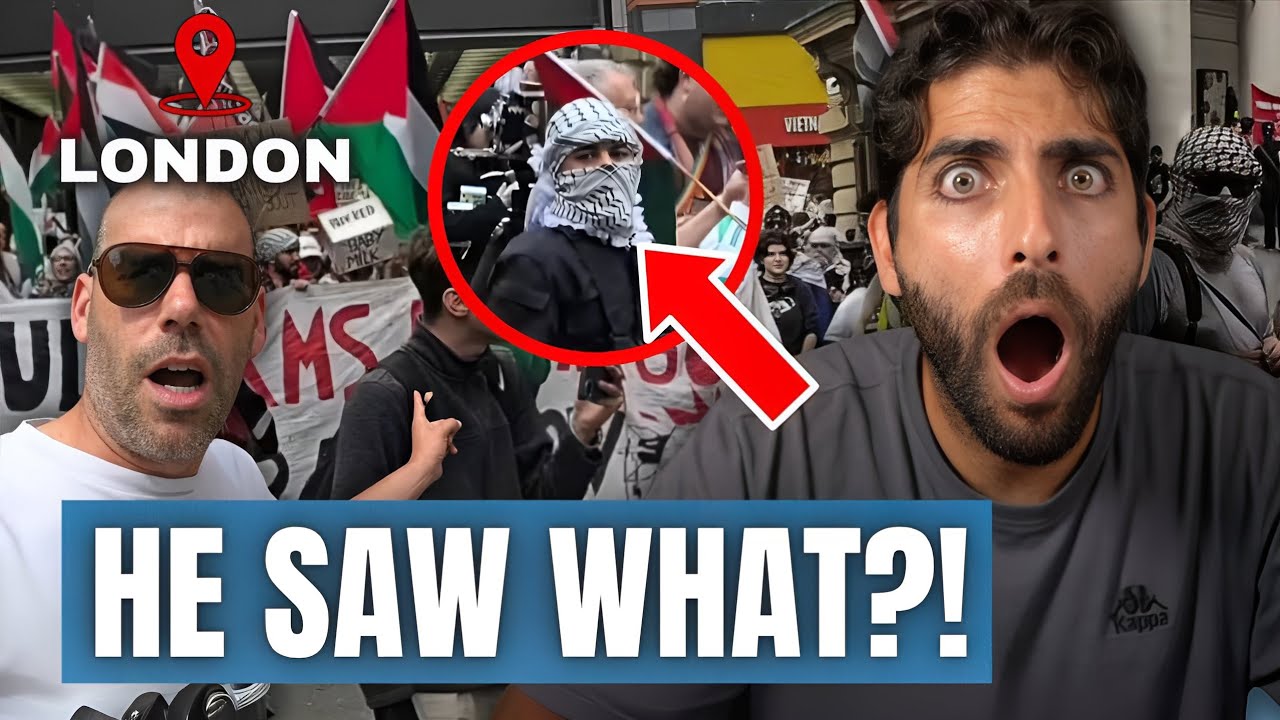
A pro-Palestinian demonstration in Manchester has erupted into fierce controversy after video footage appeared to show one participant wearing what critics described as a mock suicide vest, sparking alarm, anger, and a wave of online debate about the boundaries between political protest, public safety, and extremist symbolism on British streets.
The footage, circulated through commentary channels and social media, captured a tense street scene filled with chanting crowds, masked demonstrators, counter-protesters, police officers, and heated confrontations. But one moment stood out above everything else: a man dressed in black, seen among the marchers, wearing an object across his torso that the video creator repeatedly described as a “pretend suicide vest.”
For critics watching the scene unfold, the image was not simply provocative. It was chilling.
The video’s narrator reacted with disbelief, calling the sight one of the most disturbing things he had seen at a UK protest. His outrage was immediate and intense. In the clip, he argued that allowing someone to appear at a public demonstration wearing an object resembling an explosive vest was not edgy, comedic, or symbolic. To him and others reacting online, it was a direct glamorization of terror imagery in a country still scarred by past attacks.
The protest itself appeared to take place in Manchester, where a pro-Palestinian crowd gathered with flags, banners, chants, scarves, masks, and political signs. Throughout the video, the atmosphere shifted between street theater, shouting matches, surveillance-like filming, and moments of genuine tension. Some demonstrators tried to block the camera. Others shouted back. Counter-protesters challenged chants and symbols they believed crossed a dangerous line.
What began as another protest video quickly became something far more explosive.
At the center of the footage was a repeated accusation: that the demonstration had gone beyond support for Palestinian civilians and had drifted into the open celebration, imitation, or normalization of militant imagery. The video creator described the march as “pro-Hamas,” a label that many activists would strongly reject, arguing instead that they were marching for Palestinian rights, a ceasefire, and an end to suffering in Gaza. But the footage shows why this debate has become so emotionally charged in Britain and across the West.
The argument is no longer only about foreign policy. It is about what symbols are acceptable in public. It is about whether slogans can be separated from violence. It is about whether masked faces, militant-style clothing, and mock weapons imagery create fear among Jewish communities and ordinary passersby. And it is about whether police and local authorities are responding firmly enough when demonstrations appear to flirt with the visual language of extremism.
The video opens with commentary over scenes from the protest, where the narrator reacts to a man allegedly wearing the mock vest. He asks how such a thing could be normalized in the UK. His tone is sarcastic, angry, and incredulous. From there, the footage rewinds and follows the street encounter from the beginning, showing counter-protesters moving through the crowd while filming banners, chants, and interactions with marchers.
One of the earliest moments shows demonstrators preparing scarves and signs. The narrator mocks the scene as “cosplay,” suggesting that some attendees were dressing in ways that resembled militant figures rather than ordinary political protesters. A woman in a face covering steps into frame. Red flags appear. Police reportedly warn the counter-protesters not to create disorder. The narrator insists that they are there as “family-friendly entertainment,” though the interactions quickly become confrontational.
The footage then shifts toward a wider criticism of Britain’s public protest culture. The narrator appears shocked that people wearing militant-style clothing, face coverings, and provocative symbols could march openly near major public areas. He repeatedly suggests that the UK has become too permissive toward demonstrations that feature language or imagery associated with terrorism.
The most intense debate in the video centers on the chant “globalize the intifada.” The narrator argues that the phrase cannot be treated as harmless because the intifadas in Israel and the Palestinian territories involved waves of violence, including bombings and attacks. Supporters of the slogan often argue that it means global resistance against occupation and injustice. Critics argue that, especially in Jewish communities, it is heard as a threat of violence spreading beyond the Middle East.
That disagreement has become one of the defining flashpoints of modern protest politics. One side hears liberation. The other hears intimidation. And videos like this one only deepen the divide.
As the march continues, the footage shows a man who appears to follow the counter-protesters closely, trying to block or interfere with their filming. The narrator nicknames him “granddad” and accuses him of acting like a minder for the protest. At several moments, this older man positions himself between the camera and the marchers. The narrator claims he is trying to control what can be filmed.
That detail matters because much of the video is not simply about the protest itself. It is about the battle over footage. Who gets to record? Who gets to frame the story? Who gets to decide whether the march looks like a peaceful demonstration or something more menacing?
In today’s political climate, the camera is not neutral. It is a weapon, a shield, a witness, and sometimes a provocation. Protesters often film counter-protesters. Counter-protesters film protesters. Each side expects the footage to prove its own point. Each side believes the other is hiding something. That is why the tension in the video feels so sharp. Every gesture becomes evidence. Every chant becomes a headline. Every masked face becomes a symbol.
At one point, the footage appears to show demonstrators blocking or slowing a tram route. The narrator suggests this could amount to obstruction of a public highway and accuses police of treating activists gently because of political sensitivities. He claims that others would have been arrested faster for similar behavior. That claim is part of a broader argument often heard in Britain: that public order laws are applied unevenly depending on the cause, the crowd, or the political consequences.
Whether that accusation is fair is another matter. Police often face difficult decisions during large demonstrations, especially when mass arrests could inflame tensions or create safety risks. But the perception of double standards is powerful, and footage like this feeds it. For viewers already frustrated by repeated disruptive protests, the tram-blocking moment becomes another example of authorities losing control of public space.
The street interactions grow increasingly personal. People shout insults. Some accuse the counter-protesters of being Nazis. The narrator pushes back, saying that support for Israel does not make someone a Nazi and that the accusation makes no sense. The exchange is chaotic, but it reflects a larger collapse in political language. Words once reserved for history’s worst crimes are now thrown across crowded streets like everyday insults.
Advertisements
That is part of why the footage feels so combustible. No one is speaking carefully. No one is de-escalating. Every side is performing for the crowd, the camera, and the internet.
Then comes the moment that drives the entire controversy.
Near the later portion of the video, the narrator suddenly focuses on a man in black. He says the man is wearing a mock suicide vest. The camera captures the figure among the demonstrators, and the narrator reacts with disbelief. He repeats the accusation several times, urging others to film the man and calling the image unacceptable. The phrase “mock suicide vest” becomes the center of the video’s outrage.
The sight, if accurately described, raises serious questions. Was it meant as a costume? A political statement? A piece of street theater? A deliberate attempt to shock? A misunderstanding? Without direct comment from the individual, the intent cannot be known. But the public effect is easier to understand. In a British city that remembers mass-casualty terror attacks, any object resembling an explosive vest in a crowded public space is almost guaranteed to provoke fear and anger.
Even if the object was fake, even if there was no threat, the symbolism alone is enough to cause alarm. That is why critics argue police should have intervened immediately. They say the issue is not whether the person intended harm, but whether the visual display glorified or trivialized acts of terror.
Supporters of pro-Palestinian protests may argue that isolated footage should not be used to smear an entire movement. They would be right to make that distinction. Many people who attend such marches do so because they are horrified by civilian suffering, not because they support Hamas or any other armed group. A crowd can contain families, students, faith leaders, human rights activists, and ordinary citizens who oppose violence against civilians on all sides.
But critics counter that movements are also judged by what they tolerate in their own ranks. If someone appears with extremist imagery, if chants evoke violent uprisings, if masked men intimidate journalists or counter-protesters, then organizers cannot simply shrug and say it has nothing to do with them. Public demonstrations require public responsibility.
That is the deeper issue behind the video. It is not only about one man, one vest, one chant, or one confrontation. It is about whether political anger is being allowed to slide into menace.
The narrator also refers to past attacks in Britain, including the Manchester arena bombing, to explain why the image of a mock suicide vest felt especially offensive. For many viewers, that reference is not abstract. Manchester is not just a place on a map. It is a city with memory. It is a city where families still carry grief. To see anything resembling suicide-bomb imagery in that context feels, to critics, like a slap in the face to victims and survivors.
That emotional weight explains the intensity of the reaction. It is not just political disagreement. It is trauma being triggered by symbolism.
As the video continues, the narrator praises counter-protesters and controversial right-wing figures he believes are “patriots” defending the UK. That part of the commentary will divide viewers even further. Some will see it as a call to defend free speech and public safety. Others will see it as an attempt to frame all pro-Palestinian activism as extremist. The truth is that Britain’s debate over these protests has become deeply polarized, and each new viral clip pushes people further into their camps.
What cannot be ignored, however, is that the footage captures a public atmosphere that feels volatile. People are not merely marching. They are watching each other, baiting each other, filming each other, and daring each other to cross a line. The protest becomes both a political event and a live online battlefield.
That is the modern reality of street politics. A march no longer ends when people go home. It becomes clips, reactions, edits, thumbnails, arguments, and counterarguments. A single image can travel faster than the official facts. A few seconds can define an entire event. And when that image appears to involve terror-related symbolism, the fallout is immediate.
The mock vest controversy will likely intensify calls for tougher policing of protest imagery. It may also renew debate about face coverings, militant-style dress, chants associated with violent movements, and the responsibilities of demonstration organizers. Civil liberties groups will warn against overreach. Jewish community groups and public safety advocates will demand stronger enforcement. Pro-Palestinian activists will insist their cause is being unfairly demonized. Politicians may try to use the moment to score points.
But beyond politics, ordinary people watching the footage may have a simpler reaction: How did it get this far?
How did a public demonstration in Britain become a place where someone could allegedly appear in a mock suicide vest? How did slogans with violent historical associations become normalized enough for crowds to chant them in city streets? How did police end up stuck between free expression and public fear? And how did the conversation around Gaza become so toxic that every protest is now treated like a test of national identity?
The answers are not simple. The war in Gaza has stirred grief, rage, and fear around the world. Many Palestinians and their supporters feel ignored, dehumanized, and desperate for the world to respond to suffering. Many Jews and supporters of Israel feel targeted, abandoned, and terrified by the rise of open hostility in public spaces. Both realities exist. But when symbols associated with terrorism appear in a march, the moral conversation changes instantly.
Political protest has power because it is public. That power comes with consequences. A sign can persuade. A chant can unite. A costume can shock. But when imagery evokes suicide bombings, hostage-taking, or militant violence, it does not merely express anger. It can frighten communities and poison the legitimacy of the cause being represented.
That is why this video struck such a nerve.
For some viewers, it confirmed their worst fears about radicalization on British streets. For others, it was another example of selective outrage and hostile filming designed to discredit Palestinian solidarity. For still others, it was simply a sign that the UK’s public square is becoming increasingly unstable, where moral causes, extremist aesthetics, online fame, and street confrontation are all blending into one dangerous spectacle.
The police response will matter. If authorities determine that any laws were broken, the public will expect action. If no action is taken, critics will claim the state is too afraid to enforce its own rules. If action is taken too broadly, activists will accuse officials of suppressing political speech. Every possible response carries risk.
But one thing is already clear: the image of an alleged mock suicide vest at a UK protest is not going away quietly. It is the kind of moment that burns itself into public debate because it sits at the intersection of fear, free speech, extremism, and national memory.
The footage may be only one perspective, filmed by people openly hostile to the march. It may not show the full context. It may not represent every person who attended. But it does show a level of public confrontation that should concern anyone who cares about civic peace.
A protest for civilians should not become a stage for terror imagery. A march for justice should not make local communities feel threatened. A political cause loses moral force when its public face becomes intimidation instead of persuasion.
That is the lesson many viewers are taking from the video. Not that every protester is an extremist. Not that every supporter of Palestine endorses violence. But that movements must police their own symbols before the state is forced to do it for them.
Because in a country with painful memories of bombings, public fear is not a game. In a city like Manchester, symbols matter. And when a crowd appears to tolerate something resembling a suicide vest, even as a stunt, the damage is already done.
The controversy now leaves Britain facing an uncomfortable question about the future of protest. Can the country protect free speech while also drawing a clear line against terror glorification? Can police act firmly without inflaming tensions? Can protest movements defend human rights without allowing fringe elements to hijack the message?
The video does not answer those questions. It throws them into the street, under flashing cameras, in front of police lines, surrounded by shouting voices.
And that is why this moment has exploded far beyond one march.
It is no longer just about Manchester. It is about what Britain is willing to allow in its public spaces, what communities are expected to endure, and whether the line between protest and intimidation is still being defended.
For many viewers, the alleged mock vest was that line.
And once crossed, it cannot simply be explained away.