They Cast a 400-Pound Bigfoot Body Print — No Scientist Has Been Able to Identify It
They Cast a 400-Pound Bigfoot Body Print — No Scientist Has Been Able to Identify It
The cast was so heavy it took several men to move it. But the real weight of the discovery was not the plaster—it was the possibility that something massive, intelligent, and unknown had lain in the mud and left behind the closest thing Bigfoot hunters had ever seen to a full-body impression.
For decades, Bigfoot evidence has lived in the same frustrating category: footprints, eyewitness stories, distant screams, broken branches, blurry photographs, and videos too shaky to settle anything. Believers see a pattern. Skeptics see misidentification, folklore, hoaxes, and wishful thinking. The debate usually ends in the same place it began, with one side saying the evidence is compelling and the other saying it is never enough.
But the body print was different.
It was not just a footprint in soft earth. It was not a shadow at the edge of a road. It was not a late-night howl recorded through static. It was a massive impression in a muddy wallow, preserved in plaster, showing what some researchers believed were the marks of a large animal that had lowered itself onto the ground, reached forward, and left the outline of its body behind.
The cast became known as the Skookum Cast.
To Bigfoot believers, it was one of the most important physical artifacts ever collected. To skeptics, it was one of the most famous examples of how excitement can turn ordinary animal sign into a legend. But even after years of argument, one thing remains true: the cast still has the power to make people stop and look twice.
The story begins in Washington State, in the shadow of Mount Adams, a place already rich with Sasquatch lore. The forests there are thick, wet, and ancient-feeling, the kind of country where visibility can vanish after only a few yards and where every sound seems to come from deeper inside the trees than it should. For Bigfoot researchers, it was exactly the sort of place where a large, elusive primate could theoretically move unseen.
During an expedition in 2000, investigators placed fruit near a muddy wallow, hoping to attract wildlife and perhaps, if luck and legend aligned, something far stranger. The idea was simple: leave bait, withdraw, return later, and examine the area for tracks or disturbances. There were no clear cameras recording the moment. No dramatic footage of a creature stepping into the mud. What they found the next day was far more ambiguous—and far more controversial.
The fruit had been disturbed. The mud held impressions. Something large had been there.
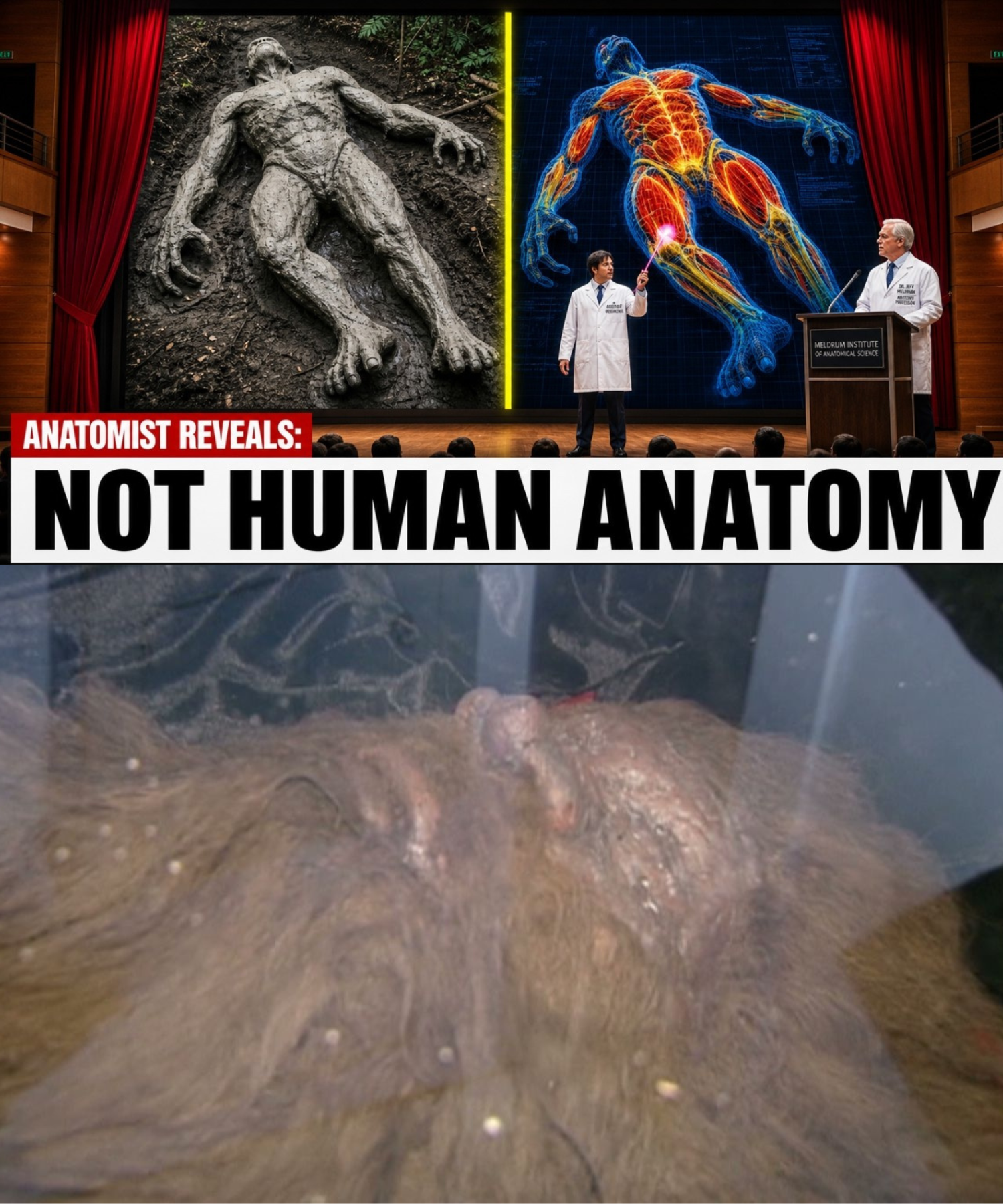
But the most striking mark was not a paw print or a human-like footprint. It was a broad, deep body impression along the edge of the wallow. The marks suggested that an animal had reclined or leaned into the mud, possibly reaching toward the bait. Researchers saw what they believed could be portions of a forearm, thigh, heel, buttocks, Achilles area, and other anatomical structures. The impression was large enough, strange enough, and detailed enough that they decided to cast it.
That decision created a 400-pound mystery.
Plaster was poured into the impression, hardening into a huge slab that would later be studied, photographed, argued over, and carried into Bigfoot history. It was not elegant. It was not easy to handle. It was not instantly readable like a footprint. It was a chaotic negative image of pressure, mud, weight, and shape. That made it difficult to interpret, but also difficult to dismiss casually.
Supporters believed the cast showed something that did not match a bear, elk, deer, or known animal. They argued that the apparent body position suggested an intelligent creature had approached the bait in an unusual way, possibly avoiding leaving obvious footprints. Some believed the animal had lowered itself onto the ground and reached forward with an arm, leaving impressions that looked more primate-like than ungulate. They pointed to areas they interpreted as hair flow, skin texture, heel features, or pressure patterns inconsistent with an elk simply lying down.
To them, the cast was not proof in the courtroom sense.
But it was evidence.
And in the world of Bigfoot research, evidence that can be touched, measured, and preserved matters enormously.
The cast attracted attention from prominent Bigfoot researchers and a handful of academics interested in the question of unidentified primate evidence. Some saw anatomical possibilities worth studying. Others remained cautious. The problem was obvious from the beginning: without a clear video of the animal making the impression, interpretation depended heavily on anatomy, context, and expectation.
That is where the case became controversial.
Skeptics argued that the cast was not mysterious at all. They said it was most likely made by an elk lying in the mud. Elk are common in the region. Elk wallows are real. Elk bodies are large enough to leave deep impressions. Elk legs, hips, bellies, and other body parts can create confusing marks when pressed into mud. If someone expects a Sasquatch, skeptics argued, they may interpret ordinary elk sign through a Bigfoot lens.
The elk explanation gained traction because other animal sign was reportedly present nearby. Elk tracks, deer tracks, bear sign, and other wildlife evidence made the setting far from clean. This was not a sterile crime scene. It was a muddy forest wallow used by animals. In such a place, multiple overlapping impressions can create patterns that look far stranger than they are.
That is the central problem of the Skookum Cast.
It is physical, but not self-explanatory.
A footprint tells a simple story: something stepped here. A body cast tells a more complicated story: something pressed into this mud, but what part of what animal did the pressing? Was it lying down, slipping, reaching, rolling, feeding, or simply resting? Which marks belong to the same animal? Which were already there? Which were made later? How did mud consistency distort the shapes? How much did the casting process preserve, and how much did it obscure?
Those questions make the cast fascinating and frustrating at the same time.
For believers, the detail that still matters is the apparent strangeness of the anatomy. They argue that certain impressions do not align easily with elk anatomy, especially if interpreted as limb and heel structures. They see a massive hominid-like form, not a reclining ungulate. They argue that the position required for an elk to make the impression is awkward and that the cast preserves features that deserve more serious study.
For skeptics, the same marks are not mysterious once the elk body is mapped onto them. They argue that what believers call a thigh may be an elk body impression, what believers call heel or Achilles features may be leg or joint impressions, and what looks primate-like may be the result of mud, pressure, and interpretation. They also argue that Bigfoot researchers were under strong pressure to find something impressive during a filmed expedition, increasing the risk of confirmation bias.
That phrase—confirmation bias—is important.
It does not mean someone is lying. It means people can sincerely see what they hope or expect to see. Bigfoot believers may overinterpret ambiguous evidence as Sasquatch. Skeptics may dismiss ambiguous evidence too quickly as known wildlife. Both sides can be influenced by expectation. That is why the cast remains so divisive. The same slab of plaster becomes two different stories depending on who is looking.
One viewer sees an unknown primate.
Another sees an elk.
The cast itself says nothing.
It only waits.
What makes the case even more compelling is the sheer drama of the object. A 400-pound plaster impression feels substantial. It feels like evidence should feel. Unlike a story, it cannot be misremembered. Unlike a sound, it cannot be blamed on bad audio. Unlike a blurry photograph, it has mass. It occupies space. It can be carried, displayed, scanned, and inspected.
But physical evidence is not the same as conclusive evidence.
That distinction is where many Bigfoot debates become emotional. Believers often feel that any unexplained artifact is unfairly rejected because mainstream science does not want Bigfoot to exist. Skeptics respond that the burden of proof for an undiscovered large primate in North America must be extremely high, especially after decades without a confirmed body, bones, DNA, or clear biological evidence.
The Skookum Cast sits directly between those positions.
It is not nothing.
But it is not enough to settle the case.
If the cast truly came from a Sasquatch, it would suggest a creature with intelligence, caution, and unusual behavior. The idea that it may have reclined to reach bait without leaving obvious tracks creates an image of a being aware of its surroundings and perhaps wary of humans. That interpretation turns the cast into more than an impression. It becomes a glimpse into behavior.
If it came from an elk, the lesson is different but still valuable. It shows how easily natural animal behavior can produce shapes that look extraordinary when viewed through the lens of mystery. It becomes a warning to investigators: the forest is filled with marks, and the human mind is eager to organize them into meaning.
Either way, the cast matters.
It matters because it reveals the difficulty of studying the unknown. In a laboratory, variables can be controlled. In the wilderness, they cannot. Mud changes. Rain falls. Animals overlap tracks. Scavengers disturb evidence. Researchers arrive too late. Cameras fail to capture the crucial moment. By the time humans discover the clue, the event that created it is gone forever.
That is why Bigfoot evidence almost always feels incomplete.
The creature, if real, leaves just enough behind to provoke argument, not enough to end it.
The Skookum Cast also shows why the Bigfoot mystery has survived for so long. It is not built only on one famous film, one footprint, or one eyewitness report. It survives through accumulation: thousands of sightings, audio recordings, footprint casts, cultural traditions, alleged hair samples, strange encounters, and artifacts like this one. Skeptics can explain each piece individually. Believers argue that the pattern as a whole is harder to dismiss.
But science does not confirm creatures by pattern alone.
It needs a body, a verified sample, a clear genetic sequence, or repeatable observation. Until that arrives, Bigfoot remains outside accepted zoology, no matter how compelling certain cases may feel.
Still, the Skookum Cast refuses to fade because it represents the kind of evidence people imagine should exist if Sasquatch is real: not just a print, but a body impression. Something heavy. Something textured. Something left behind after a large creature interacted with the world.
The question is whether the world it interacted with was the world of Sasquatch—or simply the muddy wallow of an elk.
The answer depends on how one weighs the evidence.
Supporters emphasize the unusual anatomy, the size, the context of bait placement, and the impressions they believe point toward a primate-like body. Skeptics emphasize elk presence, known animal behavior, the ambiguity of mud impressions, and the lack of independent scientific confirmation. Both sides claim the other is seeing what it wants to see.
That may be the most honest conclusion.
The cast has become a mirror.
To believers, it reflects the possibility that the most famous hidden animal in North America left its body pressed into the mud for one brief moment.
To skeptics, it reflects the danger of turning ordinary wildlife sign into extraordinary claims.
To everyone else, it remains an unsettling object from a dark Washington forest, heavy with questions and impossible to look at without wondering what really happened that night.
The greatest mystery may not be whether the cast proves Bigfoot.
It does not—not by itself.
The greater mystery is why, after so many years, the object still feels unfinished. Why it still draws debate. Why people still study its contours, argue over its ridges, compare it to elk anatomy, and imagine a huge, hair-covered figure lying silently at the edge of a muddy wallow beneath the trees.
Perhaps that is because the Skookum Cast occupies the exact place where legend and evidence touch but do not merge.
It is physical enough to matter.
Ambiguous enough to survive.
And strange enough to keep the question alive.
If it was an elk, then it is one of the most famous misread animal impressions in cryptid history.
If it was Sasquatch, then the world may have already held a piece of proof weighing 400 pounds—and still failed to recognize it.
That possibility, more than anything, is why the cast continues to haunt the Bigfoot debate.
Some mysteries vanish because there is no evidence.
This one remains because there is evidence, but no agreement on what the evidence means.