These Hieroglyphs Reveal How The Pyramid Stones Were Actually Lifted — And The Device They Used
These Hieroglyphs Reveal How The Pyramid Stones Were Actually Lifted — And The Device They Used
For centuries, everyone looked at the pyramids and asked the wrong question.
They stared at the Great Pyramid of Giza, at its impossible angles and mountain-like mass, and wondered how ancient people could have lifted stones so heavy that even modern machines would pause before touching them. Some imagined lost technology. Some whispered about aliens. Some believed the answer had been erased on purpose. But the most shocking clue may have been sitting in plain sight all along, painted on a tomb wall, surrounded by hieroglyphs, showing workers, ropes, a sledge, and one small figure pouring water onto the sand.
That tiny figure changed everything.
He was not a king. He was not a god. He was not standing beside a magical machine glowing with secret power. He was doing something so ordinary that generations of people nearly missed its genius. He was pouring water.
And that simple act may reveal more about how the Egyptians moved and lifted massive stones than any wild theory ever could.
The mystery of the pyramids has always had a strange power over the human mind. When people stand before them, they feel the same thought rise almost automatically: this should not have been possible. The blocks are too large. The alignment is too precise. The structure is too old. The scale is too overwhelming. The Great Pyramid was built more than 4,500 years ago, long before cranes, trucks, steel cables, diesel engines, iron tools, or modern surveying equipment. And yet it still stands.
That is why the pyramids attract fantasy. When human effort seems too great to imagine, people invent something beyond human. But sometimes the truth is more impressive than fantasy because it does not remove the ancient builders from history. It restores them to it.
The Egyptians did not need a miracle.
They needed a system.
That system was not one device alone, but a chain of devices and techniques: boats, canals, sledges, ropes, wet sand, ramps, wooden posts, levers, crews, overseers, scribes, food supply, seasonal labor, and ruthless organization. The pyramid was not raised by one secret machine. It was raised by an entire civilization turned into a machine.
Still, at the center of that machine was something beautifully simple: the sledge.
A sledge is not glamorous. It does not look like the answer to one of history’s greatest engineering mysteries. It is basically a platform that can carry a heavy load while being dragged across a surface. But in the ancient world, before wheeled heavy transport was practical for this kind of massive work, the sledge was a perfect tool. It spread weight. It could be pulled by teams. It could carry statues, blocks, and stone cargo. It could move across prepared ground, tracks, ramps, or sand.
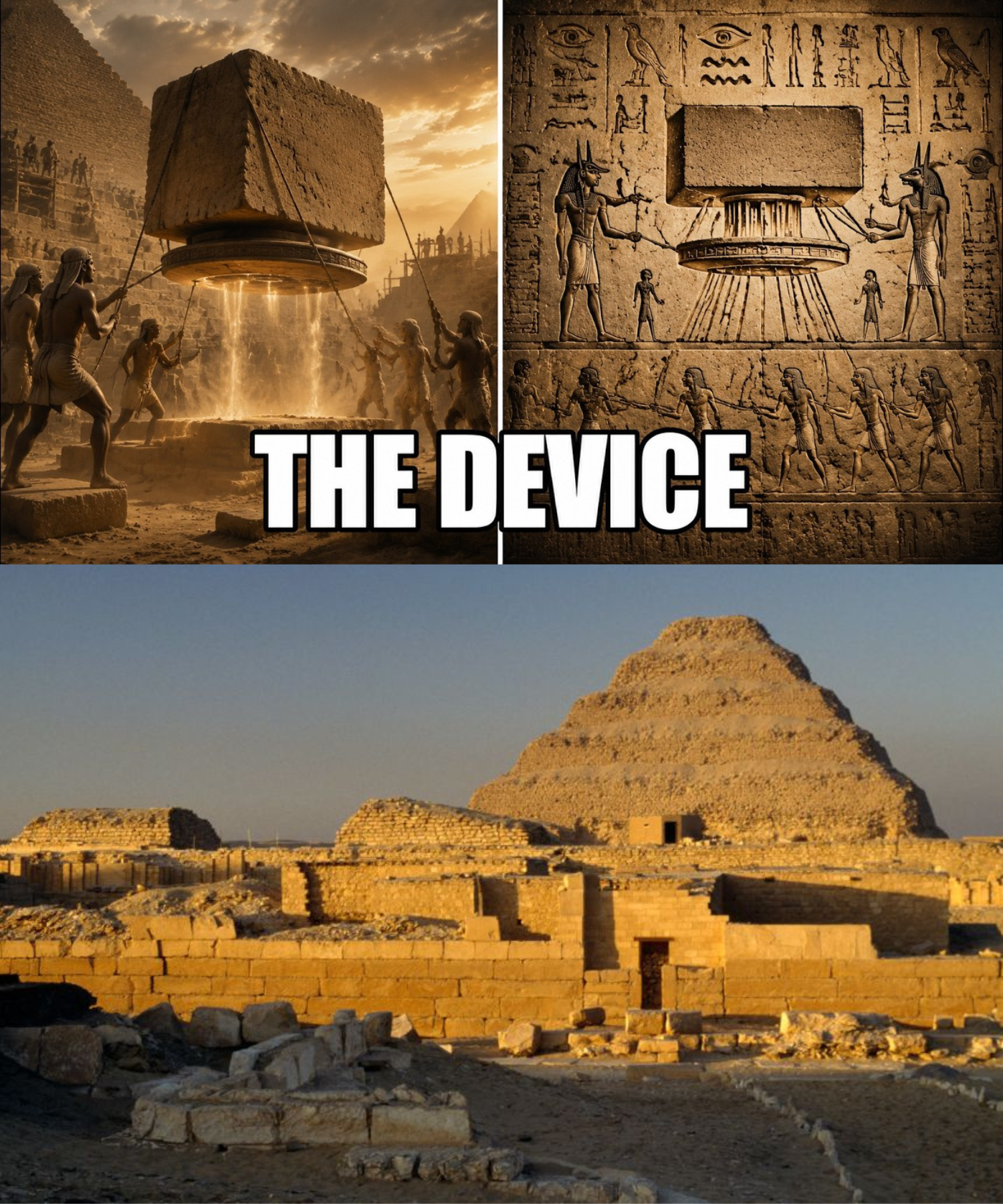
The famous scene from the tomb of Djehutihotep shows this principle in dramatic form. A colossal seated statue is strapped to a sledge. Rows of men pull it with ropes. Supervisors direct the effort. Musicians or chanters may be helping coordinate rhythm. The scale of the operation is enormous. But the most important detail is easy to overlook: a worker at the front pours liquid onto the ground.
For a long time, some viewers treated that figure as ritual. Perhaps the water was ceremonial. Perhaps it was an offering. Perhaps the scene was symbolic rather than practical.
Then physics caught up with the painting.
Dry sand piles up in front of a heavy sledge. The grains behave like a trap, forming resistance that forces workers to waste energy pushing a mound of sand as well as the load itself. But when the sand is dampened properly, water creates tiny bridges between grains, firming the surface. The sledge slides more easily because the sand does not bunch up so violently in front of it.
Too little water, and nothing changes.
Too much water, and mud becomes another problem.
But the right amount turns loose desert sand into a more cooperative surface.
That is the brilliance of the image. The worker pouring water may not be performing a meaningless ritual. He may be showing practical engineering, hidden inside ancient art. It is a visual instruction: if you want to move the impossible, first change the ground beneath it.
That idea alone transforms the pyramid mystery.
Instead of imagining ancient workers dragging stones helplessly through soft sand, we can imagine planned roads, wetted paths, teams pulling in rhythm, foremen controlling motion, and sledges moving across prepared surfaces. The Egyptians were not fighting the desert blindly. They were modifying friction.
But moving a stone across flat ground was only part of the problem.
The harder question is lifting.
How did blocks rise higher and higher as the pyramid grew?
Here, another clue comes from the desert quarries, especially the ancient Hatnub alabaster quarry. There, archaeologists found a ramp system that looked far more sophisticated than a simple slope. It included a central ramp flanked by stairways and postholes, suggesting that wooden posts could have been used with ropes to help teams haul heavy loads upward. Workers could pull from different angles. Ropes could be wrapped or redirected around posts. The system may have allowed heavy blocks to be dragged up steep slopes more effectively than brute force alone.
This is the part that sounds almost like a secret device, because in a way, it was.
Not a machine with gears and metal engines, but a human-powered traction system. A ramp combined with sledges, ropes, posts, and coordinated crews. A device made from the simplest materials: wood, fiber, stone, mudbrick, water, and muscle. It did not look like modern machinery, but it solved a modern problem: how to move a heavy object upward without losing control.
The Egyptians understood something many modern people forget. A machine does not have to be complex to be powerful. A ramp is a machine. A rope is a machine. A lever is a machine. A sledge is a machine. A watered track is a machine. Combine them correctly, and human strength multiplies.
That may be the real answer hidden behind the hieroglyphs.
The pyramid builders did not possess one magical technology. They possessed many small technologies working together.
The Merer papyri, often called among the oldest known papyri with writing, add another extraordinary layer. These ancient records describe the work of a man named Merer, an official who led a crew transporting limestone from Tura to the pyramid complex of Khufu. Suddenly, the builders are not faceless shadows. They become organized workers with schedules, deliveries, officials, waterways, and tasks.
Merer’s record does not tell us every detail of how each block was lifted into place, but it destroys the idea that the pyramid was built by chaos or mystery alone. It shows a disciplined supply chain. Stone moved by boat. Crews reported to officials. Work was measured in days. The pyramid was not a miracle appearing from the desert. It was a national project, managed with terrifying efficiency.
That is perhaps the most astonishing truth.
The pyramids were not built only at the construction site.
They were built across Egypt.
In quarries where stone was cut.
On the Nile where barges moved cargo.
At harbors where blocks were unloaded.
On causeways where sledges were dragged.
On ramps where teams pulled upward.
In bakeries where workers were fed.
In scribal offices where deliveries were recorded.
In royal ideology where the entire project was justified.
The device was not merely physical. It was social. The true machine was Egypt itself.
Still, the physical challenge remains almost unbelievable. A pyramid block could weigh several tons. Granite beams used inside the Great Pyramid were far heavier and had to be brought from Aswan, far to the south. The outer casing stones of fine white limestone had to be quarried, transported, finished, and placed with care. Each stone had to arrive at the right time, in the right condition, to the right place. The pyramid’s rising shape made movement harder with each new layer.
This is where ramps become unavoidable in almost every serious theory, though the exact type remains debated. Some researchers imagine straight ramps. Others suggest zigzag ramps, spiral ramps, side ramps, or internal ramps. Some propose combinations that changed as the pyramid rose. The answer may not be one ramp at all, but several ramp systems adapted over time.
That makes sense. The Great Pyramid was not a small house built from a single plan on a quiet street. It was a colossal, evolving worksite. The methods used at the base may not have been identical to those used near the top. The heaviest stones may have required special routes. Temporary ramps may have been built, removed, rebuilt, or reshaped. Teams may have worked in parallel, not in one slow line.
This matters because people often picture pyramid construction as a simple chain of workers hauling one block after another up one giant ramp. That image may be too crude. A project of this scale required flow. Blocks had to move continuously. Crews had to avoid crowding. The supply of stone could not stall. The slope had to be manageable. Surveyors had to preserve alignment. The structure had to remain accessible.
The Egyptians were not just lifting stone.
They were managing time.
Every delay mattered. Every turn mattered. Every broken sledge, snapped rope, injured worker, unstable ramp, or misplaced block could disrupt the rhythm of the whole project. That is why the pyramid is as much an administrative achievement as an engineering one. It required not only strength, but scheduling. Not only faith, but accounting.
And yet, the visual clue of water on sand remains one of the most powerful because it brings the scale back down to a human action.
One man pours water.
Rows of workers pull.
The sledge begins to move.
The scene is ancient, but it feels alive. You can almost hear the strain in the ropes, the chant of the men, the scrape of wood, the orders shouted from supervisors, the hiss of damp sand under the runners. You can imagine the fear when a load begins to slide too fast, or the exhausted silence when it refuses to move at all.
That is the part the alien theories steal from the ancient Egyptians.
They steal the sweat.
They steal the intelligence.
They steal the years of trial and error.
They steal the ordinary brilliance of people who learned how to turn landscape, labor, and simple machines into monuments that outlived empires.
The hieroglyphs and tomb scenes do not show helpless people waiting for supernatural help. They show organization. They show crews. They show technique. They show that the Egyptians were thinking carefully about force, surface, weight, and movement, even if they did not describe those ideas in modern engineering language.
They knew what worked because they had done it.
That knowledge may have been passed from quarrymen to haulers, from overseers to apprentices, from royal projects to regional monuments. Egypt was full of stone-working experience long before the Great Pyramid. The builders of Khufu did not wake up one morning and invent monumental construction from nothing. They inherited generations of experiments: mastabas, step pyramids, failed pyramids, bent pyramids, temples, causeways, statues, quarries, boats, and roads.
The Great Pyramid was not the beginning of Egyptian engineering.
It was a climax.
That is why the device they used seems both simple and astonishing. A sledge on wet sand sounds almost too basic to explain something so huge. But simplicity is often the mark of mature technology. The wheel is simple. The ramp is simple. The lever is simple. The rope is simple. The genius lies in using simple tools at massive scale with near-perfect coordination.
Imagine the scene at Giza during peak construction.
The plateau is alive. Workers move in teams. Scribes count deliveries. Boats unload stone from river channels. Men drag blocks across prepared tracks. Others repair ramps. Rope crews haul sledges upward. Surveyors check lines. Stonecutters shape surfaces. Water carriers wet paths. Food arrives for labor gangs. Overseers shout instructions. Dust rises. The pyramid grows slowly, layer by layer, until the shape begins to dominate the horizon like an artificial mountain.
To the workers, it may not have felt mysterious.
It may have felt exhausting.
That is another truth hidden by distance. We see the pyramid as a finished wonder. They saw it as work. Morning after morning. Season after season. The same hauling, cutting, measuring, feeding, dragging, lifting, placing, and correcting. The miracle was not one impossible moment. It was thousands of difficult moments repeated without collapse.
The device was repetition.
The device was discipline.
The device was a civilization that knew how to make human bodies move like parts of a larger machine.
This does not mean every question is answered. Archaeologists still debate the exact ramp systems used at Giza. The Djehutihotep painting shows statue transport from a later period, not a direct blueprint of Khufu’s pyramid construction. The Hatnub ramp comes from a quarry context and may not exactly match the pyramid site. The Merer papyri describe transport logistics more than final lifting. No single piece of evidence solves the entire pyramid.
But together, they form a pattern too strong to ignore.
Sledges moved heavy loads.
Water reduced friction.
Ropes multiplied human effort.
Posts and ramps helped control upward movement.
Boats carried stone across long distances.
Crews worked under organized administration.
That combination is not glamorous enough for people who want magic. But it is powerful enough for history.
The frightening part, if there is one, is not that we still lack a lost machine. It is that humans were capable of this without one. The pyramids reveal what organized belief can do when a society concentrates its labor, food, engineering, and ideology into a single project. They show the beauty of human cooperation, but also the terrifying scale of royal power.
No ordinary person wakes up and decides to build a pyramid.
A state does that.
A king does that.
A religious system does that.
A civilization convinced that the afterlife of one ruler matters enough to mobilize thousands of living bodies does that.
The device lifted stones, but belief lifted the project.
That is why the pyramids still disturb us. They are not only monuments to engineering. They are monuments to authority. They show that ancient Egypt could organize people with such intensity that the desert itself became a construction yard for eternity. The stones were lifted by sledges, ropes, ramps, water, and muscle. But the reason they were lifted came from something deeper: a worldview in which the king’s death required architecture on a cosmic scale.
The hieroglyphs do not reveal a secret button.
They reveal a society.
They show that the Egyptians understood movement, friction, leverage, logistics, and labor better than many modern people imagine. They show that the answer was not hidden because it was impossible, but because it was ordinary enough to be overlooked. A man pouring water in front of a sledge may not look dramatic beside the Great Pyramid. But without such knowledge, the stones do not move.
That is the beauty of the discovery.
The clue is humble.
The result is enormous.
The pyramid builders did not defeat gravity. They negotiated with it. They reduced friction where they could. They spread weight. They controlled slopes. They pulled in teams. They used water, wood, rope, earth, and stone against stone. They turned human rhythm into mechanical force. They transformed a desert plateau into one of the most disciplined worksites the ancient world ever saw.
So how were the pyramid stones actually lifted?
Not by one impossible secret.
By a chain of practical brilliance.
A block was quarried. A sledge received it. Water firmed the sand. Ropes tightened. Men pulled. Boats carried. Ramps rose. Posts anchored. Levers adjusted. Crews placed. Scribes recorded. The pyramid climbed.
And the device they used was not something beyond human understanding.
It was the oldest machine in history: human intelligence organized around a problem too large for one person to solve.
That may be the answer people never expected.
The pyramids were not built because ancient Egyptians had technology we cannot imagine.
They were built because they had mastered technology we stopped respecting.
A wet road.
A wooden sledge.
A rope under tension.
A ramp into the sky.
And thousands of hands pulling in the same direction.