These Hieroglyphs Describe Giants The Egyptians Saw With Their Own Eyes — And What Happened To Them
These Hieroglyphs Describe Giants the Egyptians Saw With Their Own Eyes — And What Happened To Them
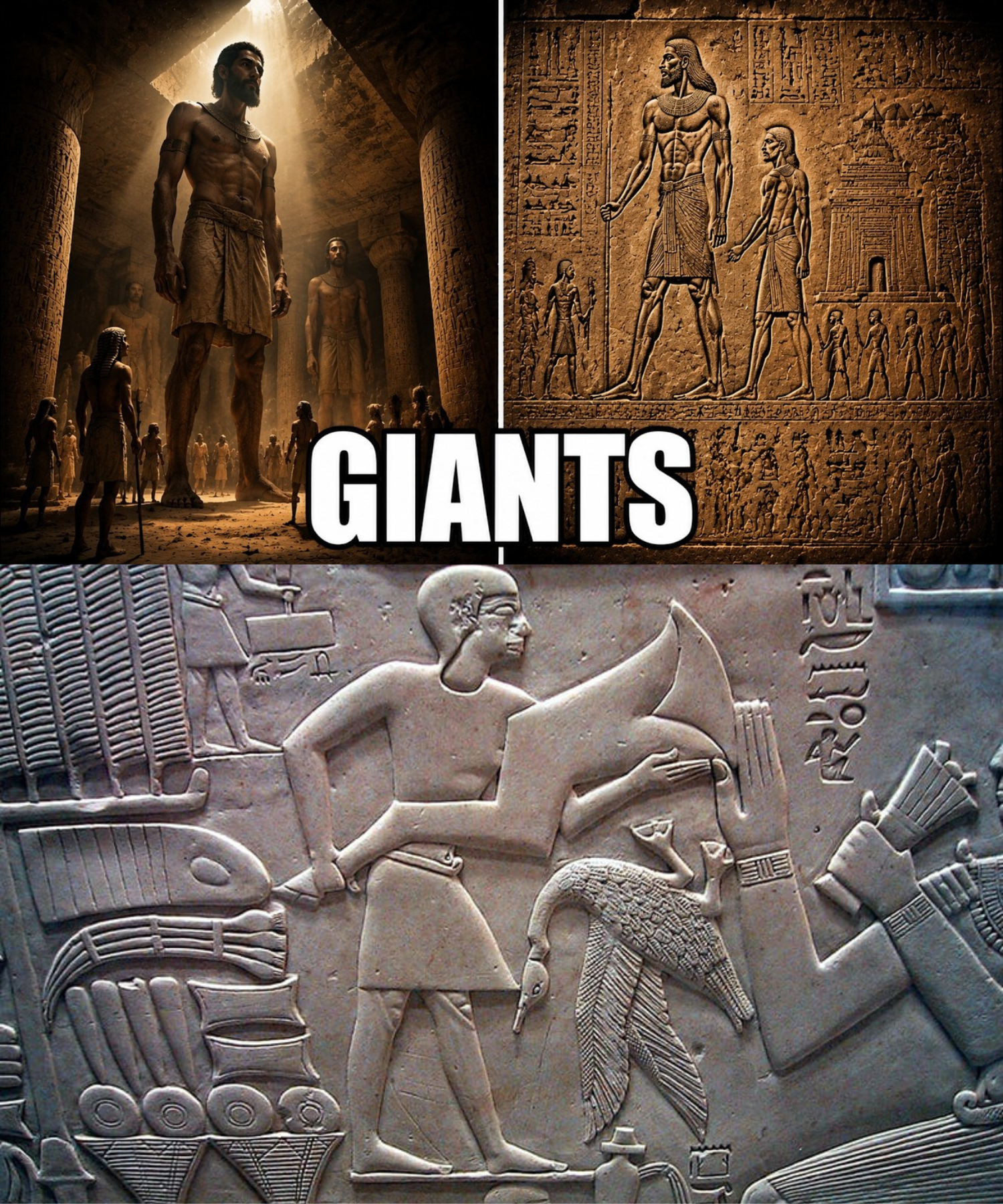
The Egyptians did not always draw giants because they were tall. Sometimes they drew them because they were powerful. But one ancient text describes men so large, so fierce, and so dangerous that modern readers are asking whether Egypt recorded something far stranger than symbolism.
The mystery begins with a mistake many people make when looking at ancient Egyptian walls. They see a pharaoh towering over enemies, gods standing larger than humans, and strange figures bending beneath divine bodies, then immediately assume the Egyptians were drawing literal giants. At first glance, the evidence looks overwhelming. A king raises his mace above tiny captives. A goddess stretches across the sky. A god stands impossibly large beside mortals. Hieroglyphs crowd the stone like captions to a forgotten history.
But Egyptian art was not photography.
It was power made visible.
To the ancient Egyptian artist, size did not always mean physical measurement. Size meant importance, authority, sacred force, and cosmic rank. A pharaoh could be carved larger than an entire group of enemies because he represented divine kingship. A god could stand taller than a human because gods belonged to a higher order of reality. A deceased noble could appear larger than servants in a tomb scene because the image was organized around social meaning, not camera-like realism.
This is the first key to the mystery: not every giant-looking figure in Egypt was meant to be a giant.
But then comes the second key—the one that refuses to disappear.
Among the ancient Egyptian writings most often brought into the debate is Papyrus Anastasi I, a New Kingdom text from the Ramesside period. It is not a temple inscription announcing the discovery of a lost race. It is a satirical letter used in scribal training, mocking an incompetent scribe by describing the dangers and knowledge required for military travel in Canaan and Syria. Yet in one famous passage, the writer describes hostile Shasu-Bedouin hidden in a dangerous mountain pass, some of them said in translation to be four or five cubits in height.
That line is the spark.
Depending on the cubit used, five cubits could suggest a man far taller than normal, perhaps over eight feet. Suddenly, modern readers see a possible bridge between Egypt and the biblical world: Canaan, terrifying tribes, unusually tall warriors, and later Hebrew traditions about Anakim, Rephaim, and giants. The question becomes irresistible. Did the Egyptians encounter unusually large people in the lands north of Egypt? Did their scribes record them? Did those memories echo later in biblical accounts?
The cautious answer is that Papyrus Anastasi I does not prove a race of supernatural giants. The text is literary, satirical, and rhetorical. Ancient writers exaggerated danger to make a point. The author is mocking another scribe’s incompetence by describing travel through foreign lands as frightening, chaotic, and full of threats. The “four or five cubits” detail may be part of that exaggeration. It may mean “huge, dangerous men” rather than a precise anthropological measurement.
But even exaggeration tells us something.
The Egyptians feared the highlands and passes of Canaan. They saw the peoples of those regions as fierce, unpredictable, and physically intimidating. Whether the men were literally eight feet tall or simply described that way to intensify fear, the image tells us that Egypt’s northern frontier was filled with stories of unusually formidable people.
And that is where history and legend begin to overlap.
The Bible later describes the Anakim as terrifyingly tall. Numbers portrays frightened Israelite spies saying they felt like grasshoppers beside them. Deuteronomy and Joshua preserve memories of giant-associated peoples in the land. Og of Bashan is remembered through the enormous size of his bed. These biblical passages are theological and literary, not modern biological reports, but they show that the ancient Near East shared a vocabulary of fear around tall warriors, giant clans, and old peoples associated with power.
So when modern readers ask whether Egyptian texts “describe giants,” the most honest answer is this: Egyptian material does not give us a clear, verified account of a literal giant race, but it does preserve descriptions of foreign warriors portrayed as unusually large, dangerous, and terrifying. That is enough to fuel the mystery.
The next question is why the Egyptians were so obsessed with showing some figures as enormous.
The answer lies in Egyptian worldview. Egypt imagined order as sacred. Pharaoh was not merely a political ruler. He was the earthly defender of maat, the divine order that kept chaos from overwhelming the world. Enemies of Egypt were often shown as small, bent, bound, or crushed beneath the king’s power. Their size on the wall was not biology. It was theology. Egypt was saying: chaos is beneath the king.
When a pharaoh towers over prisoners, he is not being drawn like a modern portrait. He is being shown as cosmic authority. His body becomes the size of his role. He is larger because Egypt itself must be larger than its enemies.
The same rule applies to gods. Nut, the sky goddess, can arch across the world because she is not a normal woman. She is the sky itself. Geb lies below as the earth. Shu holds them apart as air. In this image, divine bodies are not human bodies scaled up. They are cosmic forces given human form. To call Nut a “giant woman” would miss the point. She is not a tall person. She is heaven bending over creation.
This matters because many viral claims about Egyptian giants confuse symbolic art with eyewitness documentation. A giant god on a wall does not mean Egyptians saw a 40-foot humanoid. A pharaoh carved huge above captives does not mean the king was physically enormous. Egyptian art used scale as language.
But Papyrus Anastasi I is different because it is text, not just image.
The Shasu description is not a relief where size might be symbolic. It is a written warning about men encountered in a dangerous landscape. That makes it more intriguing. If a scribe says some of these men were four or five cubits from nose to foot, the phrase feels less like artistic hierarchy and more like a physical description.
Still, the context must not be ignored. The whole passage is designed to intimidate and ridicule. The writer is essentially saying, “You think you are qualified for dangerous missions? You do not even understand what awaits you.” The tall Shasu are part of a catalogue of threats: rough roads, ambushes, hostile people, danger to horses and chariots, and the humiliation of an unprepared traveler.
In other words, the “giants” may be literary weapons.
They exist to make the reader feel afraid.
But that does not make them meaningless. Ancient exaggerations often grow from real impressions. If a region was known for tall, powerful fighters, a scribe might exaggerate their height while preserving a memory of their intimidating presence. The Egyptians were not inventing Canaanite danger from nothing. Egypt had military, diplomatic, and economic contact with the Levant for centuries. Its scribes knew foreign names, routes, cities, tribes, and threats. Papyrus Anastasi I is valuable precisely because it preserves geographical and cultural knowledge wrapped in satire.
That is why the line still matters.
It may not prove giants.
But it proves that Egyptian scribes imagined certain foreign peoples as physically terrifying.
Then comes the question in the title: what happened to them?
If the “giants” refer to literal unusually tall warriors in Canaan or nearby regions, then the answer is simple and human. They were absorbed, defeated, mythologized, or remembered through later traditions. Ancient peoples rarely vanish cleanly. They intermarry, migrate, fall in war, become vassals, change names, or survive inside the stories of those who feared them. The Anakim, Rephaim, Shasu, and other groups in ancient texts are not always easy to map onto modern archaeology. Their names carry ethnic, geographic, social, and mythic meanings that changed across time.
If the “giants” are literary figures, then what happened to them is also clear: they became memory. They became a way ancient societies talked about fear. To say “giants lived there” was to say, “That land is dangerous. Those people are not easily conquered. Do not go there unprepared.”
In the ancient world, giant language often marked the edge of human confidence.
Giants lived in borderlands, mountains, old cities, and lands remembered as dangerous. They represented the past before order, the enemies before conquest, the powers that made ordinary people feel small. Whether physically real, exaggerated, or symbolic, they carried a message: you are entering a world where human strength may not be enough.
For Egypt, the “giant” could be the foreign warrior hidden in the pass.
For Israel, the giant could be the Anakim in the land.
For Mesopotamia, the giant could be the monstrous offspring of divine rebellion.
For Greece, the giant could be the Titans and earthborn challengers of the gods.
Different cultures used different names, but the pattern repeats. Giants mark danger, memory, and cosmic disorder.
The Egyptians were masters of turning danger into image. Their temple walls often show enemies crushed under pharaoh’s feet, bound by the hair, kneeling in rows, or presented as offerings to the gods. These scenes are not neutral war reporting. They are royal propaganda and ritual power. By carving enemies as defeated, Egypt was not only remembering victory. It was re-enacting victory forever. The wall itself became a weapon against chaos.
So when modern viewers see giant-like figures, they must ask: is this an enemy made small, a king made huge, a god made cosmic, or a text describing real fear?
That question changes everything.
The hidden truth is not that every large figure proves a race of giants. The hidden truth is that the Egyptians lived in a world where size carried meaning. Height could describe a body, but it could also describe power. A man could be “giant” because he was physically tall, because he was feared, because he belonged to a legendary people, or because later storytellers needed him to stand for something larger than life.
The danger is flattening ancient language into modern literalism.
The wonder is realizing how rich that language was.
Imagine an Egyptian scribe hearing reports from the north: rough passes, fierce nomads, men hidden among bushes, faces described as brutal, bodies said to be four or five cubits tall. The scribe writes not like a modern anthropologist with a measuring tape, but like a teacher warning a student that the world beyond Egypt is hostile, difficult, and full of humiliation for the unprepared. The men become enormous because danger makes them enormous.
Yet maybe behind that exaggeration stood real individuals of unusual height.
That possibility cannot be dismissed completely. Human populations can include exceptionally tall people. Warrior elites may have been remembered because of their physical presence. Ancient diets, genetics, and social selection could produce men whose size impressed outsiders. A single exceptionally tall fighter can become, over generations, a tribe of giants in memory.
That may be how history becomes legend.
Not by pure invention, but by enlargement.
A tall warrior becomes a giant.
A dangerous tribe becomes a race of giants.
A military warning becomes a mythic memory.
A scribal satire becomes a viral mystery three thousand years later.
This is why the Egyptian evidence is so compelling. It does not give us the clean answer people want, but it opens a window into how ancient peoples saw each other. The Egyptians were not isolated behind the Nile. They encountered Nubians, Libyans, Asiatics, Shasu, Hittites, Canaanites, and many others. They fought, traded, married, enslaved, negotiated, and recorded. Their texts and images preserve both knowledge and prejudice, observation and propaganda.
The “giants” may stand at the intersection of those forces.
They are partly observed, partly feared, partly exaggerated, and partly transformed into symbols.
The phrase “what happened to them” therefore has multiple answers. The literal tall men, if they existed, died like all men. Their bones returned to the earth. Their descendants may have blended into surrounding populations. Their names changed. Their height became rumor.
The giant tribes of legend were defeated by later storytelling. In biblical memory, the giants of Canaan become enemies overcome by God’s promise. In Egyptian rhetoric, threatening foreigners become figures crushed by pharaoh’s order. In myth, giants often lose because they represent chaos that must be subdued before civilization can stand.
But the idea of giants never died.
It survived because every civilization needs a way to talk about powers that made it afraid.
For Egypt, the greatest fear was chaos. Desert, foreign invasion, disorder, famine, rebellion, failed ritual, and cosmic imbalance all threatened maat. The giant, whether literal or symbolic, was a perfect image of chaos because it made the human world feel small. To defeat the giant was to restore order.
That may explain why giant stories are so satisfying. They allow people to imagine fear in bodily form, then imagine it conquered.
But sometimes the old texts do not show conquest. Sometimes they simply warn.
Papyrus Anastasi I does not tell us that pharaoh defeated the tall Shasu in that passage. It uses them to frighten an incompetent scribe. Their power is not in being defeated. Their power is in waiting in the mountain pass, hidden beneath bushes, ready to expose the weakness of anyone arrogant enough to travel unprepared.
That is a very different kind of giant.
Not a monster on a battlefield.
A threat in the wilderness.
A reminder that beyond the borders of order, the world is larger, rougher, and more dangerous than the classroom map suggests.
This is why the ancient Egyptian “giants” should be read carefully. They are not proof that the pyramids were built by a lost race. They are not evidence that gods physically walked the Nile as towering humanoids. They are not confirmation of every sensational giant theory online. But they are evidence that ancient Egyptian texts and images preserved memories of overwhelming beings—some symbolic, some divine, some foreign, and perhaps some based on unusually tall warriors.
The mystery is real.
The exaggeration is modern.
The challenge is to separate them without killing the wonder.
The best way to understand the evidence is this: the Egyptians saw power as size. They drew gods and kings huge because their roles were huge. They described terrifying foreigners as enormous because fear enlarged them. In at least one famous text, they wrote of Shasu in language that sounds like unusual physical height, but the literary context warns us not to read it as a simple field report.
So did the Egyptians see giants with their own eyes?
They certainly saw men, gods, and enemies who were giant in meaning.
They may have encountered unusually tall warriors whose memory grew into giant language.
They definitely carved and wrote a world where size communicated power, danger, and sacred order.
And what happened to those giants?
The gods remained on temple walls.
The pharaohs became statues, mummies, and names in cartouches.
The foreign warriors faded into dust, story, and fragments of papyrus.
The literal men died.
The symbolic giants survived.
They survive every time someone stands before an Egyptian wall and feels small. They survive in the fear that old texts still awaken. They survive in the uncomfortable realization that ancient people were not merely decorating stone; they were encoding how they understood power.
That may be the most shocking answer.
The giants were not always hidden races.
Sometimes they were the ancient world’s way of saying: this is what power looks like when carved into eternity.
And sometimes, in one dangerous mountain pass far beyond the Nile, they may have been real enough to make an Egyptian scribe warn another man not to go there alone.