The Terrifying Reason Göbekli Tepe Was Buried 😳
The Terrifying Reason Göbekli Tepe Was Buried
They did not abandon Göbekli Tepe like a forgotten village. They buried it—stone by stone, bone by bone, memory by memory—as if something there had to be sealed away.
Long before pyramids rose in Egypt, long before Stonehenge stood on the English plain, long before written kings began carving their names into history, people gathered on a limestone hill in what is now southeastern Turkey and built something the modern world was not ready to understand. Göbekli Tepe was not supposed to exist in that age. At least, not according to the old version of human history.
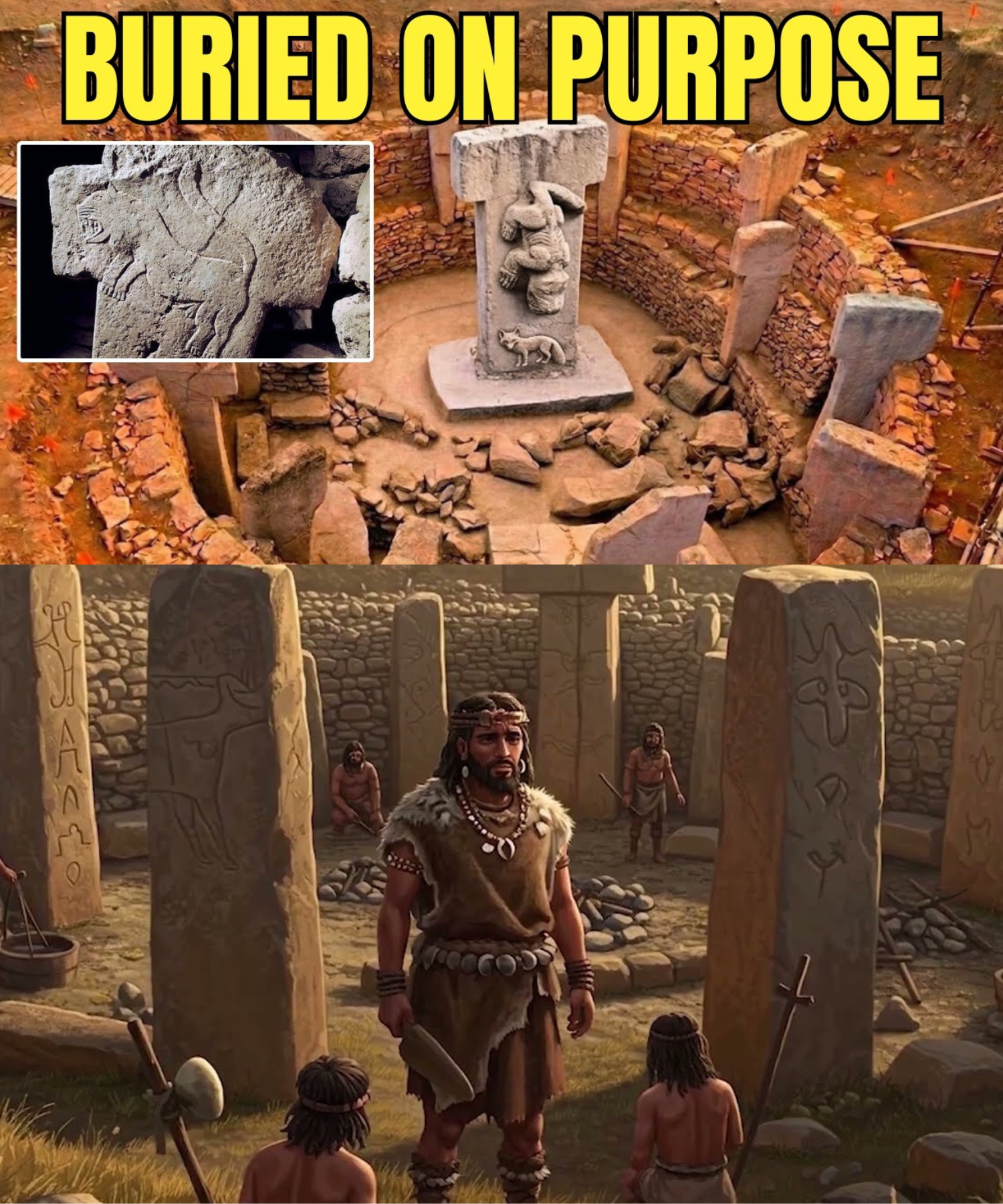
The builders lived around 11,000 to 12,000 years ago, at the dawn of the Neolithic world. They did not have metal tools. They did not have wheels. They did not have writing. They did not live in cities as later civilizations did. And yet they carved massive T-shaped pillars from limestone, dragged them into circular enclosures, decorated them with foxes, snakes, boars, vultures, scorpions, belts, hands, and strange symbols, then arranged them into monumental spaces that feel less like shelters and more like theaters of belief.
The question that has haunted Göbekli Tepe since its excavation is not only how it was built.
It is why it was buried.
The old answer sounded almost simple: at some point, the people who used the site deliberately filled the enclosures with rubble, bones, stone fragments, and soil. They covered the pillars. They sealed the spaces. They turned a sacred monument into a mound. Because of that burial, the site was preserved for thousands of years, waiting under the earth until modern archaeologists uncovered its stone faces again.
But that answer only opens a darker question.
Why would anyone bury something so monumental?
People do not casually cover a sacred place that took generations to build. They do not fill great enclosures with tons of material for no reason. They do not hide carved pillars unless the act itself means something. Göbekli Tepe was not simply left to decay. Its most important spaces were filled, closed, and transformed.
That suggests intention.
And intention is where the mystery becomes unsettling.
The first possibility is ritual closure. In many ancient societies, sacred spaces were not treated as permanent in the modern sense. A ritual building could have a life cycle. It could be born, used, renewed, repaired, transformed, and eventually closed. To bury such a structure might not mean rejection. It might mean completion. The monument had fulfilled its purpose. Its power had to be returned to the earth.
That idea may sound peaceful at first, but look closer. Ritual closure often happens when a place is too important to abandon casually. You do not simply walk away from it. You seal it. You feed it with offerings. You place fragments inside. You cover it with care. You make sure the transition between use and silence is controlled.
In that sense, Göbekli Tepe may have been buried because it was still powerful.
Too powerful to leave exposed.
The fill inside the enclosures contained huge amounts of animal bone, limestone rubble, stone tools, sculpture fragments, and even human bone fragments. This was not clean construction sand poured into an empty hole. It was a dense, messy, meaningful deposit. The remains of feasting, ritual, building, breaking, and memory may have been packed together inside the same sacred spaces where people once gathered.
Imagine the scene.
People standing around the pillars one final time.
Fires burning.
Animal bones scattered from ritual meals.
Stone fragments carried in baskets.
Perhaps chants, silence, grief, fear, or ceremony.
Then the filling begins.
The carved animals disappear first at the lower levels. The snakes vanish. The foxes are covered. The scorpions sink into shadow. The great T-shaped pillars, once towering over the people who approached them, are slowly swallowed by stone and soil. The place that once drew bodies together becomes hidden from human sight.
That is not ordinary abandonment.
That is burial.
The second possibility is social transformation. Göbekli Tepe was built during one of the greatest turning points in human history: the shift from mobile hunter-gatherer life toward settled communities and early farming. This was not a simple improvement story. It was a crisis of identity. People were changing how they ate, lived, gathered, organized labor, shared food, held power, and understood the sacred.
Göbekli Tepe may have belonged to a world that was passing away.
Its huge enclosures may have been tied to hunting communities, wild animal symbolism, seasonal gatherings, feasting, ancestor rituals, and a worldview centered on dangerous creatures and powerful human-like pillars. As settlement increased and domestic life changed, the old sacred forms may have become harder to maintain. New buildings appeared. Smaller structures replaced larger ones. The relationship between people, place, and ritual shifted.
If that is true, then the burial of Göbekli Tepe was not just the closing of a monument.
It was the burial of an old way of life.
That is terrifying in a quiet way. Civilizations often bury their pasts when they change. They cover old gods with new temples. They build churches over pagan shrines. They rename sacred hills. They hide what no longer fits the new order. Göbekli Tepe may preserve one of the earliest examples of this human pattern: a society standing at the edge of transformation and sealing away the symbols of the world it was leaving behind.
The third possibility is protection. The people who filled Göbekli Tepe may have believed the structures needed to be preserved from damage, outsiders, desecration, or misuse. If the pillars represented ancestors, spirits, gods, guardians, or mythic beings, leaving them exposed after ritual use may have been dangerous. Burial could have been a way of protecting both the stones and the living.
Many of the animals carved at Göbekli Tepe are not gentle. Snakes coil across the stone. Boars appear fierce. Foxes stare with strange intelligence. Vultures, scorpions, and predators dominate the iconography. These are not domestic animals. They are wild, dangerous, threshold creatures. They belong to death, hunting, fear, protection, and the untamed world.
The pillars themselves appear anthropomorphic. Some have carved arms, hands, belts, and loincloths. They are not simple slabs. They seem to represent stylized human-like beings, perhaps ancestors, spirits, or powerful figures beyond ordinary humanity. Standing inside those enclosures, surrounded by carved animals and towering stone bodies, must have felt overwhelming.
What if the burial was meant to contain that power?
Not because the builders hated the site.
Because they respected it.
Some sacred things are not left open forever. They are covered. They are hidden. They are returned to darkness because their force is not meant to remain exposed to everyday life.
The fourth possibility is catastrophe—not necessarily a single Hollywood disaster, but a long pressure of collapse, erosion, structural damage, and environmental change. Later research has complicated the older idea that every part of Göbekli Tepe was neatly and intentionally buried in one grand ritual act. Some structures may have been damaged by slope movement, flooding, collapse, or rubble sliding into lower areas. The mound itself was not static. It was a living landscape of buildings, debris, repair, erosion, and rebuilding.
This does not erase the ritual mystery. It deepens it.
A structure damaged by slope slides might still be ritually closed afterward. A collapsed enclosure might be filled deliberately. A sacred place wounded by nature might require ceremony to seal it. Human intention and natural process can coexist. The terrifying possibility is that the people of Göbekli Tepe may have watched their sacred architecture fail, then responded not by rebuilding forever, but by burying it.
That would make the site a place of both reverence and crisis.
The fifth possibility is death.
Human bone fragments found in the fill and modified skull fragments discovered at the site have led researchers to discuss possible skull cult practices. Burials in the ordinary sense have not been clearly identified at Göbekli Tepe, but human remains were present, and some skull pieces were carved, drilled, or modified in ways that suggest display or ritual handling.
This changes the emotional atmosphere of the site.
Göbekli Tepe was not only about stone and animals. It was also about the human dead.
If skulls were displayed, suspended, decorated, or ritually handled, then the enclosures may have been places where the living encountered the dead in a powerful and controlled way. The pillars may have stood as monumental beings among human remains and animal symbols. Feasting may have taken place near death rituals. The boundary between community, ancestors, and unseen forces may have been thin.
In that context, burying the enclosures becomes even more haunting.
It may have been a funerary act for the site itself.
A burial of a place connected to the dead.
Maybe the people did not only bury buildings.
Maybe they buried a relationship with the dead that had become too dangerous, too sacred, or too old to continue.
This is where Göbekli Tepe becomes more than an archaeological puzzle. It becomes a psychological one. The builders were living through a world-changing transition. They were learning to settle, gather in larger groups, organize work, process food, construct monumental spaces, and develop new forms of belief. That kind of transformation creates tension. Old ways and new ways do not always coexist peacefully.
Maybe the burial was a compromise.
The old sacred place could not remain active.
But it could not be destroyed either.
So it was sealed.
That act has a disturbing beauty. Burial is not the same as destruction. To destroy is to erase. To bury is to preserve while removing from sight. The people who covered Göbekli Tepe may have been saying, in the only language they had: this must not continue, but it must not be forgotten by the earth.
And the earth did remember.
For nearly 12,000 years, the pillars slept beneath the mound. Rain passed over them. Grass grew above them. Later people walked the hill without knowing what stood below. Farmers moved stones. Villagers knew the hill as a place with its own memory. But the enclosures remained hidden, their animals still carved, their pillars still standing, their questions still waiting.
When archaeologists uncovered them, the burial became the reason the site survived.
That is the great irony.
The act that hid Göbekli Tepe from history also saved it for history.
Had the enclosures remained exposed, the pillars might have been broken, robbed, weathered, reused, or erased. By burying them, intentionally or through a combination of human and natural processes, the ancient builders protected one of the most important prehistoric monuments ever found.
But protection does not explain everything.
People protect what matters.
They also hide what frightens them.
The terrifying reason Göbekli Tepe was buried may not be one single reason. It may be that the site stood at the center of too many powerful things at once: death, ritual, social change, wild animals, ancestral memory, feasting, hierarchy, fear, and the birth of settled life. At some point, the people who knew its meaning decided the enclosures had to be closed. Whether because their ritual life cycle ended, because society changed, because the structures were damaged, because the dead required sealing, or because the old sacred order no longer fit the new world, the result was the same.
The stones went under.
And once they were buried, the memory of why may have disappeared.
That is what makes the mystery so powerful. The builders left no written explanation. No inscription says, “We buried this place because…” No surviving myth tells us what the foxes meant, why the vultures mattered, what the central pillars represented, or what people felt as they covered the enclosures. We have stones, bones, tools, animal remains, and patterns. We do not have their voices.
So we are left with the silence.
But silence is not emptiness. At Göbekli Tepe, silence feels intentional. It surrounds the pillars like another layer of fill. It forces us to recognize how much of human history happened before writing, before kings, before cities, before the kinds of records we depend on. These people were not primitive simply because they left no texts. They built with vision. They carved with skill. They organized labor. They created sacred spaces that still overwhelm modern viewers.
And then they buried them.
That final act may be the most human part of the story.
Because humans are always burying what they cannot carry forward.
We bury the dead.
We bury old gods.
We bury dangerous memories.
We bury cities after collapse.
We bury temples beneath new temples.
We bury the past and then, thousands of years later, dig it up and wonder why it feels alive.
Göbekli Tepe was buried because something ended there.
A ritual era.
A sacred cycle.
A social world.
A relationship with the dead.
A dangerous power.
Maybe all of them.
The fear is not that the builders hid a monster beneath the hill. The fear is that they hid a truth about humanity’s beginning that we still do not fully understand: civilization may not have started with farming, trade, or kings. It may have started with ritual, death, gathering, and the need to face forces too large for one person alone.
Before cities, there was ceremony.
Before writing, there were symbols.
Before temples, there were pillars watching from the dark.
And before history could remember Göbekli Tepe, its own builders sealed it away.
Perhaps they buried it to protect the sacred.
Perhaps they buried it to close a world that had become too dangerous.
Perhaps they buried it because the age of the hunters was ending, and a new human future was beginning.
Whatever the reason, the result is chilling.
The oldest monumental sanctuary ever found was not lost because people forgot how to build.
It was hidden because people chose to cover it.
And now that it has been uncovered, the question is no longer only why they buried it.
The question is what they knew that made burial necessary.