The Sumerian Tablet the Bible Couldn’t Hide — It Describes Who the Serpent in the Garden Really Was
The Sumerian Tablet the Bible Couldn’t Hide — It Describes Who the Serpent in the Garden Really Was
The serpent in Eden may not have begun as a snake at all. Long before Genesis was written down, older Mesopotamian stories were already speaking of gardens, forbidden life, divine knowledge, and serpent-linked beings standing at the boundary between humanity and immortality.
For centuries, readers of the Bible have imagined the serpent in the Garden of Eden as the ultimate deceiver: a cunning creature who whispers doubt into Eve’s mind, tempts humanity toward forbidden knowledge, and opens the door to exile, death, and suffering. In Christian tradition, the serpent later becomes closely associated with Satan, rebellion, and spiritual corruption. In popular imagination, the story is simple: God gave a command, the serpent lied, humanity fell.
But the ancient world behind Genesis was not simple.
Long before the Hebrew Bible took shape, the civilizations of Sumer, Akkad, Babylon, and Assyria had already filled clay tablets with stories about divine gardens, sacred plants, lost immortality, serpents, underworld guardians, and gods who gave humanity knowledge that other gods did not want humans to possess. These older traditions do not “disprove” the Bible, but they do reveal something unsettling: the serpent motif was far deeper, older, and more complicated than many modern readers realize.
The mystery begins with a question most people never ask.
Why a serpent?
Why not a wolf, lion, eagle, scorpion, or dragon? Why does the story place humanity’s first great test in the mouth of a creature associated across the ancient Near East with wisdom, danger, healing, death, rebirth, and hidden knowledge?
The answer may lie in the world of ancient Mesopotamia, where serpents were not merely low animals slithering in dust. They could symbolize renewal because they shed their skin. They could represent danger because they carried venom. They could guard sacred boundaries. They could appear near plants of life, underworld passages, divine gates, and healing mysteries. In other words, the serpent was already a symbol of the threshold—the place where life and death, knowledge and danger, humanity and divinity meet.
That makes the Eden serpent more than a talking animal.
It makes him part of a much older symbolic language.
One of the most striking parallels comes from the Sumerian myth known as Enki and Ninhursag. The story is set in Dilmun, a pure and radiant land often compared by modern readers to a paradise. Dilmun is described as pristine, untouched, and blessed with fresh water after divine intervention. It is not identical to Eden, but the atmosphere is familiar: a sacred place, life-giving water, divine presence, and a drama involving plants.
In the myth, the god Enki eats sacred plants grown by Ninhursag. His act brings a curse, illness, and a need for restoration. The story is strange, poetic, and full of symbolic wordplay, but the echoes are difficult to ignore. A divine garden-like place. Forbidden or sacred plants. A transgressive act involving consumption. Consequences that affect life, body, and divine order.
This does not mean Genesis copied the Sumerian myth word for word. Ancient traditions rarely move that simply. But it does suggest that biblical Eden belongs to a much larger ancient conversation about paradise, knowledge, life, and boundaries.
Then there is the figure of Ningišzida.
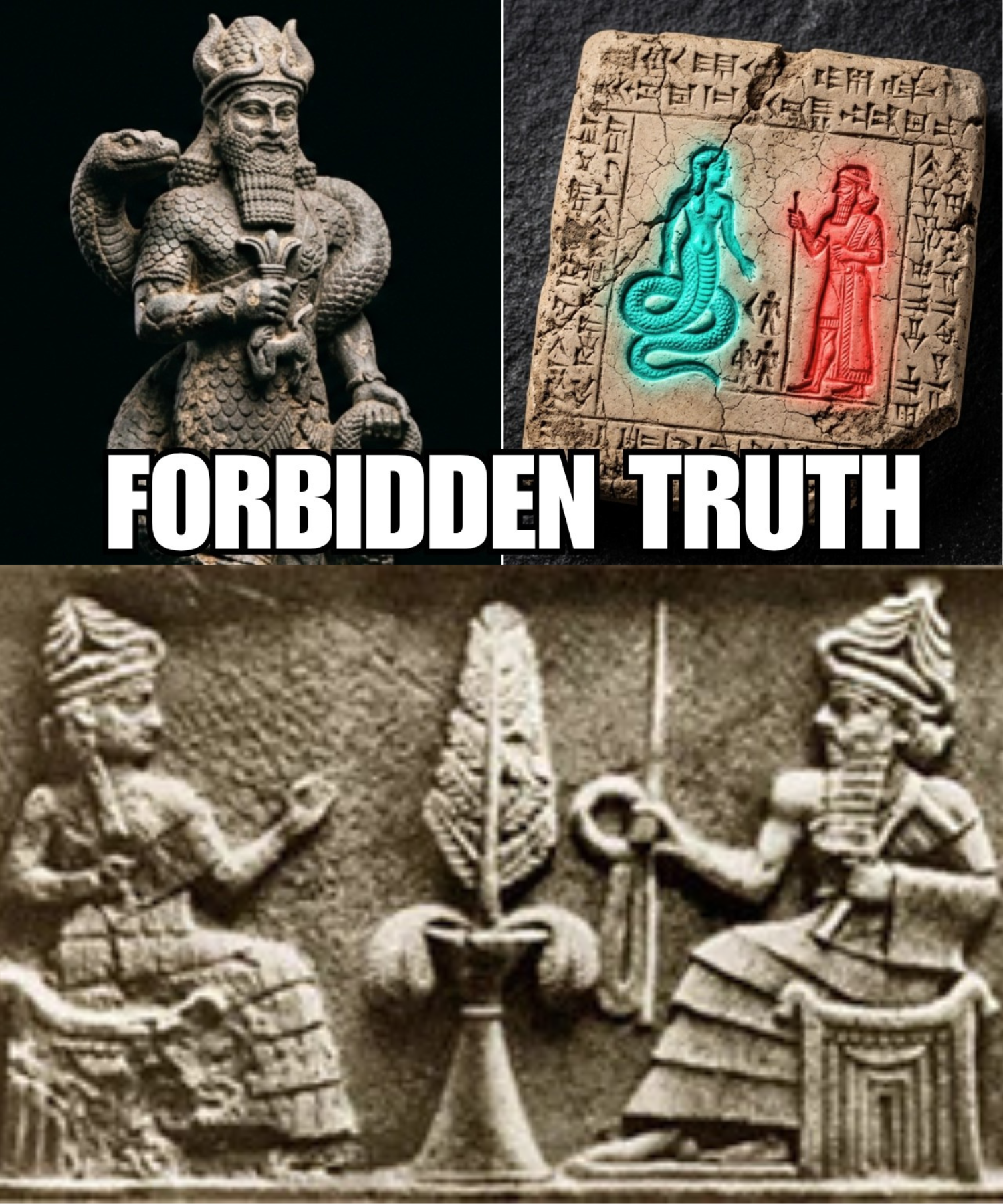
Ningišzida is one of the most fascinating serpent-linked beings in Mesopotamian religion. His name is often interpreted as “Lord of the Good Tree” or connected with a true, good, or reliable tree. He is associated with vegetation, the underworld, snakes, and dragon-like beings. In some imagery, serpents rise from his shoulders. In the myth of Adapa, he appears with Dumuzi as a gatekeeper of Anu’s heavenly realm.
That combination is almost impossible not to notice.
A serpent-associated divine figure.
A “good tree.”
A gate between human and divine realms.
A story involving lost immortality.
To mystery writers and alternative interpreters, Ningišzida becomes an obvious candidate for the older identity behind Eden’s serpent. They argue that what Genesis later presents as a deceiving snake may preserve a distorted memory of a more complex Mesopotamian figure: a guardian, mediator, or knowledge-bringer associated with the sacred tree and the boundary between mortality and divine life.
Mainstream scholars would be more cautious. They would not say, “The serpent was definitely Ningišzida.” The texts do not allow that kind of certainty. Genesis has its own theology, language, and literary purpose. But the symbolic overlap is powerful enough to explain why the theory refuses to disappear.
The serpent may not have been invented as a cartoon villain.
He may have emerged from a world where serpent figures were guardians of mysteries humans were not supposed to control.
The Adapa myth deepens the mystery even further. Adapa is a wise human figure connected with the god Ea, also known as Enki. He is granted wisdom, but not immortality. After an offense involving the South Wind, Adapa is summoned to heaven before Anu. Ea warns him not to eat or drink what is offered there, telling him it will be food and water of death. But when Adapa arrives, Anu offers him the food and water of life. Adapa refuses, obeying Ea’s warning, and loses the chance at immortality.
This is one of the great ancient stories of humanity losing eternal life not through brute force, but through knowledge, deception, obedience, and misunderstanding.
The parallels to Eden are not exact, but they are haunting. In Genesis, humans eat what is forbidden and lose access to the tree of life. In Adapa, a human refuses the food and water of life and remains mortal. In both, divine knowledge and mortality are intertwined. In both, a human stands at the edge of becoming more than human. In both, the outcome is loss.
Here the serpent question becomes sharper.
What if the serpent in Eden is not simply “evil,” but the figure who reveals the tension the gods wanted hidden: that knowledge and immortality were connected, and that humanity was being kept from one or both?
This is the controversial reading. It says the serpent did not merely trick Eve. He told a partial truth. In Genesis, he says that eating the fruit will open human eyes, and after Adam and Eve eat, the text itself says their eyes are opened. They become aware. They become morally conscious. They become like divine beings in one specific sense: knowing good and evil.
But they also lose access to the tree of life.
That is the trap.
The serpent offers knowledge, but not the power to survive knowledge.
This may be the deepest meaning of the ancient motif. Humanity wants divine awareness, but cannot handle divine consequence. The serpent opens the door, but the door does not lead only to enlightenment. It leads to exile.
In Mesopotamian myths, gods often guard the boundary between humans and immortality. Humans may receive civilization, wisdom, writing, kingship, agriculture, ritual, and craft—but not eternal life. Knowledge can be given. Immortality remains withheld. That pattern appears again and again, and Genesis enters the same territory with unforgettable force.
The serpent is dangerous because he stands exactly at that boundary.
He speaks from the place where human desire meets divine restriction.
That is why calling him “just a snake” misses the ancient depth of the story. In the world of the ancient Near East, serpents were symbols of hidden life and hidden danger. They moved between holes in the earth and the surface world. They shed skin and seemed renewed. They could kill with venom and heal in symbolic medicine. They were feared, watched, and mythologized. A serpent could represent death, but also transformation.
The Eden serpent carries that entire symbolic burden.
He is low to the ground, yet speaks of becoming like God.
He is animal, yet intellectually sharp.
He is cursed to crawl, yet his words reach into heaven.
He is a creature of dust, yet he changes human destiny.
No wonder the story has never stopped disturbing readers.
The “tablet the Bible couldn’t hide,” then, is not one simple smoking-gun artifact. It is a family of older clay traditions that preserve a world of ideas surrounding trees, serpents, knowledge, immortality, and divine limits. These traditions do not erase Genesis. They make Genesis more frightening because they show how old the question really is.
Were humans meant to remain innocent?
Was knowledge a gift or a trap?
Did the divine powers protect humanity from immortality, or withhold it?
Was the serpent a deceiver, a revealer, or both?
The genius of Genesis is that it refuses to make the answer easy. The serpent is crafty. His question is poisonous, but not stupid. He twists God’s command, but he also exposes human desire. Eve does not eat because she hates God. She eats because the fruit appears good for food, pleasing to the eye, and desirable for wisdom. The temptation is not ugliness. It is beauty joined to disobedience.
That is much more dangerous.
Ancient Mesopotamian material helps modern readers see that the serpent belongs to a profound mythic pattern: the being who mediates forbidden transition. He is not merely a random villain. He is the voice at the threshold whispering that humanity can cross over.
But crossing over has a price.
In the later Epic of Gilgamesh, a serpent steals the plant that could restore youth. Gilgamesh, the mighty king, has traveled through grief and terror seeking a way to escape death. He finally obtains a plant of rejuvenation, only to lose it when a serpent takes it while he bathes. The snake sheds its skin and vanishes. Once again, human immortality is lost, and the serpent remains connected to renewal.
This motif is devastating.
Humans reach for life.
The serpent is there.
Humans lose immortality.
The serpent is renewed.
Whether in Eden, Adapa, or Gilgamesh, the same ancient anxiety returns: humanity stands near divine life but fails to possess it. The serpent marks the moment of failure.
That does not mean all these stories are identical. They are not. Genesis is not simply a rewritten Sumerian myth. It is a theological text with its own power. But it speaks in a symbolic world already crowded with older images. The serpent in the garden is unique in Genesis, yet familiar in the ancient imagination.
This may be why later religious traditions identified the serpent with Satan. The text of Genesis itself presents the serpent as a creature, but later interpretation expands him into the cosmic enemy. That move makes theological sense within Jewish and Christian development, but the ancient background suggests the serpent originally carried broader meanings: wisdom, danger, divine rivalry, forbidden knowledge, and the boundary of death.
In other words, the serpent became Satan because he was already more than zoology.
He was the ancient face of rebellion disguised as revelation.
Still, the alternative reading remains tempting. Some modern interpreters argue that the serpent was the true liberator, the one who gave humans knowledge against a jealous divine order. This idea appears in some later Gnostic traditions and in modern reinterpretations of Eden. But the older texts warn against making the serpent too heroic. Yes, he brings knowledge. But the knowledge comes without wisdom, without obedience, without life. He opens the eyes, but cannot heal what those eyes now see.
That is not liberation.
It is exposure.
The serpent’s gift is incomplete, and incomplete gifts can destroy.
This is where the story becomes deeply modern. Humanity still lives under the serpent’s temptation. We still reach for knowledge before wisdom. We still build technologies before moral maturity. We still open doors before asking what waits behind them. We still believe that if our eyes are opened, we will become gods. But Genesis and the older Mesopotamian echoes both ask the same chilling question: what if the knowledge you steal is too heavy for mortal hands?
That is the real warning behind the serpent.
Not curiosity itself.
Not learning.
Not wisdom.
The warning is the desire to seize divine status without divine character.
The serpent in the garden, whether read through Genesis alone or through the older world of Sumerian and Mesopotamian symbolism, represents the voice that says boundaries are lies and consequence is illusion. He makes disobedience sound like awakening. He makes distrust sound like intelligence. He makes death seem distant until it is already inside the story.
So who was the serpent really?
The safest answer is that he was the biblical figure of temptation, a creature whose role later tradition understood as satanic. The deeper historical answer is that he also belongs to an ancient Near Eastern family of serpent symbols tied to wisdom, trees, healing, underworld power, and lost immortality. The mystery answer is that he may preserve, in transformed biblical form, the memory of older serpent-linked divine beings like Ningišzida, guardians of life’s thresholds and symbols of knowledge humanity could approach but not control.
But the most powerful answer may be literary and spiritual.
The serpent is the voice that tells humans they can become divine by taking rather than receiving.
That voice is older than Eden.
Older than empires.
Older than writing.
And the clay tablets of Mesopotamia show that humanity was wrestling with it from the very beginning of civilization.
The Bible did not hide the serpent.
It preserved him.
But the older Sumerian and Mesopotamian echoes reveal why he was so dangerous in the first place. He was not terrifying because he looked monstrous. He was terrifying because he spoke to the part of humanity that wanted wisdom without trust, life without obedience, and godhood without God.
That is why, thousands of years later, the serpent still waits in the garden.
Not outside us.
Within us.