The Sumerian Tablet the Bible Couldn’t Hide — It Describes Who the Nephilim Really Were
The Sumerian Tablet the Bible Couldn’t Hide — It Describes Who the Nephilim Really Were
The Bible gives them only a few terrifying lines. But when scholars looked beyond Genesis into the older world of Mesopotamian myth, the Nephilim began to look less like a footnote—and more like the shadow of something ancient.
The mystery begins in Genesis 6, in one of the strangest passages in all of Scripture. The text says that the “sons of God” saw the daughters of men, took them as wives, and produced children. Then, almost as if the writer is opening a door and closing it immediately, the Nephilim appear: mighty ones, men of renown, figures tied to the dark days before the Flood. No long explanation. No physical description. No genealogy that solves the mystery. Just a sudden glimpse of forbidden unions, violent greatness, and a world so corrupted that judgment follows soon after.
For centuries, readers have asked the same question.
Who were the Nephilim?
Were they giants? Warriors? Fallen ones? Hybrid offspring of rebellious divine beings and human women? Legendary kings remembered through myth? Or something older than the Bible’s brief account—something the ancient world knew but Genesis deliberately compressed into a warning?
This is where the so-called “Sumerian tablet” claim becomes so powerful online. Viral versions often say that a hidden Sumerian text finally reveals the truth the Bible tried to hide: that the Nephilim were not merely giants, but the offspring or descendants of divine beings, ancient sages, watchers, or gods who brought forbidden knowledge to humanity before the Flood. The claim is dramatic, but the real story is even more interesting because it does not depend on one magical tablet. It depends on a whole ancient pattern.
Across Mesopotamia, long before many later biblical interpretations took shape, there were stories of beings who came before the Flood and gave knowledge to humanity. They were known in Akkadian as apkallu and in Sumerian as abgal. They were sages, culture-bringers, guardians of hidden wisdom, and servants of the divine order. Some traditions describe seven great sages connected with the earliest cities and kings. They were not the Nephilim in a direct one-to-one way, but their mythological role is impossible to ignore: they belonged to the antediluvian world, the world before the Flood, and they were associated with extraordinary knowledge given to human civilization.
That is the first shock.
The Bible’s Nephilim appear just before the Flood.
Mesopotamia’s apkallu also belong to the primeval world before the Flood.
In both traditions, the time before the Flood is not simply ancient. It is dangerous. It is an age when boundaries between heaven and earth, gods and humans, wisdom and corruption, seem to blur. Civilization advances, but something goes wrong. Knowledge enters the human world, but not all knowledge heals. Power grows, but so does violence. The result is judgment.
Genesis says the earth became corrupt and filled with violence.
The Book of Enoch, a later Jewish text that expands Genesis 6, gives the story its most dramatic form. In Enoch, the “sons of God” become Watchers—heavenly beings who descend to earth, take human women, produce giants, and teach forbidden arts. They reveal weapons, cosmetics, sorcery, astrology, enchantments, and secret knowledge. Humanity does not simply become sinful; it becomes contaminated by knowledge it was not meant to receive in that way. The giants devour, destroy, and bring bloodshed until the world can no longer endure them.
This is not the calm story of progress.
It is the nightmare version of civilization.
The Enochic giants are monstrous not only because of their size, but because of what they represent: a world where heavenly rebellion becomes earthly violence. The Watchers cross a boundary. Their children embody the violation. Their teachings accelerate human corruption. The Flood becomes not random destruction, but cosmic cleansing.
Now compare that with Mesopotamian apkallu traditions. In the Mesopotamian version, the sages are often positive or protective figures. They are linked with wisdom, ritual, purification, city foundations, and sacred knowledge. But later scholarship has noticed that when Jewish apocalyptic writers retold primeval history, they may have inverted this old Mesopotamian motif. What Mesopotamia celebrated as divine wisdom-bringers could become, in Jewish imagination, dangerous heavenly beings who gave knowledge outside God’s permission.
That is the second shock.
The Nephilim tradition may not be isolated.
It may be part of an ancient argument about knowledge.
Who gave civilization its arts?
Were those arts a blessing?
Or were some of them the result of rebellion?
This is where the Bible’s silence becomes meaningful. Genesis does not give the full Enochic story. It does not list the forbidden teachings. It does not name the Watchers. It does not explain the mechanics of angelic descent. It gives a compressed theological warning: divine-human boundary violation, Nephilim, violence, corruption, Flood. The rest is left hanging, almost as if the ancient audience already knew the broader world of stories.
The Bible did not necessarily “hide” the Nephilim.
It made them terrifying by refusing to explain too much.
Sometimes silence is stronger than detail.
The word Nephilim itself remains debated. Some connect it to the idea of “fallen ones.” Others emphasize the tradition of giants. In Numbers, the Israelite spies describe seeing descendants of the Nephilim and feel like grasshoppers beside them. This later passage helped cement the association between Nephilim and giant warriors. But Genesis is more mysterious. It calls them mighty men of old, men of renown. That phrase sounds almost heroic, yet the context is ominous. They are famous, but fame does not mean righteousness. They belong to a world sliding toward judgment.
That detail matters deeply.
Ancient people often remembered violent figures as heroes. A man could be mighty, renowned, and still morally corrupt. The Nephilim may represent the terrifying glamour of power without holiness. They are admired and feared. Their names survive. Their deeds echo. But their world is doomed.
That may be why the Nephilim still fascinate modern readers. They stand at the intersection of everything forbidden: giants, angels, ancient gods, lost knowledge, pre-Flood civilization, violence, and divine judgment. They are just visible enough to obsess over and just hidden enough to never fully solve.
The Mesopotamian comparison adds another layer. The apkallu were not simply monsters. They were sages. They were linked with wisdom, ritual protection, and culture. In Assyrian art, apkallu figures appear as protective beings, sometimes human-headed, bird-headed, or fish-cloaked, standing near kings or sacred trees. They are not the same as biblical giants, but they show that ancient Near Eastern cultures imagined extraordinary beings who mediated knowledge between divine and human realms.
That is the bridge.
Genesis and Enoch ask: what happens when the bridge becomes rebellion?
If the Nephilim were the offspring of heavenly beings and human women, then they were not merely tall people. They were living evidence that creation’s boundaries had been violated. Their bodies became a scandal. Their strength became a curse. Their fame became an indictment. They were “men of renown,” but renown in a corrupt age may mean terror, conquest, and domination.
This interpretation also explains why the story appears before the Flood. The Flood is not only about ordinary human evil. It follows a strange escalation: heavenly beings crossing into human life, hybrid offspring appearing, violence filling the earth, and God judging the world. The Nephilim are part of the background to that crisis.
But there is another possible reading. Some Jewish and Christian interpreters, especially in later traditions, rejected the idea that angels could mate with humans. They argued that the “sons of God” were human rulers, or descendants of Seth, or powerful men who took women violently. In this view, the Nephilim were not supernatural hybrids, but tyrants born from social corruption. The sin was not angelic rebellion, but elite abuse: powerful men taking whoever they wanted.
That interpretation is less sensational, but still frightening.
It turns the Nephilim into symbols of predatory power.
Kings, warriors, rulers, and strong men who behave as if women, families, and societies exist for their appetite. The result is still violence. The world still becomes corrupt. Judgment still comes.
In fact, both readings share a deeper theme: power crossing boundaries.
In the supernatural reading, heavenly beings cross divine boundaries.
In the human-tyrant reading, rulers cross moral boundaries.
In both, the weak are taken.
In both, violence spreads.
In both, God judges a world where strength has become law.
That may be the real secret of the Nephilim.
They are not simply about height.
They are about corrupted power.
The Sumerian and Mesopotamian background does not “prove” that the Nephilim were dinosaurs, aliens, or literal gods disguised as astronauts, as some viral theories claim. Those ideas go far beyond the evidence. But the ancient texts do show that the Bible’s world was surrounded by stories of pre-Flood sages, divine-human contact, semi-divine figures, heavenly knowledge, and catastrophic judgment. Genesis 6 is not floating alone in a vacuum. It is part of a larger ancient Near Eastern conversation about why the world before the Flood became so dangerous.
And that conversation is darker than many modern readers realize.
It is not merely asking, “Were there giants?”
It is asking, “What happens when humanity receives power without obedience?”
The Watchers in Enoch teach forbidden arts. The apkallu bring civilization’s wisdom. The Nephilim become mighty men of old. The pre-Flood world fills with violence. All these traditions circle the same terrifying idea: knowledge and power are not automatically good. When separated from divine order, they become weapons.
That idea feels painfully modern.
Humanity today has more knowledge than any ancient society could imagine. We split atoms, edit genes, build artificial intelligence, map the brain, engineer diseases, manipulate public opinion, and watch the planet from orbit. We are not ancient giants, but we are surrounded by giant powers. The old Nephilim question has returned in another form.
Can human beings carry godlike power without becoming monstrous?
That may be why these ancient stories refuse to die. The Nephilim are not only a biblical mystery. They are a mirror. They show what happens when greatness is severed from goodness. They warn that a civilization can become advanced and still be judged. It can become famous and still be corrupt. It can produce mighty men and still be filled with violence.
In the ancient world, the Flood washed away the age of the Nephilim.
But the warning remained.
The Book of Enoch adds another chilling detail: after the giants die, their spirits become evil spirits, wandering the earth. This idea later influenced some Jewish and Christian demonology. In that tradition, the Nephilim were not only a problem while alive; their corruption continued after death. They became the origin of demonic affliction, hunger without bodies, violence without flesh.
This shows how serious the Nephilim problem became in later imagination. They were not just unusual humans. They were the residue of a cosmic crime.
Genesis does not say all that.
But Enoch does.
And Mesopotamian traditions provide the ancient mythological soil where such ideas could grow.
The phrase “the Bible couldn’t hide” is therefore misleading if taken literally. The Bible did not fail to hide a secret tablet. Rather, Genesis preserved a brief, explosive fragment of a much larger ancient memory. Later Jewish writers expanded that memory. Mesopotamian texts reveal parallel ideas about pre-Flood beings and forbidden or divine wisdom. Together, they show that ancient people were obsessed with the danger of boundary-breaking before the Flood.
The Nephilim were not an isolated curiosity.
They were part of the story of why the old world had to end.
But what were they really?
The most responsible answer is layered.
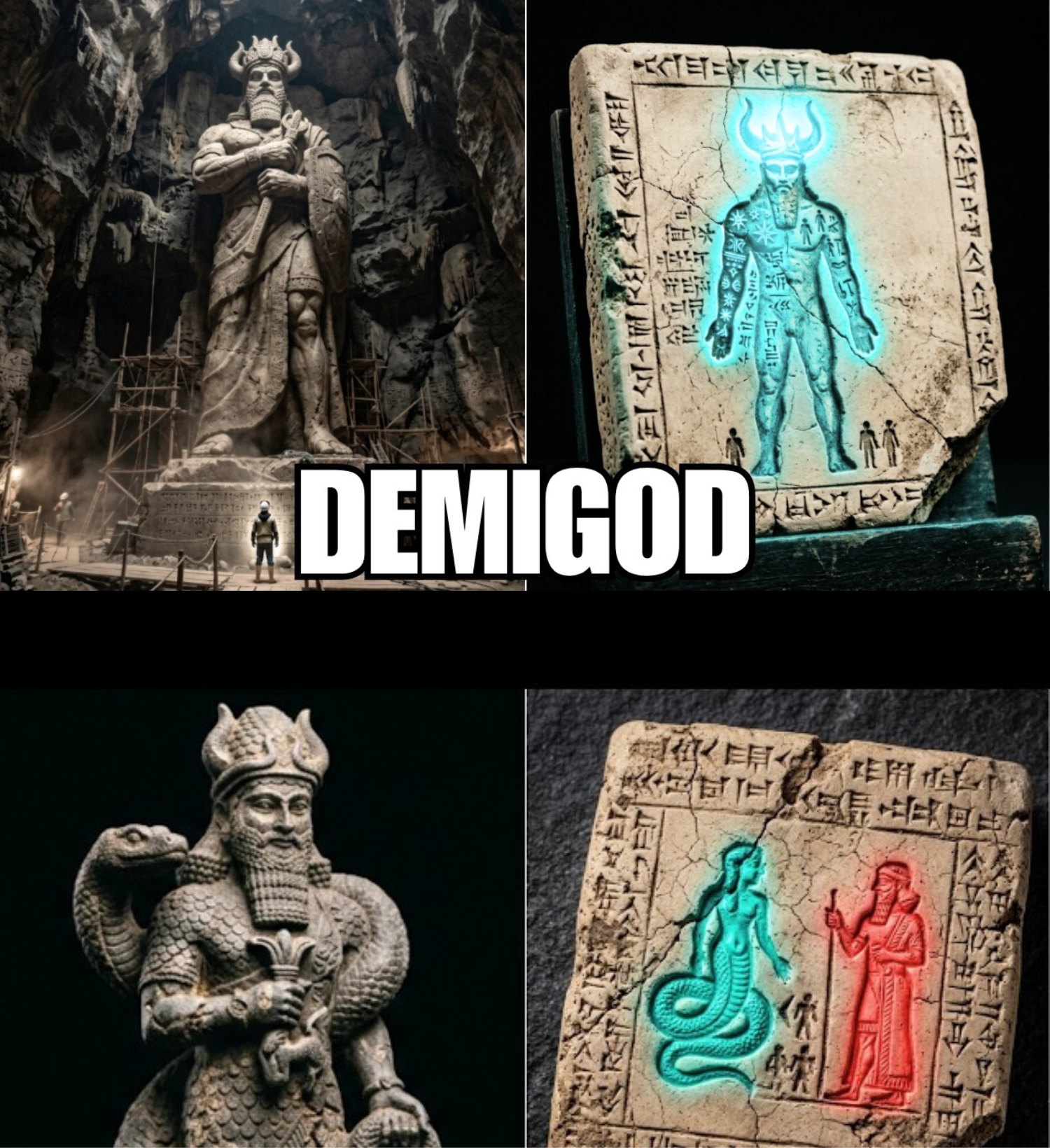
In Genesis, they are mysterious mighty figures connected with the union of the “sons of God” and human women, appearing in the violent world before the Flood.
In later Enochic tradition, they are giants born from rebellious Watchers, embodiments of forbidden union and corrupt knowledge.
In ancient Near Eastern comparison, they may echo broader Mesopotamian traditions of antediluvian beings—especially the apkallu—who stood between gods and humanity as bearers of wisdom before the Flood.
In theological meaning, they represent corrupted greatness: power, fame, and knowledge without submission to God.
That is more powerful than a simple monster story.
The Nephilim were the warning that humanity can become mighty and still be doomed.
They were the heroes of old, but not the holy ones.
They were remembered, but not redeemed.
They were famous, but their fame belonged to a dying world.
This should unsettle modern readers. We live in an age that worships fame, strength, influence, and technological mastery. We call people “giants” of industry, politics, science, and entertainment. We celebrate those who reshape the world. But Genesis asks a question fame cannot answer.
Are the mighty righteous?
Or merely renowned?
That distinction may be the difference between civilization and judgment.
The ancient Sumerian and Mesopotamian tablets do not give us a hidden photograph of the Nephilim. They do not solve every mystery. They do not erase the Bible or replace it. What they do is reveal the world Genesis was speaking into—a world haunted by memories of pre-Flood sages, divine knowledge, hybrid beings, violent heroes, and cosmic disaster.
The Bible gives the Nephilim only a few lines because perhaps that is all we need.
Enough to know they were real in the imagination of the ancient world.
Enough to know they were connected to forbidden power.
Enough to know their age ended in judgment.
And enough to warn every generation after them.
The Nephilim were not simply giants.
They were what happens when heaven’s boundary is crossed, when knowledge becomes corruption, when power becomes appetite, and when fame survives after righteousness dies.
That is why the old tablets still matter.
They do not merely describe who the Nephilim were.
They reveal why the world that produced them could not be allowed to continue.